-
-
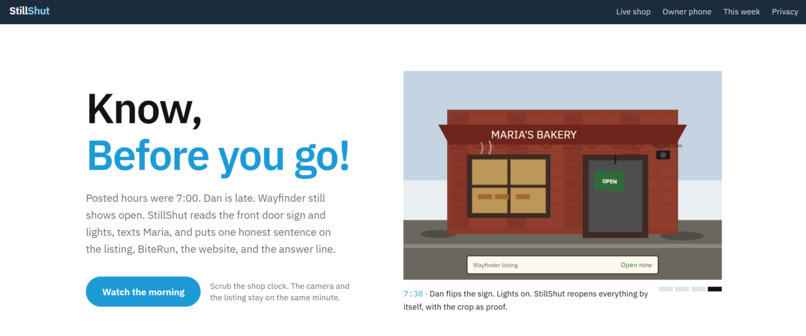
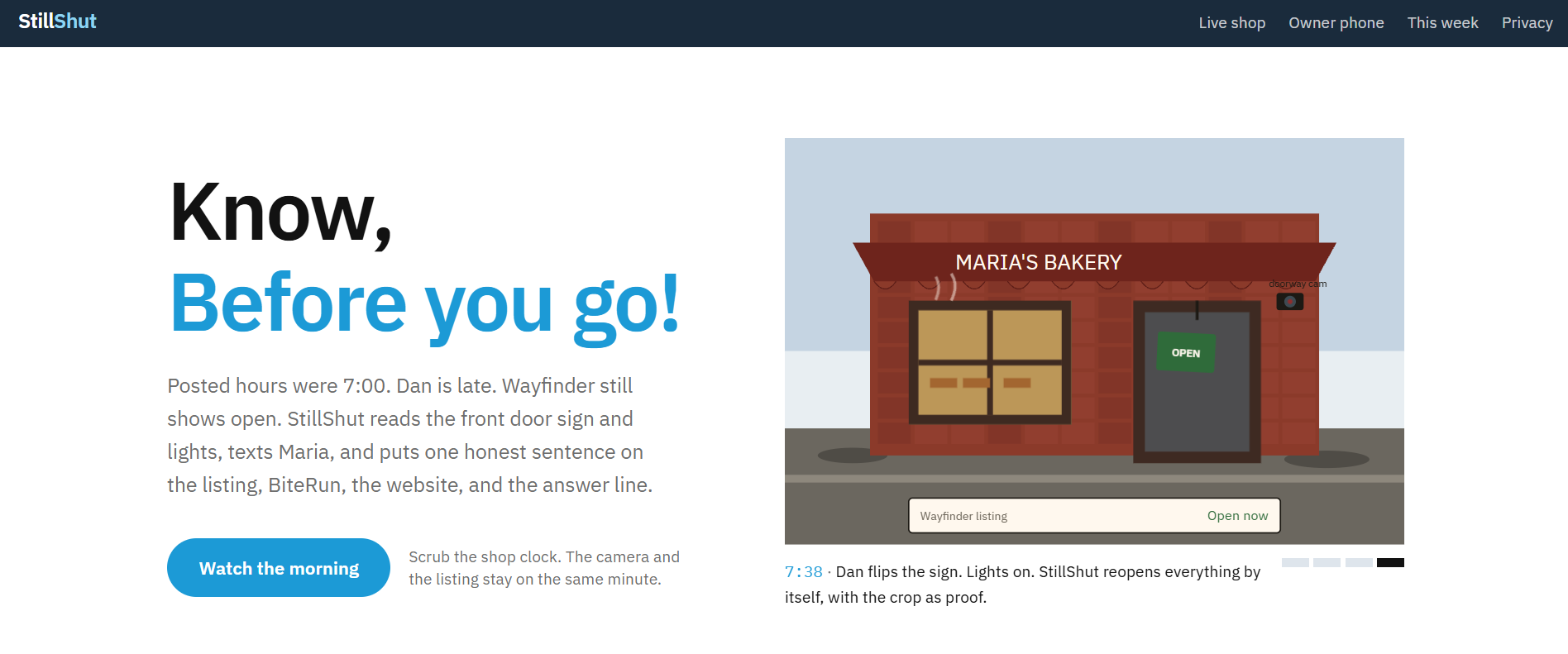
Know, Before you Go!
-
-
-
-
-
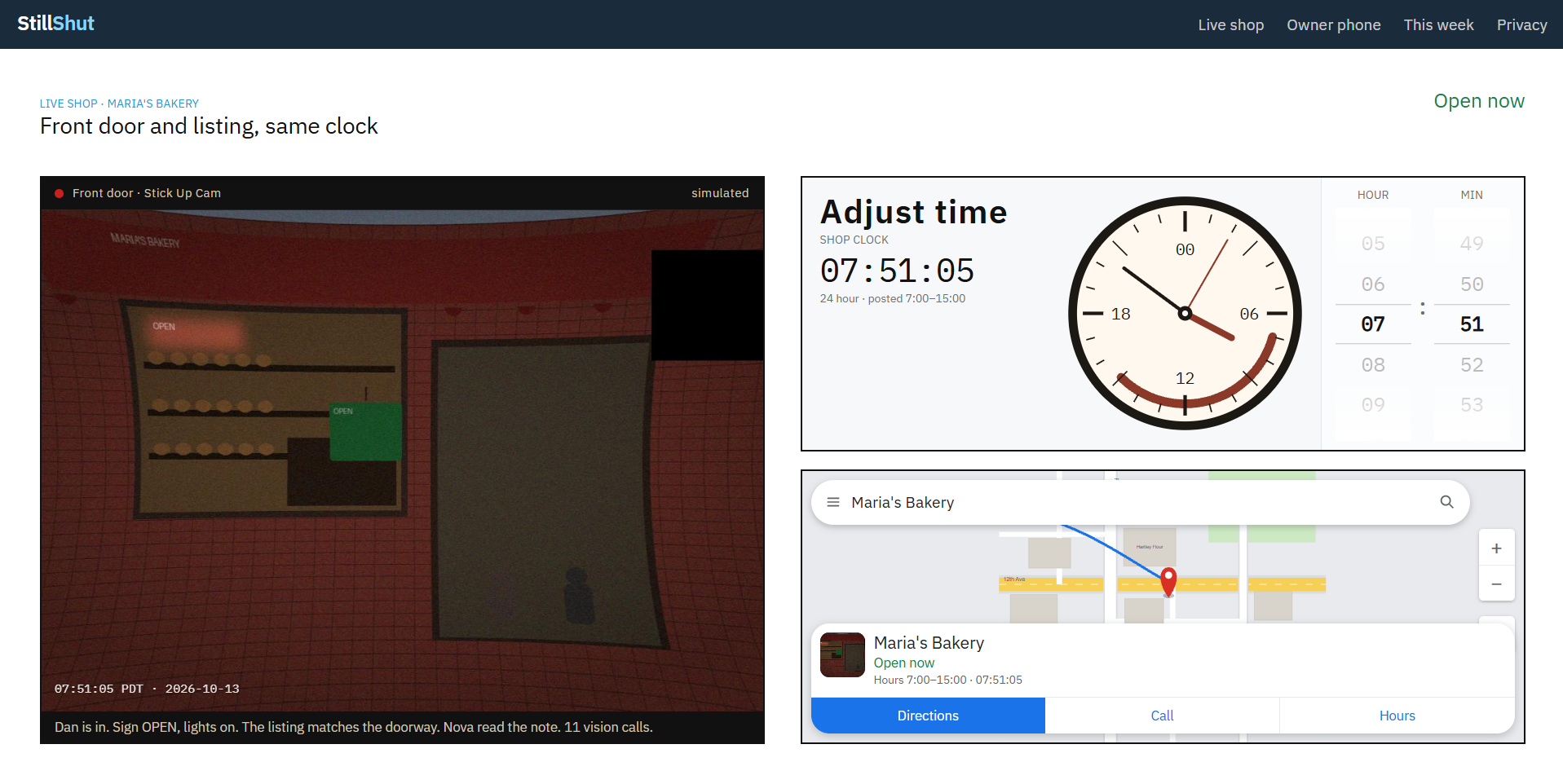
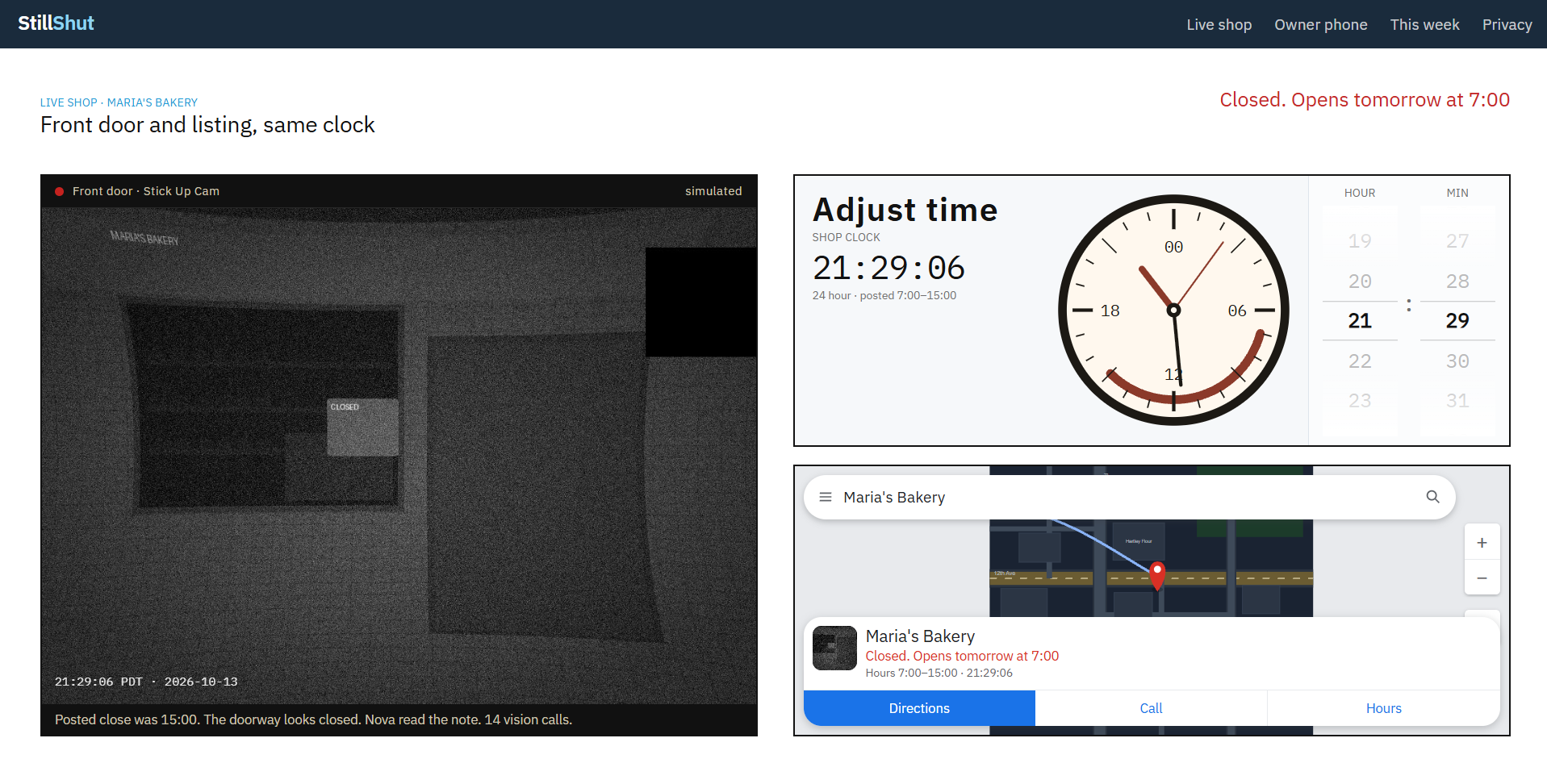
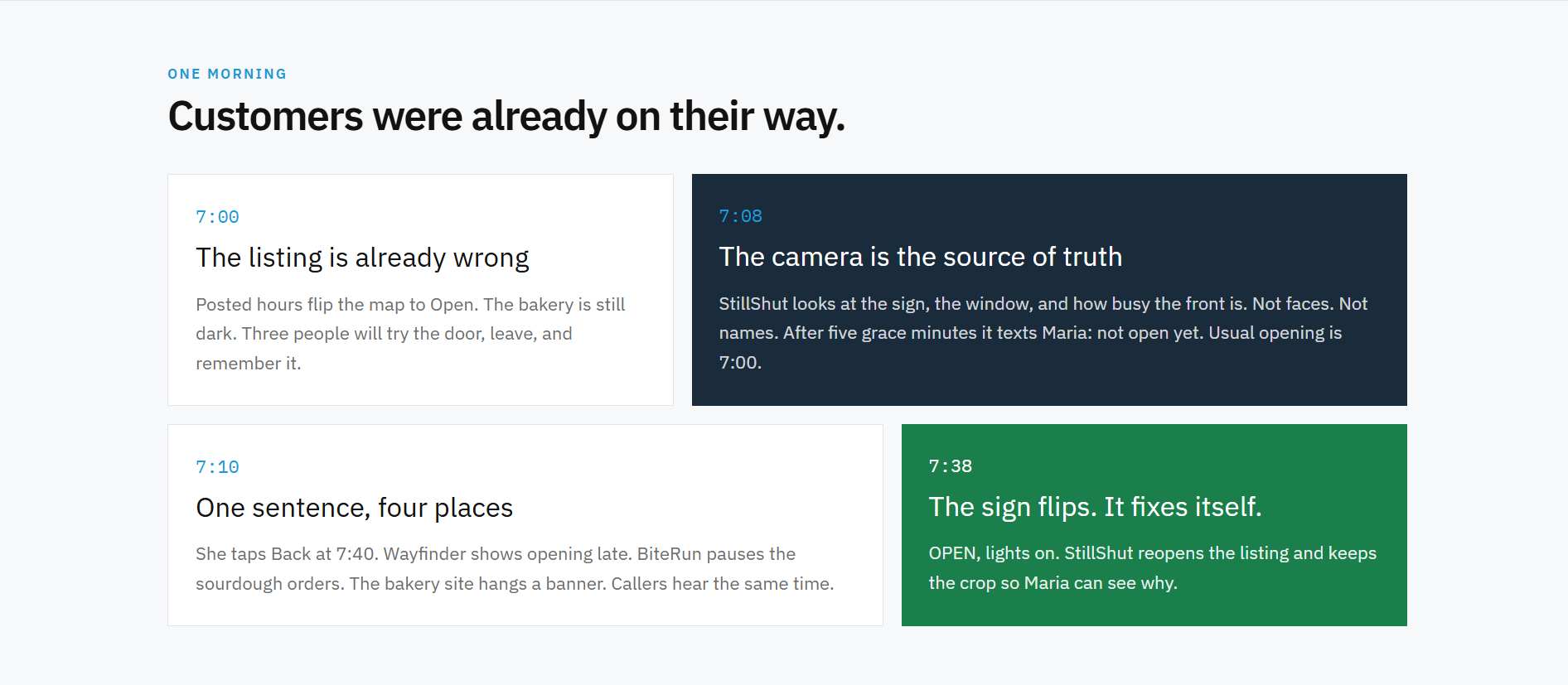
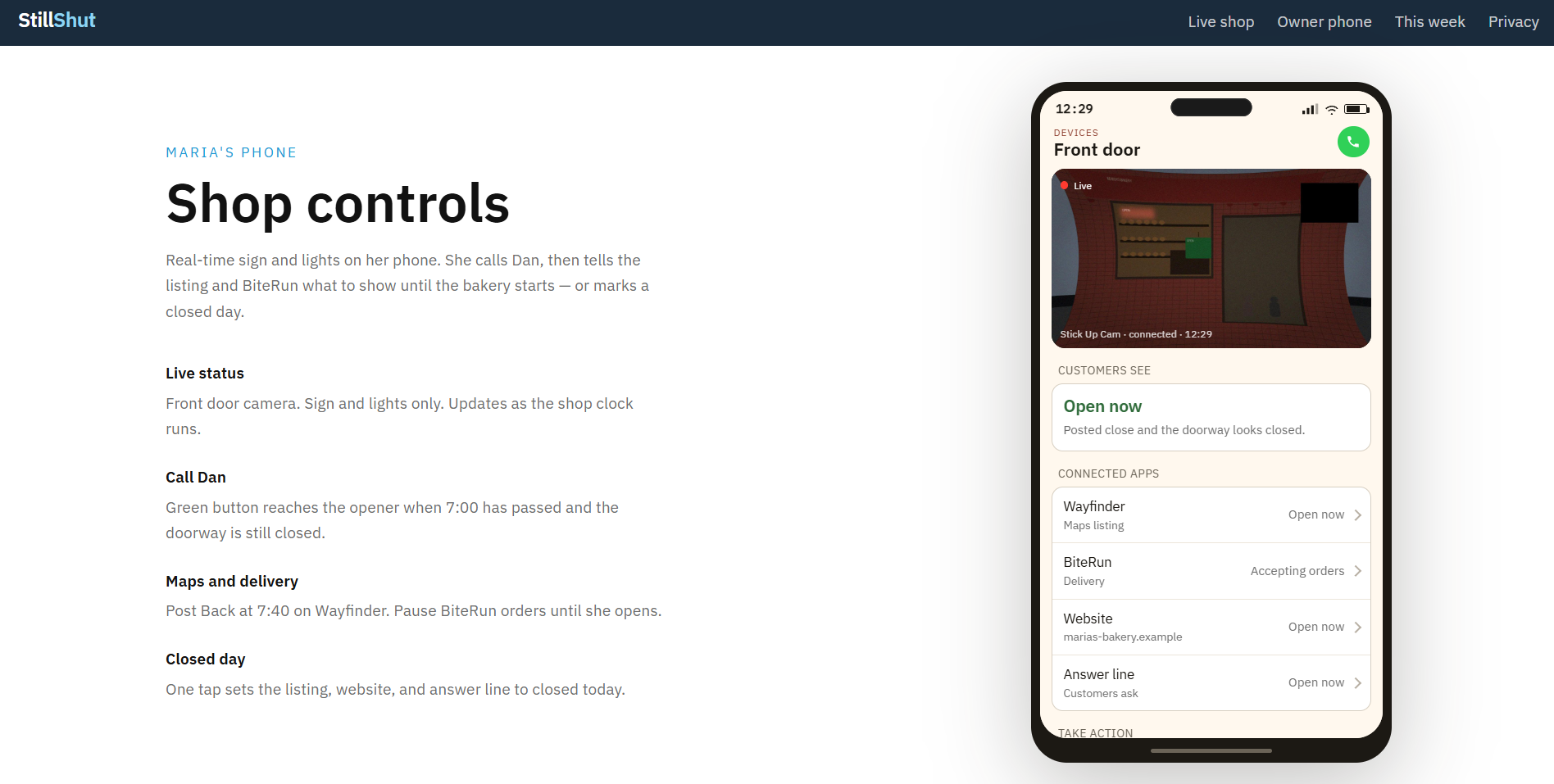
StillShut — Your Storefront, Verified
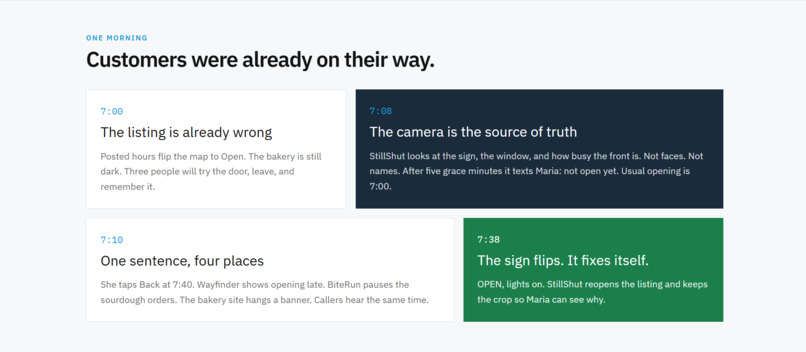
The listing said open. The storefront said otherwise.
StillShut is an AI-powered storefront verification platform that helps small businesses keep their online opening status aligned with what is actually happening at their doors.
By combining camera observations, intelligent image analysis, owner confirmation, and event-driven status synchronization, StillShut helps businesses communicate unexpected closures and reopening times before customers make a wasted trip.
💡 Inspiration
| A shop can be marked “Open” online while its doors remain shut in the real world. Whether an employee is running late, an unexpected closure occurs, or a shop opens outside its usual routine, customers often discover the truth only after arriving. We wanted to bridge the gap between what online platforms promise and what customers actually experience. |
StillShut was inspired by a simple idea: your storefront should tell the truth, even when you cannot be there to update it yourself.
🚀 What it does
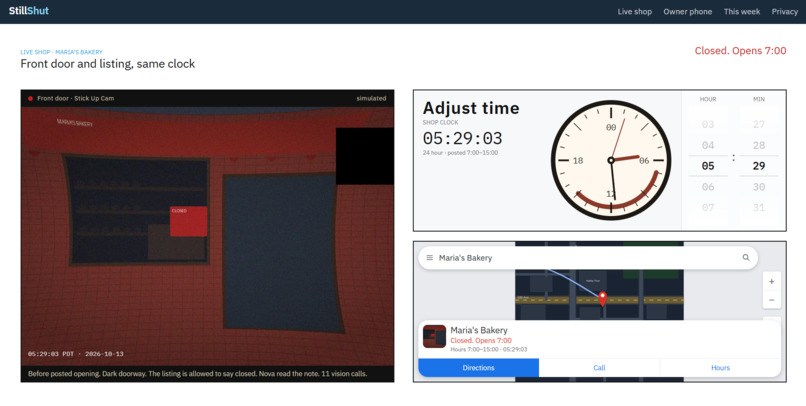
StillShut uses Ring camera imagery to verify storefront conditions and help small businesses maintain accurate public opening statuses.

|
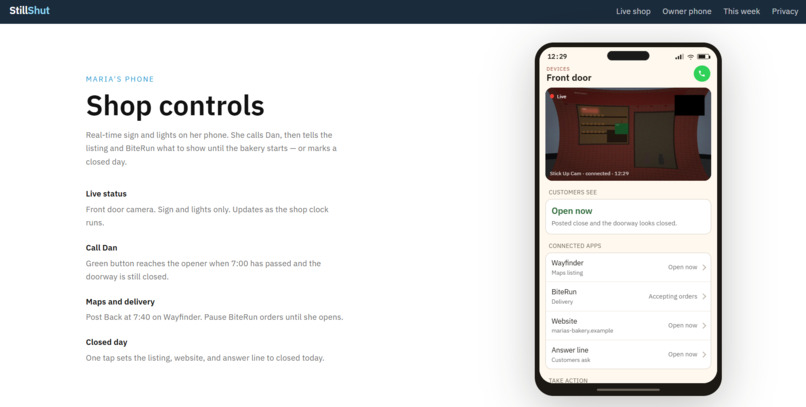
When a shop appears closed despite its published hours, StillShut alerts the owner with simple actions: Back at 7:40, Closed today, I'm opening now The owner can quickly communicate what is happening without navigating complicated business-management tools. |
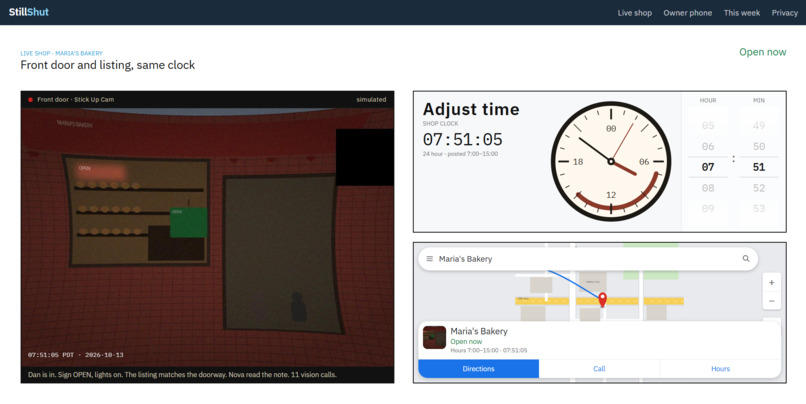
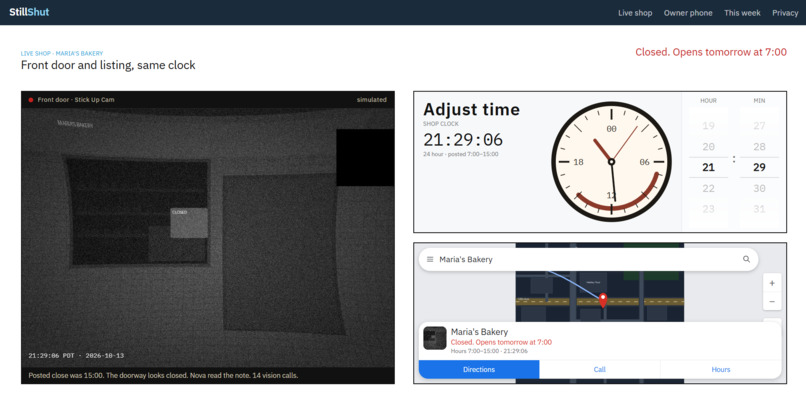
Once the owner confirms a change, StillShut synchronizes the updated status across simulated map listings, delivery platforms, websites, and its customer answer line.
When the shop is verified as open again, its status can automatically return to “Open now.”
The platform also provides:
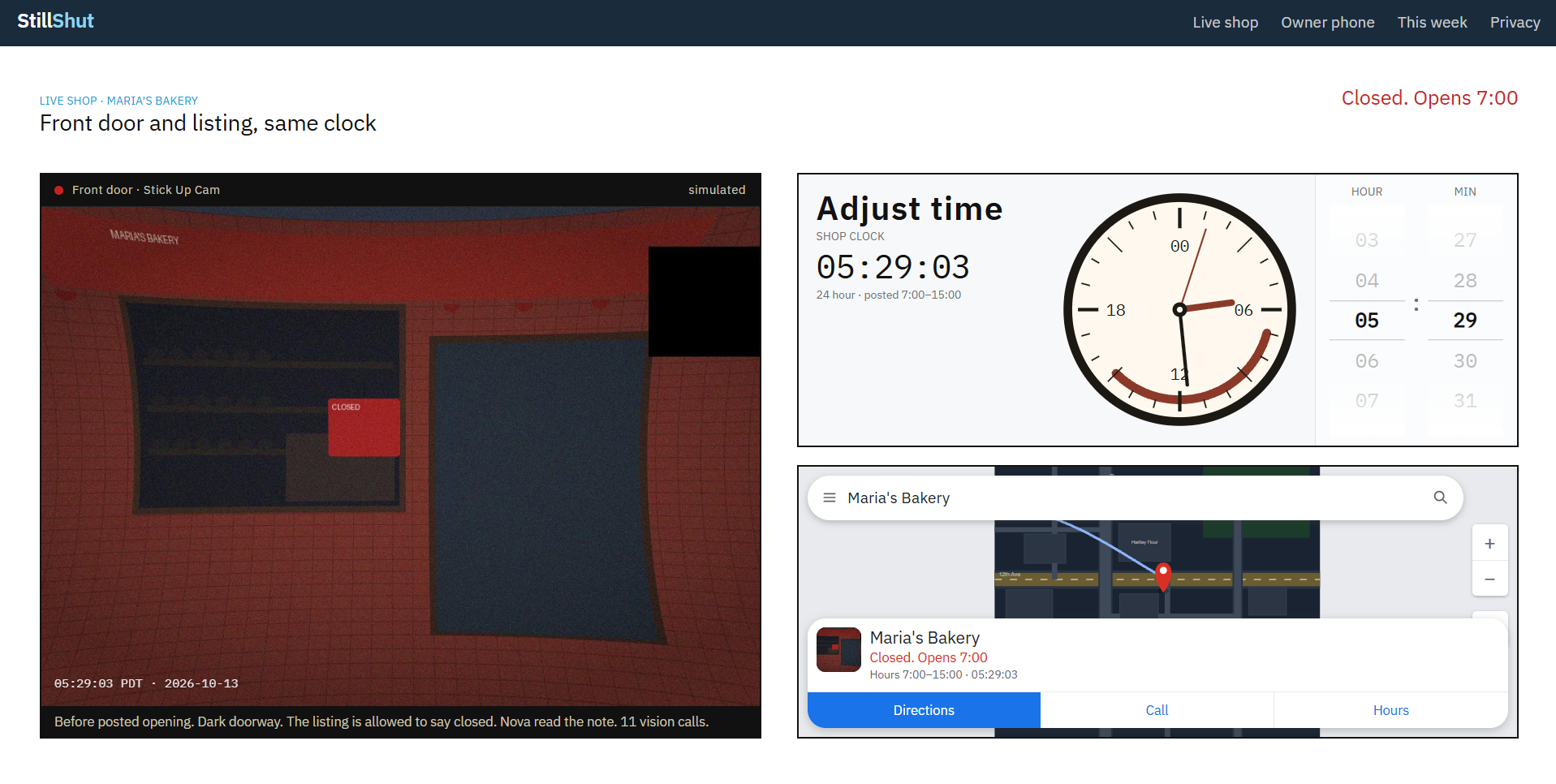
- A live status dashboard.
- Weekly reports comparing published and observed opening hours.
- A privacy-first evidence trail explaining status decisions.
- An interactive scenario console for demonstrating real-world conditions.
🛠️ How we built it
StillShut follows an event-driven architecture with three main components.
flowchart TD
    A["Ring Camera Simulator"] --> B["Signed Webhooks"]
    B --> C["Webhook Verification"]
    C --> D["Event Processing"]
    D --> E["Relevance Filtering"]
    E --> F["Image Analysis"]
    F --> G["Confidence Fusion"]
    G --> H{"Decision"}
    H -->|High confidence| I["Status Engine"]
    H -->|Ambiguous evidence| J["Owner Confirmation"]
    H -->|Unreliable evidence| K["Report Uncertainty"]
    J --> I
    I --> L["Owner Alerts"]
    I --> M["Channel Synchronization"]
    I --> N["Audit Trail and Reports"]
Frontend — Next.js
The frontend provides a mobile-first owner dashboard, a live demonstration view, an interactive scenario console, and a customer-facing answer line.
AI-powered verification
Our multi-stage AI pipeline is designed to balance efficiency and reliability:
- Lightweight filtering: Ignore irrelevant events before expensive analysis.
- Image-processing heuristics: Examine storefront indicators and available visual evidence.
- Vision-model analysis: Interpret ambiguous signs and handwritten notices when necessary.
- Confidence fusion: Determine whether the system should update a status, request owner confirmation, or report uncertainty.
The goal is not to force a decision from every image. It is to make the most reliable decision supported by the available evidence.
⚙️ Challenges we ran into

|
### 1. Distinguishing closure from temporary inactivity Lights, signs, and doorway activity can provide conflicting signals. A quiet shop is not necessarily closed, and a camera snapshot may not reveal the full situation. We designed the verification workflow around confidence thresholds, multiple observations, and owner confirmation when evidence is ambiguous. |

|
### 2. Coordinating time-sensitive events Late-opening alerts, promised reopening times, automatic status restoration, and evidence expiration all depend on consistent time handling. We designed a shared clock abstraction to keep these behaviors consistent in accelerated demonstrations and normal operation. |
3. Handling unreliable infrastructure
Duplicate webhooks, offline cameras, encrypted media, expired tokens, and failed channel updates can disrupt a real-time workflow.
Our approach uses idempotent event handling, retries, graceful degradation, and explicit uncertainty to avoid misleading customers.
🏆 Accomplishments we're proud of
- Designed an end-to-end workflow connecting storefront observations to actionable owner alerts and synchronized public statuses.
- Created a tiered AI pipeline intended to reserve expensive vision-model calls for relevant, ambiguous events.
- Prioritized privacy through short-lived image processing, restricted evidence retention, and explicit data deletion controls.
- Designed a unified status engine with an audit trail explaining the evidence and reasoning behind status changes.
- Developed a realistic demonstration plan covering late openings, handwritten notices, automatic reopening, weekly reporting, and resilience scenarios.
Our most important accomplishment is turning a simple question — “Is this shop really open?” — into a practical system for improving customer trust.
📚 What we learned
We learned that useful AI is not just about recognizing what appears in an image. It must understand context, communicate uncertainty, respect privacy, and trigger the right action at the right time.
We also learned the importance of separating observation from decision-making.
A camera may suggest that a shop is closed, but the system should avoid making an unsupported public claim when the evidence is unclear.
Reliable event processing, explainable decisions, and graceful failure are just as important as model accuracy.
🔐 Privacy by design

|
StillShut is designed to minimize unnecessary exposure of camera imagery. - Full camera frames are temporary. - Persistent evidence is restricted to relevant sign and note crops. - The system avoids identifying or tracking individuals. - Status decisions retain an explanatory evidence trail. - Explicit data deletion controls support responsible evidence management. **Privacy is a core design principle, not an afterthought.** |
🔮 What's next for StillShut
Our next steps are to validate the prototype against more diverse storefront scenarios, improve recognition of signs and handwritten notices, and measure the accuracy of opening and closing predictions.
We plan to explore authorized real-device Ring integration, followed by production integrations with map listings, delivery services, and business websites.
Future improvements may include configurable approval policies, smarter weekly opening-hour recommendations, and support for more independent businesses.
| Our long-term vision is simple: **Help every small business keep its online presence as honest and up to date as its real-world storefront.** *StillShut — Because customers deserve to know before they go.* |

|
Built With
- ai
- amazon
- amazon-web-services
- bedrock
- docker
- llm
- nextjs
- node.js
- ocr
- render
- ring
- yaml

Log in or sign up for Devpost to join the conversation.