-
-
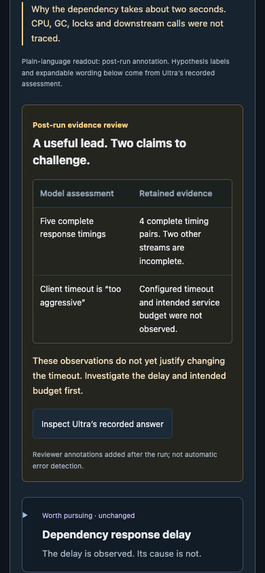
The model/evidence comparison on mobile. Complete records remain available; this is an emulated mobile viewport.
-
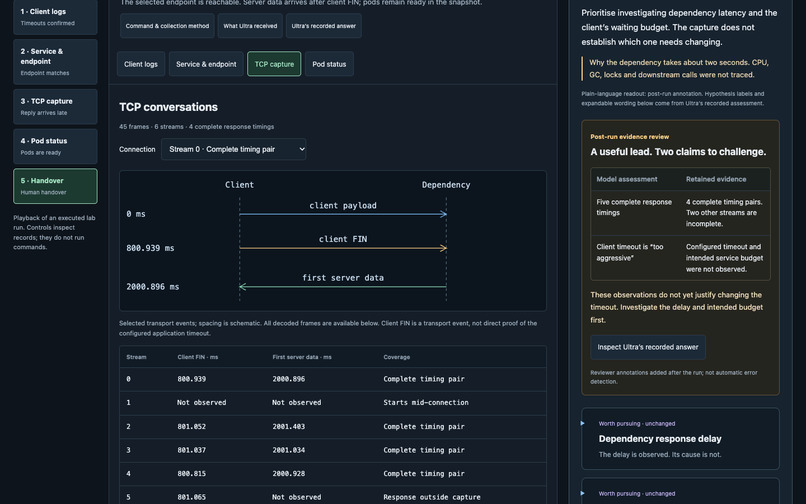
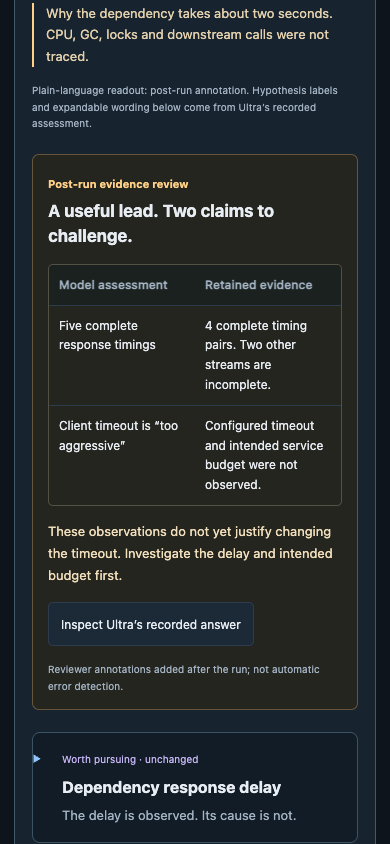
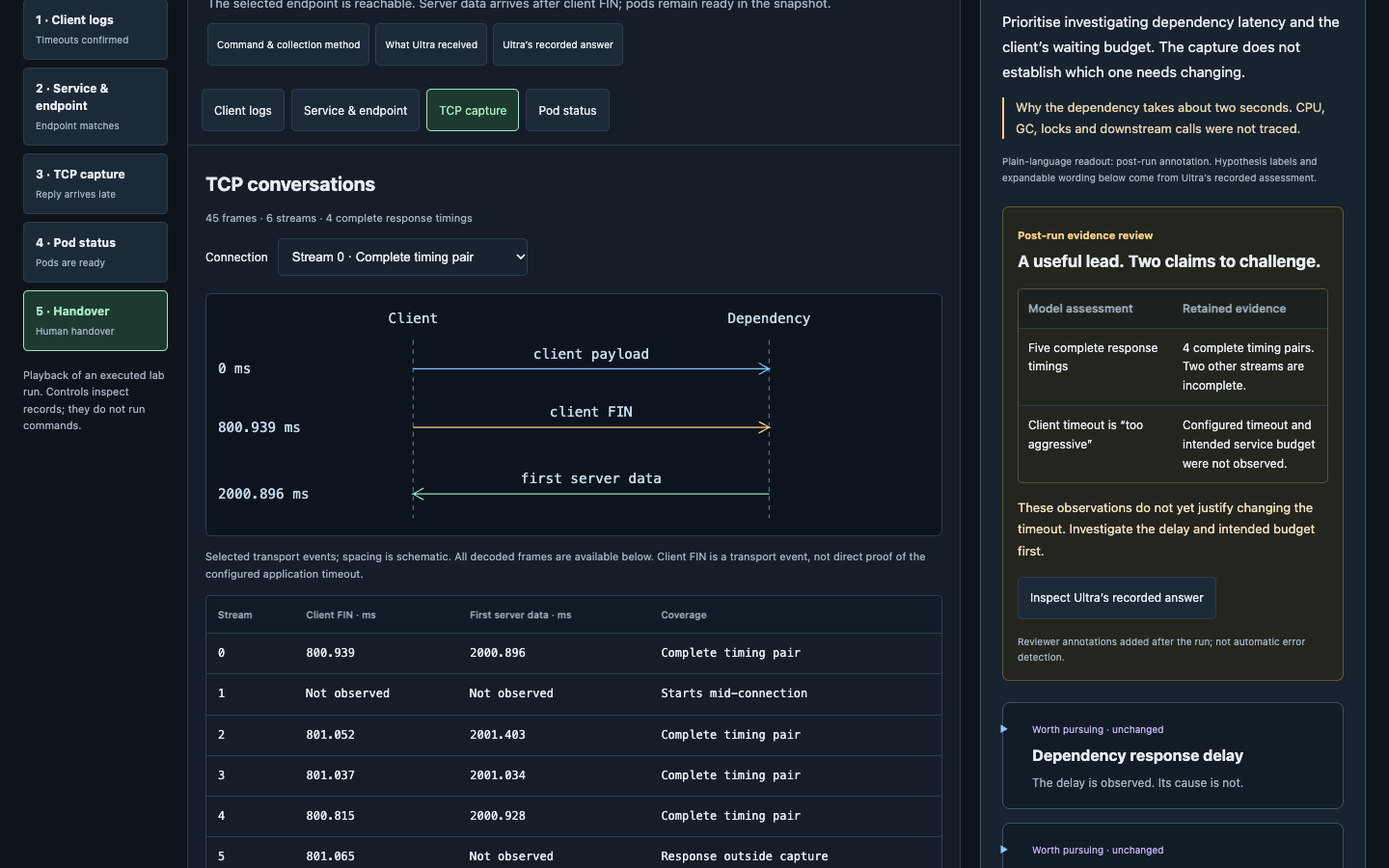
Compare Ultra’s assessment with the retained capture. Explicit post-run reviewer qualifications; no automatic correction claimed.
-
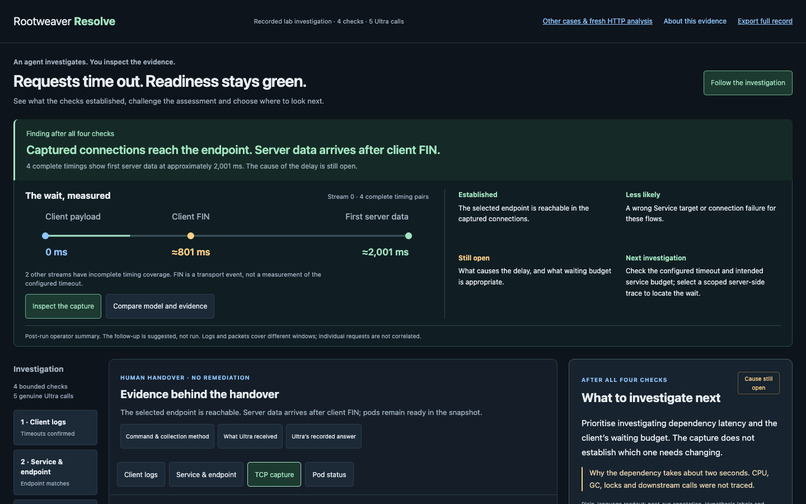
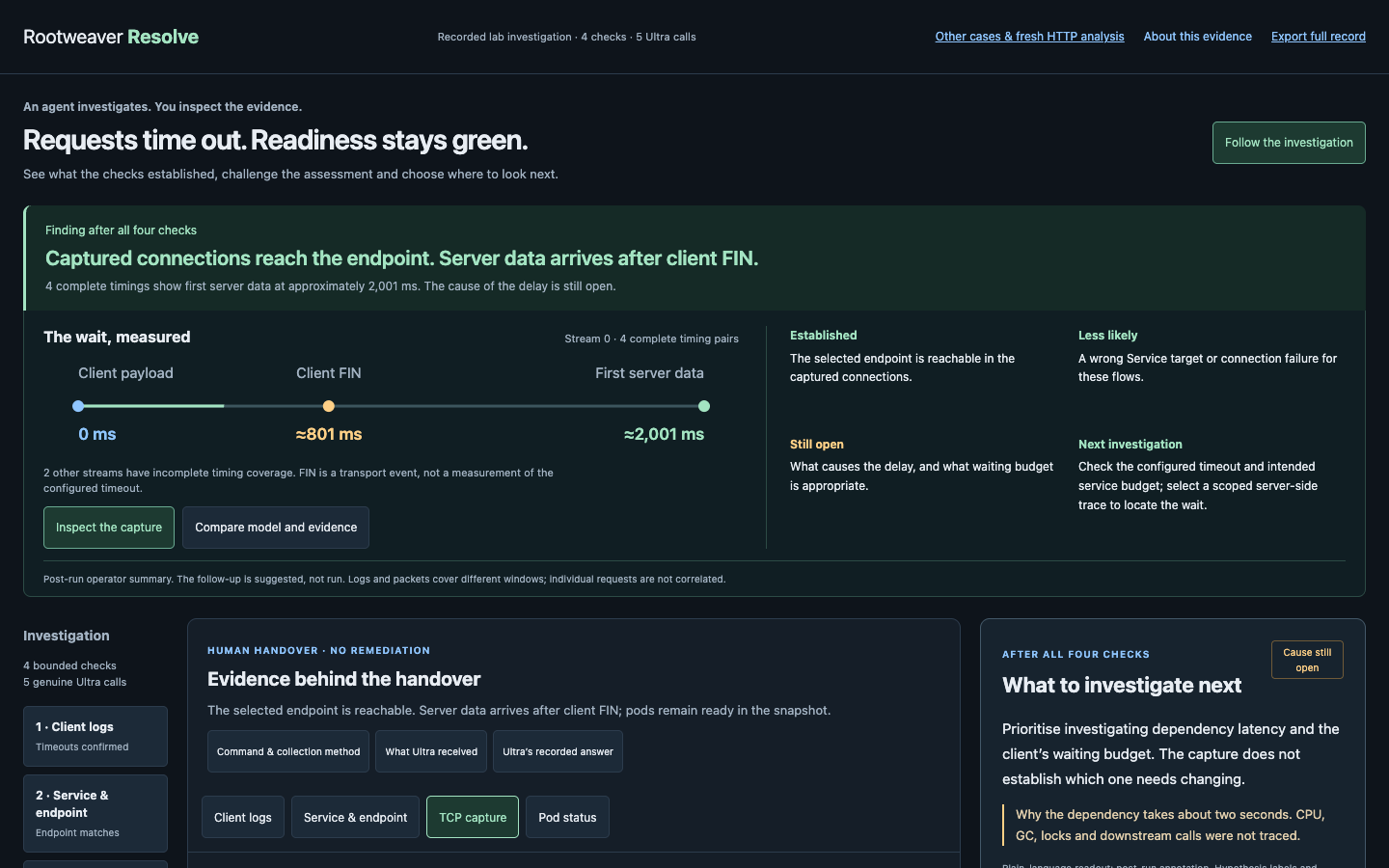
Measured packet evidence upfront: four complete timings, remaining uncertainty and the next suggested investigation.
-

The evidence bench: inspect before acting. Conceptual anime artwork, separate from the actual product screenshots and measurements.

Inspiration
I am an SRE. Agents can be useful at reading logs and suggesting explanations, but their proposed fixes can conflict or be disruptive. A model may not know the full architecture, the dependencies, the business purpose of a service or the impact of changing it. A technically effective restoration still needs operational judgement.
I built Resolve to let the model do the investigative legwork: choose bounded debugging checks, gather more information and develop possible explanations that an experienced person can review. I want to see what it checked, what came back, why its assessment changed and what it is still guessing. The useful outcome is a narrower investigation and a better-informed next decision.
What it does
Resolve gives NVIDIA Nemotron 3 Ultra a fixed catalogue of scoped checks. In the demonstrated laboratory run, Ultra selected client logs, Service/EndpointSlice inspection, a bounded TCP capture and pod status, then handed the unresolved investigation to a human. Rootweaver Observe supervised collection; the controller constrained the targets and budgets. The model could not execute arbitrary commands or remediate.
Observe supplies observations that can strengthen or weaken competing hypotheses. It does not supply complete architecture or business understanding. The operator reviews whether the evidence supports the conclusions, identifies missing dependencies or constraints, and decides what to investigate or change next. Human review is an assessment of the investigation, with operational authority remaining outside the model.
The workbench opens with the concrete finding and a proportional packet timing diagram. Established observations, weakened explanations, remaining uncertainty and the next suggested investigation are visible together. Readable log rows, resource snapshots and TCP conversations remain beside the evolving hypotheses. Every check exposes its recorded command, output, model input and accepted assessment. A human can follow the method and access complete captured records without having to read JSON first.
The demonstration
A dependency times out while readiness stays green. Service evidence weakens an endpoint-selection explanation. Packet evidence shows successful exchanges and four complete timings: first server data around 2,001 ms after client payload, after client FIN around 801 ms. The investigation narrows toward response delay and client waiting budget, but it does not establish the underlying latency cause or the correct timeout.
The model overstated five complete timings and called the timeout too aggressive. A side-by-side model/evidence comparison preserves those statements and shows the reviewer qualifications. These were added after the run, not detected automatically by the agent. The practical consequence is explicit: these observations do not yet justify changing the timeout. Check its configuration and intended service budget, then select a scoped server-side trace to locate the wait; that follow-up has not run. The video and default viewer replay genuine prior execution; they do not imply that playback runs new commands or inference. The viewer uses an explicitly aliased derivative. The repository also includes the original lab PCAP, retained model requests and public answers, and commands to reproduce the four timings offline. The earlier log window and later packet window are not correlated request by request.
How we built it
Python, plain JavaScript and SVG; NVIDIA Nemotron 3 Ultra through Nebius Token Factory; Kubernetes reads and Observe-supervised dumpcap with offline TShark decoding. The bounded investigation selected from four approved checks, with deadlines, a fixed target and no remediation. An independent experiment runner handled recovery. The public test build has no cluster connection.
The existing four-case console remains available. It includes a narrow deterministic Service-selection check and an opt-in runtime action that sends fixed sanitised HTTP evidence for fresh Ultra analysis. That action is separate from the packet investigation and is disabled by default. It requires the operator's own Nebius key and retains call budgets and audit outputs.
Challenges and learning
Readable output and honest attribution mattered as much as tool access. A readiness result does not establish application health. A packet capture does not identify a server-side lock or GC pause. Valid JSON and citations do not establish a correct explanation. We preserve evidence windows, model mistakes, complete outputs and the distinction between observations, model assessments and post-run editorial explanations.
Where richer context could help
The intended direction is an investigation assistant that fits into an operator's existing environment and uses the context they authorise. Architecture and dependency information could reveal missing relationships and potential impact. Deployment-matched source code and configuration could help explain observed behaviour. Business objectives and service contracts could establish acceptable waiting budgets and what a restoration must preserve. Deployment history could help test an explanation against recent changes.
Those context integrations are future work. Their sources, versions and freshness would need to remain inspectable, and providing more information would not expand the model's authority to make changes. Today, the standalone viewer installs without private services; the original Observe collector is not bundled as a plug-and-play cluster integration. This release does not ingest arbitrary codebases, architecture or business documents.
Scope and limits
The main run contains five genuine calls and four checks in one adapted disposable fixture. Four earlier fault case records contain seven separate historical calls. These controlled examples demonstrate parts of the investigative workflow; they do not establish that a laboratory diagnosis or restoration generalises to an enterprise production system. They use differing prompts and windows and are not a combined accuracy benchmark, held-out evaluation, calibrated confidence estimate or proof of reduced MTTR. No production qualification, autonomous remediation or superiority over experienced SREs is claimed.
Existing work and AI assistance
Rootweaver predates this competition. Resolve's application, bounded model integration, evidence contracts, fault demonstrations and investigation workspace were developed during the competition. The older platform and independent watchdog are disclosed dependencies. Ryan Duffy owns the problem, architecture and acceptance; OpenAI Codex assisted implementation, verification and packaging. OpenAI image generation supplied conceptual cover artwork, separate from actual product screenshots. NVIDIA Nemotron produced the actual diagnostic outputs. No fine-tuning was performed.
Explore the project
Download the v0.5.0 test build · Read the engineering article · Inspect the source and experiments
The cover is conceptual anime artwork. Product screenshots, original experiment records and the Ryan-narrated demonstration remain separately identified.
Built With
- dumpcap
- javascript
- kubernetes
- nebius-token-factory
- nvidia-nemotron
- python
- svg
- tshark

Log in or sign up for Devpost to join the conversation.