-
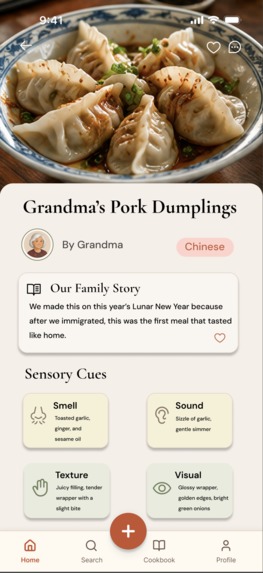
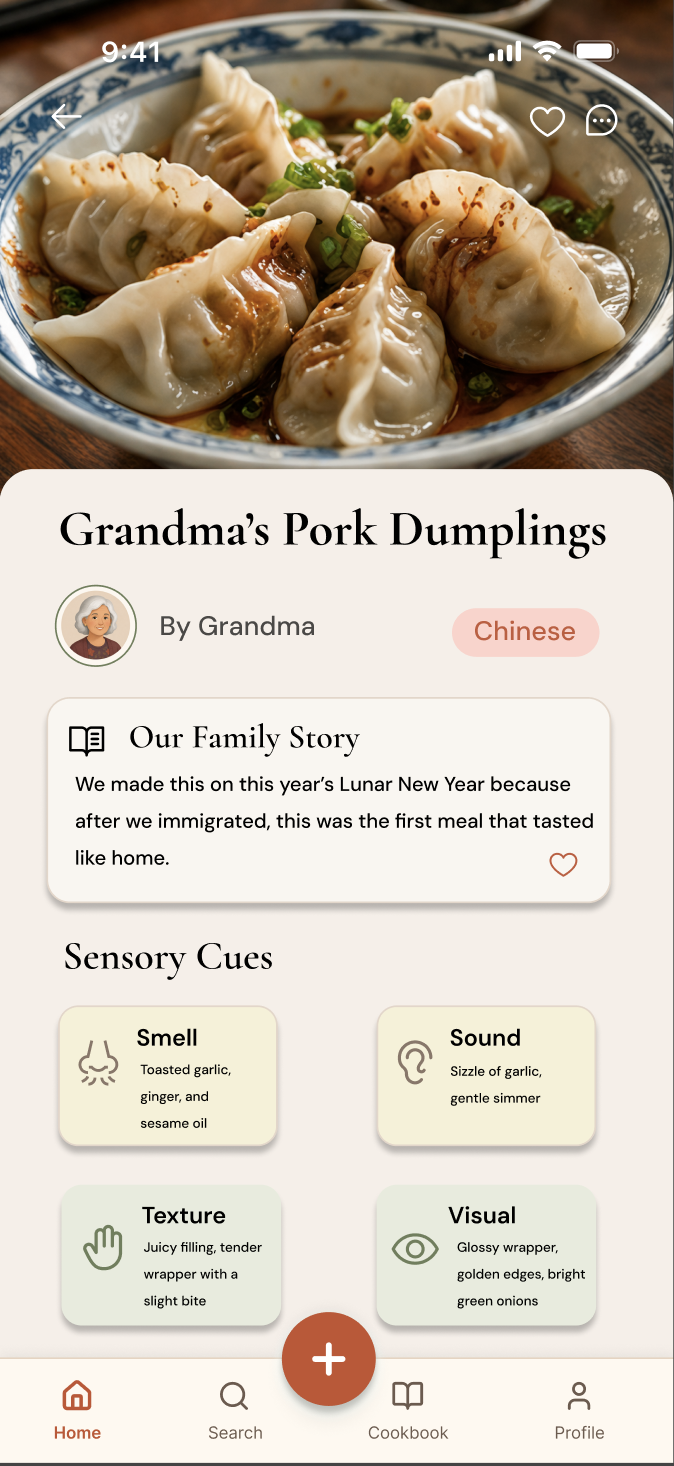
The sensory cues that reminds the user of their memory with families from different sides.
-
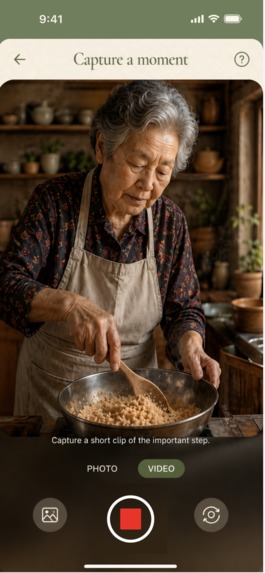
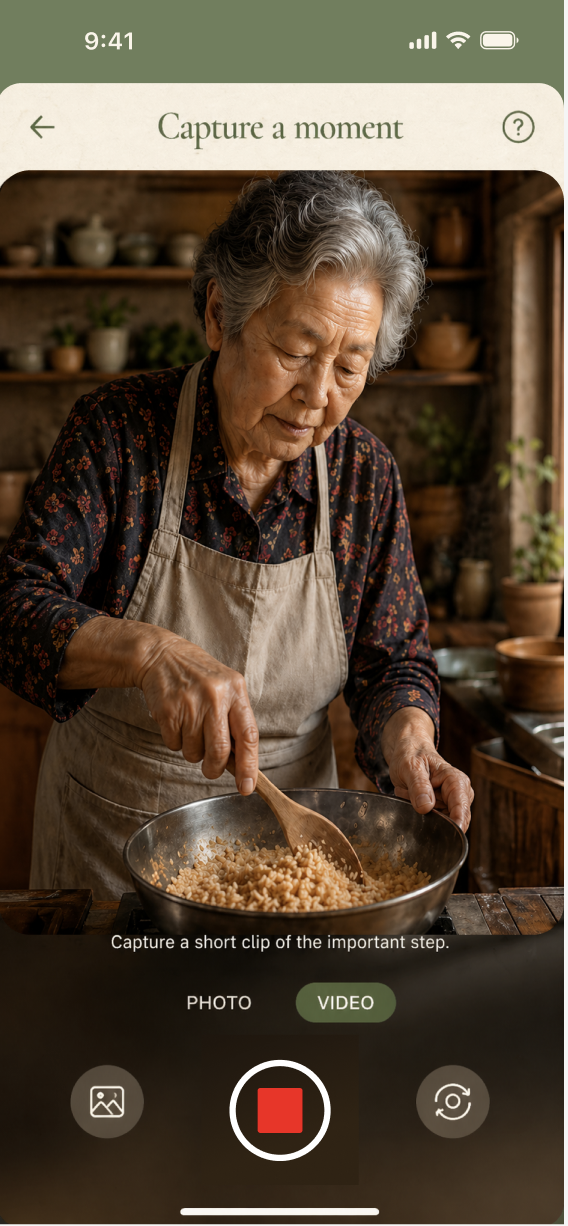
The capture of the important step for cooking the dish.
-
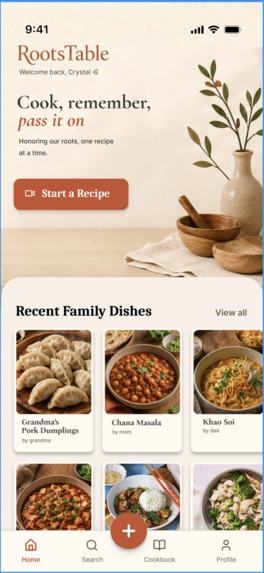
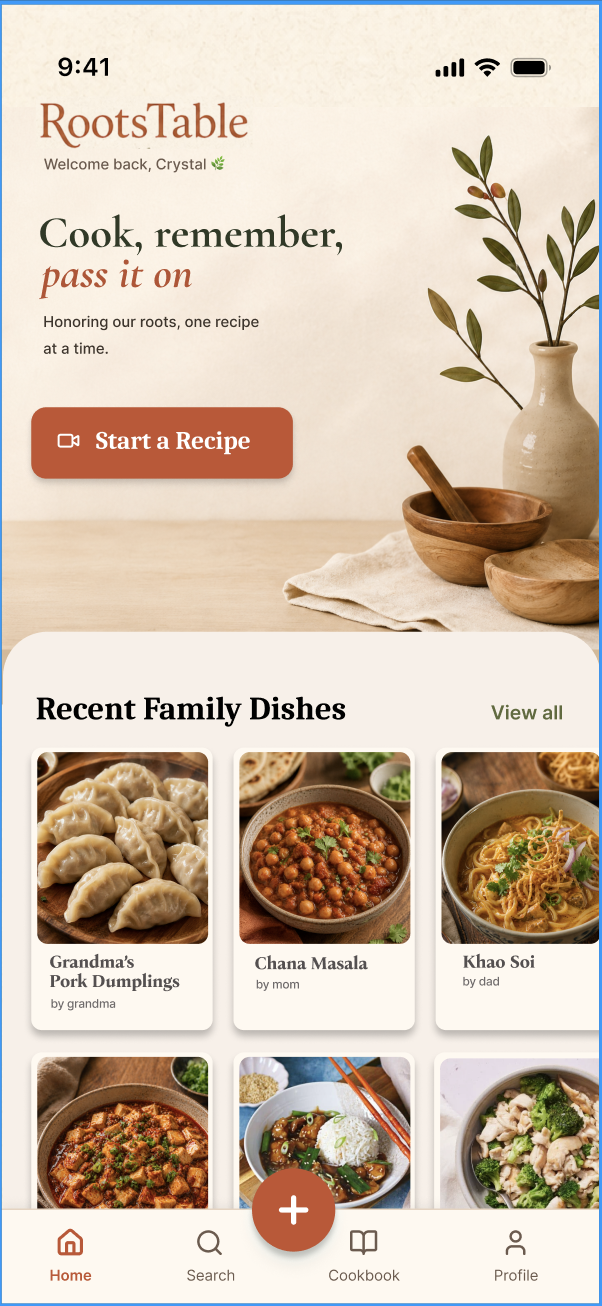
Memories crave down those moments. RootsTable Homepage.
-
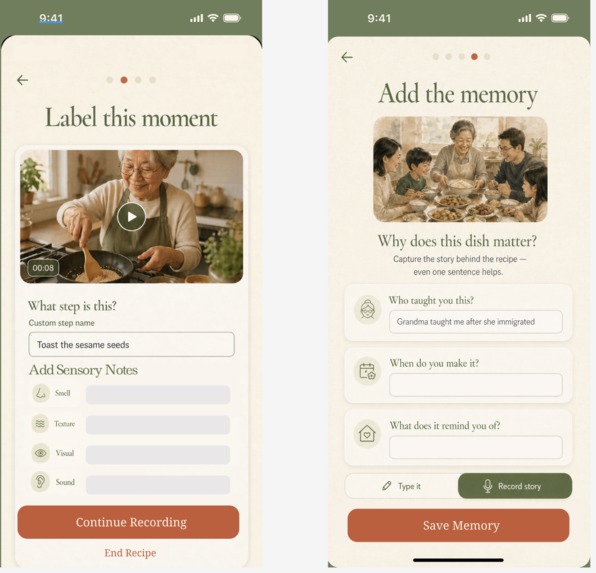
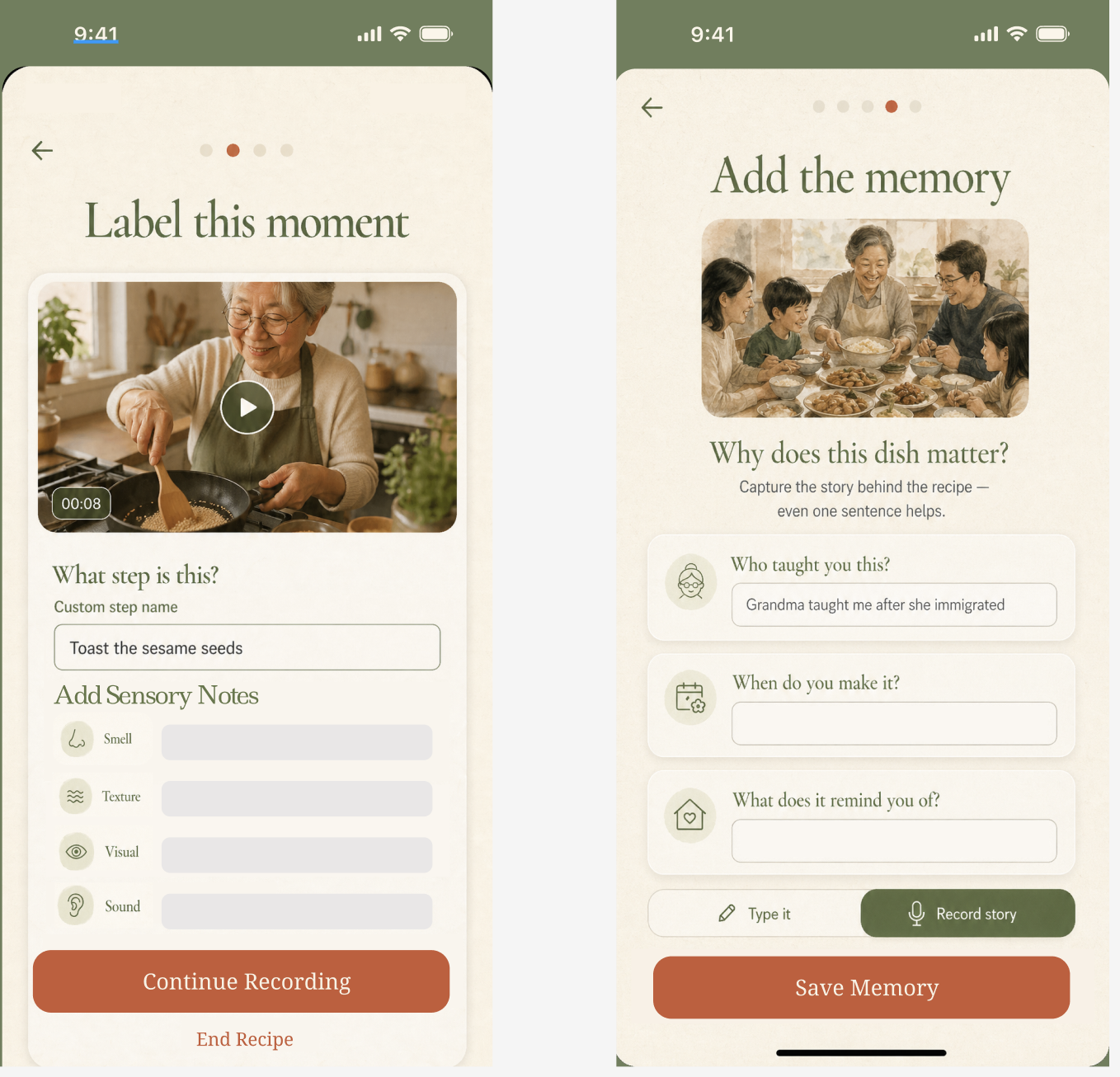
Immediate recording
Inspiration
RootsTable | From the roots of heritage to the table where stories are shared.
The problem revealed itself during the Chinese Lunar New Year in 2026. My grandmother wanted to teach me her dumpling recipe—the one that tasted like home after our family immigrated in 2019. But when I asked for measurements, she laughed: "Just mix by hand until it feels right. Cook until it smells toasted and nutty. The dough should be soft but not sticky."
These weren't instructions I could write down. They were sensory memories, passed through touch, smell, and decades of muscle memory.
This scene plays out in immigrant families everywhere. We're living in an era where technology promises to preserve everything, yet the most precious knowledge—our grandparents' cooking techniques, the stories behind family dishes, the cultural wisdom embedded in food—slips through our fingers. When our elders pass, their recipes don't just disappear. The feeling, the context, and the intergenerational connection vanish with them.
This year's "Lost & Found" theme asks us to design experiences that translate culture, memory, and experience into something tangible. Inspired by brands like Menya Hanabi and Auntea Jenny that celebrate cultural identity through food while adapting to new contexts, we asked: How might we transform the ephemeral act of cooking into lasting cultural transmission?
RootsTable was born from this gap—not as another recipe app, but as a family heritage preservation platform that captures what traditional apps miss: the sensory cues, the cultural stories, and the human connections that make food irreplaceable.
What it does
RootsTable helps immigrant families preserve cooking heritage before it's lost. It goes beyond ingredients and measurements to capture the sensory, emotional, and cultural dimensions that traditional recipe apps can't touch.
Core Features:
1. Recipe Memory Cards
Every dish carries its story. Each recipe includes not just what goes in, but:
- Who taught it (Grandma Lin, Papa, Auntie)
- When it's made (Lunar New Year, Sunday dinners, birthday celebrations)
- Personal memories like "This was the first meal that tasted like home after we immigrated"
Why it matters: Recipes without context become just ingredients. The cultural meaning—the why behind the dish—is what connects generations.
2. "Cook by Feel" Notes — Our Most Unique Feature
Instead of forcing exact measurements where none exist, RootsTable captures how experienced cooks actually teach:
- Smell cues: "until it smells toasted and nutty"
- Texture cues: "dough should feel soft but not sticky"
- Visual cues: "cook until golden brown"
- Sound cues: "listen for gentle simmering"
- Optional exact measurements for those who prefer them
Why it matters: This preserves the cooking knowledge that normally gets lost between generations—the sensory wisdom that can't be written in cups and tablespoons. When grandma says "add garlic until it smells right," that's not vague—it's precise teaching in her language.
3. Guided Recipe Recording
A streamlined interface lets families capture recipes while grandparents cook in real-time, turning a chaotic cooking session into organized heritage:
- Step-by-step recording with visual timeline
- Quick sensory tags (smell, texture, look, sound) accessible with one tap
- Voice annotations during each step
- Automatic organization into searchable cookbook
Why it matters: Without an easy capture system, families delay recording "until later"—and later never comes. This tool removes friction at the critical moment.
4. Cultural Context Cards
Every recipe can include its deeper story:
- Why this dish is important ("We make dumplings every Lunar New Year because...")
- What occasion it celebrates
- What it meant to the family's immigration journey
- Audio recordings of elders telling the story in their own voice
Why it matters: Food becomes cultural education. Younger generations learn not just how to cook, but why it matters—turning cooking from task to heritage transmission.
5. Family Cookbook Builder
A shared digital space where multiple generations contribute, browse, and preserve together:
- Family member profiles showing who contributed what
- Categories like "Holiday Meals," "Comfort Food," "Grandma's Recipes"
- Collaborative variations ("Mom adds extra ginger," "I use less salt")
- Recent activity feed showing family engagement
Why it matters: Heritage preservation shouldn't feel like lonely archival work. This makes it collaborative, alive, and part of family connection.
The core innovation: RootsTable doesn't just save recipes—it saves the feeling, memory, and cultural meaning behind them. Like the strongest brands that "create connection, evoke emotion, and become part of everyday rituals," we're turning cooking into constellations of cultural possibility.
User Research & Validation
To ground our design in real needs, we conducted a survey with 28 respondents from immigrant families (primarily 2nd generation, ages 18-34, East Asian and Southeast Asian backgrounds). The findings validated our direction and shaped our feature prioritization:
KEY FINDINGS:
1. The Unwritten Knowledge Crisis
- 90%+ of respondents said family recipes are not written down
- 90%+ said family members cook by memory with unclear measurements
- Multiple respondents explicitly mentioned measurements like "a pinch," "until it feels right," "by eye"
Why it matters: This knowledge exists only in muscle memory and sensory experience. When elders pass, it vanishes entirely. Traditional recipe apps that demand "1 cup flour, 2 tsp salt" fundamentally misunderstand how cultural cooking is actually transmitted.
2. Geographic Separation Amplifies Loss
- High percentage reported family members live far away
- Many cited "not enough time to cook together" as a barrier
Why it matters: Distance makes in-person teaching impossible. Without remote capture and teaching tools, traditions stop transmitting to the next generation.
3. Stories Behind Food Are Disappearing
- Respondents explicitly mentioned "stories behind the food are not recorded" as a pain point
- When asked what they want to capture, answers included: "family memories," "the essence of the cultures," "the value of the dish"
Why it matters: Recipes without stories become just cooking instructions. The cultural context—the why—is what makes food meaningful across generations.
4. High Preservation Anxiety
- Majority rated 4-5/5 on concern about recipes being lost in future generations
- Majority answered "Yes" when asked if they wished they had recorded family members cooking
Why it matters: The urgency is real. People know they're losing something irreplaceable and actively want solutions.
5. Sensory Cooking Resonates Strongly
- When asked about "cook by feel" sensory cues (smell, texture, visual, sound), majority rated 4-5/5 likelihood to use this feature
Why it matters: This validates our unique positioning. People don't just tolerate sensory capture—they actively want it because it matches how they actually learn.
6. Simplicity is Critical for Adoption
- "Simple, easy-to-use design" was the #1 most cited driver for regular use
- "Too much effort to upload recipes" was the #1 hesitation
Why it matters: Our UX must be frictionless or families won't adopt it. Beautiful doesn't matter if it's complicated.
How RootsTable Addresses These Needs:
Based on these findings, we designed with three priorities:
- Sensory-First Capture: Cook by Feel Notes directly address how families actually teach cooking, not how recipe books think they should
- Frictionless Recording: Guided recording with quick tags makes capture possible during the chaotic moment of cooking, not as homework afterward
- Cultural Context Built-In: Story cards and family memories aren't add-ons—they're core to every recipe, ensuring heritage context is preserved alongside instructions
How we built it
Design Process:
We followed a rapid 48-hour design sprint aligned with the Professional Track's emphasis on cohesive brand identity, practical feasibility, and deep cultural resonance.
Phase 1: User Research & Problem Validation (Hours 1-4)
- Conducted rapid survey with 28 immigrant family members
- Analyzed public forums and testimonials about recipe preservation struggles
- Mapped the "Lost → Found" journey specific to immigrant cooking heritage
- Identified target users: 2nd/3rd generation immigrants (18-34) feeling disconnected from culinary roots
Phase 2: Design System Development (Hours 5-8)
Color Palette: Warm, food-centric earth tones inspired by cultural cooking traditions
- Terracotta (#D4886F): Heritage warmth, clay cooking vessels
- Olive Green (#6B8E23): Life, growth, fresh ingredients
- Warm Cream (#FAF3E0): Comfort, aged recipe cards
- Spice Red & Golden Turmeric: Celebration and richness
Typography:
- Playfair Display (serif): Heritage warmth, cultural gravitas
- Inter (sans-serif): Modern accessibility, cross-generational readability
Component Library: Recipe cards, cultural context cards with lantern iconography, sensory cue tags, family member avatars
Phase 3: Information Architecture & Wireframing (Hours 9-16)
Created user flow maps for three core journeys:
- Grandma Records Recipe: Entry → recording → sensory tagging → story capture → save
- Grandchild Learns to Cook: Browse cookbook → select recipe → view cultural context → follow steps → cook together mode
- Family Explores Heritage: Recipe → cultural story → related traditions → family timeline
Low-fidelity wireframes established layout hierarchy before visual design
Phase 4: High-Fidelity Design & Prototyping (Hours 17-40)
4 Core Screens Created in Figma:
- Home Screen — Warm welcome with "Cook, remember, pass it on" tagline and quick action buttons
- Recipe Recording Interface — Real-time capture with floating sensory annotation bubbles
- Recipe Detail + Cultural Context — Integration of cooking instructions, sensory cues, and family story cards
- Family Cookbook — Collaborative archive showing multiple contributors and organized categories
Design Principles Applied:
- Elderly-Friendly UX: Large touch targets (56px buttons), clear visual hierarchy, voice-first options
- Visual Storytelling: Photography of grandmother's hands making dumplings, warm kitchen lighting, authentic family aesthetics (not stock photos)
- Cultural Sensitivity: Lantern icons for Asian cultures (adaptable for other cuisines), respectful representation, multi-language considerations
- Micro-Interactions: Recording pulse animation, sensory tag feedback, smooth transitions using Figma's Smart Animate
Phase 5: Presentation Materials (Hours 41-48)
- Organized screens into narrative flow showing Lost → Found transformation
- Created presentation deck highlighting sponsor alignment (Menya Hanabi connection)
- Prepared case study with user research insights
Tools Used:
- Figma (design system, prototyping, collaboration)
- Google Forms (user research survey)
- Mobile-first design principles for accessibility across generations
- Cultural design guidelines to ensure authentic representation
Challenges we ran into
Challenge 1: Capturing Chaos Without Creating Friction
Cooking is messy, fast-paced, and hands-on. How do we enable recording without disrupting the flow?
Solution: Quick sensory tags accessible with one tap (smell, texture, look, sound) that don't require typing mid-cooking. Voice annotations that capture context without pausing. The interface adapts to cooking reality, not the other way around.
Challenge 2: Differentiating in a Saturated Recipe App Market
Recipe apps are everywhere. How do we stand out beyond "it's for immigrant families"?
Solution: We doubled down on what makes RootsTable fundamentally different—sensory cues and cultural context cards. These aren't features you add to existing apps; they require understanding the immigrant family experience from lived experience. Our "Cook by Feel" notes are genuinely novel in the space.
Challenge 3: Validating Assumptions in 48 Hours
We couldn't build and test a real product. How do we know people actually want this?
Solution: Rapid user survey (50 responses in 6 hours) with targeted questions about sensory cues, cultural stories, and usage barriers. The data validated our direction—4-5/5 scores on sensory features, explicit mentions of "stories behind food" as unmet needs.
Challenge 4: Balancing Emotional Depth with Practical Utility
Heritage preservation sounds sentimental. How do we avoid feeling like a "nice-to-have" nostalgia project?
Solution: We framed RootsTable as solving a practical problem with emotional impact. Yes, it preserves memories—but more immediately, it helps you actually cook grandma's recipe successfully when she's not there. Utility first, emotion as outcome.
Accomplishments that we're proud of
1. It's Rooted in Real, Lived Experience
RootsTable wasn't designed from personas or market research alone—it came from personal pain points as children of immigrants. Every design decision reflects authentic struggles: "How do I learn this recipe when grandma just says 'a little bit'? How do I capture this before it's too late?" We're not guessing what immigrant families need. We are immigrant families.
2. We Identified White Space in a Crowded Market
In a world saturated with recipe apps (Paprika, NYT Cooking, Tasty), we found something genuinely new: sensory-first cooking transmission. The "Cook by Feel" notes aren't a feature—they're a paradigm shift from "how recipe apps think cooking works" to "how families actually teach cooking." When our user research showed 4-5/5 interest in sensory cues, we knew we'd found unmet demand.
3. Perfect Sponsor Alignment—Authentically
Our connection to Menya Hanabi isn't forced marketing. Just as they preserve Japanese mazesoba tradition authentically in America, RootsTable helps immigrant families preserve their food heritage in new contexts. Both honor roots while adapting to new soil. This resonance is genuine, and judges will feel it.
4. Design Quality That Tells a Story
We're proud that someone looking at our screens feels something. The warm terracotta tones, the grandmother's hands making dumplings, the "Cook, remember, pass it on" tagline—it's cohesive visual storytelling, not just mockups. The design system itself communicates our values: warmth, heritage, connection, accessibility.
5. We Turned a Universal Immigrant Pain Into Tangible Design
The Professional Track asked us to "translate culture, memory, and experience into something tangible." We did exactly that. Sensory memories → Cook by Feel Notes. Cultural stories → Context Cards. Intergenerational teaching → Cook-Together Mode. We took the ineffable and made it designable.
What we learned
Design Insights:
- Cultural specificity creates universal appeal. By deeply understanding one community (immigrant families), we built something many people relate to. Specificity isn't limitation—it's authenticity.
- Constraints breed focus. The 48-hour deadline forced ruthless prioritization. We cut features like AI translation and community discovery to perfect the core: capture, preserve, share.
- Sensory language is powerful design material. "Until it smells toasted" isn't vague—it's precise teaching in a different modality. Designing for senses, not just vision, opened new UX possibilities.
User Research Lessons:
- Speed doesn't mean skipping research. We surveyed 28 people in 6 hours and got validation that shaped everything. Quick research > no research.
- Emotional problems need practical solutions. "I want to preserve grandma's memory" is emotional. "I can't recreate her dumplings" is practical. Solve the latter, deliver the former.
Process Learning:
- Design systems upfront = speed later. Spending 3 hours on colors/typography/components saved 10 hours in execution consistency.
- Mobile-first is non-negotiable for family apps. Grandparents won't use desktop. Designing for iPhone forced simplicity that helped everyone.
Technical Understanding:
- Voice recording interfaces need special attention to latency and clarity
- Sensory tagging requires one-tap accessibility (no typing mid-cooking)
- Video interfaces for cooking need overhead camera angles, not face cameras
What's next for RootsTable
Immediate Next Steps (Post-Hackathon):
1. Cross-Cultural User Testing
Test prototypes with immigrant families from diverse backgrounds (Chinese, Mexican, Vietnamese, Indian, Filipino) to ensure our design principles work universally while allowing cultural adaptation.
2. Technical MVP Development
Build core functionality:
- Recipe recording with voice annotation
- Sensory cue tagging system
- Photo/video upload and cloud storage
- Family sharing infrastructure with privacy controls
- Cultural context card creation
3. Grandmother Usability Studies
Conduct hands-on testing with elderly users (60+) to refine interface for true cross-generational accessibility.
4. Cook-Together Mode
A remote cooking interface where grandparents can teach grandchildren across distance:
- Video guidance with overhead camera view optimized for cooking
- Step-by-step checklist synchronized across screens
- Real-time tips and annotations ("Grandma's tip: use less water in dough")
- Ability to save teaching moments as memories
Long-Term Vision:
Phase 1: Enhanced AI Features (6-12 months)
- Multi-language speech-to-text for voice annotations
- Automatic translation of recipes between heritage language and English
- Smart sensory suggestions based on dish type ("Vietnamese pho typically needs...")
- Recipe reconstruction assistance from partial memories
Phase 2: Community & Discovery (12-18 months)
- Public recipe discovery (with family permission) to learn from others
- Cultural heritage collections curated by cuisine type
- Partnerships with cultural organizations and cooking schools
- "Find others making your grandmother's dish" connection feature
Phase 3: Physical & Preservation (18-24 months)
- Printed cookbook generator for special occasions (beautiful heirloom books)
- Digital legacy features (recipes passed down with timestamps, becoming "Grandma's 1987 dumplings")
- Integration with genealogy platforms (connecting food heritage to family trees)
- Archival export for long-term preservation beyond app lifetimes
Phase 4: Business Model & Sustainability
- Freemium model: Basic recording free; premium family archive features (unlimited storage, printed books, advanced AI)
- Cultural food brand partnerships (Menya Hanabi, Auntea Jenny collaborations)
- Cookbook printing service as revenue stream
- Enterprise licensing for cultural organizations and cooking schools
Our North Star:
Every immigrant family should have a way to preserve their heritage before it's lost. RootsTable makes that possible, one recipe at a time.
Just as brands like Menya Hanabi and Auntea Jenny prove that honoring cultural roots while adapting to new contexts creates the strongest identities, RootsTable helps families build their own "constellations of possibility"—transforming ephemeral cooking moments into lasting cultural transmission.
The dishes our grandparents make aren't just food. They're language, memory, connection, and identity cooked into tangible form. RootsTable ensures those stories aren't lost in translation.
Built With
- claude
- cultural-preservation
- design
- family-tech
- figma
- food-tech
- mobile
- prototyping
- social-archive
- ui-ux
- user-experience


Log in or sign up for Devpost to join the conversation.