-
-
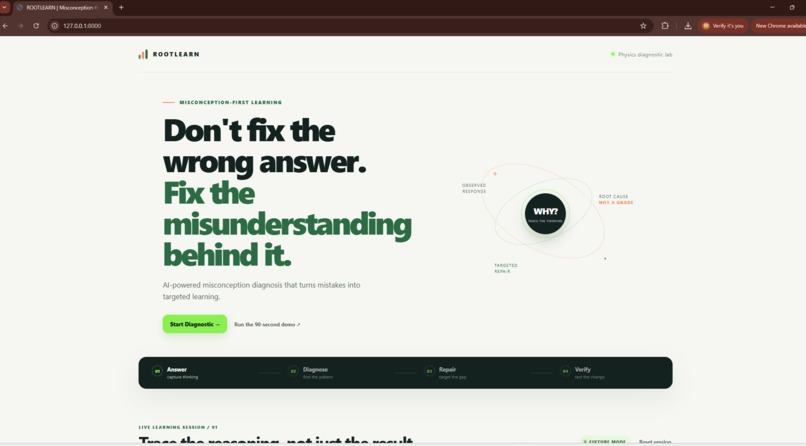
ROOTLEARN — Misconception-First Learning
-
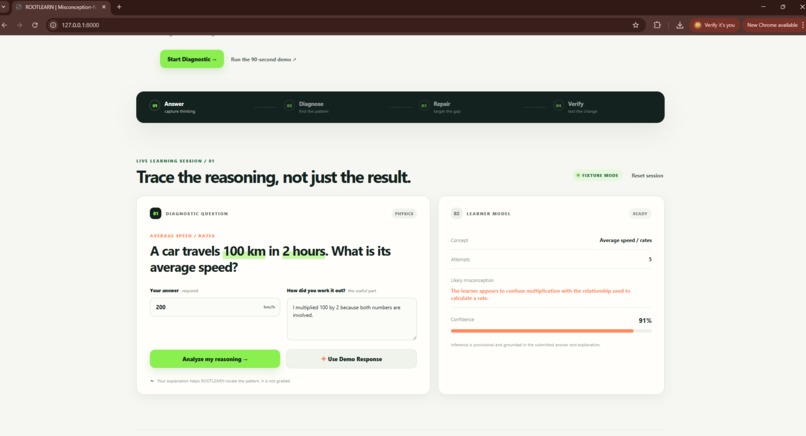
ROOTLEARN — Trace the Reasoning
-
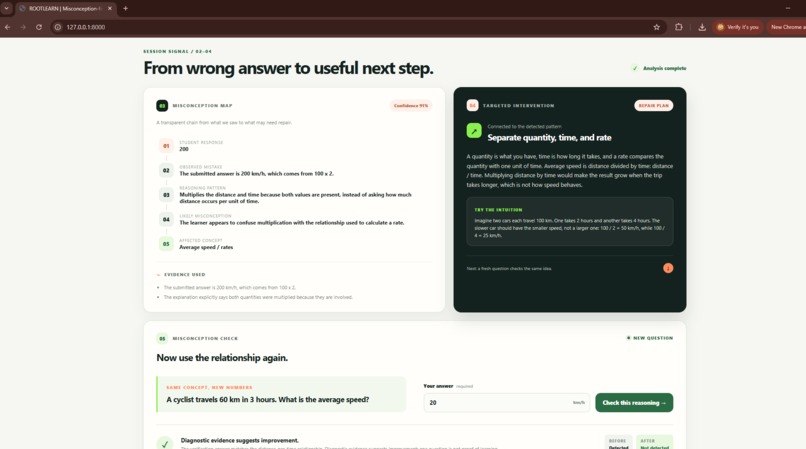
ROOTLEARN — AI Misconception Map & Targeted Repair
-
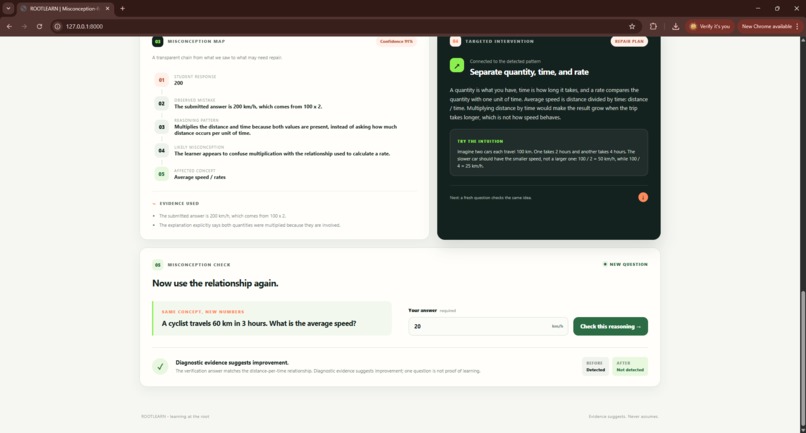
ROOTLEARN — Verify Learning Improvement
ROOTLEARN
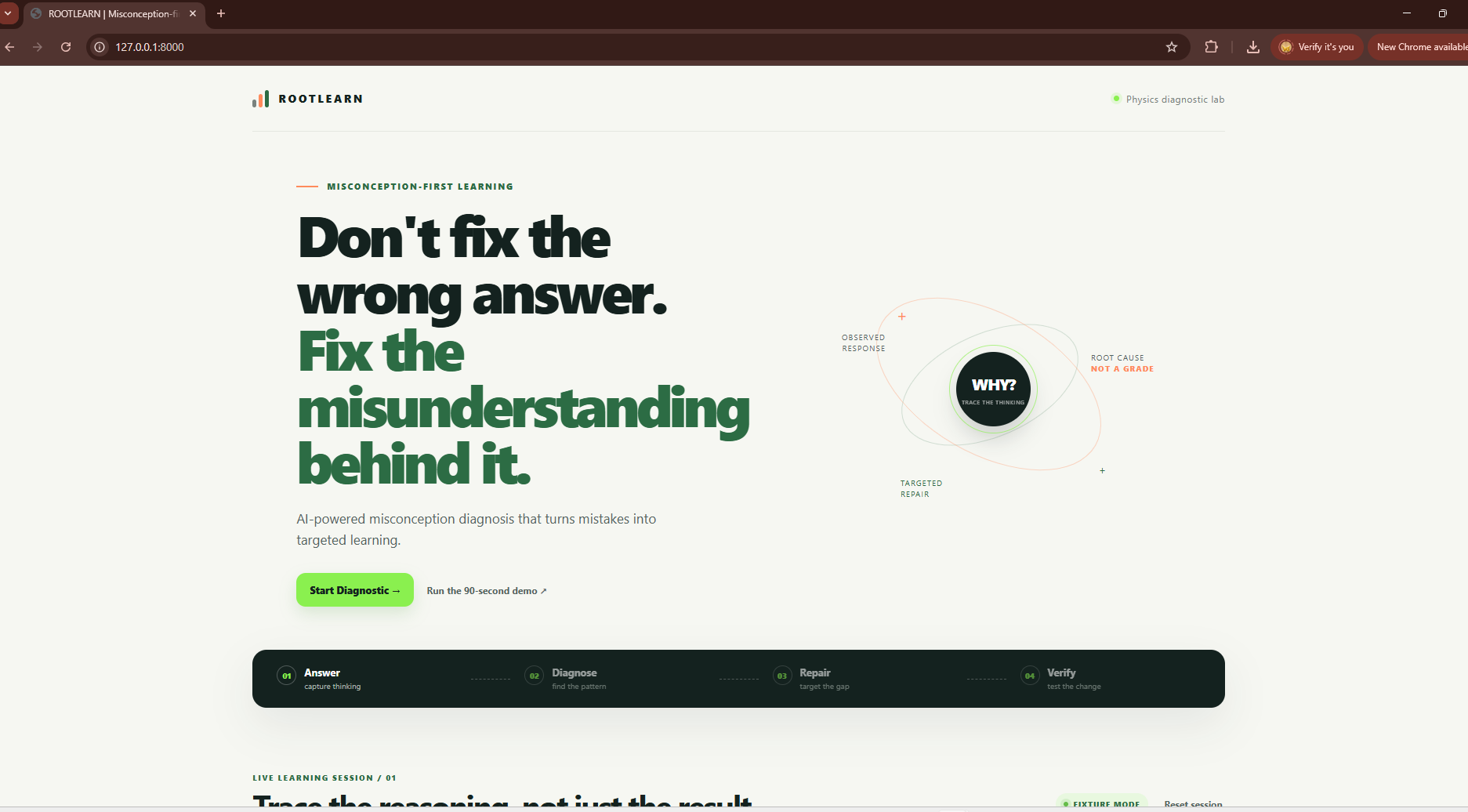
Don't fix the wrong answer. Fix the misunderstanding behind it.
ROOTLEARN is an AI-powered learning tool designed around a simple idea: a wrong answer is often a symptom of a deeper misunderstanding.
Traditional learning tools usually focus on whether an answer is right or wrong. ROOTLEARN goes one step deeper by looking at how the learner reasoned.
💡 Inspiration
We were inspired by a common learning problem: two students can give the same wrong answer for completely different reasons.
If a student gets a question wrong, simply showing the correct answer may not fix the underlying misunderstanding. The learner may repeat the same mistake on the next question.
ROOTLEARN was built to turn that mistake into a useful learning signal.
🧠 How it works
ROOTLEARN follows a continuous diagnostic learning loop:
Student reasoning → Misconception detection → Targeted intervention → New question → Verification
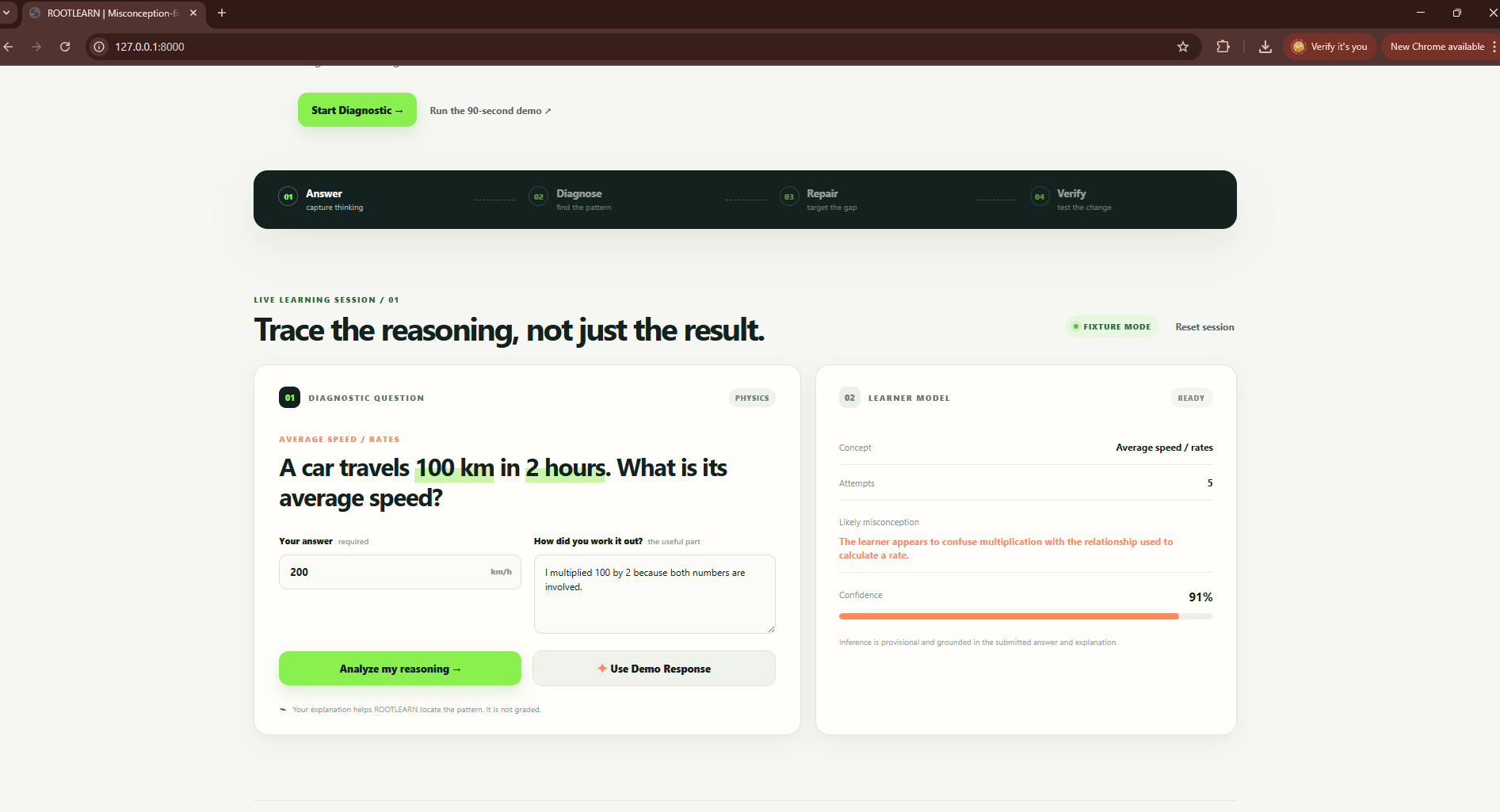
1. Capture the reasoning
The learner provides both:
- their answer
- an explanation of how they arrived at it
The explanation is important because it provides evidence about the reasoning pattern behind the answer.
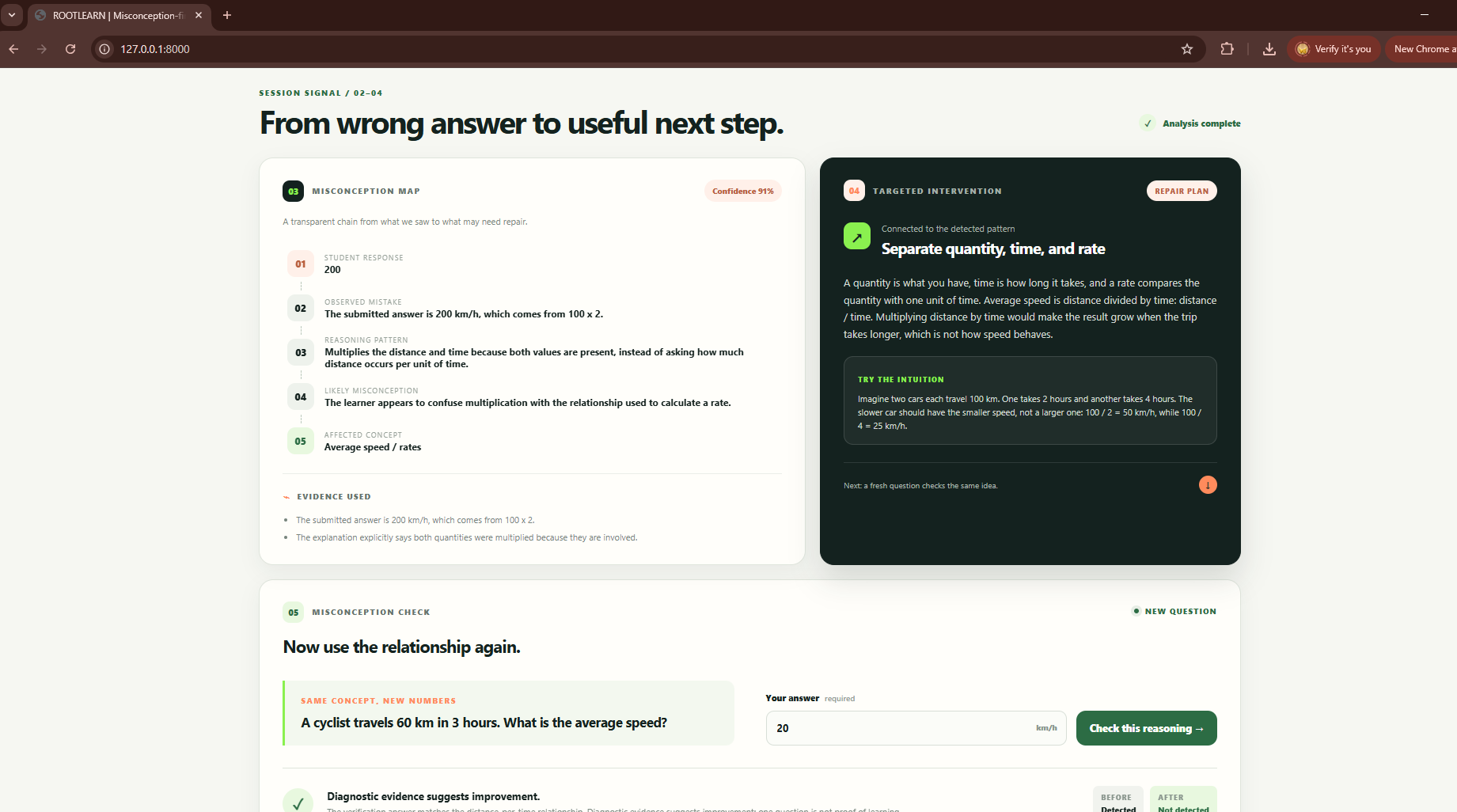
2. Diagnose the likely misconception
ROOTLEARN analyzes the response and reasoning to produce a transparent chain:
Observed mistake → Reasoning pattern → Likely misconception → Affected concept → Evidence
Instead of claiming to know exactly what a learner is thinking, ROOTLEARN identifies a likely misconception with confidence and supporting evidence.
3. Repair the specific misunderstanding
The system generates a targeted micro-intervention connected to the detected reasoning pattern.
For example, if a learner calculates average speed by multiplying distance and time, ROOTLEARN does not simply provide the correct answer.
It explains the relationship between distance, time, and rate, then gives an intuitive comparison that helps the learner understand why the relationship works.
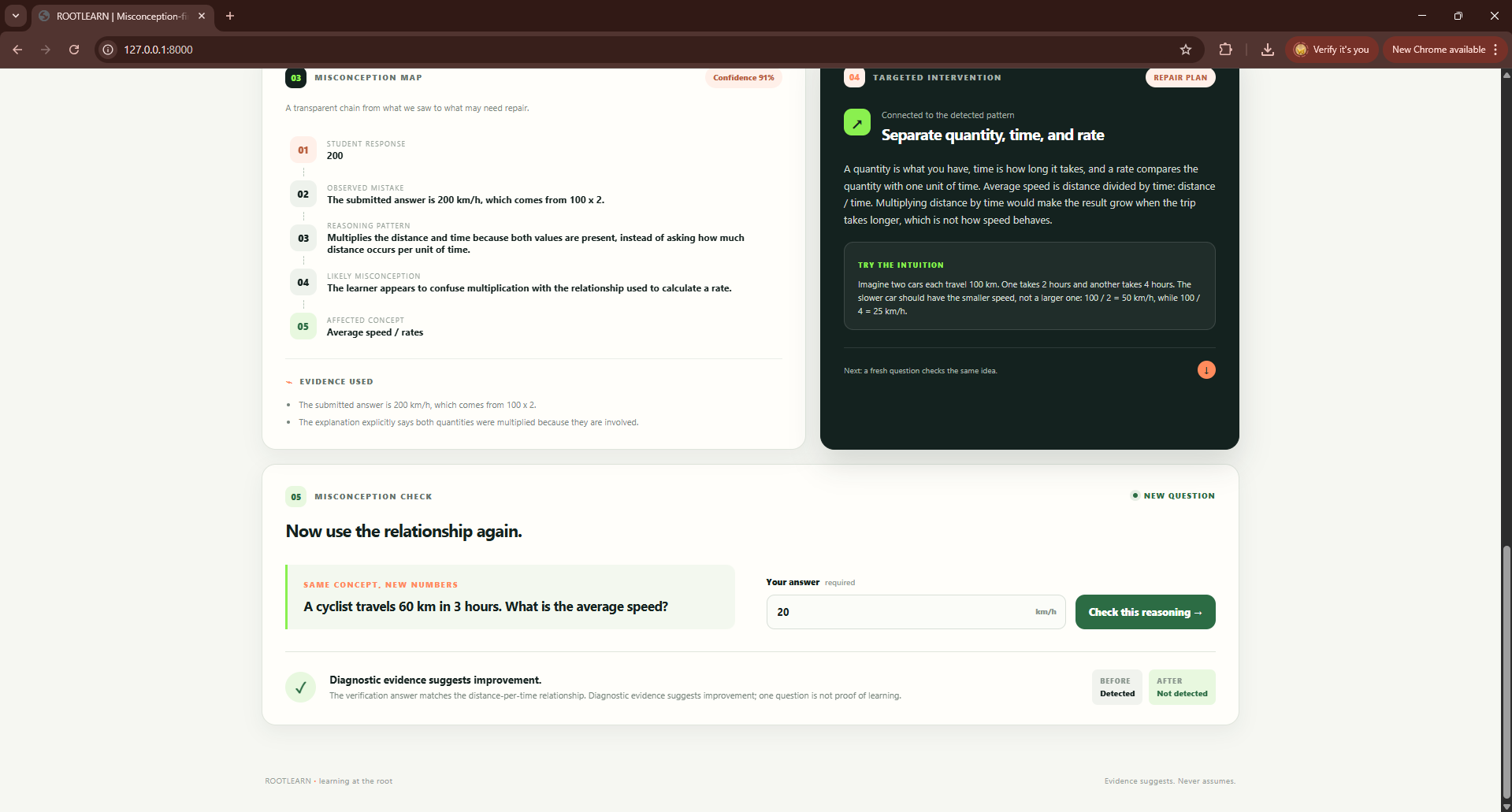
4. Verify with a new question
ROOTLEARN then presents a fresh question testing the same concept with different numbers.
The learner's new reasoning is evaluated against the previously detected pattern.
The result is shown transparently:
Before: Detected → After: Not detected
ROOTLEARN deliberately describes this as diagnostic evidence of improvement, not proof of learning from a single question.
🔬 Example
A student is asked:
A car travels 100 km in 2 hours. What is its average speed?
The student answers:
200 km/h
and explains:
I multiplied 100 by 2 because both numbers are involved.
ROOTLEARN identifies the likely reasoning pattern: the learner is multiplying the distance and time instead of reasoning about distance per unit of time.
It then provides a targeted intervention and asks:
A cyclist travels 60 km in 3 hours. What is the average speed?
When the learner answers:
20 km/h
using distance divided by time, ROOTLEARN reports diagnostic improvement.
🛠️ How we built it
ROOTLEARN uses a lightweight web architecture:
- FastAPI for the backend API
- Pydantic for structured and validated AI outputs
- Python for diagnostic and learner-state logic
- HTML, CSS and JavaScript for the responsive frontend
- A provider abstraction that separates AI inference from deterministic learning-state and verification logic
- Fixture/demo mode for a reliable, reproducible demonstration without requiring an external API key
The system maintains a small evidence-based learner state rather than relying only on the latest answer.
We also added automated tests covering the core diagnostic engine and API behavior.
🚧 Challenges
One of the biggest challenges was making the AI output useful without turning it into an unexplained black box.
We wanted the learner and educator to be able to see why a misconception was suggested.
Another challenge was separating probabilistic AI interpretation from deterministic application behavior. The diagnostic output is structured and validated, while verification and learner-state transitions remain explicit and testable.
📚 What we learned
Building ROOTLEARN taught us that AI in education does not have to mean simply generating more explanations.
A more useful role for AI can be diagnosis: identifying patterns in learner reasoning and deciding what small intervention should come next.
The key insight behind ROOTLEARN is:
The wrong answer is not the end of the learning process. It is evidence about where learning can begin.
🌱 What's next
Future versions could build longer-term misconception maps across subjects, detect recurring reasoning patterns across multiple sessions, provide educator dashboards, and adapt intervention difficulty based on accumulated evidence.
ROOTLEARN is designed to move learning from:
Answer checking → Understanding checking
Built With
- artificial
- css
- education
- fastapi
- html
- intelligence
- javascript
- learning
- machine
- pydantic
- python

Log in or sign up for Devpost to join the conversation.