Plant it. Keep it. Get paid for it.
RootedPlants.AI turns a planted tree into a year of verified care, and pays the person who does it.
The problem, in numbers
India's national auditor spent ten years looking at the Green India Mission across 15 states, and published the count in 2026. About 5% of a 2.8 million hectare planting target was achieved. At roughly 70% of the sites assessed, tree cover had not improved at all. Of 559 sites physically verified, 95 came in between 0 and 40% survival. Surviving plants averaged 22.42 cm against a prescribed minimum of 75 cm. At one site in Uttarakhand, 2,000 plantings were reported, 30 to 40 saplings were found, and none had lived.
One line explains the rest. 431 of 556 plantation journals did not record the species planted, the coordinates, or the survival percentage. Four out of five. Nobody was ever asked to keep that record, so nobody kept it.
The money is not the missing piece either. Indian companies spent ₹40,794 crore on CSR in FY 2024-25, a record, and ₹3,397 crore of it on environmental work, up 40% in one year. Above a ₹10 crore obligation the Companies Act already requires an independent assessment of what that money achieved. The spending exists. The law already asks for proof. The proof is what nobody can produce.
And it is not only forests. A tulsi on a balcony, a money plant in a living room and a lemon tree by a kitchen window run on the same year of small boring jobs, and nothing is attached to doing any of them. We pay people to pay a credit card bill on time. We pay nobody to keep a plant alive.
What it does (nine steps, one loop, all on a phone)
Register: one photograph, and the species comes back from the photograph rather than a dropdown, searched by the names people use, so "mogra" finds jasmine and "kadi patta" finds curry leaf. The spot is read off the device, never typed. That first photograph becomes the baseline every later one is measured against, for as long as the plant lives.
Refuse: point it at a notebook and it says so, out loud, before anything is registered. A plain object scores 0.2% as a plant, a wall 0.5%, the weakest real plant photograph 9%. The bar is 3%.
Schedule: each species carries its own watering interval, what to feed it with and what goes wrong with it, and open-meteo then moves every task by the weather at that plant's own coordinates. Rain pushes the next watering out. A heat spell pulls it in. A pest check comes round sooner after warm wet days, because that is when pests arrive. The line under the task says what moved it.
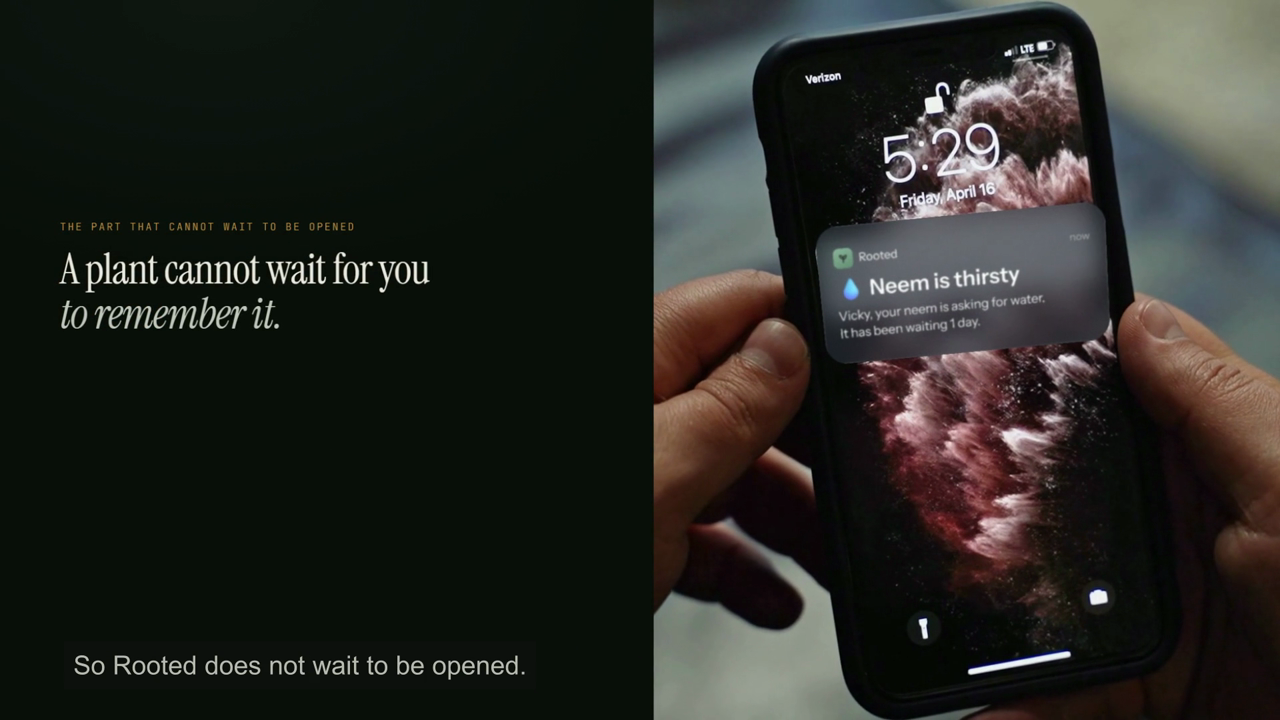
Remind: when a task comes due the same message goes out on WhatsApp, on email and as a text, and the plant asks in its own words. "💧 Neem is thirsty. Vicky, your neem is asking for water. It has been waiting 1 day." A name, a plant and a date reach the server to send it. No photographs. No coordinates.
Shoot: the camera says the one thing that would make the shot pass, out loud, because whoever holds the phone is also holding a watering can. It reads the live frame twice a second on the device. Tilt down so the soil is in frame. Hold still for a second. That is it, take it. The ring round the shutter turns green when there is nothing left to fix.
Check: five checks, and every one reports the number it measured instead of a verdict. It came off the camera, not a file picker. The time is taken on our side, not read off the file. The location is within 120 m of where the plant was registered. The soil is at least 5% darker than that plant's own dry baseline: a watered pot measured 28.4%, the same frame against itself 0.0%.
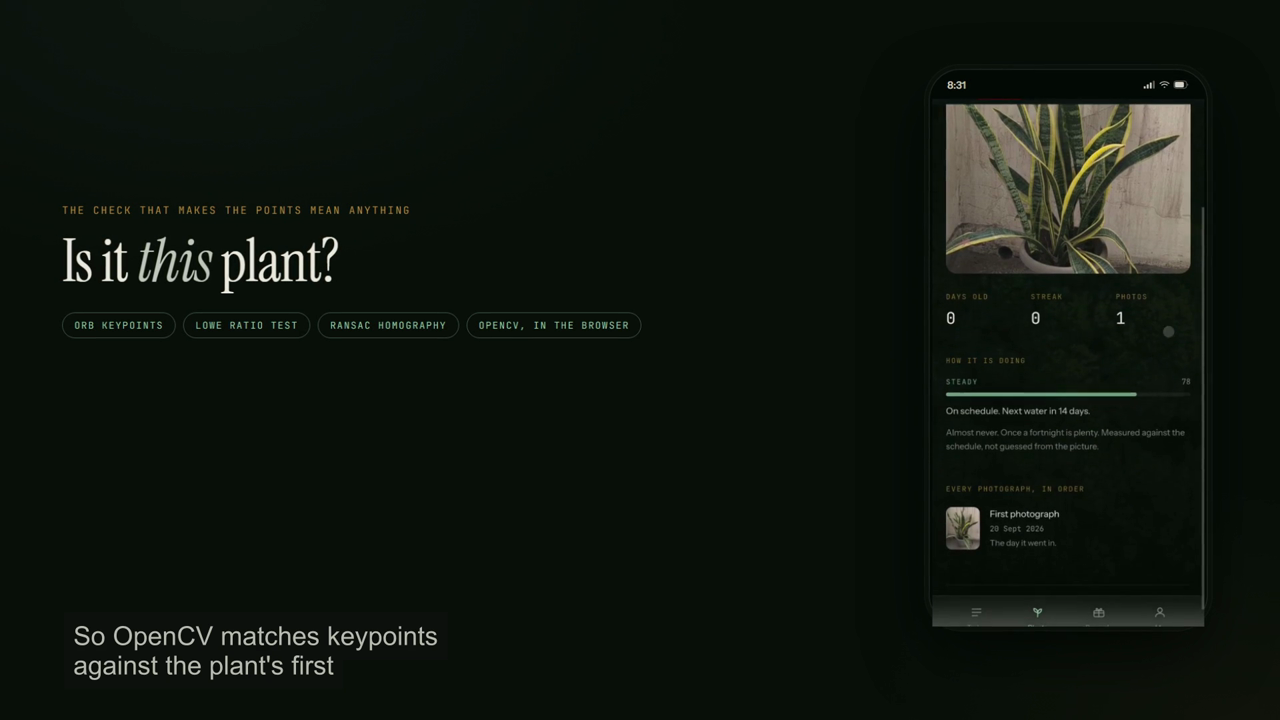
Prove it is that plant: ORB keypoints and a RANSAC homography against the plant's own first photograph, run in the browser on a 256 px copy with nothing uploaded. The same plant returned 485 agreeing points. A different neem in a similar pot returned 4.
Score: every plant carries a health band and one sentence saying what moved it, computed from how the schedule has actually gone. It never reads the leaves and calls the plant sick, because a yellow leaf has a dozen causes.
Earn and redeem: points land on the task, not on the planting, and they redeem. Because every point traces back to one verified task, what accumulates is not a score. It is the record of what survived.
Technological implementation
The identity check runs in the browser. OpenCV 5 compiled to WebAssembly, served as a plain script rather than bundled, because the bundler detects a Node environment inside it and fails on fs, and serving it keeps 24 MB out of the app bundle. It extracts 1,200 ORB keypoints at a scale factor of 1.2 over 8 levels from a 256 px copy of the new photograph and of the plant's own first photograph, matches them with Lowe's ratio test, and asks RANSAC whether the survivors agree on one homography. Twenty-five agreeing points is the bar. The same plant returned 485 in the live app. A different neem tree in a similar pot returned 4. Nothing is uploaded to do any of it.
Species and "is this even a plant" are one call. A server route posts the photograph to PlantNet's /v2/identify/all with organs=auto, so the key never reaches a browser, and the best score doubles as the plant test. Calibrated against real inputs: a plain object scores 0.2%, a wall 0.5%, noise returns a 404, and the weakest genuine plant photograph scored 9%. The bar sits at 3%.
The watering check measures the soil. It samples the band from 62% to 98% of the frame height against the same band in the plant's dry baseline and requires it to be at least 5% darker. The framing check deliberately ignores the soil and only reads the top 62% of the frame, because the one thing that proves the watering is the one thing that would otherwise make the composition score drop.
Everything that can stay on the phone stays on the phone. Plants, photographs at 1280 px, thumbnails at 256 px, baselines, points and history live in IndexedDB. What reaches a server for a reminder is a name, a plant and a date. No photographs. No coordinates. No points.
Reminders go out on every channel that is configured. One message composed once, sent through Resend for email and Twilio for WhatsApp and text, fired by a Vercel cron once a day, with Upstash Redis holding the clock. A missing key costs you that one channel and never the whole reminder.
The care data is 78 species carrying the names people actually use, so "mogra" finds jasmine and "kadi patta" finds curry leaf, each with its own watering interval, what to feed it with, and what goes wrong with it. Five fallback profiles cover anything not on the list, because naming a plant and knowing how to keep it alive are different jobs.
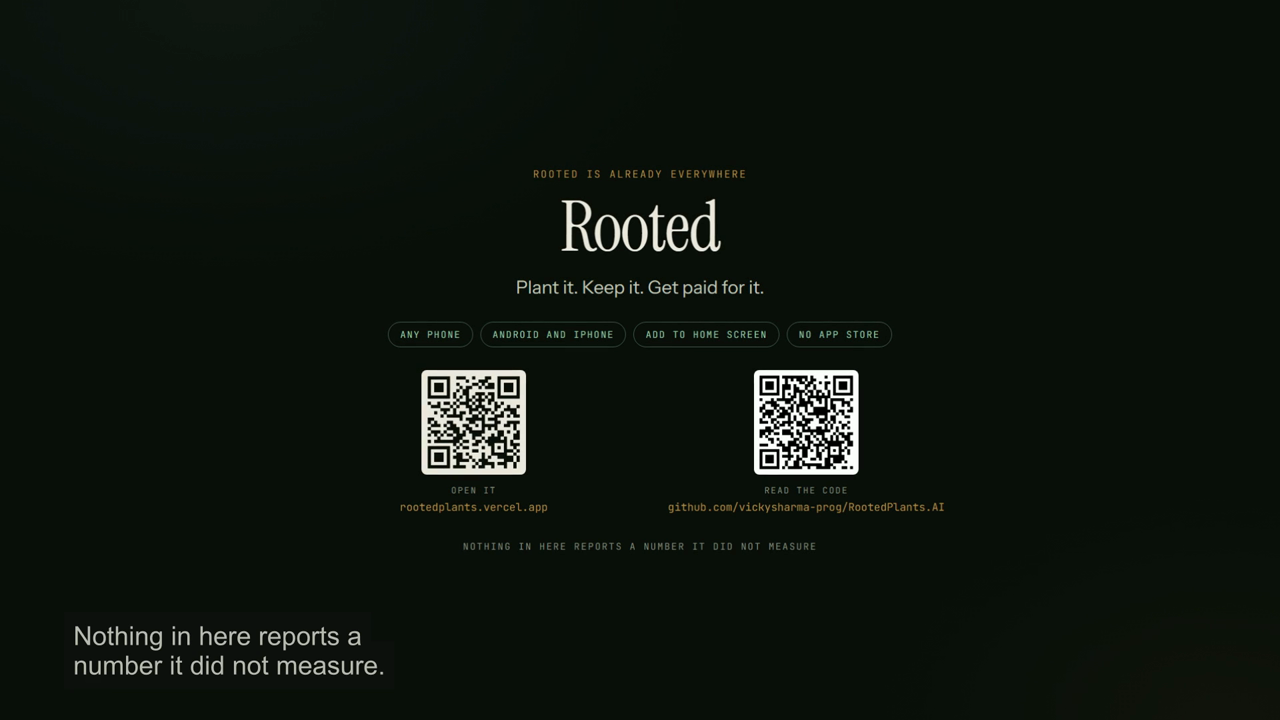
It installs. The manifest and icons make it an app on the home screen from the browser, on Android and on iPhone, with nothing to download from a store.
Why the points are worth something
If any plant could earn points, the points would be worth nothing, and the record they add up to would be worth less. So the product is built around one question it has to answer honestly: is this the same plant, photographed now, here, by the person claiming it.
Every check states the number it measured rather than a verdict, and the app shows that number to the person being checked. The health score is computed from schedule adherence alone. It never reads the leaves and calls the plant sick, because a yellow leaf has a dozen causes and a number invented from one is a number that gets trusted. The rewards catalogue holds stand-ins rather than real offers, because naming a company in a demo puts words in their mouth.
What I measured before shipping it.
Three features are in their second version, because I put a number on the first one and the number sent me back.
I built an on-device colour and texture classifier for species. Against 17 real photographs it got 0 right, where guessing at random scores 8%. It went, and PlantNet came in.
I decided whether a photograph contained a plant by how green it was. Real plants turned out to run from 0% to 97% green, so the measure said nothing.
The watering check compared the new photograph's composition against the baseline, and it included the soil. Water the plant properly, the soil darkens, the composition score drops, and the check fails because the watering worked. It now measures only above the soil line.
I also laid out contact sheets of every photograph I fetched and looked at all of them, which is how I caught a picture of Bitcoin in a plant pot filed under "money plant", a haworthia sold as an aloe, and an Aglaonema I had labelled tulsi myself. PlantNet read that last one back to me.
What I learned
Putting a number on a feature before shipping it changes what ships. Each of the three above felt fine until it was measured. The on-device classifier in particular was the weakest thing in the app wearing the name of the strongest.
A check can also fail in the direction of the user's success, which is the hardest kind to notice. The framing check punished people at the exact moment they had done the job properly.
Impact
It moves the unit of account. Everything built around planting counts saplings put in the ground, which is why 431 of 556 plantation journals could be filled in without anyone knowing whether a single tree lived. Rooted counts something else: one verified act of care, by one named person, at one set of coordinates, on one day. Add those up and you have survival, measured continuously, by the only person who was there every time.
It puts the household in the same system as the forest. A planting drive is one afternoon a year. A balcony is 365 days of it. The tulsi, the money plant, the lemon by the kitchen window and the sapling from last month's drive all run on the same year of small boring jobs, so they run on the same app and the same schedule. That is the part nobody is serving, and it is the larger number: the plants already in people's homes, already being kept alive for free, by people nobody has ever paid or counted.
It turns a cost into an instrument. ₹3,397 crore went into environmental CSR in one year, up 40%, and above a ₹10 crore obligation the Companies Act already requires an independent assessment of what the money achieved. Today a company buys a planting and receives a photograph from day one. With this it buys a year of proof: what was planted, where it stands, and whether it lived, each line traceable to a photograph that passed five checks. The spending does not change. What comes back does.
It pays the right person. Loyalty points, credit card rewards and streaks have trained a whole economy to pay people for spending. This points the same machinery at keeping something alive, and it pays the person holding the watering can rather than the organisation holding the press release.
And it is honest about what it knows. Every number on screen is a number the app measured. The identity check separates the same plant from a different one of the same species by 485 to 4. Nothing here reports a figure it did not measure, which is the only reason the record it produces is worth anything at all.

Log in or sign up for Devpost to join the conversation.