-
-
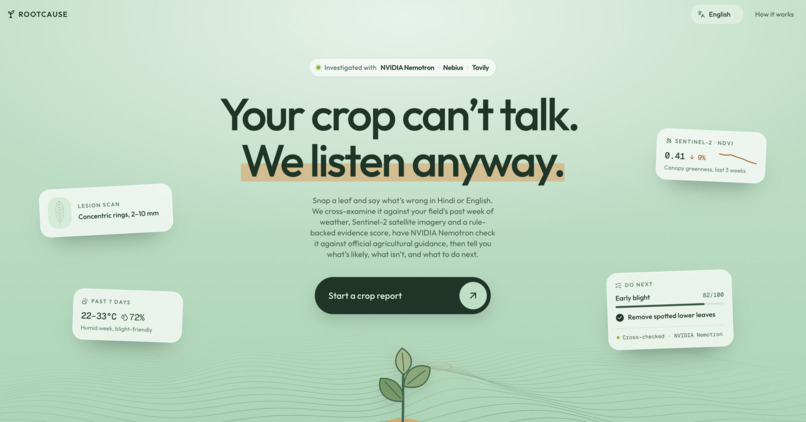
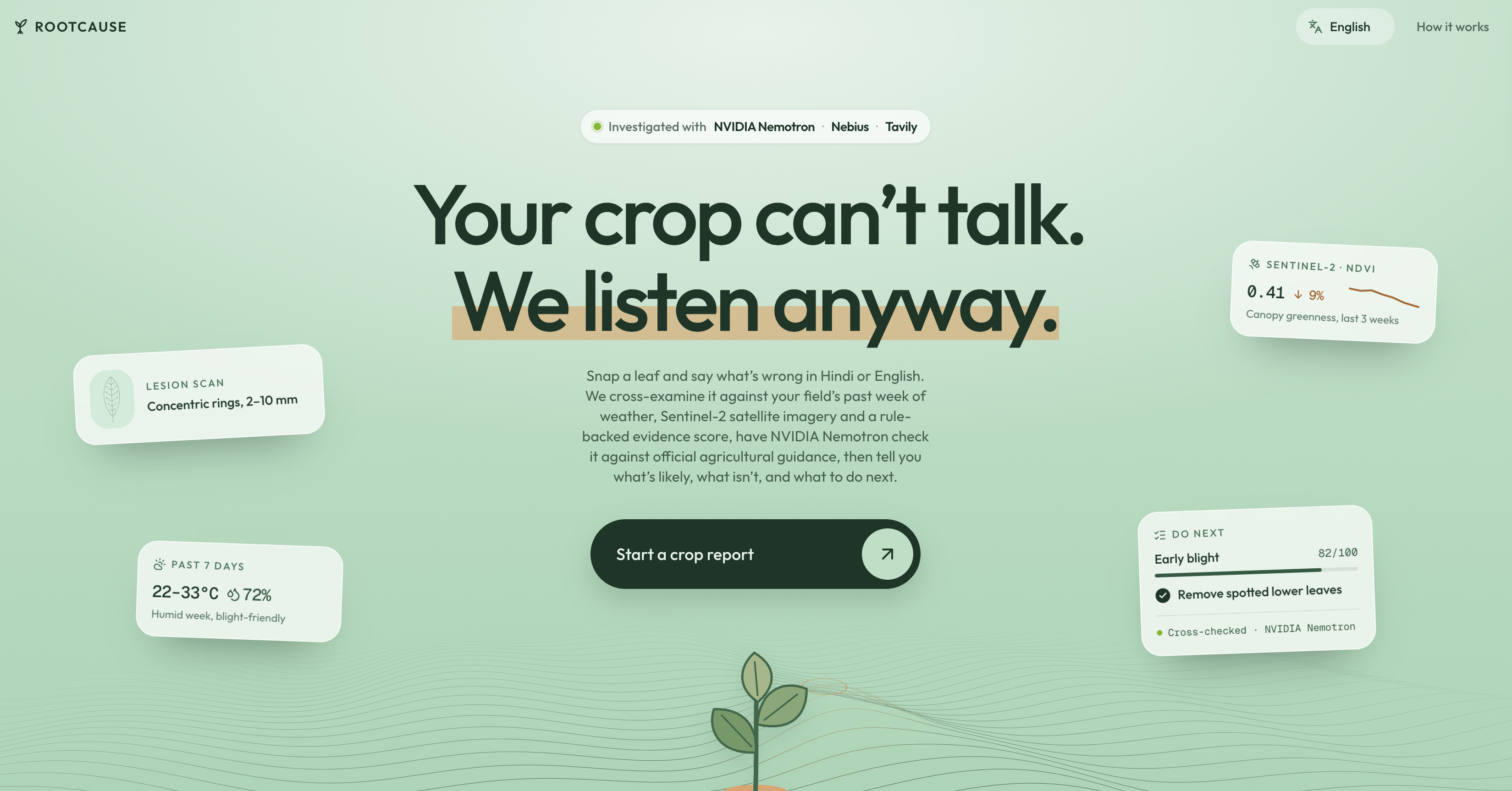
RootCause welcomes farmers with a simple promise: share a crop photo and get help investigating what may be wrong.
-
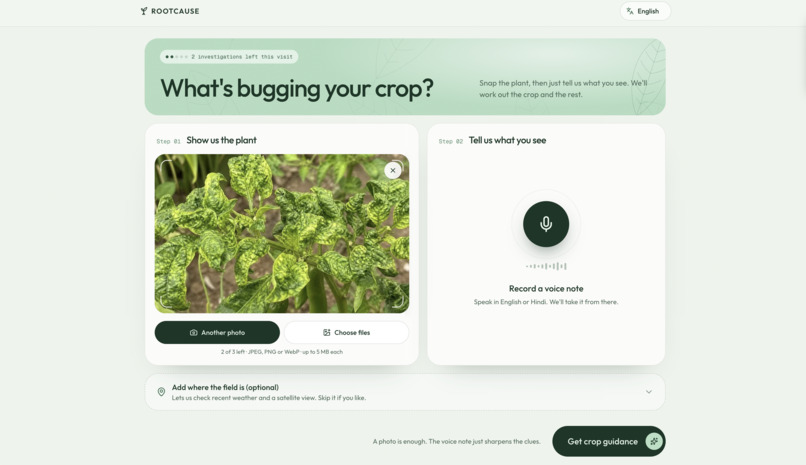
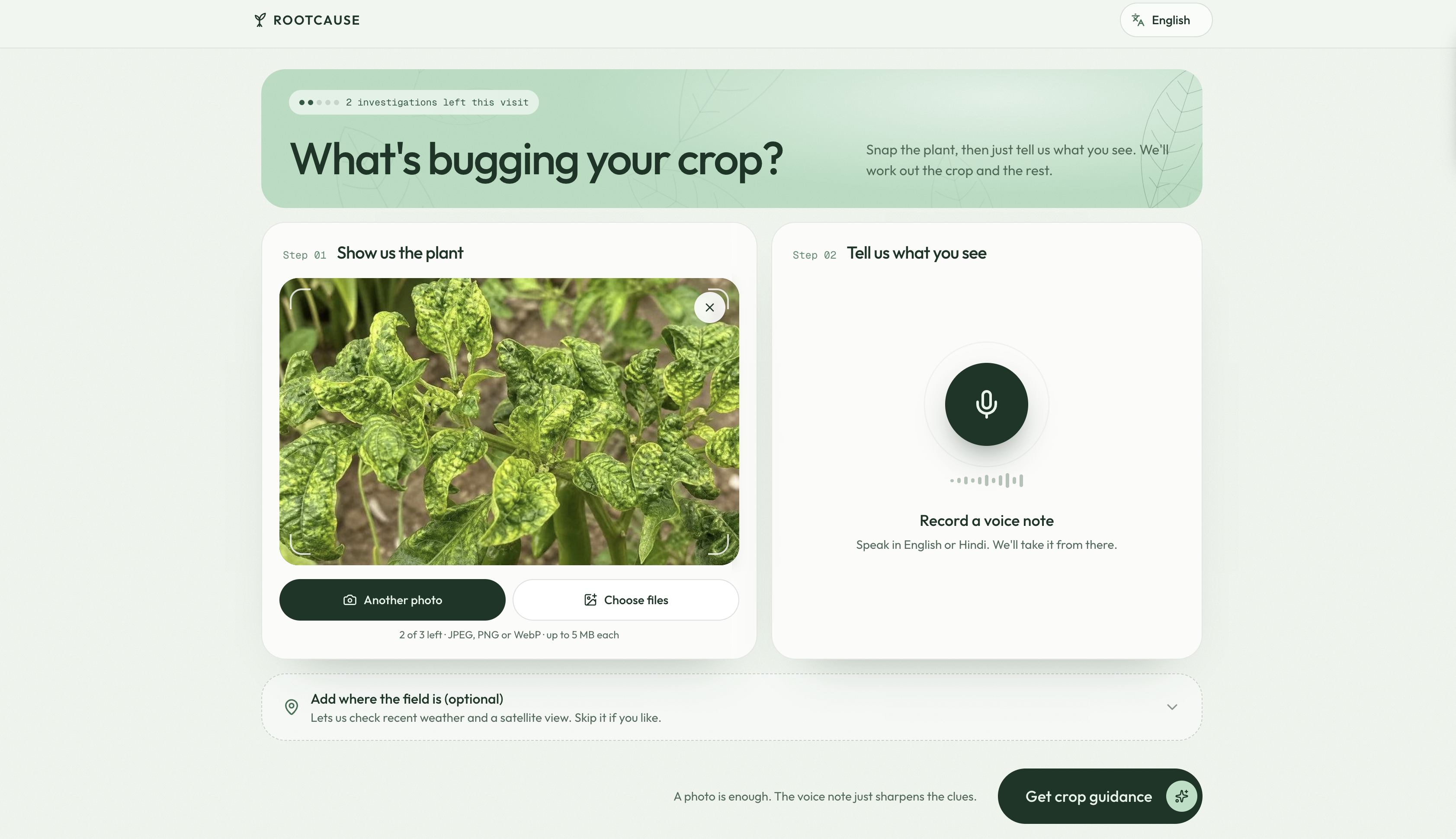
Start a crop report with photos and a description, or explore the experience with a sample case.
-
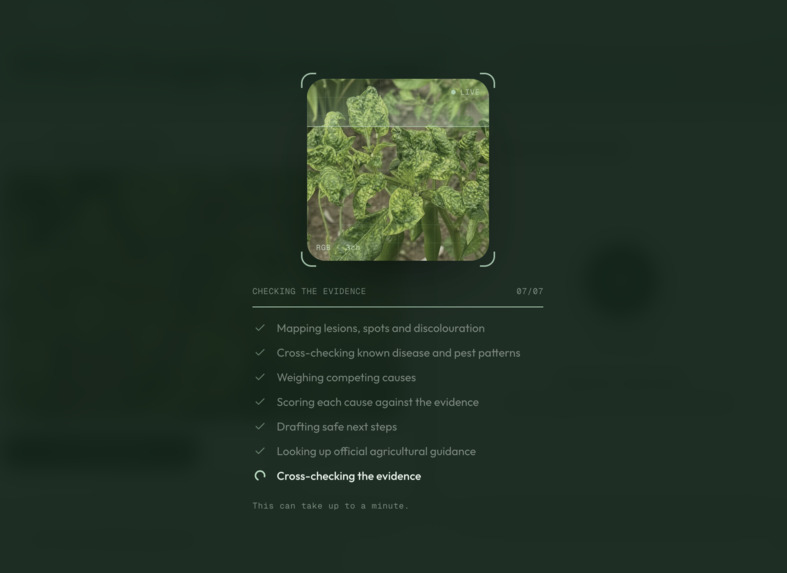
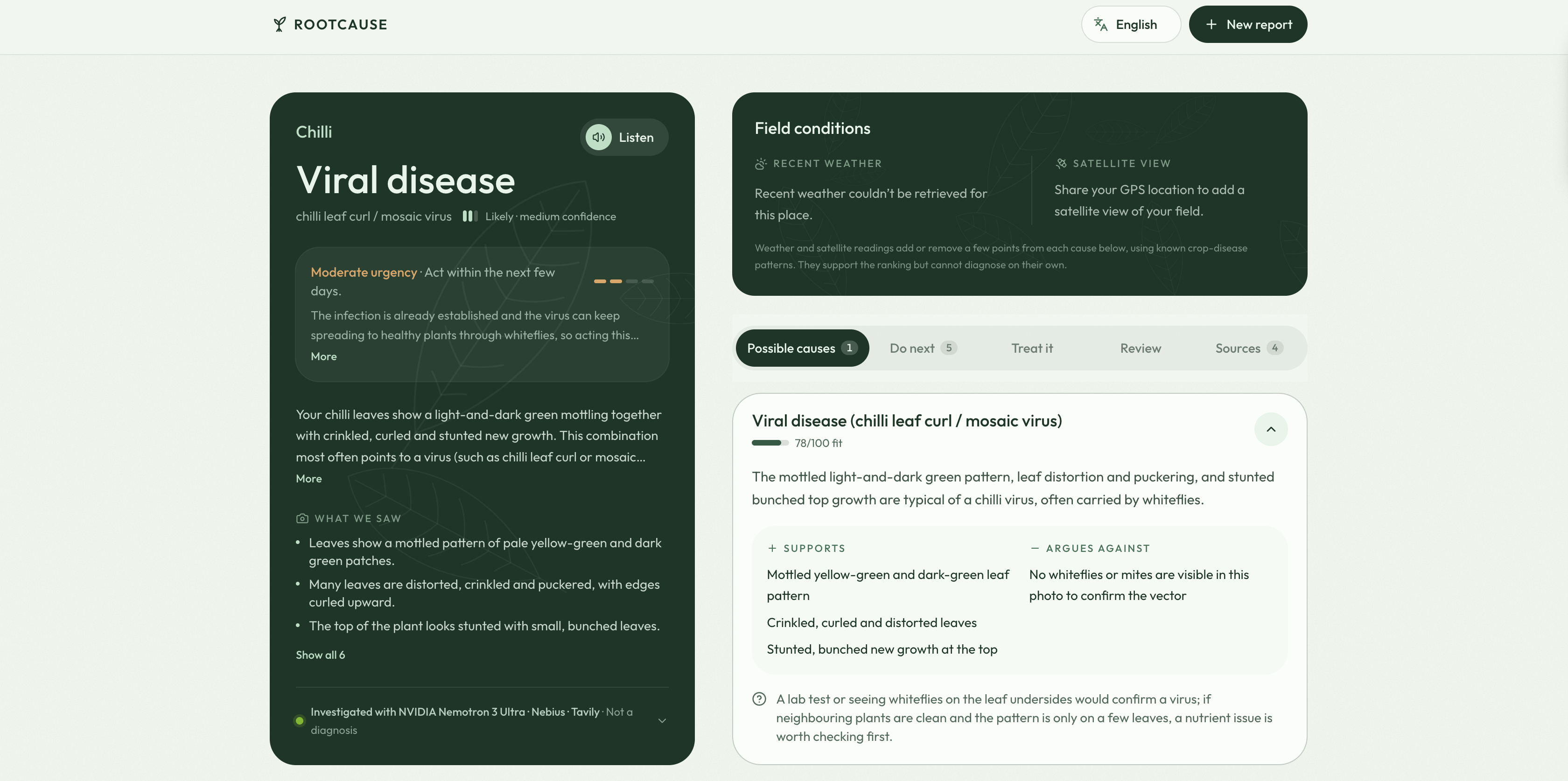
RootCause reviews the crop photo and evidence to explore possible causes, not make a definitive diagnosis.
-
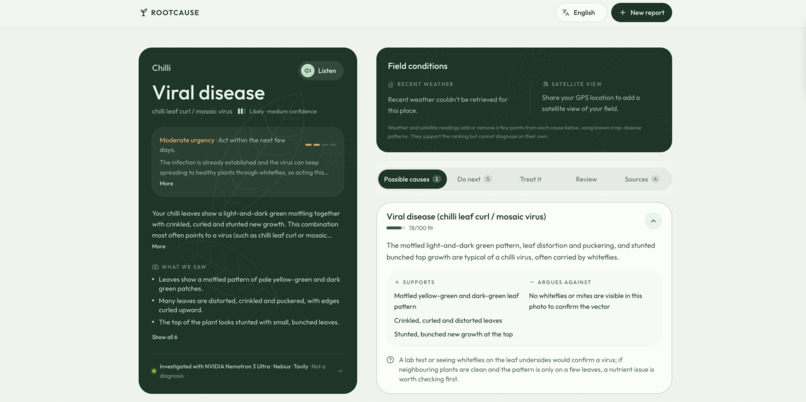
The results page brings together visual observations, supporting evidence, and practical next steps.
Inspiration
A farmer notices yellowing leaves. Is it a fungal infection, nutrient deficiency, water stress, or something else?
For millions of farmers, answering that question quickly can mean the difference between saving a harvest and losing months of hard work.
Most AI crop diagnosis tools rely heavily on photographs. But a single image cannot explain everything happening in a field. Weather patterns, soil conditions, satellite observations, and agricultural research all contribute to understanding crop distress.
We wanted to go beyond identifying symptoms and build an AI system that actually investigates them.
That vision started with RootCause, our multimodal crop distress triage platform. For the Nebius × NVIDIA Global AI Hackathon, we're taking it further with RootCause X: Beyond Diagnosis. Into Investigation.
Our goal is to make agricultural intelligence more accessible, explainable, and useful to the people who need it most.
What it does
RootCause X is an evidence-driven agricultural AI investigation platform that helps farmers understand crop distress and make informed decisions.
Farmers can upload crop photographs, describe symptoms through text or voice, and share their crop type and location.
Instead of producing a single disease prediction, RootCause X investigates multiple signals:
- AI Vision: Examines crop photographs to identify visible symptoms and potential causes.
- Weather Intelligence: Analyzes recent rainfall, temperature, and humidity using Open-Meteo.
- Satellite Intelligence: Uses Sentinel-2 imagery and Google Earth Engine to examine vegetation health through NDVI and NDMI.
- Evidence Scoring: Evaluates possible causes using deterministic rules, supporting observations, and contradictory evidence.
- NVIDIA Nemotron: Reviews the collected evidence, challenges unsupported conclusions, identifies uncertainty, and suggests useful follow-up observations.
- Tavily Research: Retrieves relevant agricultural guidance from trusted sources to support traceable, evidence-backed recommendations.
The platform aims to answer five important questions:
- What could be happening to the crop?
- What evidence supports or contradicts each possibility?
- How urgent is the situation?
- What additional information would help?
- What safe actions should the farmer consider next?
RootCause X doesn't just provide an answer. It explains the investigation behind it.
How we built it
RootCause X combines multimodal AI, environmental data, deterministic evidence analysis, and agentic reasoning into a unified investigation workflow.
Our technology stack includes:
- Frontend: Next.js, React, TypeScript, Tailwind CSS
- Backend: Python, FastAPI, Pydantic
- AI Vision: Google Gemini
- AI Reasoning: NVIDIA Nemotron via Nebius Token Factory
- Agricultural Knowledge Retrieval: Tavily Search and Extract APIs
- Weather Data: Open-Meteo
- Satellite Intelligence: Google Earth Engine and Sentinel-2
- Deployment: Google Cloud
Our investigation architecture
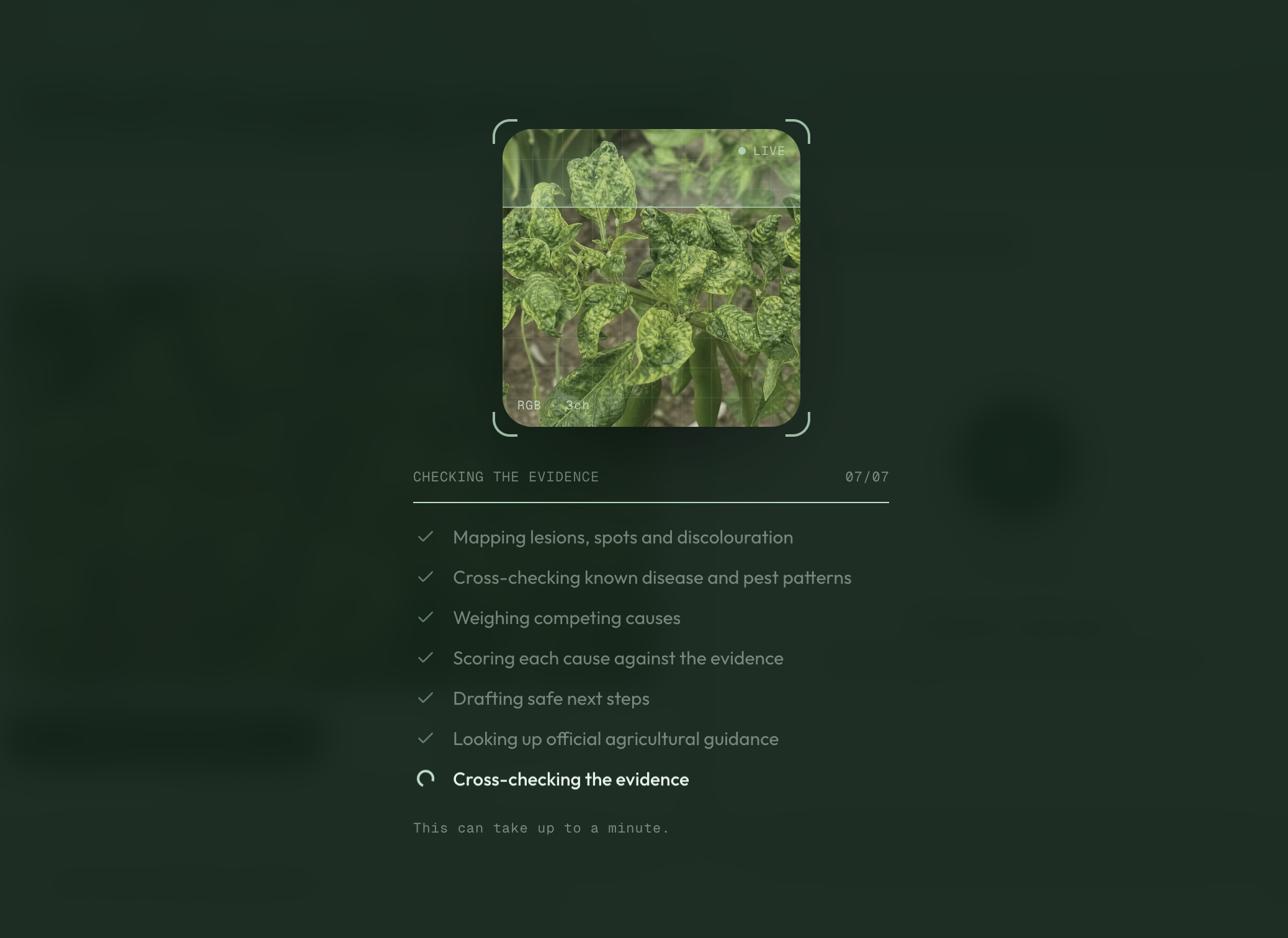
The workflow begins when a farmer submits photographs and describes crop symptoms.
Gemini analyzes the images and produces structured observations. Open-Meteo provides recent weather context, while Google Earth Engine processes satellite vegetation indicators.
These signals enter a deterministic evidence engine that evaluates possible causes and records supporting evidence, contradictions, and missing information.
We extend this foundation in RootCause X with two specialized capabilities:
1. NVIDIA Nemotron Investigation Agent
Nemotron, accessed through Nebius Token Factory, evaluates the existing evidence, identifies gaps, reconciles conflicting signals, and helps determine the next useful observation.
Rather than replacing the evidence engine, Nemotron adds a reasoning layer while preserving deterministic safeguards.
2. Tavily Agricultural Knowledge Agent
Tavily searches for relevant guidance from authoritative agricultural sources. Retrieved material is filtered for relevance and source credibility before being used in the investigation.
This helps connect agricultural recommendations to traceable reference material instead of relying entirely on a language model's internal knowledge.
Building on the original RootCause
RootCause X evolves from RootCause, originally developed for the Google AI Builder Cup.
The original project established the multimodal triage foundation, including image analysis, weather intelligence, satellite observations, and evidence scoring.
RootCause X is developed in a separate repository for the Nebius × NVIDIA hackathon, extending that foundation with Nemotron-powered investigation and Tavily-assisted agricultural research.
The objective is not simply to switch AI models, but to create a deeper and more explainable investigation workflow.
Challenges we ran into
1. A symptom is not a diagnosis
Yellowing, wilting, and leaf spots can result from multiple unrelated causes. Designing a system that acknowledges uncertainty instead of confidently choosing one explanation was a major challenge.
2. Combining evidence from different sources
Photographs, weather observations, and satellite measurements operate at different scales and can sometimes contradict one another.
We had to design a consistent evidence-processing approach that preserves those differences rather than treating every signal as equally reliable.
3. Preventing AI hallucinations
Agricultural recommendations affect real livelihoods. An unsupported diagnosis or incorrect treatment recommendation can create financial and environmental harm.
We addressed this through deterministic evidence rules, constrained AI reasoning, explicit uncertainty, and source-validation safeguards.
4. Integrating multiple AI systems
Combining Gemini's multimodal capabilities, NVIDIA Nemotron's reasoning, and Tavily's retrieval required carefully defined responsibilities, structured API contracts, and failure handling.
The challenge was making these technologies work together as an investigation system rather than a collection of disconnected API calls.
5. Making complex intelligence understandable
Farmers don't need raw satellite indices or lengthy model explanations. They need to understand what might be wrong, why the system thinks so, and what to do next.
Translating technical evidence into accessible, actionable guidance became a central product-design challenge.
Accomplishments that we're proud of
We're proud of building a foundation that approaches agricultural distress as an evidence-gathering problem rather than a simple image-classification task.
Key accomplishments include:
- Combining crop photographs, farmer observations, weather data, and satellite vegetation indicators.
- Building deterministic evidence scoring that considers both supporting and contradictory signals.
- Making uncertainty and missing information part of the investigation instead of hiding them.
- Designing an NVIDIA Nemotron reasoning layer that evaluates evidence without overriding established scoring rules.
- Extending the workflow with Tavily-based agricultural research and source traceability.
- Building around multilingual accessibility and a farmer-focused user experience.
- Establishing a modular architecture that can grow into regional agricultural early-warning infrastructure.
Most importantly, we're working toward a system that helps farmers understand why a recommendation was made, not just what the recommendation says.
What we learned
The biggest lesson from building RootCause was that AI becomes more useful when it understands the limits of its own evidence.
A powerful model can identify patterns, but it shouldn't invent certainty where none exists.
We learned that combining independent information sources can be more valuable than relying on a single model's prediction.
We also learned the importance of assigning different responsibilities to different technologies:
- Vision models observe.
- Data services measure.
- Retrieval tools find relevant knowledge.
- Reasoning models connect evidence.
- Deterministic rules enforce safeguards.
Working with NVIDIA Nemotron and Nebius Token Factory has shaped our approach to building an agent that investigates evidence instead of simply generating answers.
And Tavily has reinforced another important principle: AI recommendations become more trustworthy when users can trace them to relevant, credible sources.
What's next for RootCause
Our long-term vision is to transform RootCause X from an individual crop investigation assistant into a proactive agricultural early-warning network.
We're exploring five major directions:
1. Regional Crop Distress Detection
Aggregate anonymized farmer reports, environmental signals, and satellite trends to identify emerging distress hotspots before they become widespread.
2. Interactive AI Investigations
Enable farmers to answer targeted follow-up questions, submit additional photographs, and progressively refine an investigation.
3. Hyperlocal Agricultural Intelligence
Expand region-specific agricultural knowledge, crop coverage, and localized recommendations.
4. Voice-First Multilingual Access
Make the experience more accessible to farmers who prefer speaking in their native language rather than navigating complex interfaces.
5. Agricultural Field-Officer Intelligence
Build dashboards that help agricultural experts identify emerging problems, prioritize field visits, and intervene earlier.
Ultimately, we envision a future where farmers don't have to wait for visible crop damage to become a crisis before getting meaningful help.
RootCause X isn't about replacing agricultural experts. It's about bringing better evidence, earlier warnings, and more informed decisions within every farmer's reach.
RootCause X. Beyond Diagnosis. Into Investigation.
Built With
- agentic-ai
- agriculture
- computer-vision
- fastapi
- generative-ai
- google-cloud
- google-earth-engine
- google-gemini
- multi-agent-systems
- multimodal-ai
- nebius-token-factory
- next.js
- nvidia-nemotron
- open-meteo
- pydantic
- python
- react
- rest-api
- retrieval-augmented-generation
- satellite-imagery
- sentinel-2
- tailwind-css
- tavily
- typescript

Log in or sign up for Devpost to join the conversation.