-
-
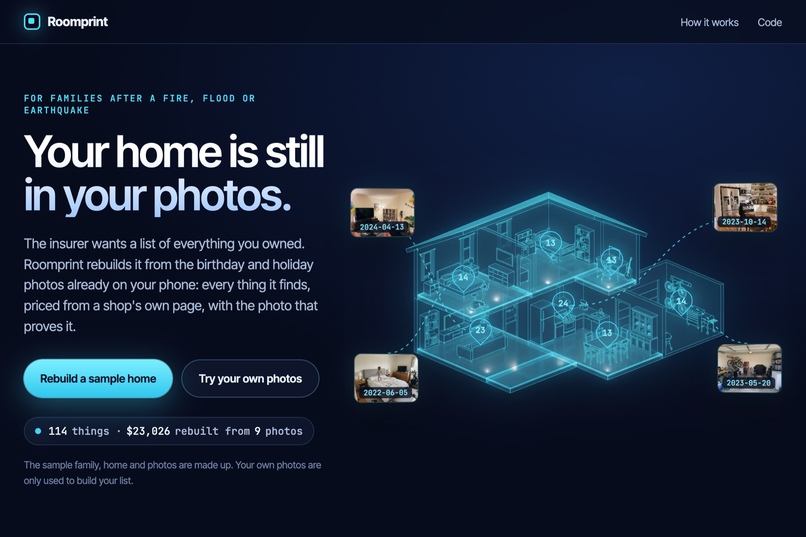
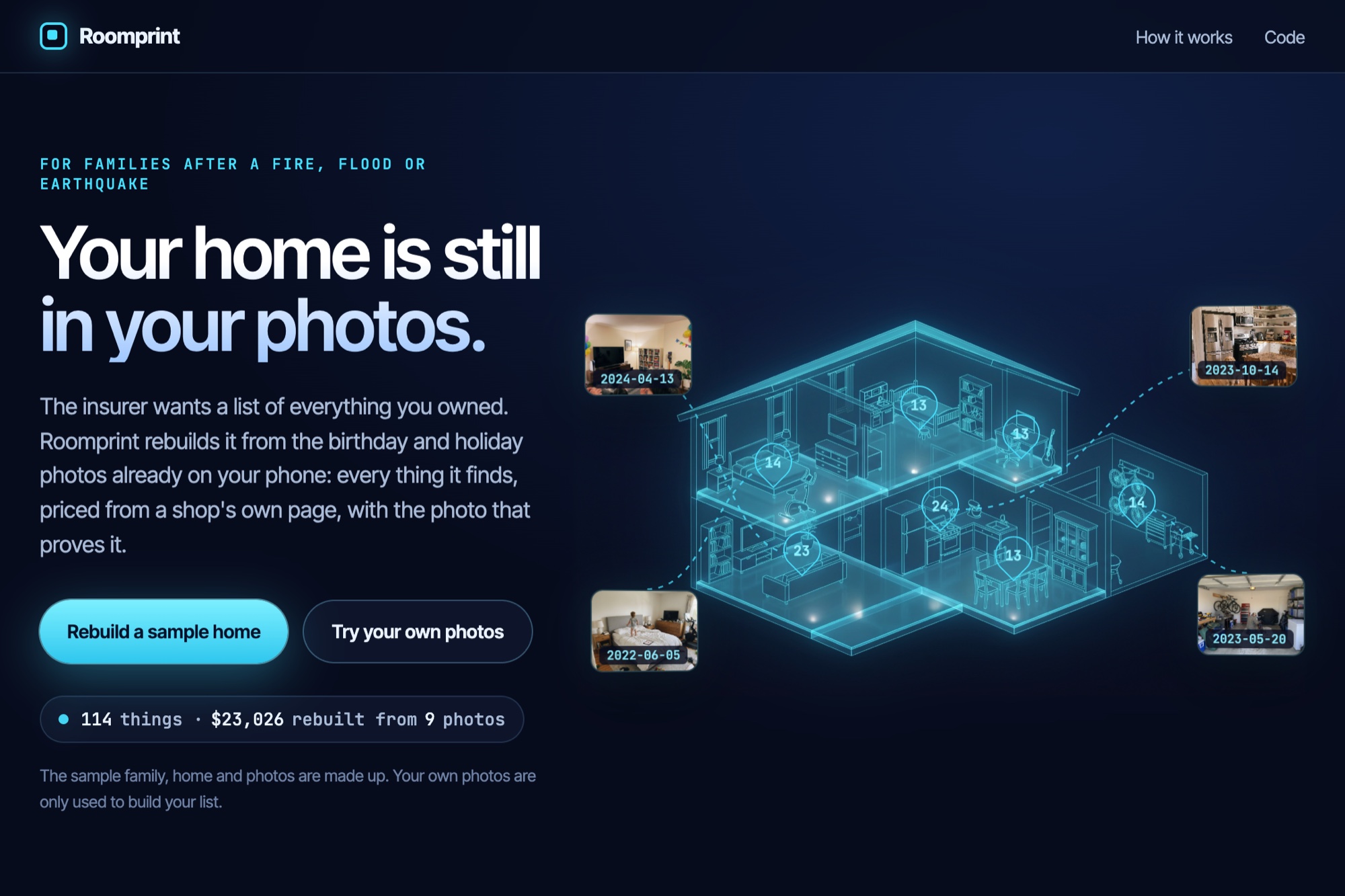
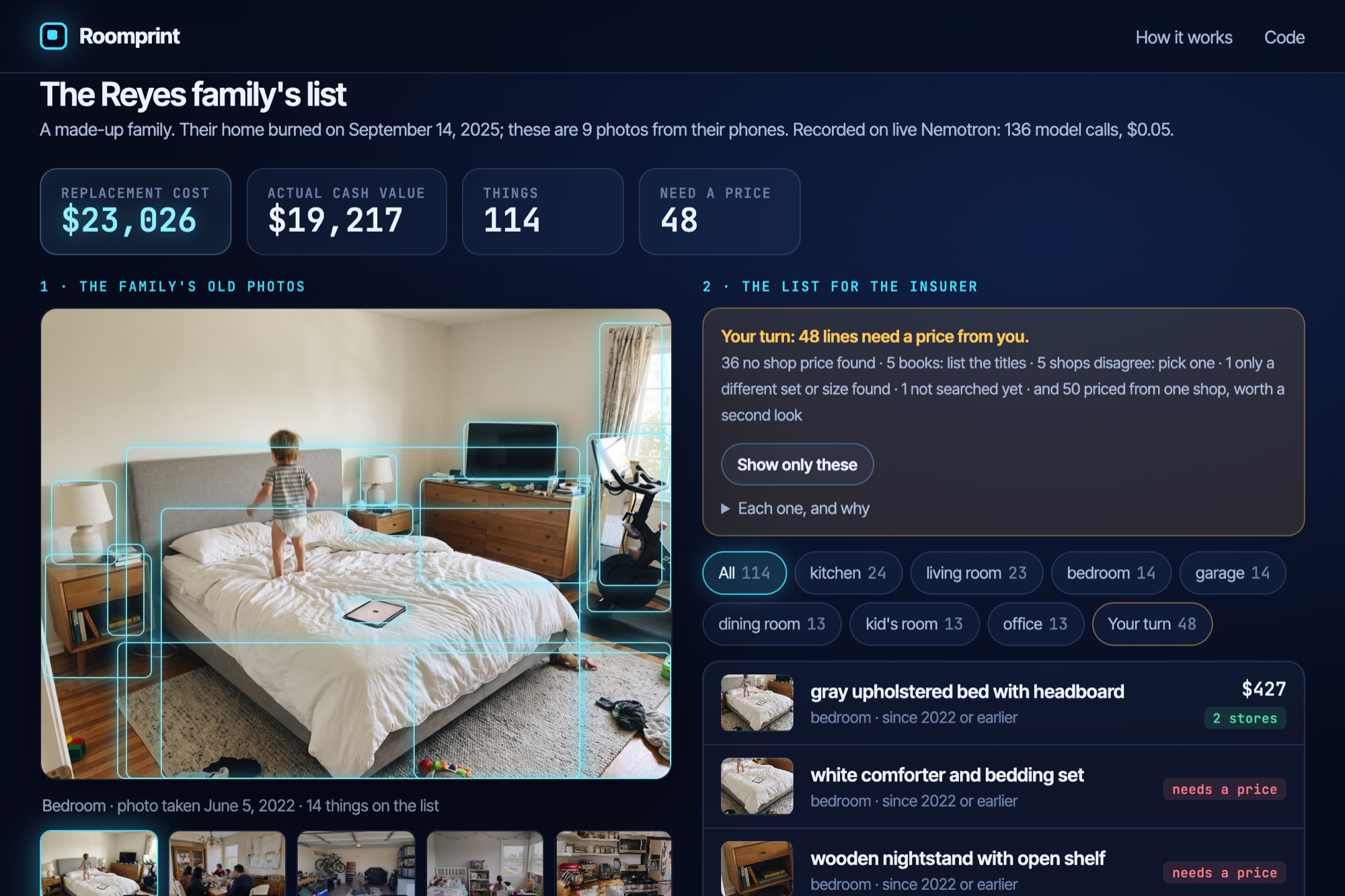
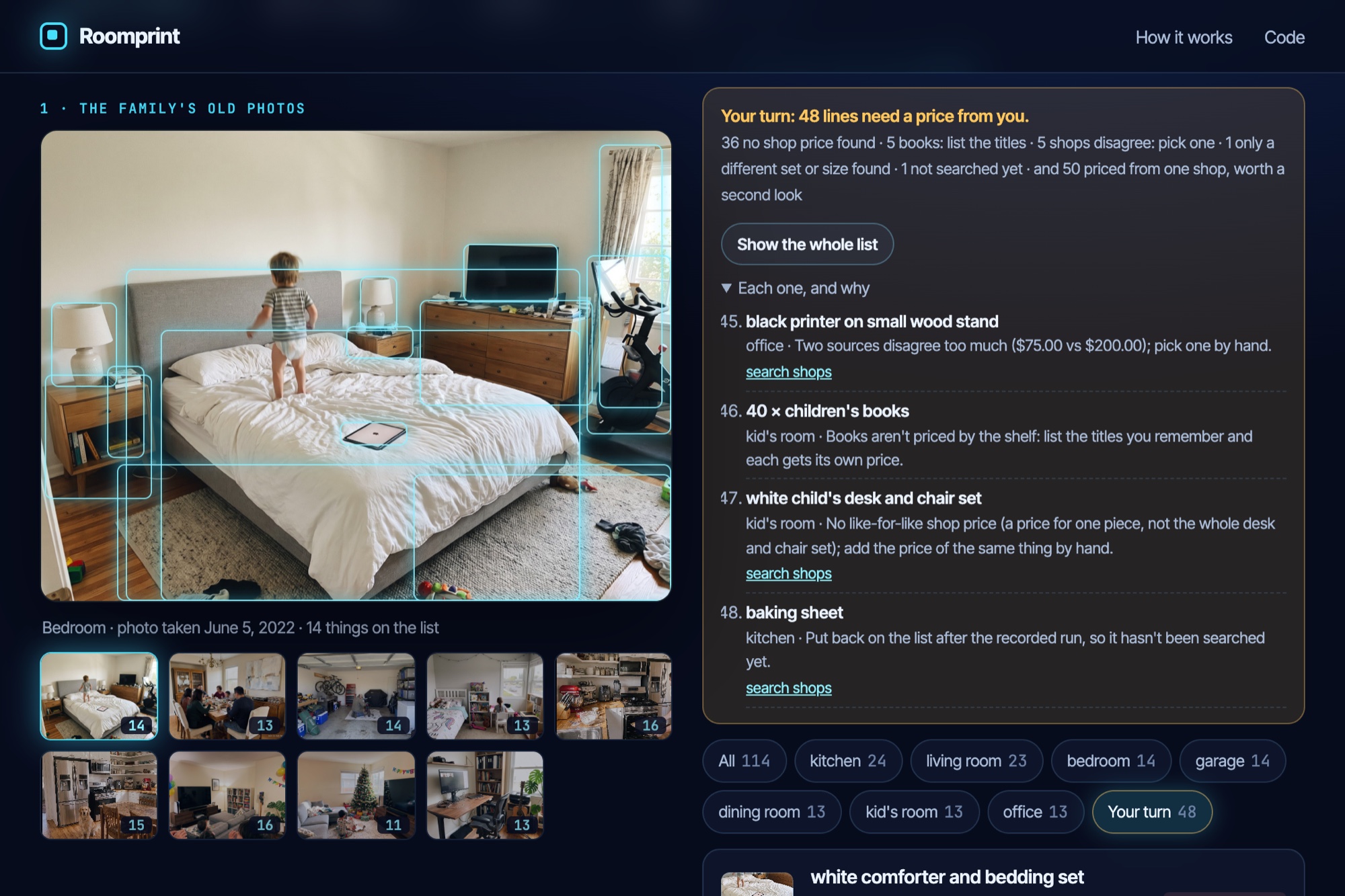
The sample family's home, rebuilt from 9 old phone photos: rooms light up as Nemotron finds what's in each one.
-
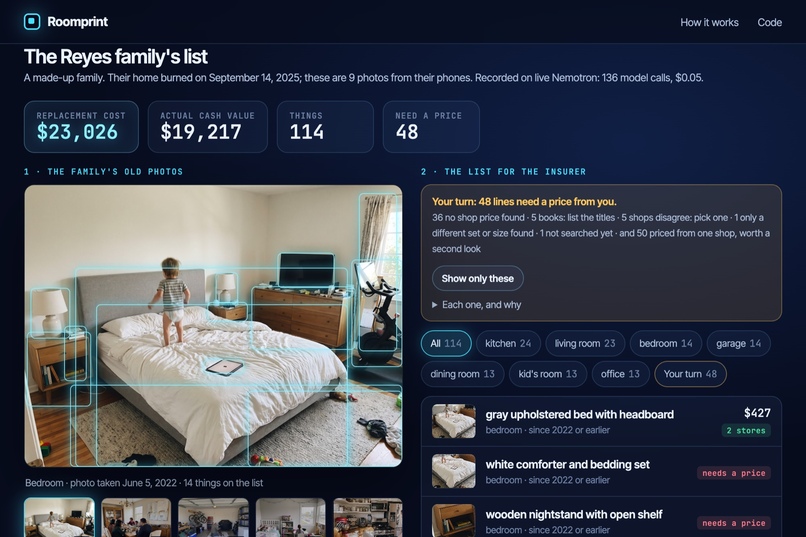
The list for the insurer: every thing in its room, a box on the photo it was seen in, a price from a shop's page. 48 still need a price.
-
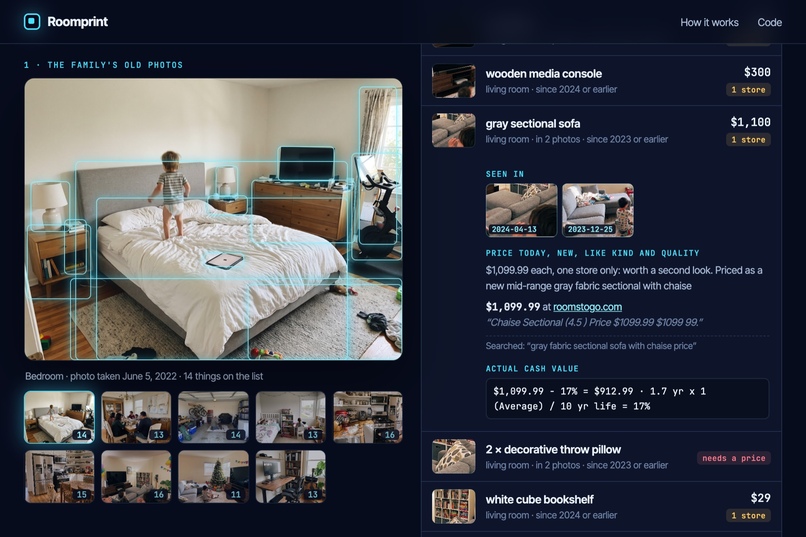
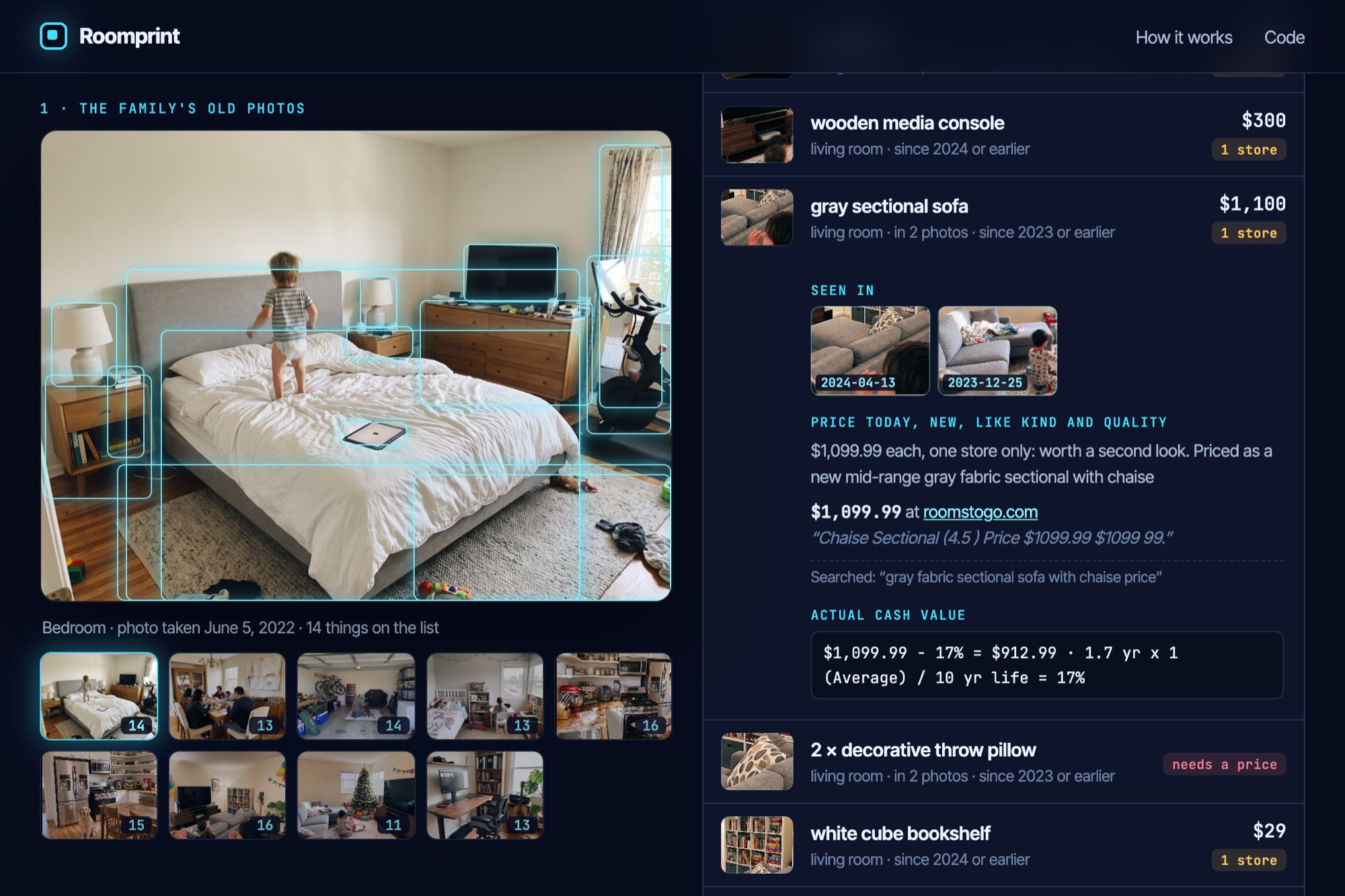
Same sofa at a birthday and at Christmas: counted once. Nemotron VL compared the two crops; both sightings stay as proof.
-
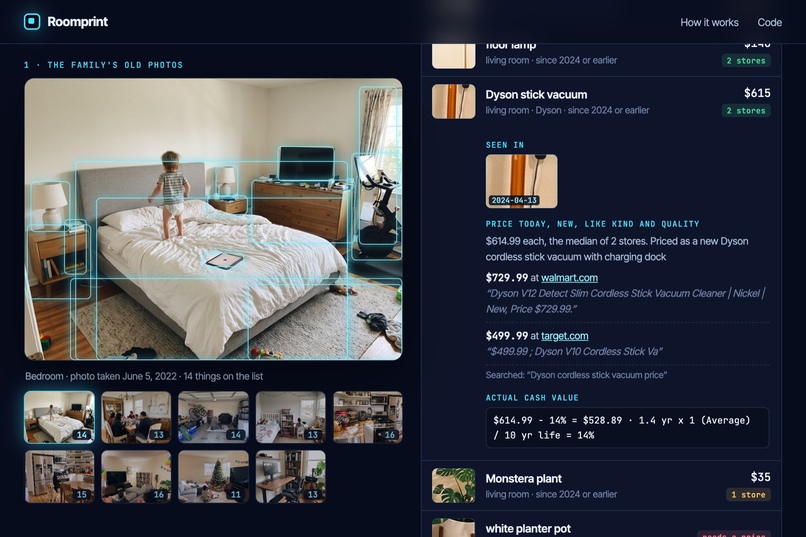
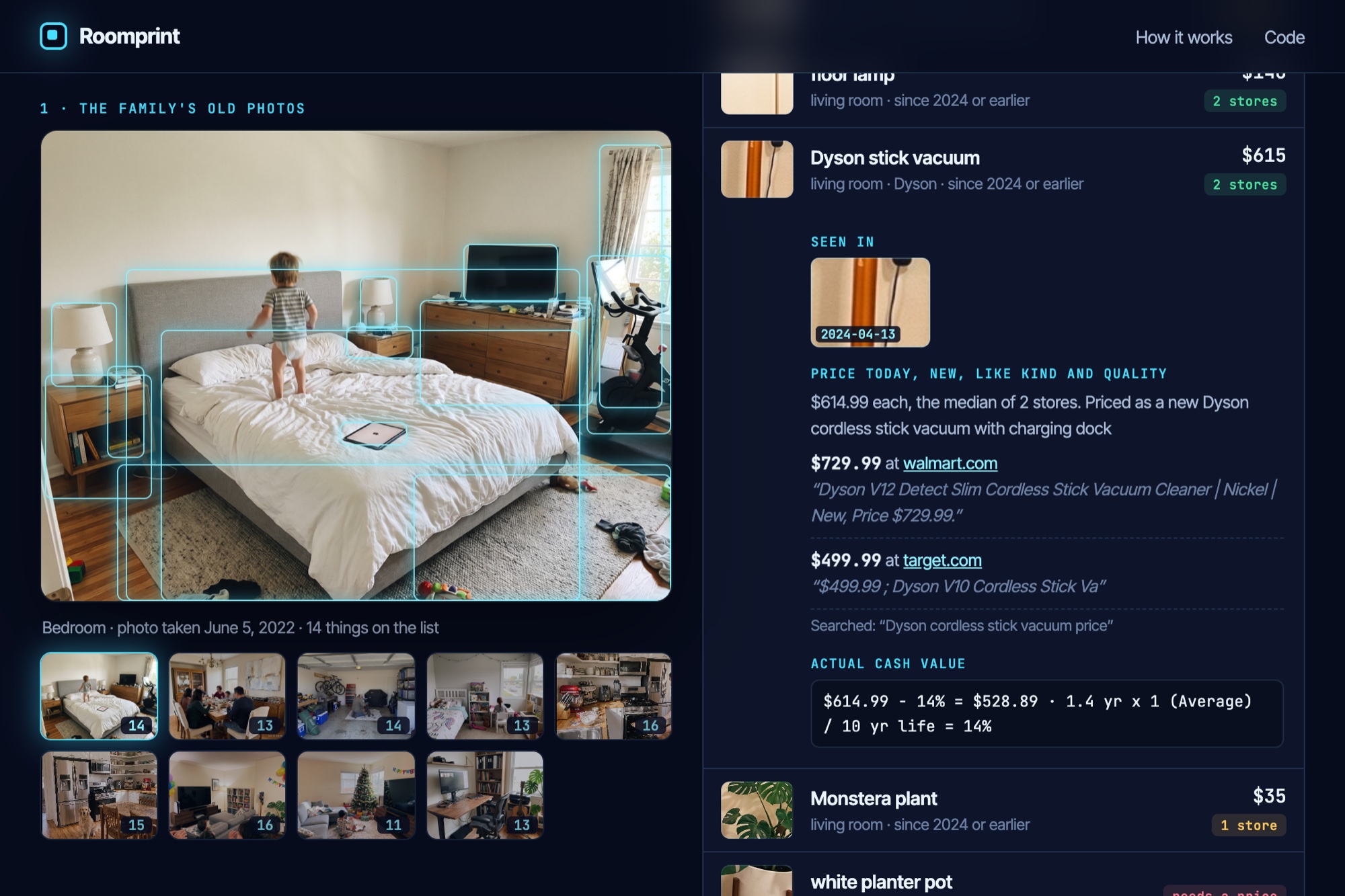
Every price shows its shop, its link and the words on the page. Used, 'was' or monthly prices are thrown out by code.
-
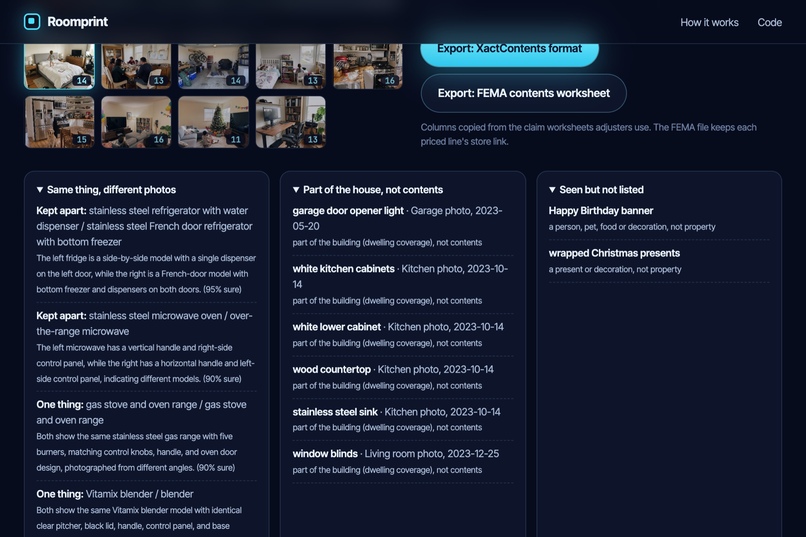
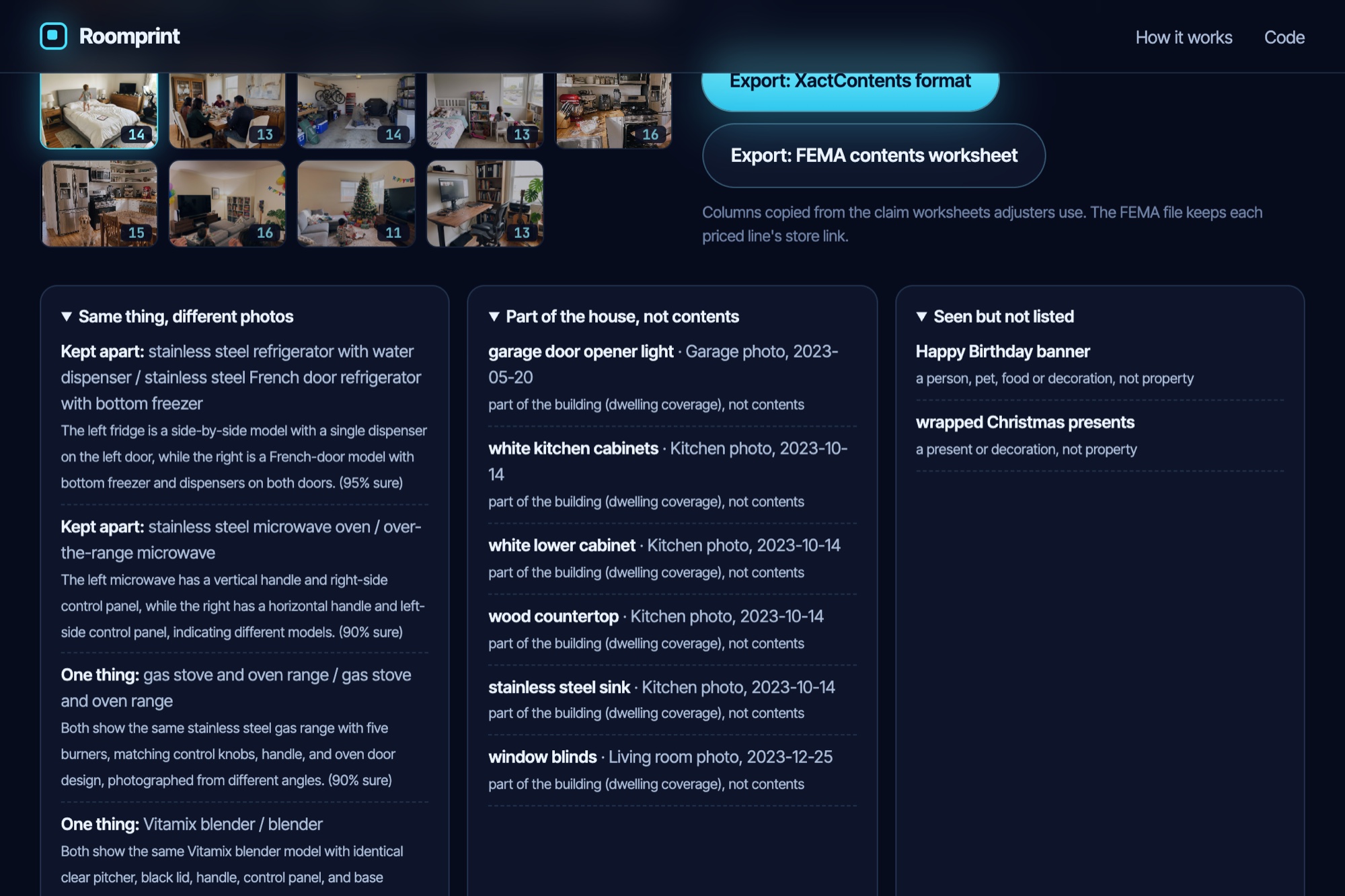
Things merged or kept apart, and the parts of the house moved off the contents list. One click exports State Farm's or FEMA's worksheet.
-
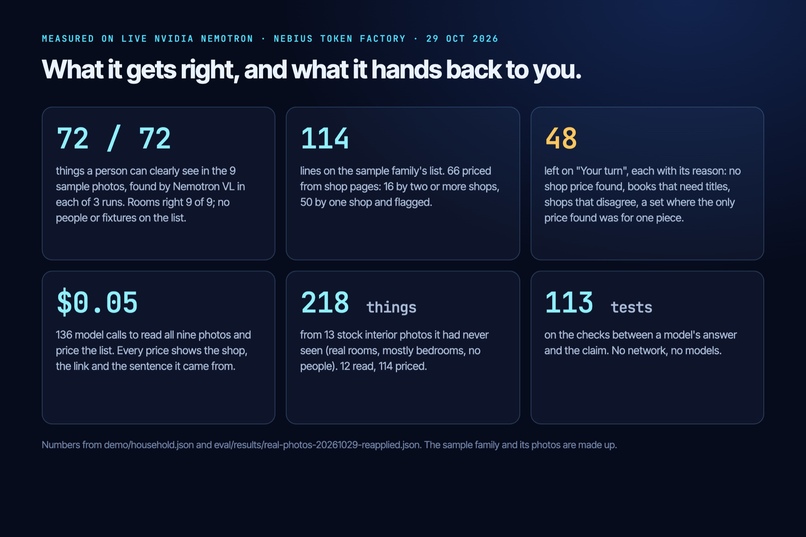
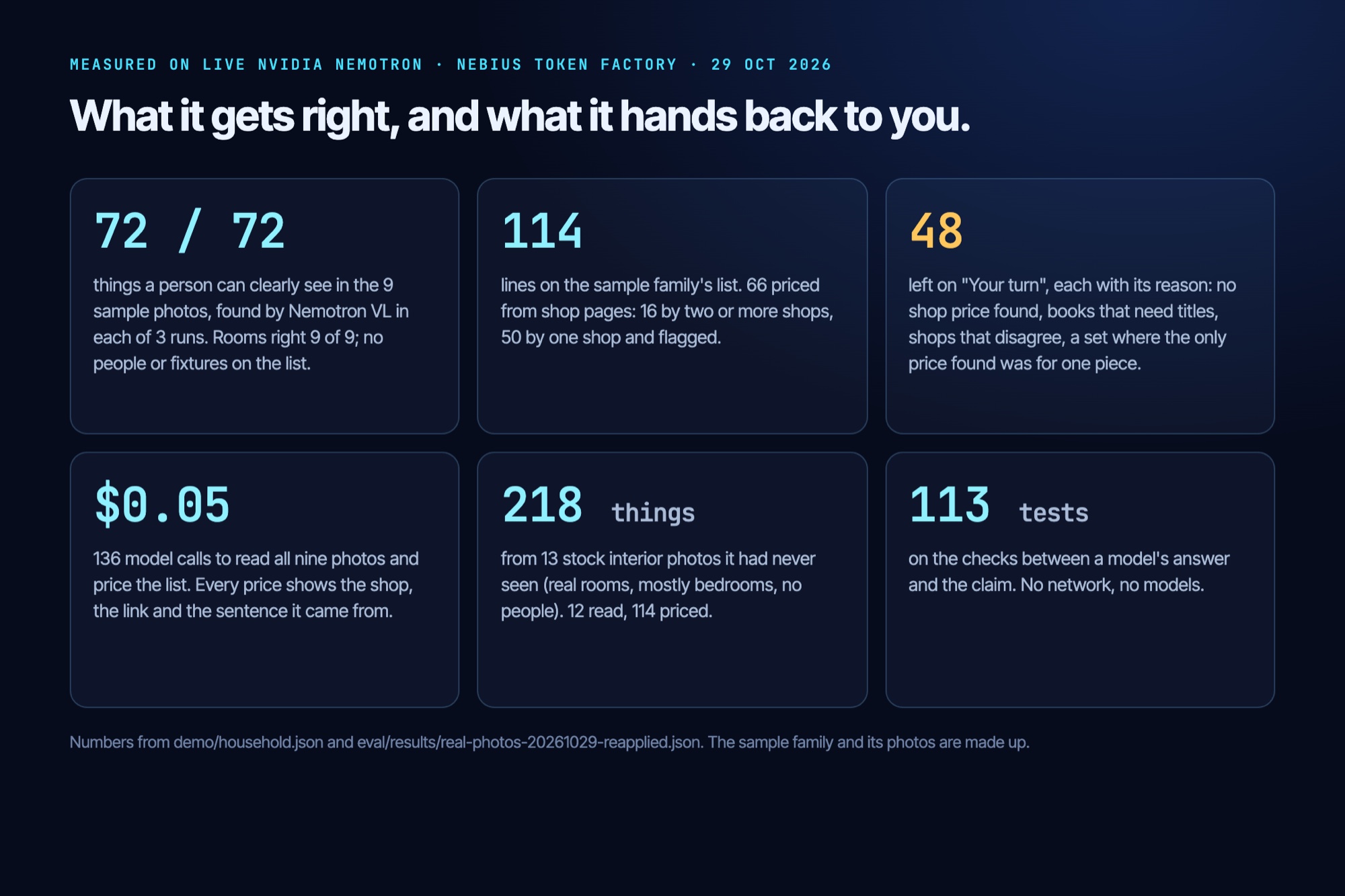
Measured on live NVIDIA Nemotron: 72 of 72 visible things found in each of 3 runs; 136 model calls, 5 cents for 9 photos.
-
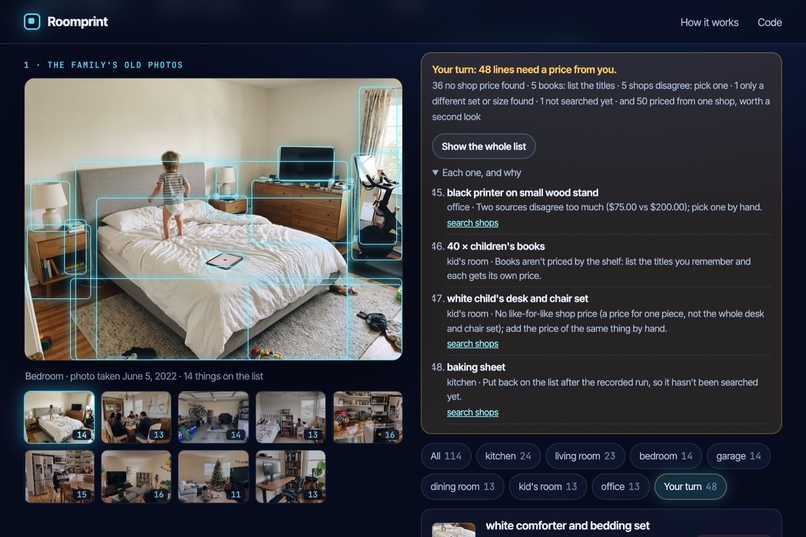
Your turn: every line without a price, with its reason and a shop search. Books wait for titles; a set isn't priced from one piece.
Inspiration
After a fire, a flood or an earthquake, the insurance company asks the family for a list of everything they owned: what it was, how old, and what it costs to replace. Most people never made one (59% in an NAIC survey). Six months after the 2025 Los Angeles fires, 57% of the survivors United Policyholders surveyed said their insurer wanted every single item listed and described. People write these lists from memory, in a motel, for weeks, and forget most of what they had.
The home isn't completely gone, though. It's in the birthday photos, the Christmas mornings and the first day of school. Every one of those pictures shows the room behind the people.
Home-inventory apps already exist, but they ask you to walk through your house with a phone before anything happens, and most people never do. Roomprint works after the loss, from the photos you already have.
What it does
Drop in old photos. Roomprint rebuilds the home room by room and hands back the list the insurer asked for:
- Every thing in every photo. NVIDIA Nemotron 3.5 Super VL looks past the people at the room and lists what's there, each with a box on the photo. That crop, and the date the photo was taken, become the line's evidence.
- Counted once. The same sofa at a birthday and at Christmas is one sofa; the merge is decided by comparing the two crops, and the reason is shown.
- Only contents. Kitchen cabinets, sinks and flooring go to a separate list, because policies pay for those under the building, not the contents. People, pets, food and party decorations are left off, judged by what a line is: a child's desk, children's books, a food processor or a dog bed stay on the claim. A baking sheet of cookies stays too, as a baking sheet.
- A price, with its source. Each item is priced at today's cost of a new like-kind replacement, found with Tavily on shop pages (news, review, blog and publishing sites don't count). The line shows the shop, the link and the sentence on the page the price came from. A set has to be priced as the whole set: a child's desk-and-chair set is never priced from the chair alone. If no shop price survives the checks, the line says "needs a price". Books aren't priced by the shelf at all; the line asks for the titles. Nothing is guessed.
- Depreciation you can argue with. Actual cash value follows the rules State Farm prints on its own worksheet (effective age by condition, capped at 80%), with useful lives from United Policyholders; the maths is on each line.
- What's left for you. Every line still without a price sits in one "Your turn" list with its reason (no shop price, books need titles, shops disagree, only one piece of a set was priced) and a shop search to start from.
- In the insurer's columns. One click exports State Farm's worksheet (which is Xactware's XactContents import template, the system adjusters price in) or FEMA's flood contents worksheet. The FEMA file has a store link on each priced row. The XactContents columns have no place for a link, so that file doesn't carry one.
- What no photo shows. Per room, the common things not yet on the list (pots and pans, clothes, tools).
- The California clock. Since 2026, after a declared disaster and a total loss, the insurer must offer 60% of the contents limit with no list. Roomprint shows that number next to what the list adds.
How we built it
Propose, check, or leave it blank: models propose, plain Python checks every proposal, and anything that fails is shown as unresolved, never filled in.
| A model proposes | Code checks |
|---|---|
| an item and its box | box inside the photo and big enough to show; the line isn't a person, pet, food, present or decoration (judged by its head noun, so "child's desk" stays, and "baking sheet with cookies" becomes "baking sheet"); fixtures go to the building list |
| "same object as in that photo" | only asked for plausible pairs (same room, same last word, no clashing brand, never two sightings from one photo; "same last word" still lets a plant stand meet a TV stand, and the model kept those apart); merged only on a confident yes |
| a price | the amount is in a sentence Tavily returned from a shop page, next to the item's name; not used, refurbished, "was", "starting at" or per month; a "set of 4" becomes a unit price; a set takes only a price for the whole set, and one thing never takes a pack price; books without titles aren't priced; marketplaces, news, reviews and blogs don't count; two or more shops → median, one → flagged |
| an age | taken from the photo's own date, not from the model |
| the export | totals recomputed; every line keeps its photo and its store link |
Models (NVIDIA Nemotron on Nebius Token Factory):
- Nemotron 3.5 Super VL (reasoning off) reads each photo and returns items with boxes in about 7–20 seconds, and compares two crops side by side for duplicates. We need a vision model whose boxes are good enough to become evidence an adjuster can see; that is the whole product.
- Nemotron 3 Super reads messy shop sentences and judges "like kind and quality", the one step that needs real reading.
- No Nano or Ultra. Every other decision (what counts as contents, ages, depreciation, totals, which sources count) is plain code, so there was nothing left for a small router model; and because code checks every price pick, we chose the cheaper Super over Ultra for it. We haven't run Ultra side by side, so we don't claim it would do worse.
Reading nine photos and pricing the list costs about five cents in model calls; a daily cap stops calls before they happen.
Tavily does the outward-looking half: one basic search per item, and an advanced search (more of each page) when the basic one returns fewer than six priced sentences. Results are cached, so the same "65-inch TV" isn't searched twice.
Stack: Python 3.12, FastAPI, Pillow, plain JSON; front end in plain HTML/CSS/JS. Deployed with Docker on Render.
Measured
| What | Result |
|---|---|
| Things a person can clearly see in the 9 sample photos (hand-made list of 72), found by Nemotron VL | 72 / 72, in each of 3 runs |
| Room recognised | 9 / 9 |
| People, food or decorations put on the list | 0 |
| Sample family, full run | 114 things; 66 priced from shop pages (16 by two or more shops, 50 by one shop and flagged); 48 on "Your turn": 36 with no shop price, 5 shelves of books waiting for titles, 5 where shops disagreed, 1 set where only one piece had a price, 1 baking sheet put back after the run and not searched yet |
| Cost of the full sample run | 136 Nemotron calls, $0.05. Re-checking it under the new rules cost nothing: no new calls |
| 13 stock interior photos (real rooms, not generated; mostly bedrooms, no people), never seen before | 12 read, 218 things listed, 114 priced from shop pages (117 before the set and books checks); by hand on 2 photos: 21 of ~26 and 21 of ~22 visible things found |
| Tests (no network, no models) | 113 |
| One real photo, live, upload to priced list | about 1 min 40 s (the first real photo, run again live: 23 things, 14 priced; the batch run had found 21, the model doesn't answer the same way twice) |
Challenges we ran into
- Store pages hide prices. Extracting a retailer's product page usually returns everything except the price, which is drawn by JavaScript. What works is reading the price sentences search results already carry, and then being strict about which sentences count.
- Prices lie in many ways. "Was $439.99", "starting at $395", "$37.50/mo", "Restored Dyson V8 $179.99", "set of 4 chairs $599". Each one would have put a wrong number on someone's claim; each is now a check with a test.
- The same photo, different objects. Our generated sample photos don't always agree with each other (one shows a side-by-side fridge, the other a French-door one), and the duplicate check rightly kept them apart. We left it that way rather than force a merge.
- We caught our own filter hiding the children's things. A rule meant to keep people and pets off the list matched any line with "child", "baby" or "dog" in its name. The child's desk, about 40 children's books and the bicycle went missing, which is exactly what a family forgets. The same rule threw away a baking sheet because it held cookies. Now it reads what a line is (its head noun), so a dog bed stays and the dog doesn't, the sheet stays and the cookies don't, and every one of those names is a test.
- Not every page with a price is a shop. A console was priced from a tech news article and a stack of books from publishing blogs. Only shop pages count now.
- A set isn't its cheapest piece. A strict review caught two of our lines: a child's desk-and-chair set at $29.99 (the shop sentence was for the chair) and a shelf of cookbooks at 12 × $5 from a clearance page. A set now needs a sentence that names the whole set, and books wait for titles. Both lines moved to "Your turn".
- Our own mistake. While tuning prices we used up a month of search credits in a day. We now check the remaining credits before any batch run, cache every search, and count credits per run.
Accomplishments we're proud of
- Every line on the list can be checked by a stranger in ten seconds: the photo it came from, the store, the words.
- The model is never the last word on a number.
What we learned
Vision models are already good enough to find things in ordinary family photos, boxes included. The hard part of an insurance list isn't seeing the TV; it's the price, the age and the proof, and those are better left to code that can show its working.
What we checked ourselves, and where the edges are
We'd rather show you the edges than have you find them.
- The nine sample photos are generated, so we also ran Roomprint on 13 stock interior photos: real rooms it had never seen. Most are bedrooms and none has people in it, so this tests reading a room, not the crowded birthday photo a family would really upload. It read 12 (one answer came back unreadable, and the app says so) and listed 218 things, about 18 a photo. 114 were priced from shop pages, the rest marked for the family. We checked two photos by hand: it caught 21 of about 26 visible things in one and 21 of about 22 in the other, and what it missed was small (a plush toy, a plant, curtains). The first photo took about 1 min 40 s from upload to a priced list. The photos aren't one family's, so look-alikes were a real trap for the duplicate check: it merged three pairs (two similar laptops among them), which is why every merge shows both photos.
- Roomprint never guesses a price. When one shop names the item, the line says "one source"; when none does, it asks the family. On the sample home that's 48 of 114 lines, all in one "Your turn" list with the reason for each. The list does the hard part (what you owned, how old, which photo proves it) and hands the rest back clearly marked.
- Two TVs that look alike in small crops can still be counted twice. Every line shows its photos, so a person spots it in seconds.
- Nobody outside the team has used it yet. A family going through a claim, and a public adjuster, are the next test.
What's next
Video walkthroughs (a phone pan through a room), receipts and order-history emails as a second source of evidence, and a reviewer mode for public adjusters and nonprofits who help survivors with claims.
Try it
Open the live demo and press Rebuild a sample home: click any room in the house, then any line to see the photo it came from, the stores and the maths. Or press Try your own photos and add one or two photos of a room: about a minute later you get your own list, priced.
Live demo: https://roomprint.onrender.com · Code: https://github.com/mini4ai4/roomprint
Built With
- docker
- fastapi
- javascript
- nebius-token-factory
- nvidia-nemotron
- pillow
- python
- render
- tavily
