-
-
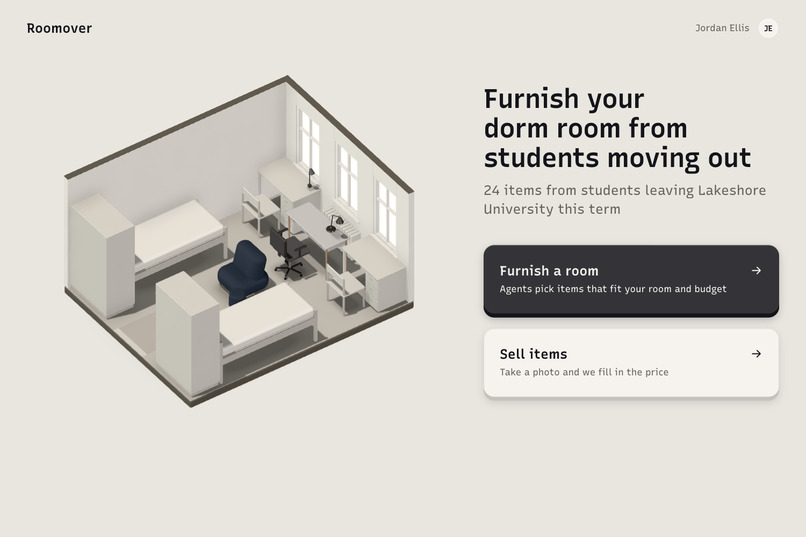
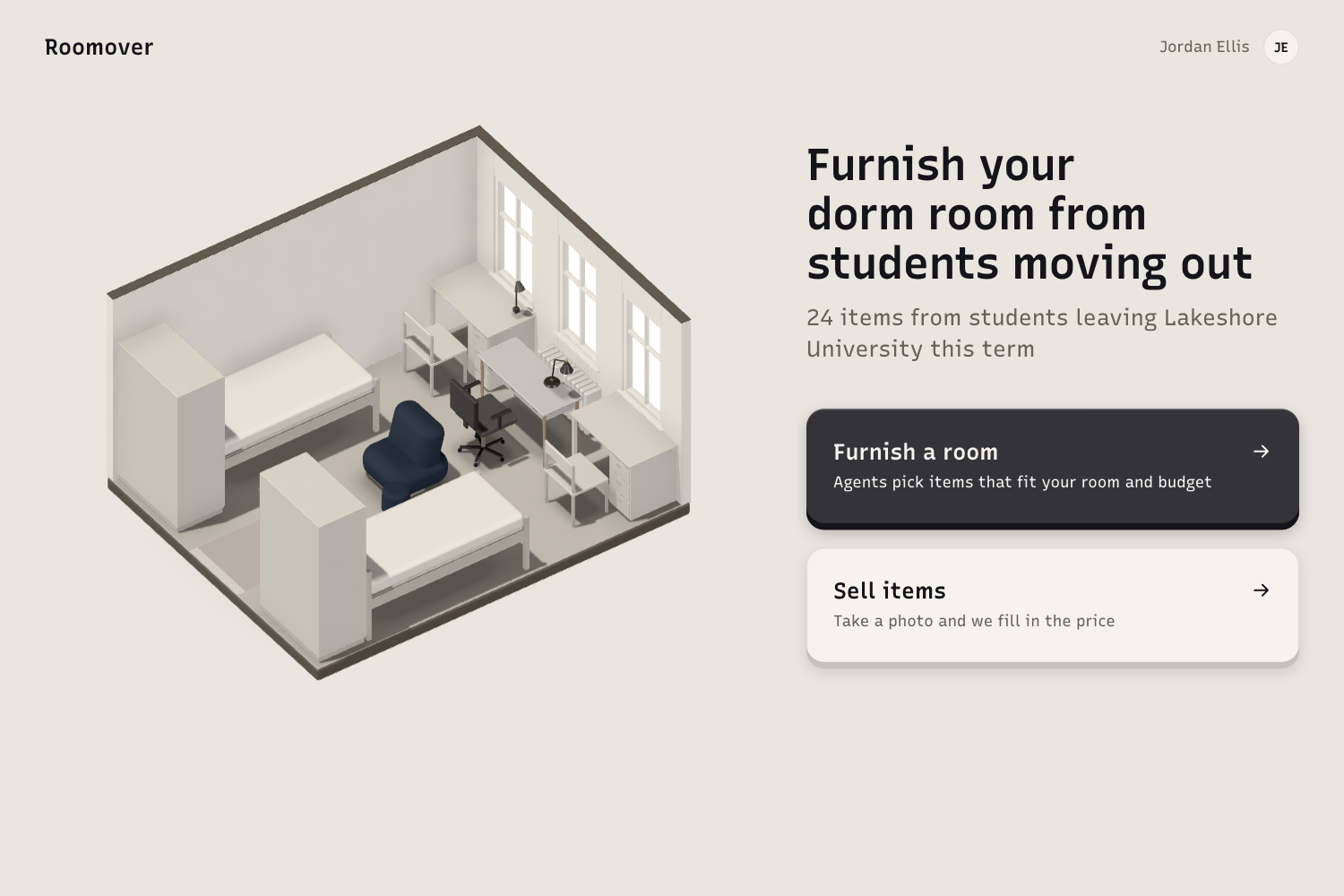
Roomover's home page: furnish a dorm room from students moving out, or sell items from one photo.
-
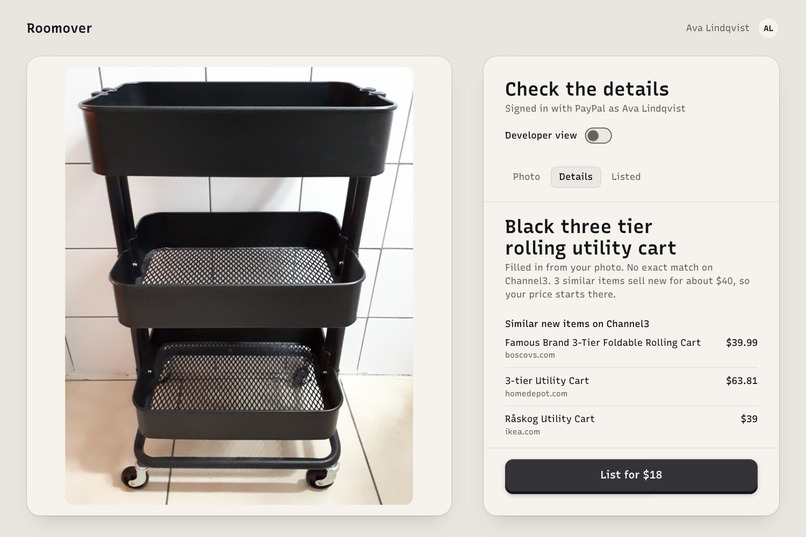
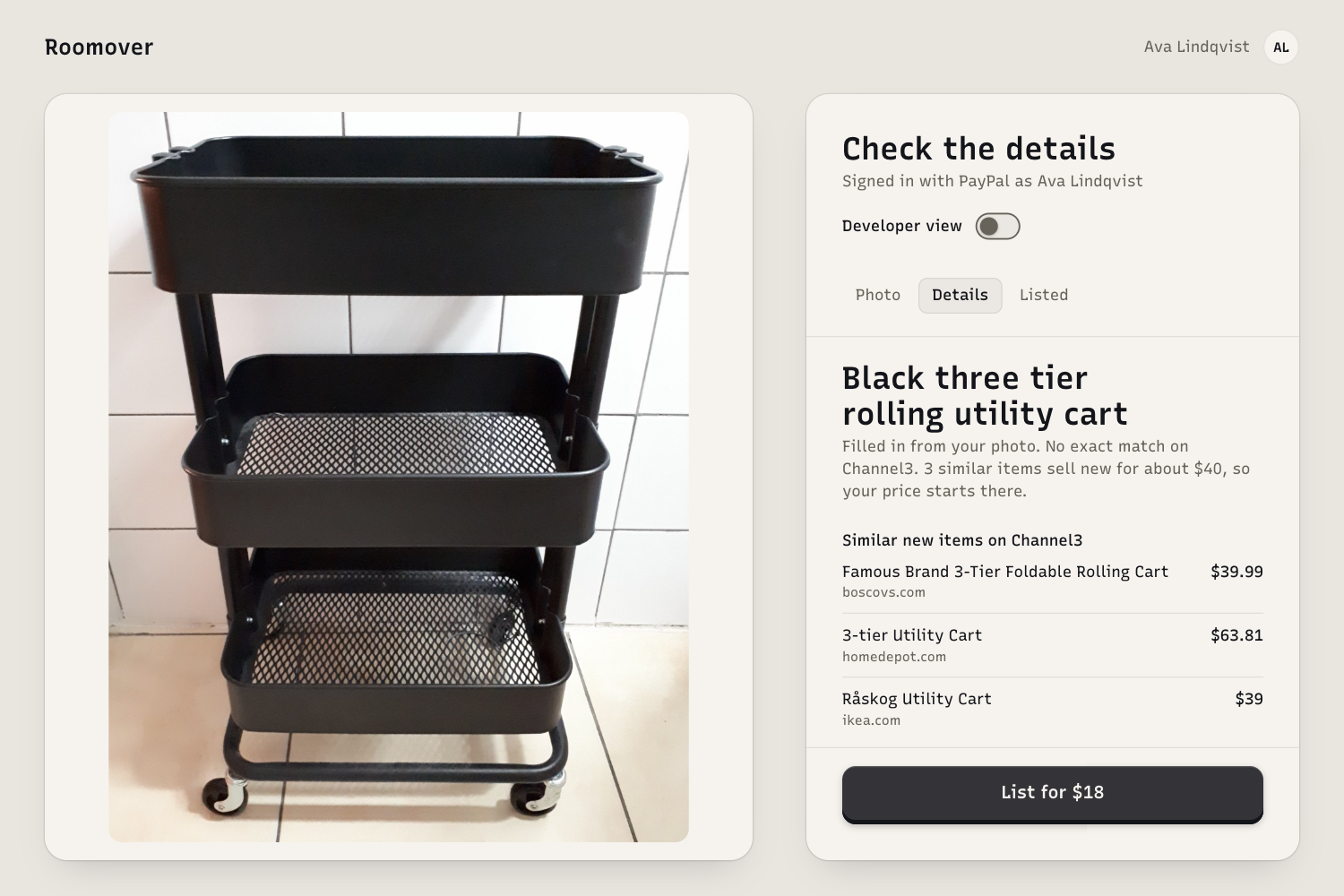
Sell: one photo, and Claude writes the listing while Channel3's similar new items set the price reference.
-
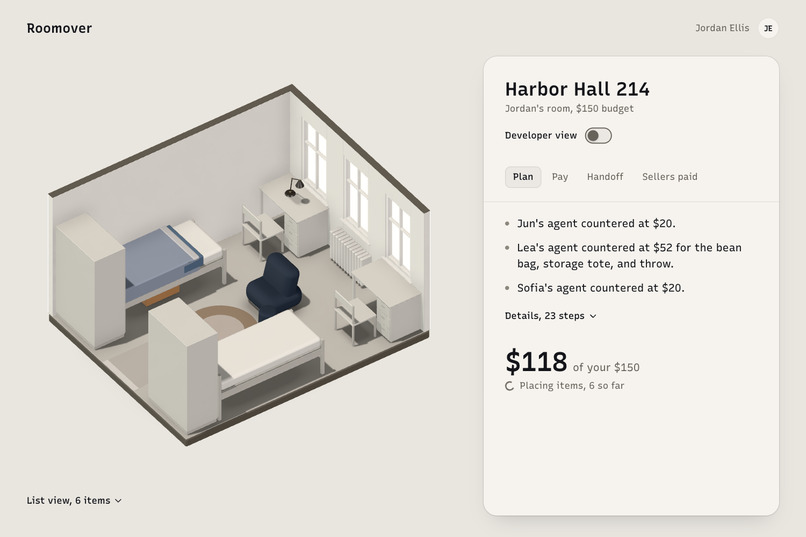
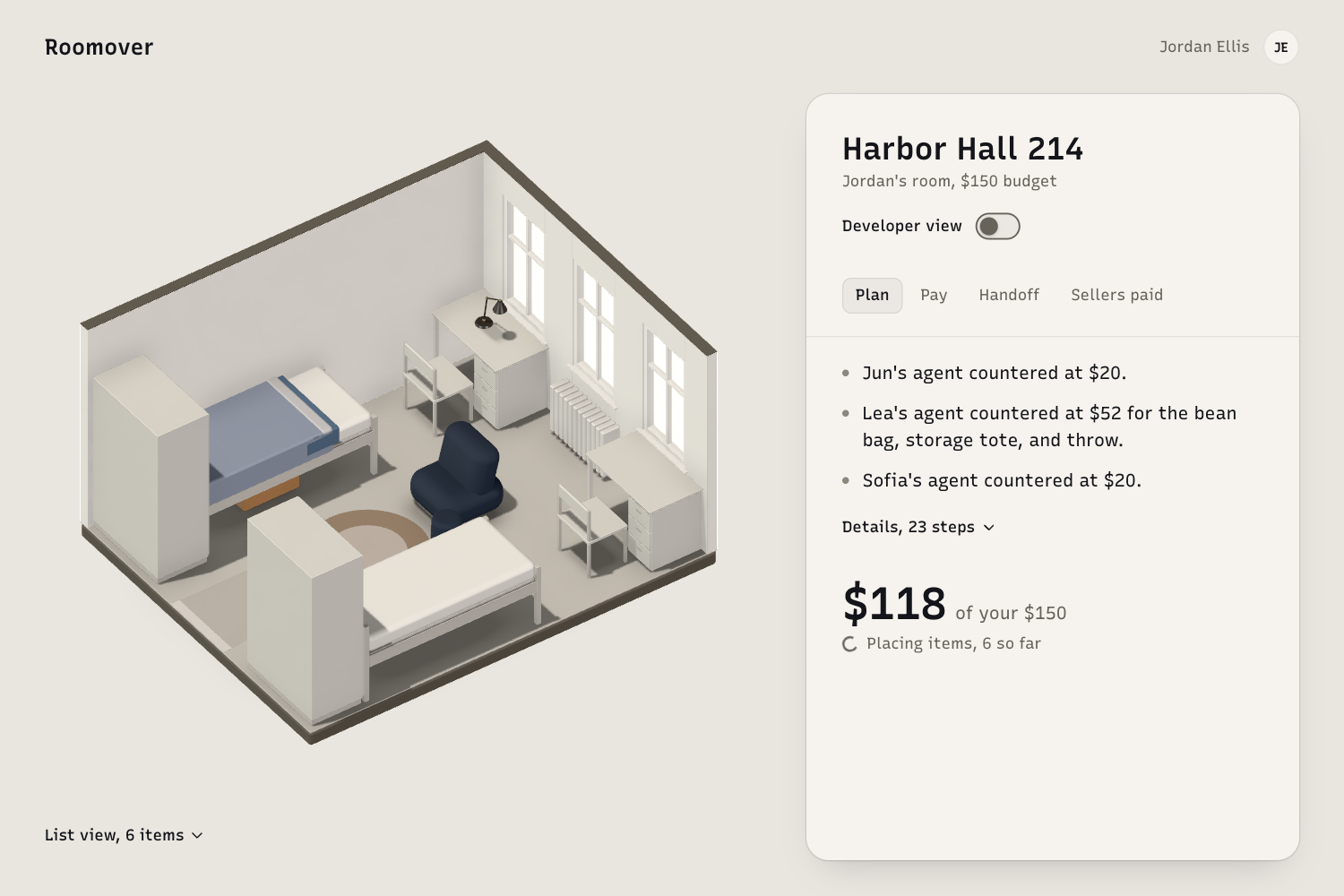
Furnish: the buyer agent fills Harbor Hall 214 in 3D while each seller's agent counters its offers.
-
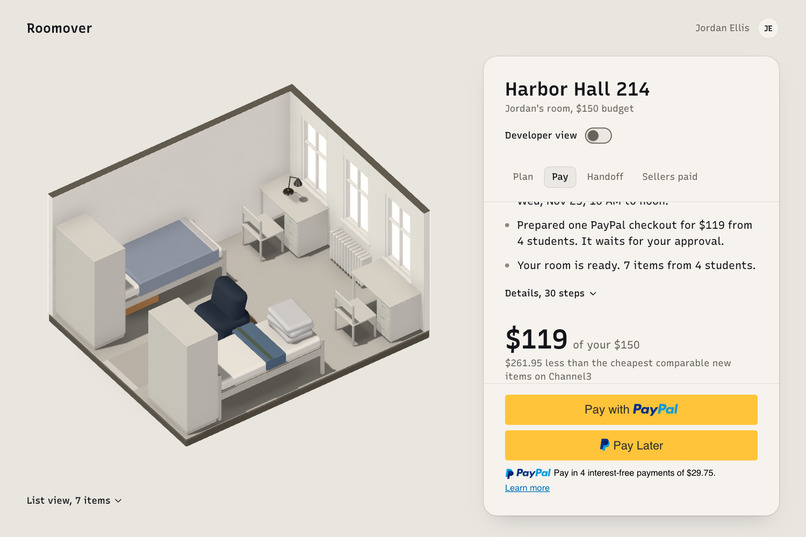
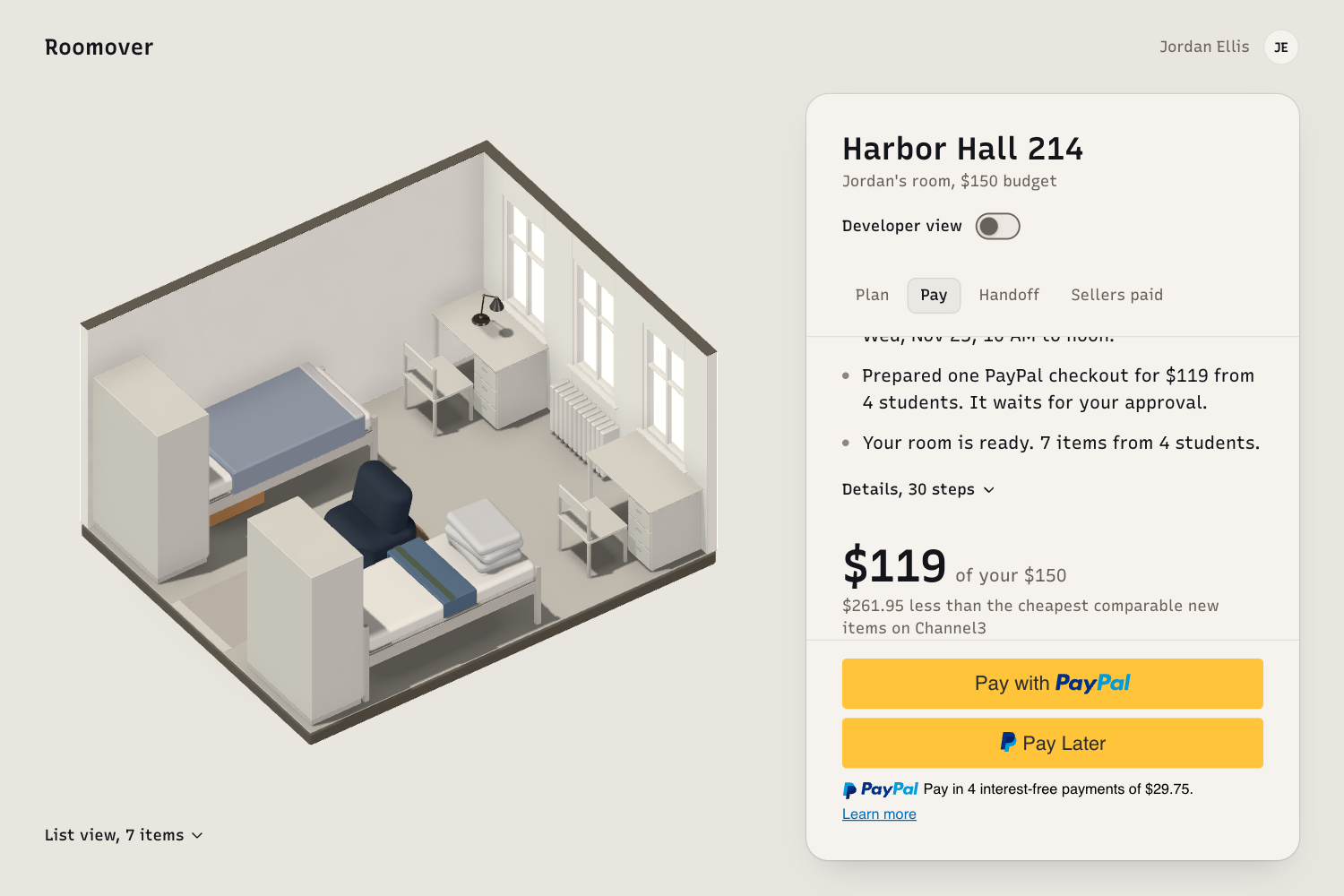
One PayPal approval covers items from four students, with Pay Later and Pay in 4 beside it.
-
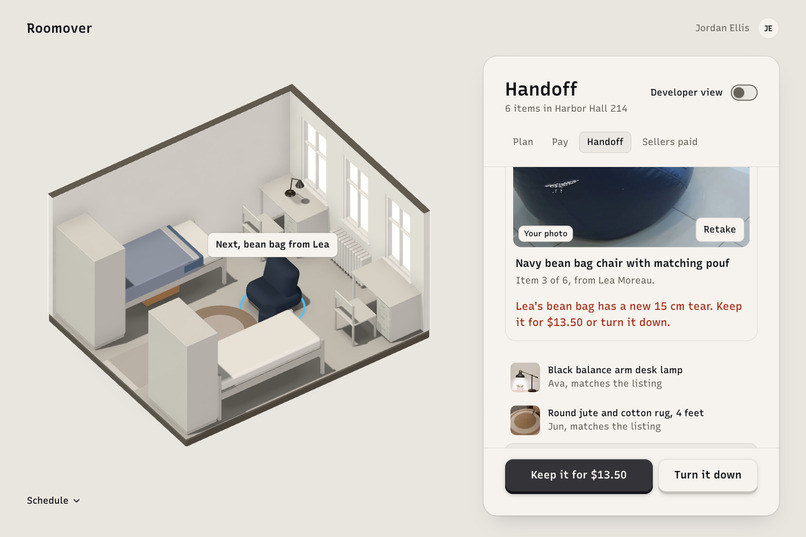
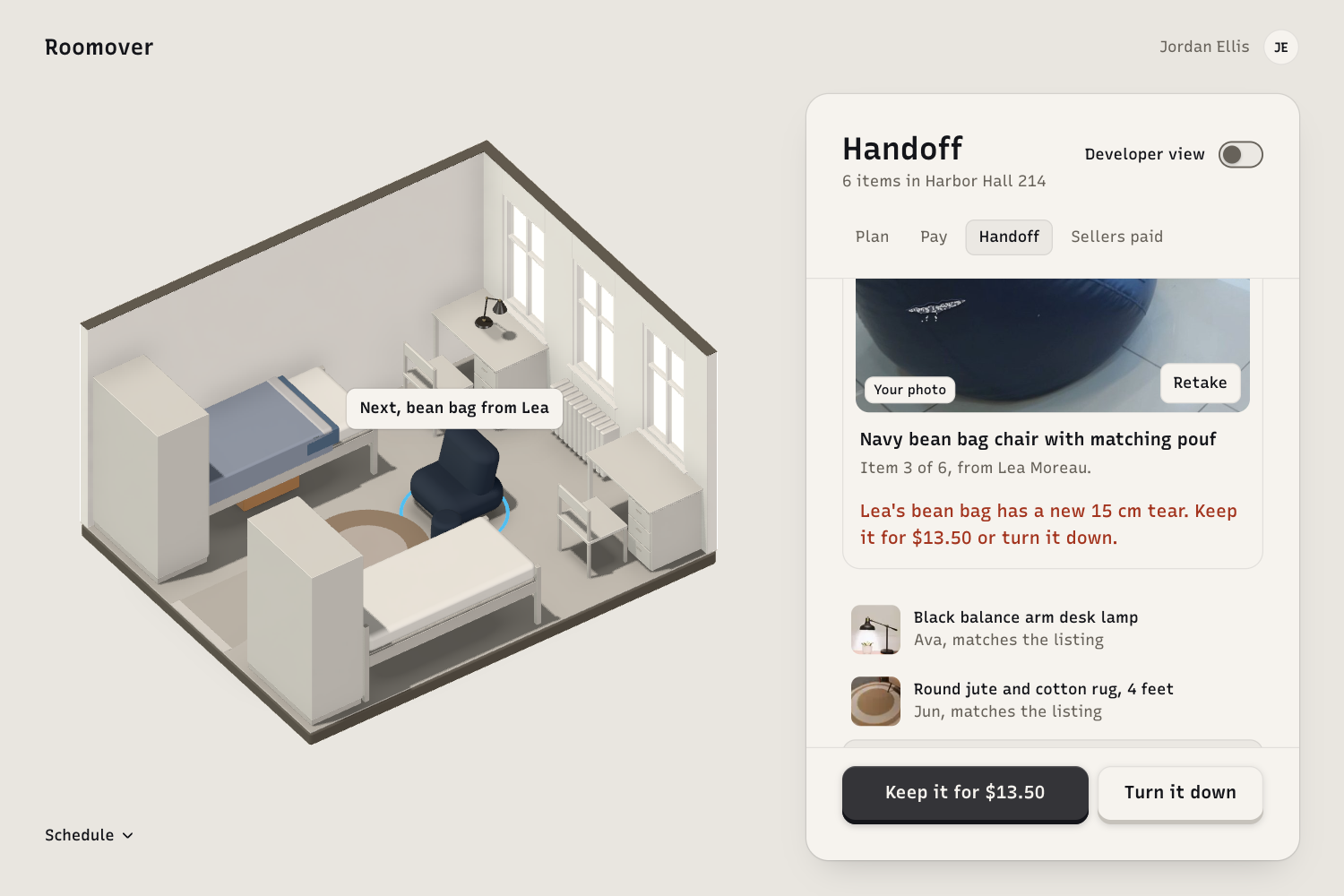
Handoff: the verifier agent compares Jordan's photo with the listing and finds a new 15 cm tear, so the price drops to half.
-
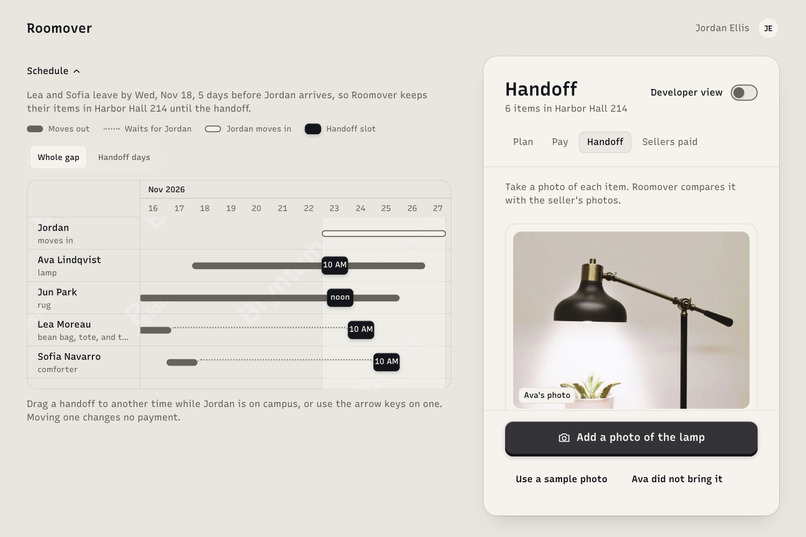
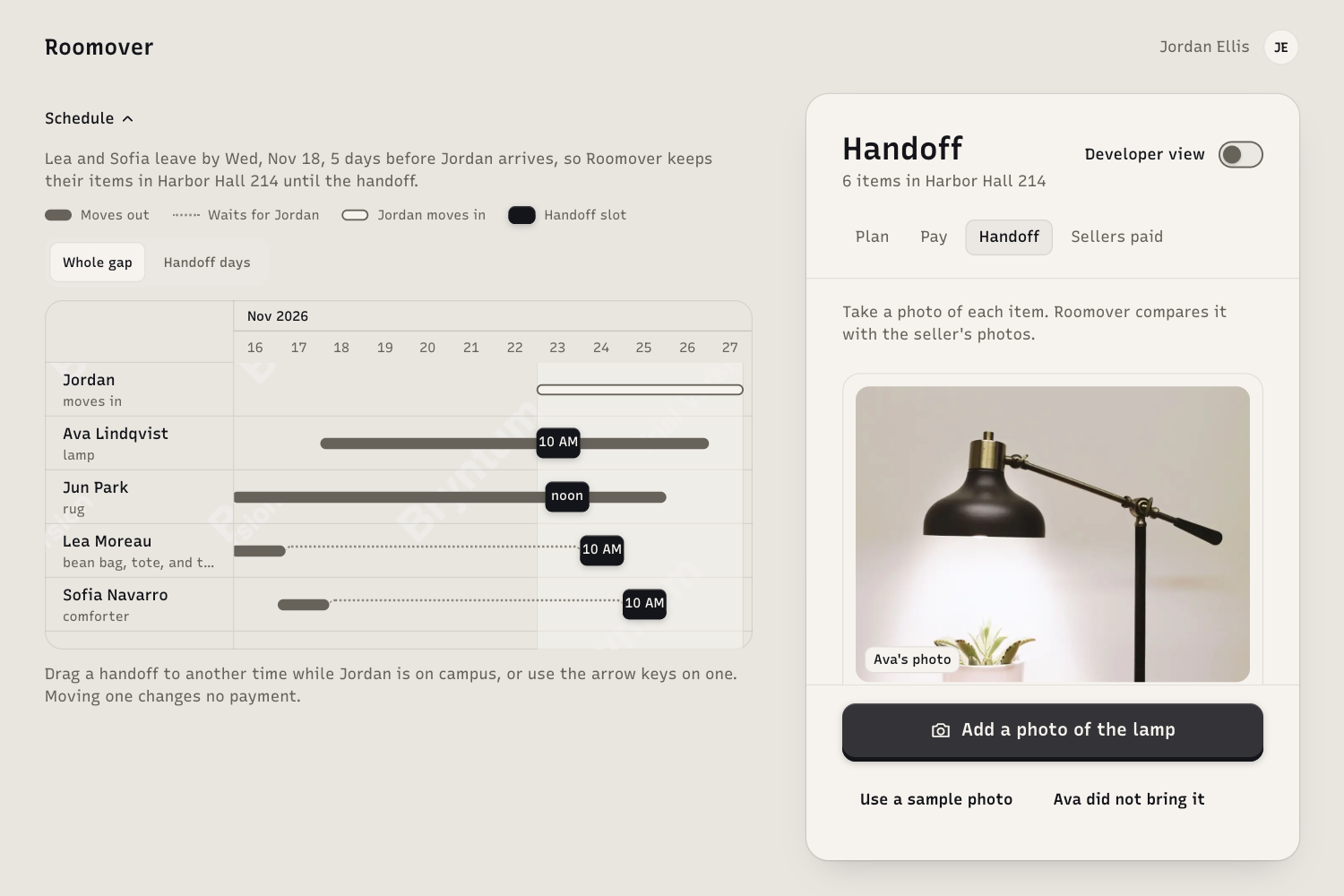
The Bryntum schedule shows each seller's move out, Jordan's move in, and the handoff slots the agents agreed on.
-
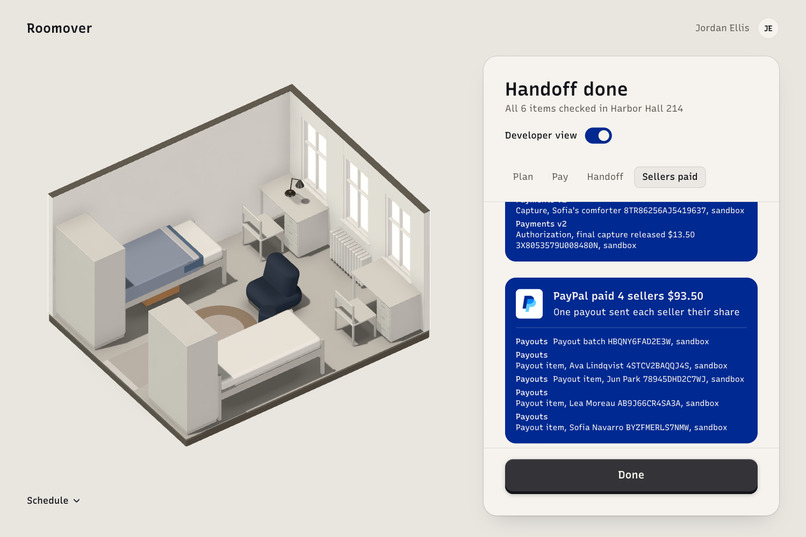
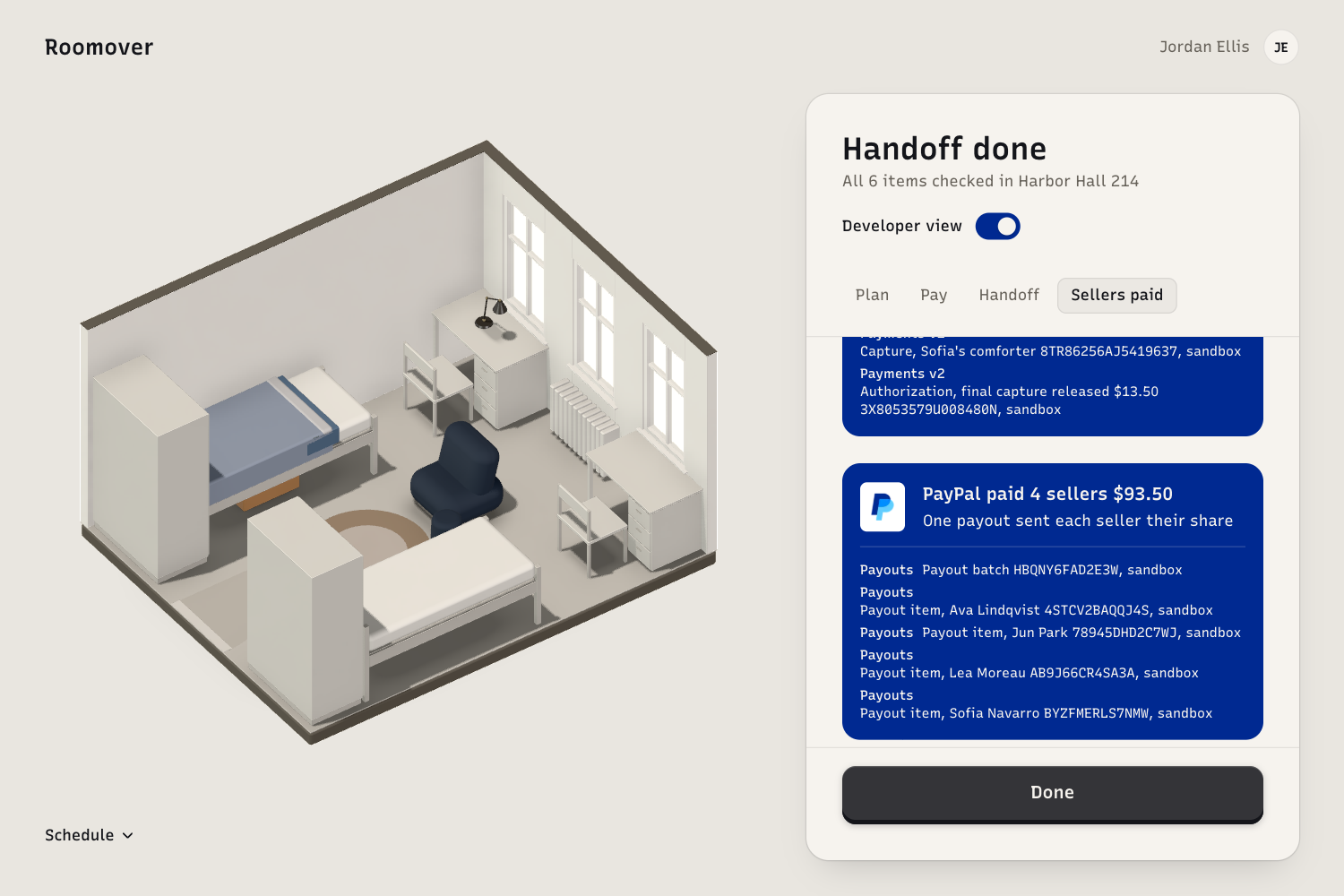
Sellers paid: one PayPal Payouts batch pays four sellers, with real sandbox IDs in the Developer view.
-
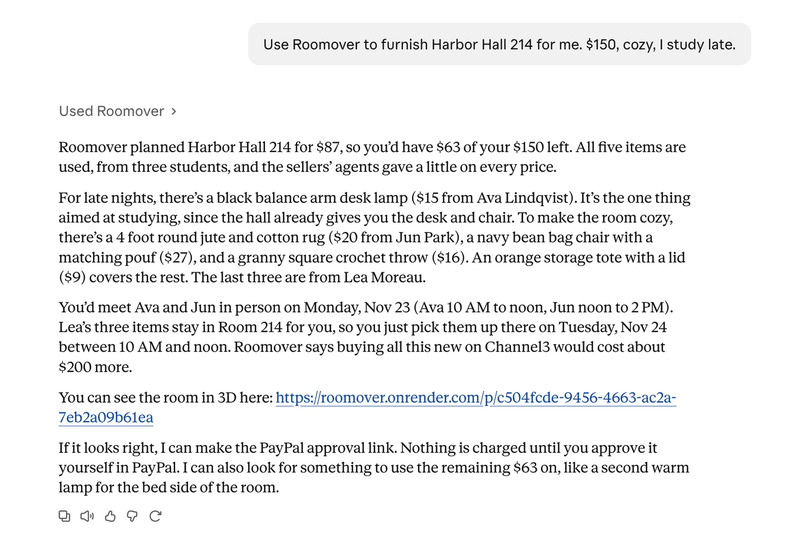
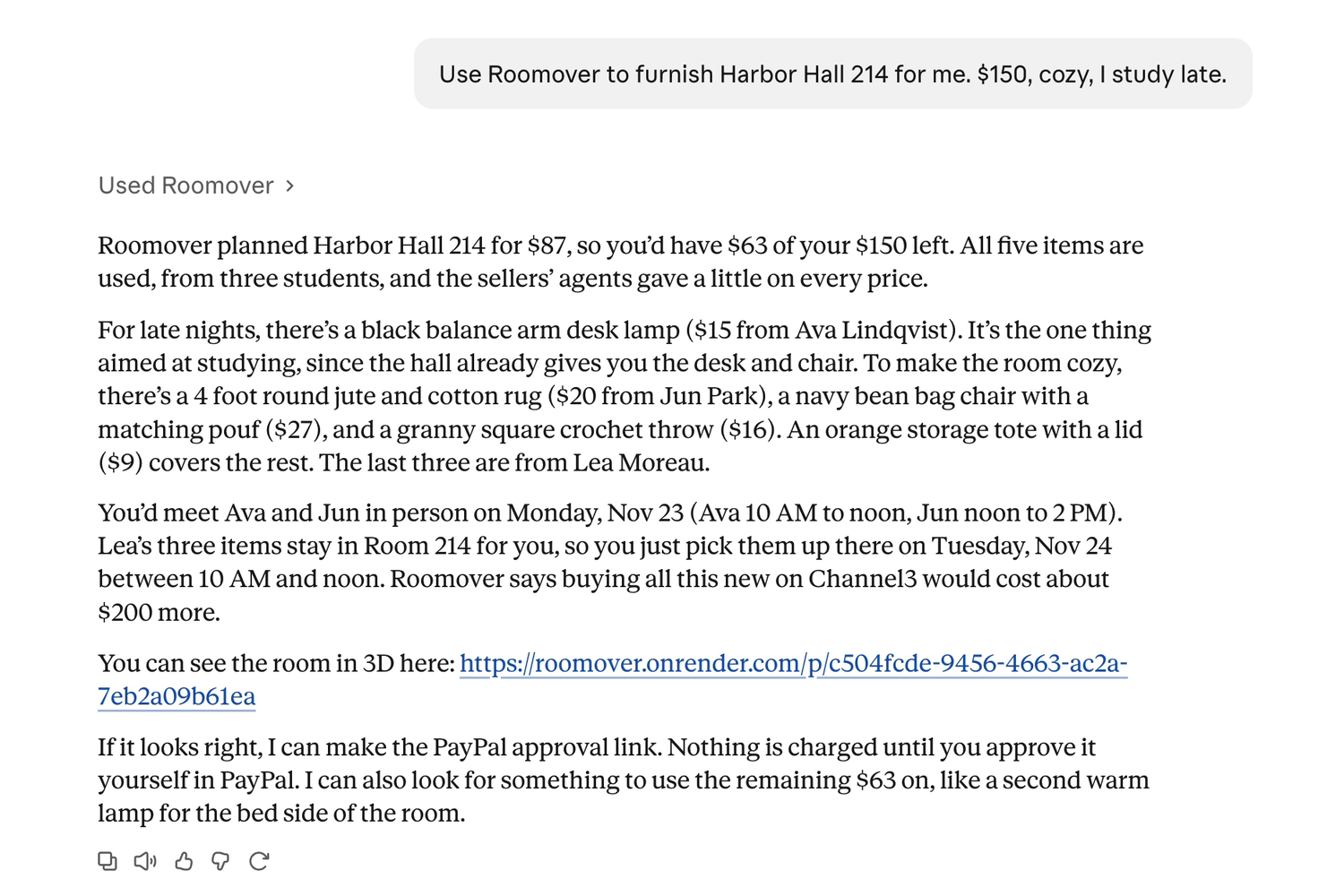
The Claude app plans the same room through Roomover's MCP server and returns a 3D preview link.
Inspiration
As an international student, I've moved between Seoul, Kansas, Minnesota, Texas, and Illinois for school. I've always been a maximalist, so every time I moved somewhere new, I would fill my room with furniture and things I liked, even when I knew I might have to leave a year or two later.
Over the years, I've thrown away more furniture than I can remember. Most of it was still in good condition, but moving it often cost more than buying it again. I wanted to find someone who could use it, but finding a buyer before moving was rarely easy.
I noticed the same problem on college campuses. Every spring, students leave furniture that incoming students will need a few months later. I wanted to make it possible for them to buy and sell furniture even when their move dates don't overlap. That's where the idea for Roomover came from.
What it does
I built Roomover to help students sell their furniture before leaving campus and help incoming students furnish their rooms.
For sellers, it starts with a photo. Claude examines the furniture, and Channel3 finds similar products and their retail prices. Claude uses that information to write a listing and suggest a fair used price.
For buyers, I wanted to make furnishing a room as simple as describing what they need. Students can choose their dorm room and enter something like "$150, cozy, I study late." Claude searches the listings, negotiates prices and pickup times with the sellers' agents, and arranges the furniture in 3D. The application checks the room dimensions, dorm rules, budget, and seller minimum prices in code.
The payment process was especially important to me because the buyer and seller might never meet. Buyers pay through PayPal, but sellers receive their money only after the buyer verifies each item. At pickup, Claude compares a new photo with the original listing. If an item arrives damaged, the buyer can accept it at an adjusted price or reject it. PayPal processes the final amount for each item and distributes the payments through Payouts.
I also connected Roomover to the Claude app through MCP, so students can plan their rooms in Claude and receive a link to review their furniture and approve checkout.
How I built it
I used Next.js and TypeScript for the application and React Three Fiber for the 3D rooms. I built the furniture models around their actual dimensions, with code checking whether each item fits the room and follows the dorm rules.
I created three Claude agents for buying, selling, and verification. I integrated Channel3 to identify furniture and find similar products from photos. For scheduling, I used Bryntum to show when sellers leave, when buyers arrive, and when pickups are arranged.
For PayPal, I integrated Orders v2 with the JavaScript SDK v6 checkout buttons and Pay Later. I used Payments v2 for authorization, partial captures, reauthorization, voids, and refunds. Payouts distributes the final amounts to sellers, and the Disputes API handles evidence submissions. I also added Webhooks to track payment events, Log in with PayPal for seller accounts, and the PayPal Agent Toolkit for retrieving transaction information inside the agents.
While building the payment integration, I connected the APIMatic Context Plugin for PayPal to my AI coding agent. I used it to check the Server SDK configuration and the Orders v2 and Payments v2 APIs. I documented the integration and the changes informed by the plugin in the README's Development section.
I deployed the application on Render with PostgreSQL and tested the main workflows with 889 unit tests and Playwright.
Challenges I ran into
The biggest challenge was handling the time between moving out and moving in. PayPal authorizations have a limited duration, while some students might arrange a pickup weeks in advance. I had to account for the pickup dates when deciding whether to authorize a payment or capture it at checkout. For later pickups, I implemented refunds to account for damaged or rejected items. I also needed to make sure sellers received their payments after verification.
Connecting AI agents to payments brought another challenge. Claude can negotiate prices and evaluate furniture, but I couldn't rely on its responses to determine how much money should move. I wrote validation code to check every amount against the agreed price and seller limits. I also used idempotency keys to prevent duplicate payment requests.
I ran into problems identifying used furniture from photos as well. Exact matches were often unavailable, so I used Channel3's similar product results to estimate reasonable prices.
What I learned
I learned a lot about how payment systems work when transactions involve several sellers and items that are verified at different times. What seemed like a simple checkout became much more complicated once I started handling partial captures, refunds, and seller payouts.
Building the agents also helped me understand how to use AI for decisions while keeping payment calculations and transaction rules in application code. I spent a lot of time testing how those two parts worked together.
What's next
I want to expand Roomover to more universities and work with campus storage and moving services to make furniture exchanges easier between semesters.
I'd also like to support apartments and houses using their floor plans, and integrate PayPal's marketplace onboarding for production payments.
Built With
- anthropic
- apimatic
- bryntum
- channel3
- claude
- drizzle-orm
- log-in-with-paypal
- mcp
- next.js
- pay-later
- paypal
- paypal-agent-toolkit
- paypal-disputes
- paypal-js-sdk
- paypal-orders-v2
- paypal-payments-v2
- paypal-payouts
- paypal-webhooks
- playwright
- postgresql
- react
- react-three-fiber
- render
- three.js
- typescript
