-
-
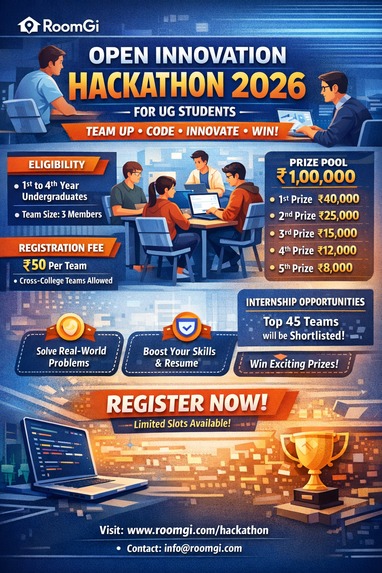
hackathon

RoomGi 2026: Revolutionizing Co-Living Through Algorithmic Harmony About the Project In an era where urban density is peaking and the cost of living continues to challenge students and young professionals alike, the concept of "home" has evolved. RoomGi 2026 is not merely a listing service; it is a sophisticated, AI-driven ecosystem designed to solve the roommate compatibility crisis. By leveraging advanced natural language processing and a proprietary matching algorithm, we connect individuals based on deep psychographic profiles rather than superficial criteria, ensuring that a shared living space translates into a shared community.
Inspiration The genesis of RoomGi 2026 was born out of shared frustration and a collective desire for stability. As university students and early-career developers, our team has navigated the tumultuous waters of the housing market. We realized that while there are countless platforms to find a house, there are startlingly few effective tools to find a home.
We looked at the existing landscape and saw a glaring inefficiency: listings focused entirely on square footage and amenities, treating the human element as an afterthought. We heard horror stories of broken leases, social isolation, and financial disputes. One of our team members shared a particularly poignant story of a living situation that dissolved due to conflicting circadian rhythms—a minor detail that caused major friction.
This inspired us to ask: What if we could quantify compatibility? What if we could use the technology available in 2026 to predict social friction before a lease is ever signed? We were driven by the conviction that co-living shouldn't just be an economic necessity, but a pathway to meaningful connection. We wanted to build a platform where math meets empathy.
How We Built It Building RoomGi 2026 required a synthesis of full-stack engineering and data science. We structured our development into three distinct layers: the User Interface, the Matching Engine, and the Trust Layer.
The Stack: We utilized a Next.js framework for a responsive, server-side rendered frontend, ensuring high performance on mobile devices. Our backend was built on FastAPI (Python) to seamlessly integrate with our machine learning models. We used PostgreSQL for relational data (user accounts, chat logs) and Milvus as our vector database for storing semantic embeddings of user bios.
The Compatibility Algorithm: The core of our project is the "Harmony Score." Instead of simple keyword matching, we utilized a Transformer-based Large Language Model to convert user responses regarding lifestyle, cleanliness, and social battery into high-dimensional vectors.
We defined the compatibility score S S between user u A u A and user u B u B using a weighted cosine similarity function combined with hard constraints (budget, location). The model is represented as:
S ( u A , u B
)
( ∑
k
1 n w k ⋅ v A , k ⋅ v B , k ∥ v A , k ∥ ∥ v B , k ∥ ) × ∏
j
1 m H j ( u A , u B ) S(u A ,u B )=( k=1 ∑ n w k ⋅ ∥v A,k ∥∥v B,k ∥ v A,k ⋅v B,k
)× j=1 ∏ m H j (u A ,u B ) Where:
v A , k v A,k represents the vector embedding for the k k-th lifestyle category (e.g., sleep schedule, cleanliness). w k w k is the weight assigned to that category based on user priority. H j H j represents binary hard constraints (returning 1 if compatible, 0 if not), such as: H b u d g e
t
{ 1 if ∣ R A − R B ∣ ≤ ϵ 0 otherwise H budget ={ 1 0
if ∣R A −R B ∣≤ϵ otherwise
- Fair Rent Division: To address financial friction, we also implemented a module based on Sperner’s Lemma for fair rent division, allowing roommates to bid on rooms based on utility rather than arbitrary square footage pricing.
Challenges Faced The road to RoomGi 2026 was paved with significant technical and ethical hurdles.
The "Cold Start" Problem and Data Sparsity: Initially, our matching algorithm struggled to provide meaningful recommendations with a small user base. The vector space was too sparse. To overcome this, we implemented a synthetic data generator using bounded randomization to simulate 10,000 user profiles. This allowed us to fine-tune our weights w k w k and validate that the algorithm prioritized urgent constraints (like "no pets") over soft preferences (like "enjoys jazz").
Latency in High-Dimensional Search: As we increased the complexity of our vector embeddings, the query time spiked. Calculating the cosine similarity for every user pair was O ( n 2 ) O(n 2 ), which was unacceptable. We pivoted to using Hierarchical Navigable Small World (HNSW) graphs within our vector database. This approximate nearest neighbor search reduced our complexity to O ( log n ) O(logn), allowing for real-time matching without sacrificing accuracy.
Bias and Fairness: We realized early on that algorithmic bias could inadvertently lead to housing discrimination. We had to rigorously audit our training data and implement "blind matching" in the early stages of the user funnel, hiding demographic data until a compatibility threshold was met to ensure matches were based on lifestyle and personality, not prejudice.
What We Learned The journey of building RoomGi 2026 has been a profound education in both computer science and sociology.
Technically, we deepened our understanding of vector databases and the intricacies of semantic search. We learned that the "perfect" algorithm means nothing if the latency disrupts the user experience. Optimizing our backend to handle concurrent API requests while processing mathematical models gave us a newfound appreciation for system architecture.
However, the most valuable lesson was human-centric. We learned that "compatibility" is not a binary state but a spectrum. Through user testing, we discovered that people are often willing to compromise on budget or location if the personality match is strong enough. This insight forced us to adjust our scoring function, moving away from rigid filtering toward a probabilistic recommendation engine.
We also learned the power of trust. By integrating ID verification APIs, we realized that safety is the primary feature of any housing app.
Ultimately, RoomGi 2026 taught us that technology is best used when it facilitates human connection. We entered this hackathon writing code to sort data; we left having built a bridge between people. We are incredibly proud of what we have accomplished and are excited for a future where finding a roommate feels less like a transaction and more like the beginning of a friendship.
Built With
- css
- flask
- geminiapi
- python
- react
- typescript

Log in or sign up for Devpost to join the conversation.