-
-
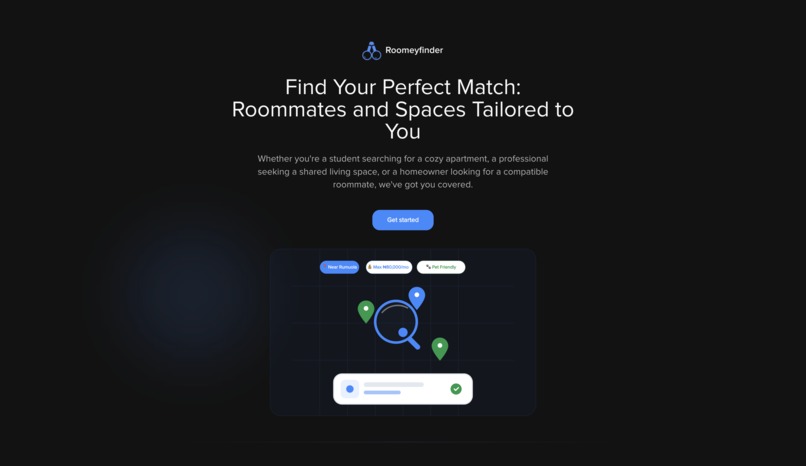
Landing page
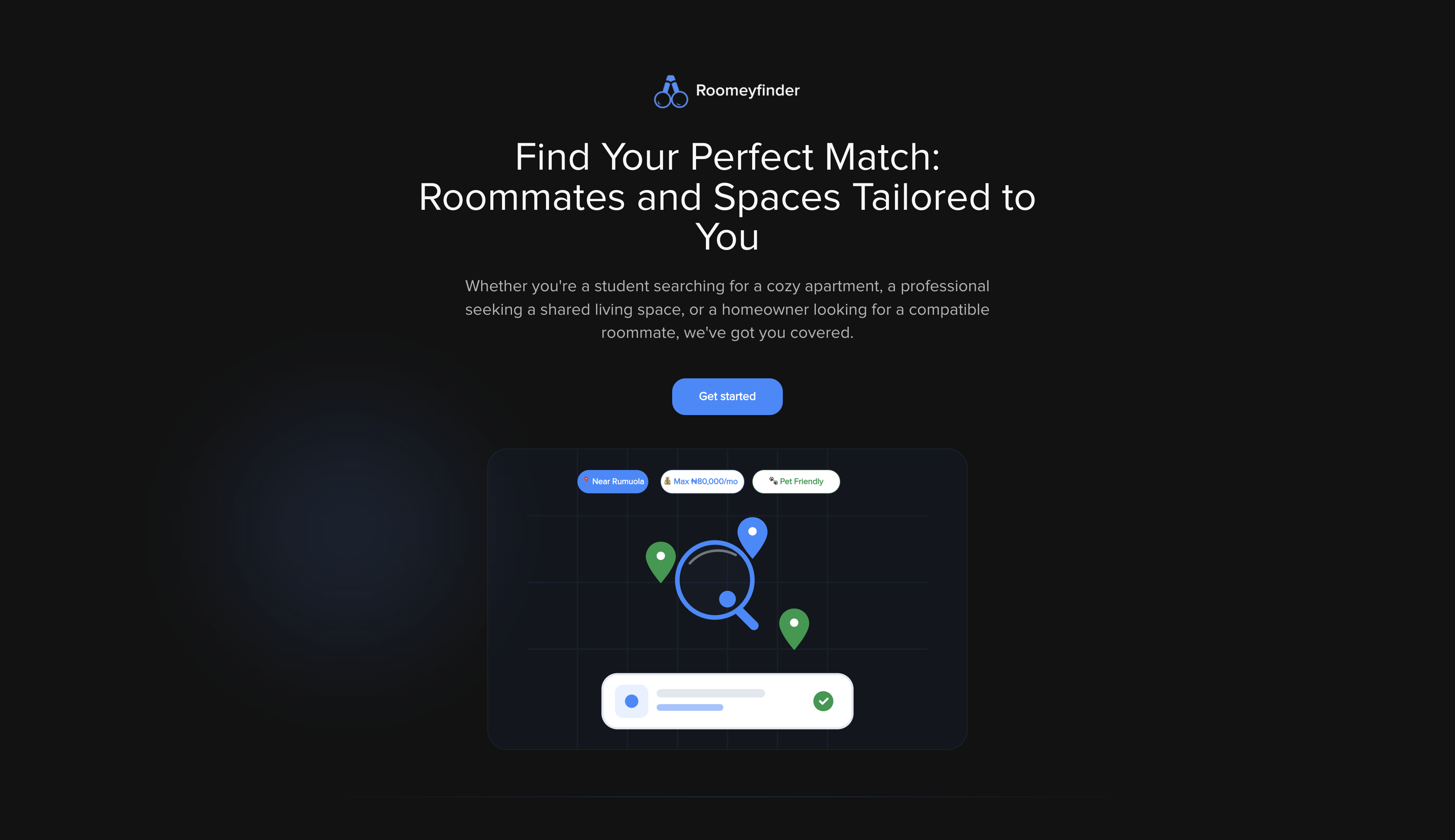
RoomeyFinder
RoomeyFinder helps people in Nigeria find compatible roommates and shared homes. Users create a profile, describe their living preferences, discover compatible matches, and connect only after mutual interest.
The app is built with Next.js and Supabase, with privacy-conscious profile data, authenticated workflows, home listings, photo uploads, and database-backed matching.
Inspiration
In Nigeria and across Africa today, the skyrocketing cost of housing has made independent living nearly impossible for students and young professionals. To survive economically, pairing up to split the bills has shifted from an option to an absolute necessity.
Yet, the current solution is broken. People are still forced to rely on chaotic Facebook groups or random Twitter threads to find housemates. Traditional housing apps focus heavily on property listings, forcing users to endlessly swipe through raw profiles without any real filter for personal alignment. We built RoomeyFinder to completely eliminate the guesswork, friction, and privacy risks of the traditional roommate hunt.
What it does
RoomeyFinder.com is a privacy-first, compatibility-driven roommate discovery platform designed to end the era of random internet searches. Instead of scrolling through an endless directory of strangers, our algorithm computes compatibility programmatically in the background based on location, budget, lifestyle, and home preferences.
Privacy is at the core of the user experience. Personal data, sensitive living preferences, and contact information are fully locked and hidden from public view. When a match is calculated, users only see that they are fundamentally compatible. If you send an interest request, your personal info remains completely hidden until the other party explicitly accepts it. Once mutual interest is confirmed, the profiles unlock, contact details are revealed, and communication can safely begin.
How we built it
The platform is engineered using a robust, modern stack focused on speed, type-safety, and rigorous data security:
- Frontend & Routing: Built using Next.js (App Router) and React for fluid, multi-step onboarding flows, styled dynamically with Tailwind CSS.
- Backend & Database: Powered by Supabase (PostgreSQL), utilizing complex SQL functions to evaluate and rank user compatibility server-side.
- Security & Data Privacy: Relies heavily on Supabase Row Level Security (RLS) policies and private Storage buckets to ensure no user data is exposed without strict, programmatically verified mutual consent.
- Animation & UI Primitives: Accessible foundations via Radix UI and Lucide React, paired with clean, intentional motion powered by GSAP.
Challenges we ran into
This project marked our first time deep in the weeds with the Supabase CLI, requiring an incredibly meticulous loop of configuring migrations, storage rules, and testing database seeds locally.
The biggest hurdle came during authentication setup. Our magic-link and social sign-ins kept throwing silent failures due to a URL mismatch between 127.0.0.1 and localhost within the local auth redirect rules. Because the underlying code logic was technically perfect, our AI development collaborator (Codex) couldn’t detect the environmental discrepancy and spent hours trying to refactor working code. The breakthrough came only when we stepped back, stopped relying blindly on AI suggestions, manually audited the environment configuration, and spotted the routing mismatch.
Accomplishments that we're proud of
- True Zero-Knowledge Browsing: Successfully implementing an architecture where users can confidently find high-quality living matches without broadcasting their personal lives or exact locations to the public internet.
- Deterministic Local Testing: Building a comprehensive local testing suite with 48 distinct seed accounts mimicking homeowners, pairs, and seekers, allowing us to validate matching logic instantly.
- Bulletproof RLS: Forcing authorization directly down into the database layer via PostgreSQL policies rather than relying on flimsy client-side checks.
What we learned
We walked away with a profound respect for strict local-first database development. More importantly, this hackathon taught us how to effectively pair with cutting-edge LLMs. While Codex and GPT-5.6 are phenomenal for accelerating UI builds and schema generation, they can easily get stuck in a loop when debugging subtle, environment-specific infrastructure bugs. Human intuition and careful system auditing are still irreplaceable.
What's next for RoomeyFinder
The MVP proves that programmatic compatibility matching works safely. Next, we plan to implement a secure, anonymous real-time chat interface directly into the platform so matched users can iron out living agreements before exchanging telephone numbers. Additionally, we aim to expand our geocoding capabilities to map out neighborhood-specific security ratings, giving young Africans deeper insights into the safety of their potential shared spaces.
Built With
- netlify
- nextjs
- react
- supabase
- tailwind

Log in or sign up for Devpost to join the conversation.