-
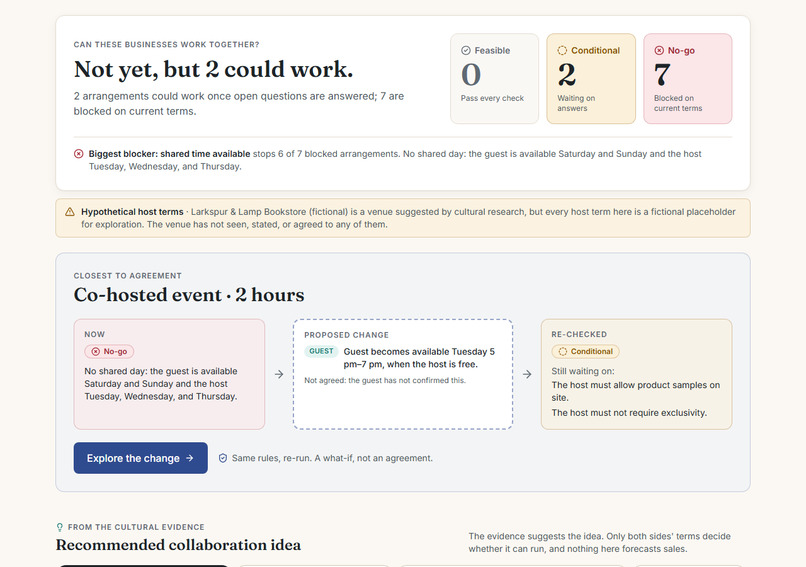
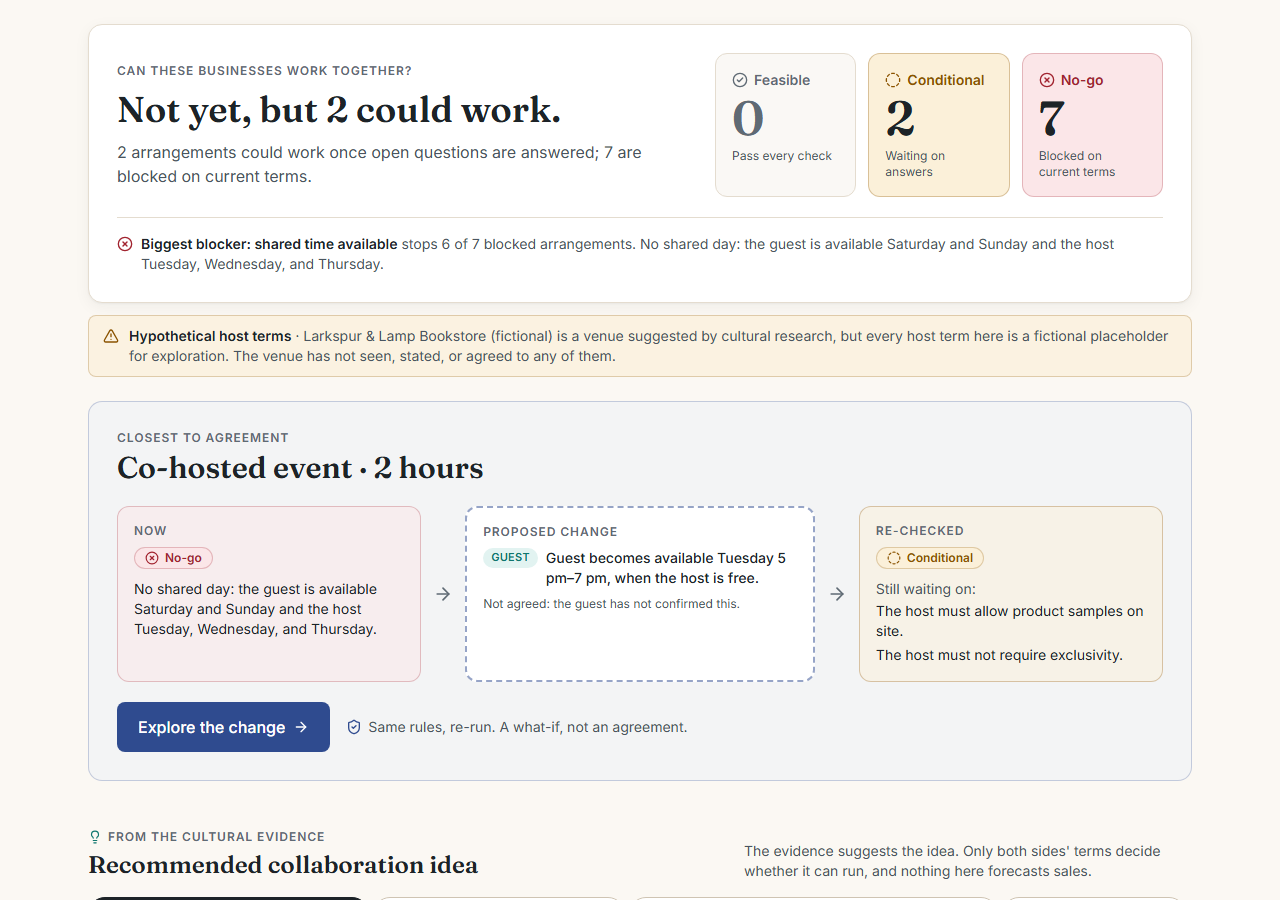
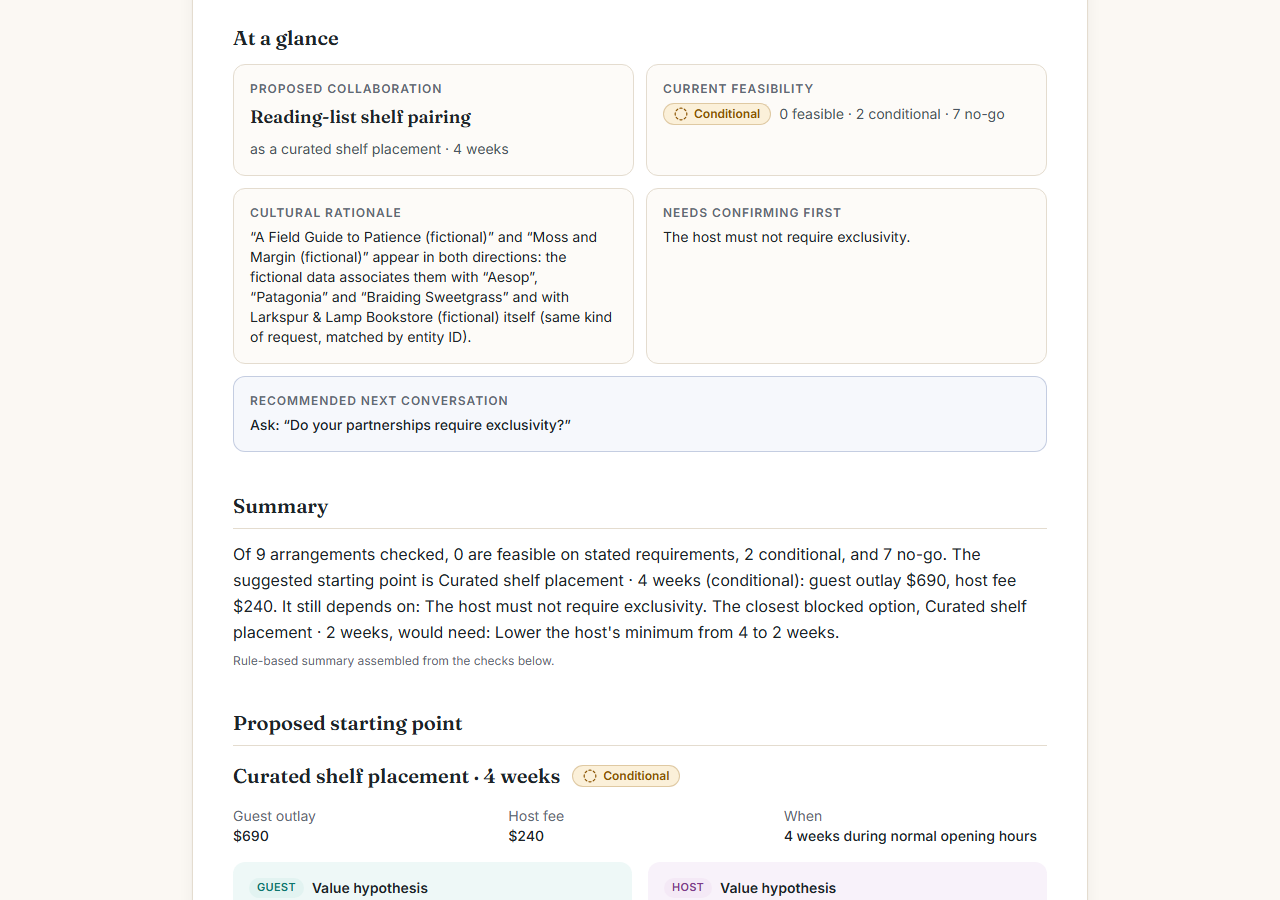
Not every good match makes a good deal. Here's how nine different options stack up against what both sides need.
-
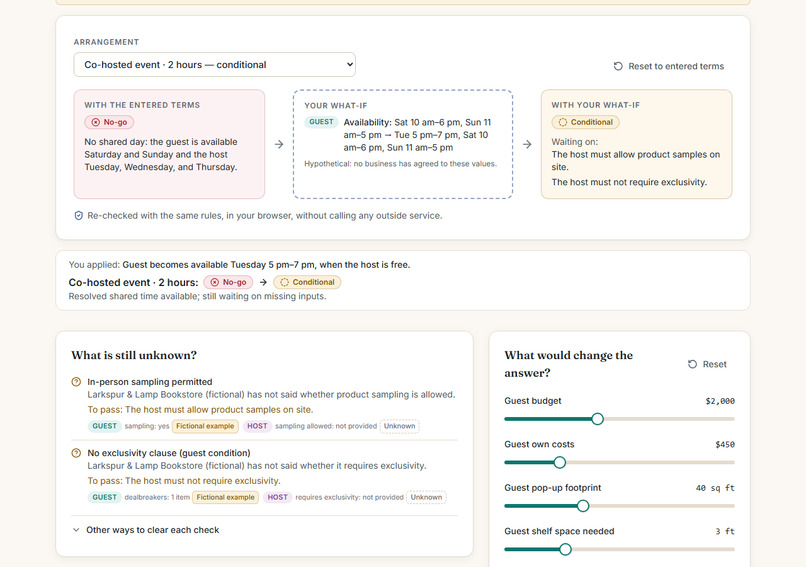
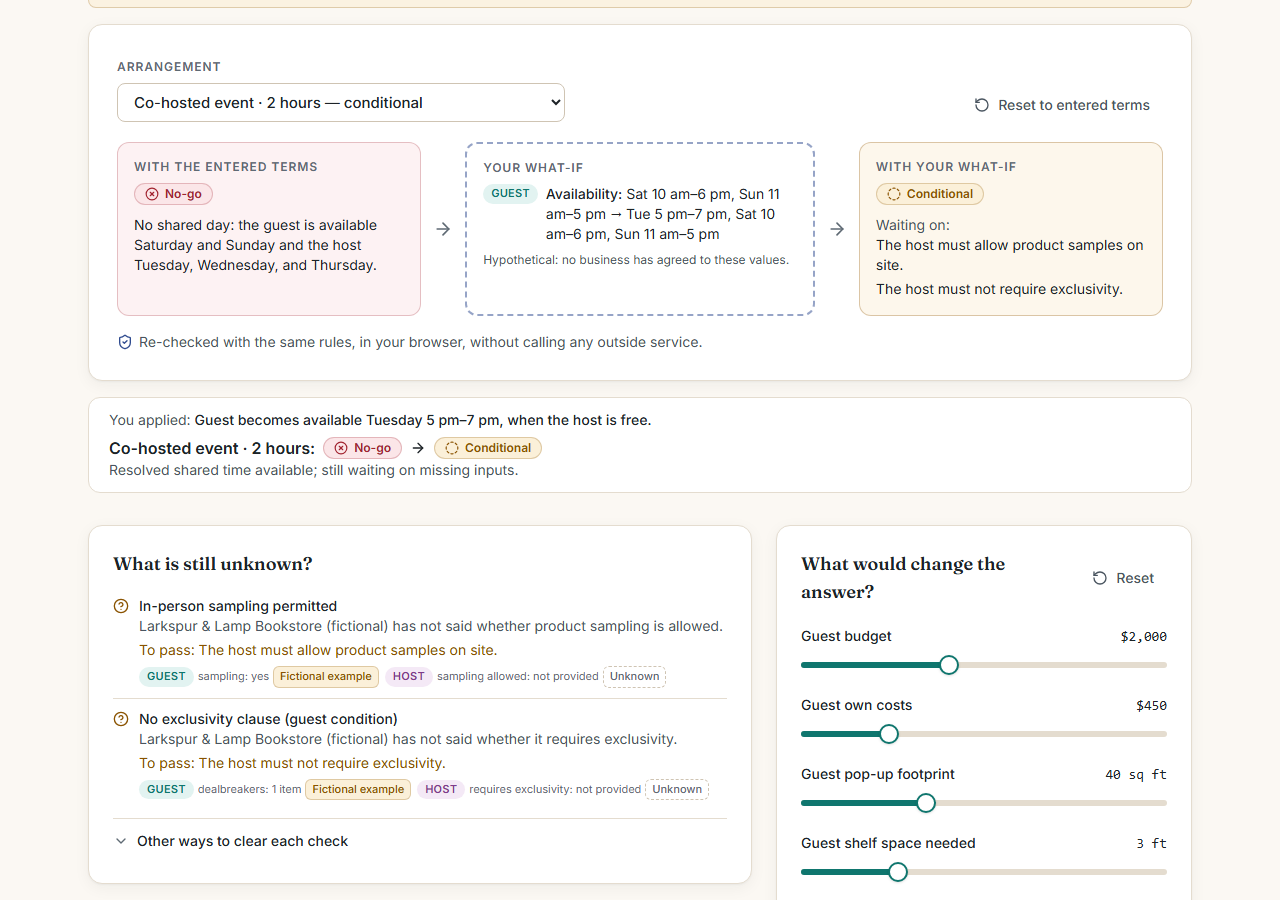
One small schedule change turns a no-go into a possible deal. Here's what still needs to be worked out.
-
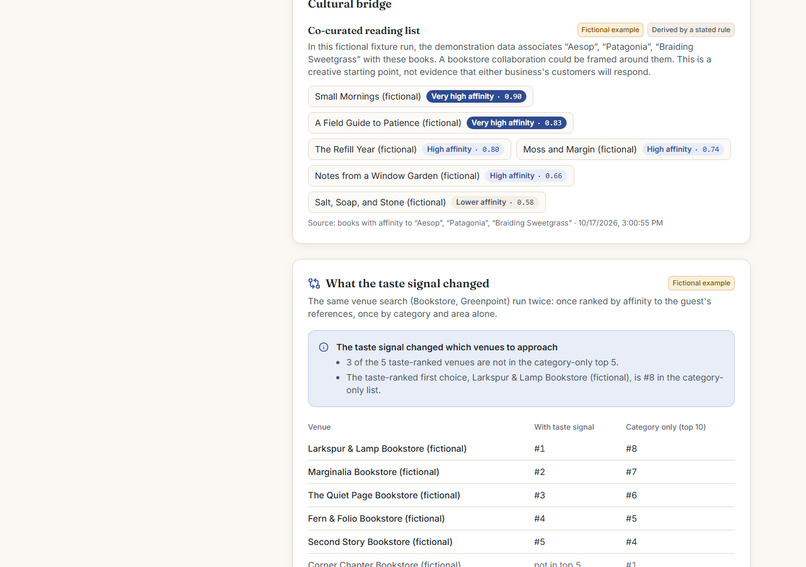
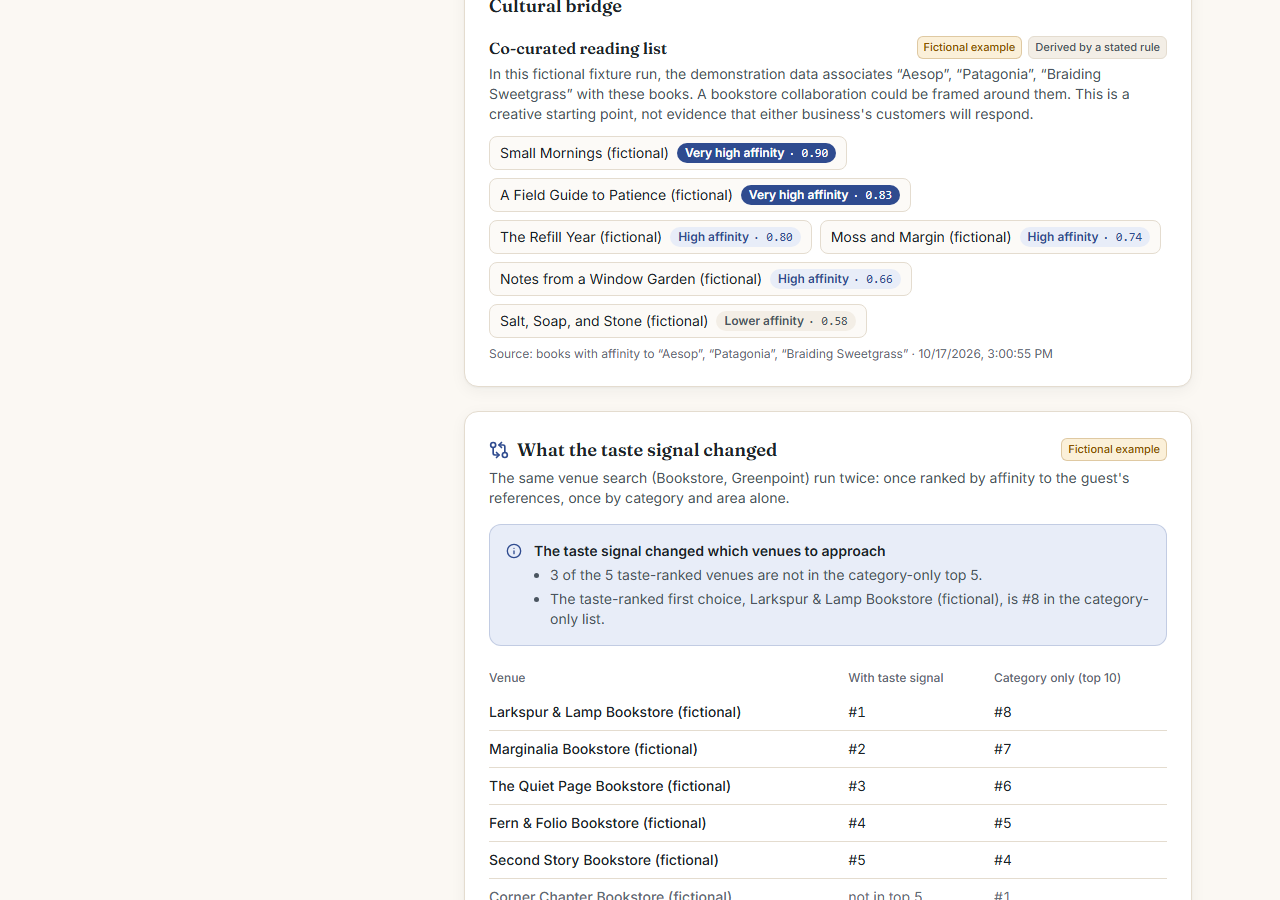
Finding places your audience might love, and seeing how Qloo changes the recommendations.
-
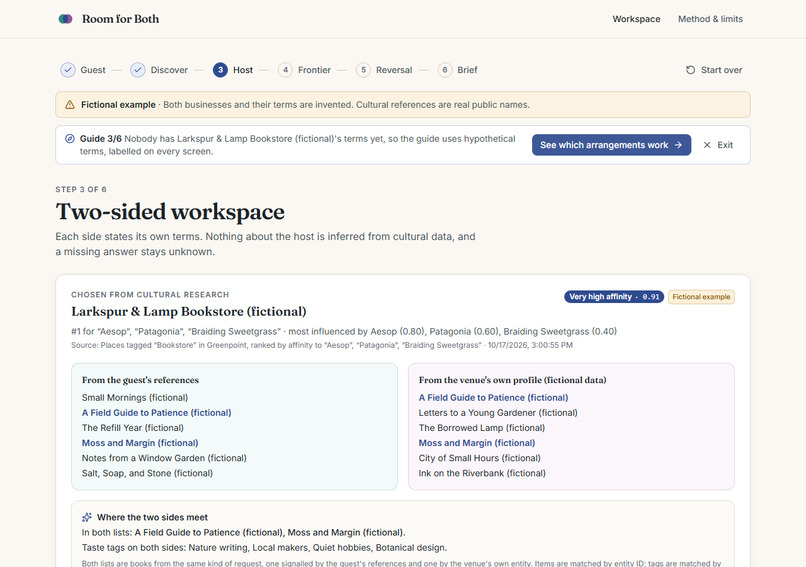
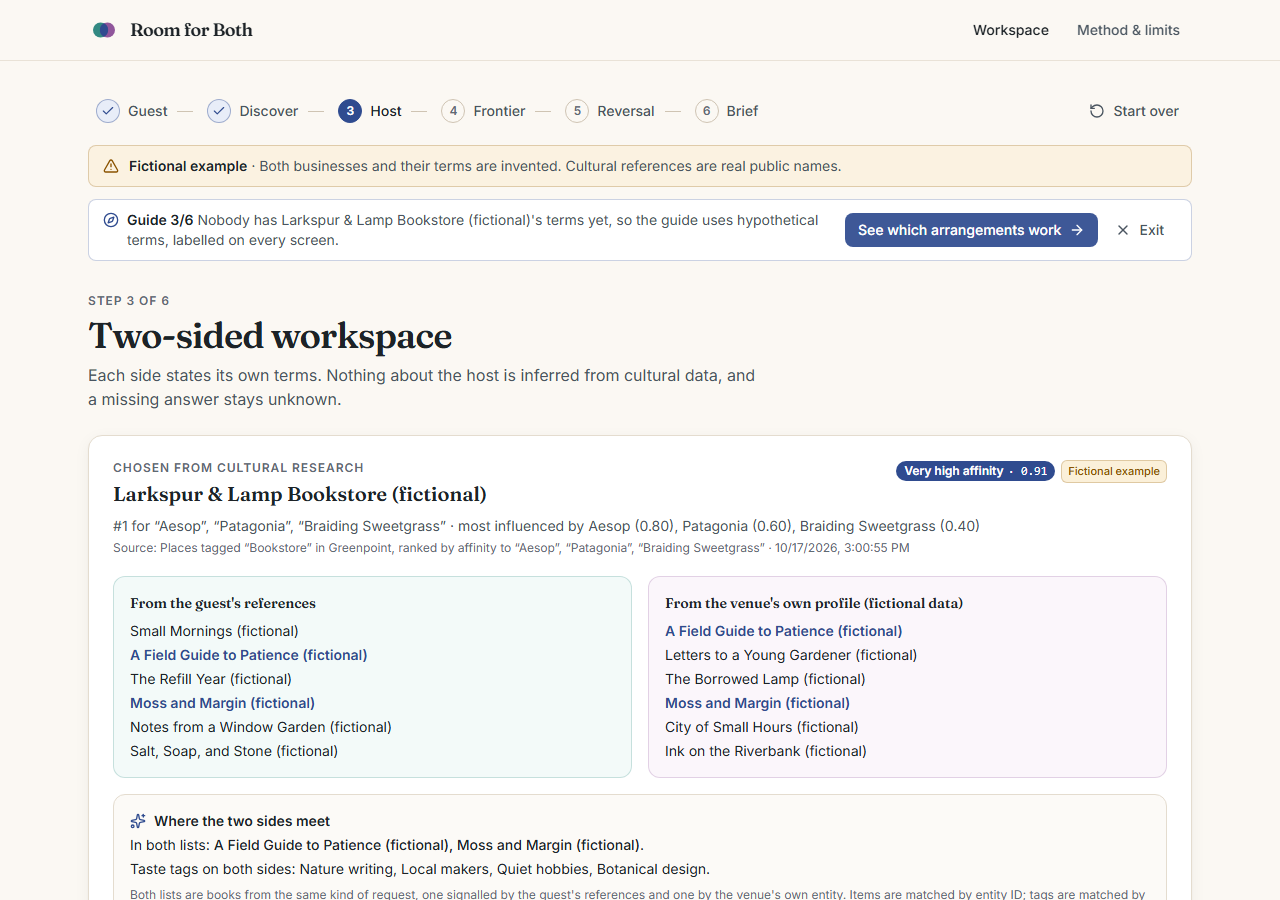
A partnership has two sides. Here's where the venue's needs, interests, and limitations come into the picture.
-
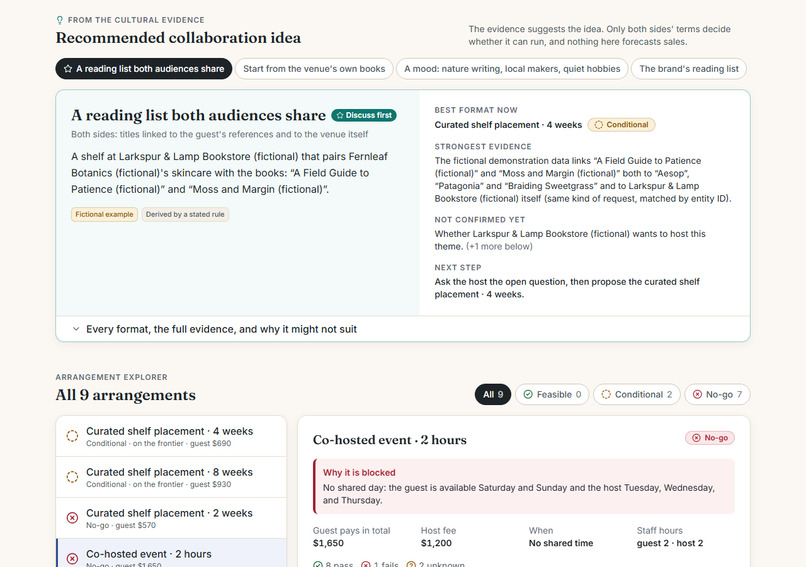
A few ways these businesses could work together, inspired by what their audiences have in common.
-
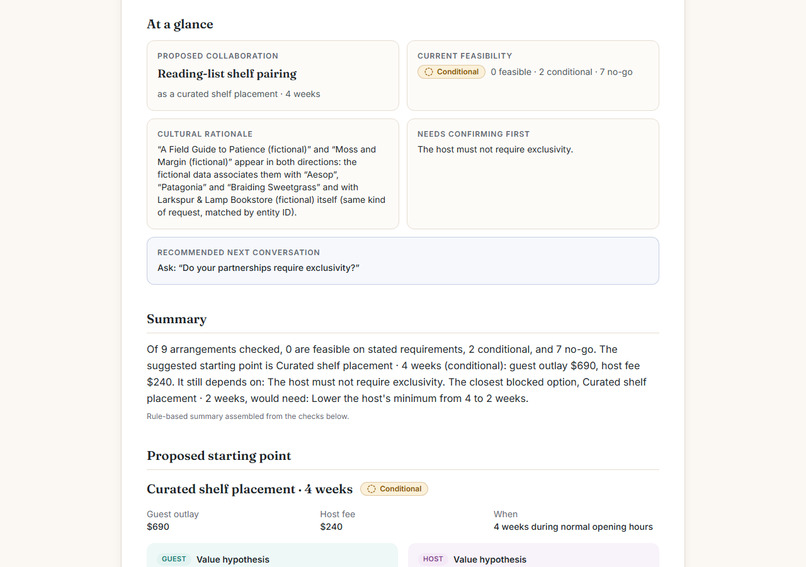
Everything in one place: the idea, what might work, what's still uncertain, and what to discuss next.

Inspiration
The idea for Room for Both came from my experience as a UMBC Odyssey Fellow at MicDots, where I worked on project coordination, client outreach, and understanding what potential clients needed.
During those four months, I noticed something that stuck with me: finding a potential client was only the beginning. Even when two businesses saw value in working together, their expectations, priorities, and practical limitations didn't always align.
Coming from a software engineering and data science background, I kept thinking: Could technology help businesses find common ground before a promising opportunity falls apart?
When I discovered Qloo's cultural intelligence API, I saw a way to explore that question through partnerships between small brands and local venues.
I didn't want to build another tool that simply says two businesses are a good match. I wanted to help them figure out what it would actually take to work together.
That's how Room for Both started.
What it does
Room for Both helps small brands discover culturally aligned venues and work out partnership terms that make sense for both sides.
It connects three things:
1. Cultural discovery: Qloo identifies relevant venues and unexpected connections through shared interests in books, music, brands, and other cultural references. Users can compare recommendations with and without Qloo's taste signals to see what actually changed.
2. Agreement Frontier: Both businesses provide their budgets, schedules, space, staffing needs, and restrictions. The system evaluates nine possible collaboration arrangements and explains which are feasible, conditional, or blocked.
3. Decision Reversal: My favorite feature. Instead of just saying "No-go," the system identifies a change that could make an arrangement work and verifies the result.
In the fictional demo, changing the guest's availability to Tuesday, 5–7 PM, moves a co-hosted event from No-go to Conditional. The system also explains what still needs the venue's confirmation.
The result is a printable, evidence-linked decision brief that gives both businesses a starting point for a real conversation.
How I built it
I built the application with React, TypeScript, Vite, Hono, Cloudflare Workers, and D1.
Qloo powers cultural research, venue discovery, and affinity comparisons. A deterministic TypeScript engine evaluates business constraints and verifies proposed changes.
I also integrated Gemini for optional, consent-based research planning, comparisons, and summaries. AI-generated suggestions are validated, and the language model never overrides the decision engine.
I used Vitest, Playwright, and GitHub Actions to test the system across its core workflows.
Challenges I ran into
Working with real Qloo data was more complicated than expected. Book subtitles affected matching, some venue categories were ambiguous, and certain cultural queries needed fallback strategies.
I addressed these issues through better normalization, bounded research steps, and regression tests.
The bigger challenge was making the recommendations trustworthy.
Cultural affinity doesn't mean a business is willing or able to collaborate. I made sure the application never confuses Qloo evidence with actual business requirements, consent, or guaranteed outcomes.
Accomplishments that I'm proud of
I'm particularly proud of turning a simple partnership-discovery idea into a working, two-sided decision tool.
The Decision Reversal feature captures the whole purpose of the project: rather than ending a conversation when something doesn't work, help people understand what could change.
Another meaningful milestone came on October 28, 2026, when the founder of XERJ selected Room for Both's Decision Reversal implementation for the XERJ Corpus Hub, where it is indexed as a reusable open-source reference with attribution.
What I learned
Building Room for Both reinforced something I first noticed while working with clients: a good opportunity isn't necessarily a workable agreement.
I also learned that AI is more useful when it knows its limits. Cultural data can reveal possibilities, but transparent reasoning and real input from both parties are what make those possibilities worth discussing.
What's next
I want to put Room for Both in front of real small businesses, venues, and partnership organizers, learn where their negotiations get stuck, and improve the tool based on their feedback.
My longer-term goal is to make it easier for startups and small businesses to find opportunities, understand each other's constraints, and build collaborations that genuinely work for both sides.
Find common ground. Build a better deal.
Built With
- cloudflare-d1
- cloudflare-workers
- gemini
- github-actions
- hono
- node.js
- playwright
- qloo
- react
- tailwind-css
- typescript
- vite
- vitest
- zod

Log in or sign up for Devpost to join the conversation.