-
-
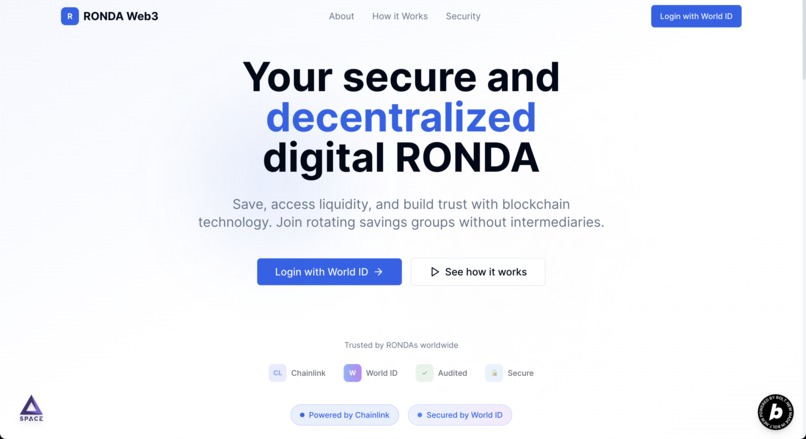
Landing page
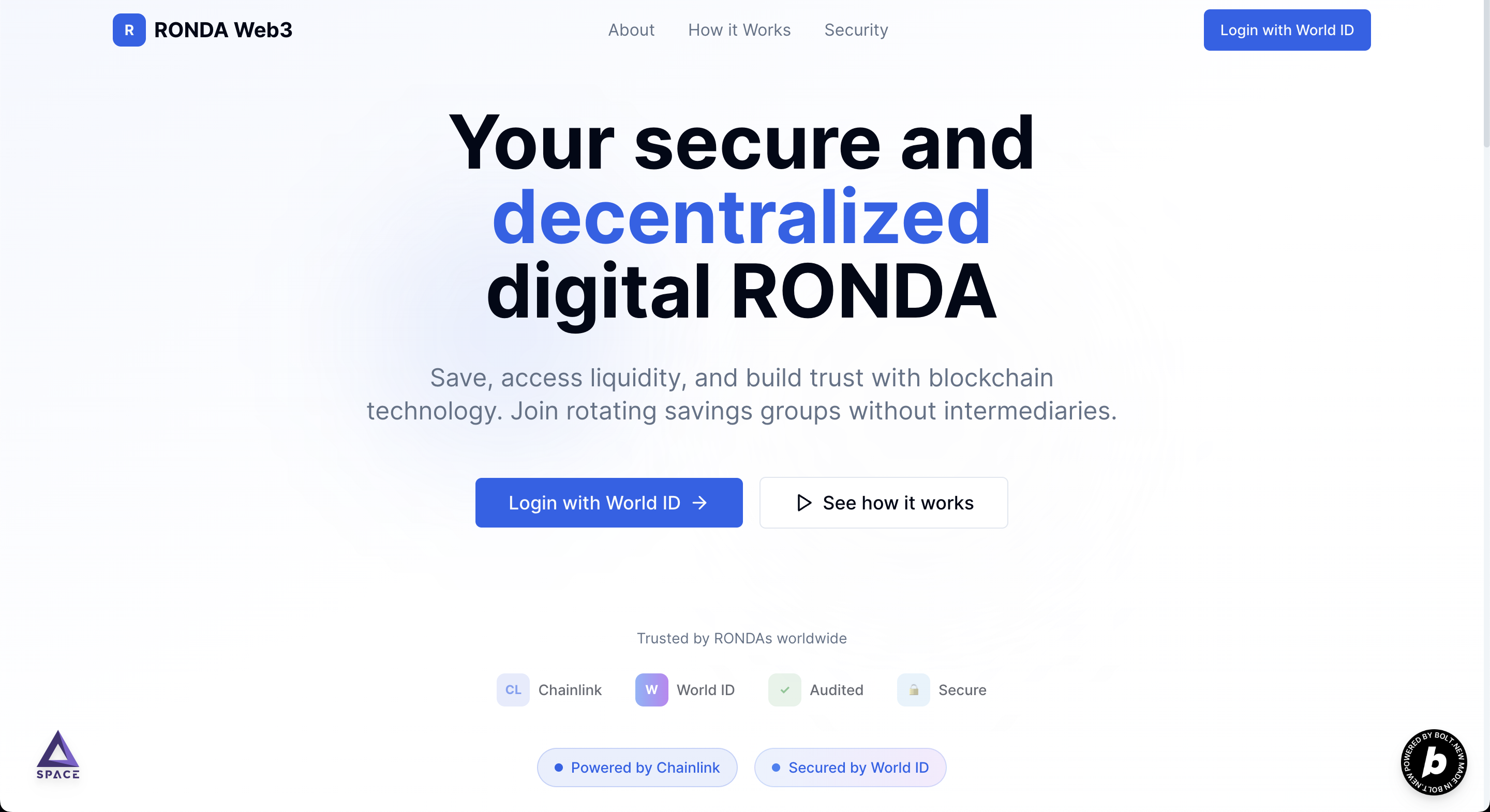
Inspiration
In Latin America, people access credit through high-interest credit cards, abusive personal loans, or risky informal lenders. Traditional RONDAs ("tandas", "panderos", "cajas") offer community-based alternatives but suffer from:
- Lack of transparency - Centralized, informal organizers
- Fraud risk - No enforcement when members default
- Limited scalability - Requires pre-existing trust relationships
- No reputation building - No credit history for future participation
What it does RONDA Web3
Our blockchain implementation provides:
- ✅ Complete transparency through auditable smart contracts
- ⛓️ Automatic execution with no possibility of "forgetting"
- 🔀 Verifiable randomness using Chainlink VRF for fair slot assignment
- 📊 On-chain reputation with defaulter bans and Soulbound Token penalties
- 🧠 Privacy-preserving identity via Proof of Humanity (no KYC required)
- 🌎 Global scalability without requiring participants to know each other
🧮 How It Works
- Group Formation: 10 participants commit to monthly contributions (e.g., $100 USDC)
- Slot Auction: Early slots (1-4) are auctioned - liquidity seekers pay fees for immediate access
- Neutral Slot: Slot 5 has no fees or interest
- VRF Lottery: Slots 6-10 assigned randomly via Chainlink VRF, earning increasing interest
- Revenue Distribution: Auction fees fund interest payments and protocol revenue
Slot Distribution Example
| Slot | Assignment | Fee/Interest |
|---|---|---|
| 1 | Auction | Pays ≥+10% |
| 2 | Auction | Pays ≥+7.5% |
| 3 | Auction | Pays ≥+5% |
| 4 | Auction | Pays ≥+2.5% |
| 5 | Neutral | 0% |
| 6 | Neutral | 0% |
| 7 | VRF Lottery | Earns +2.5% |
| 8 | VRF Lottery | Earns +5% |
| 9 | VRF Lottery | Earns +7.5% |
| 10 | VRF Lottery | Earns +10% |
How we built it
Frontend (/frontend)
The UI is rapidly built and iterated using Bolt.new, enabling fast prototyping and seamless integration with modern Web3 tools. The interface is clean, mobile-friendly, and optimized for onboarding, group management, and real-time RONDA participation.
- Framework: Next.js 14 with TypeScript and App Router
- Web3 Integration: Wagmi, Viem, RainbowKit for wallet connectivity
- UI/UX: Tailwind CSS + shadcn/ui components
- State Management: Zustand for application state
Smart Contracts (/contracts)
- Development: Foundry framework with Solidity
- Core Logic: RONDA circles, factory deployment, reputation management
- External Integrations: Chainlink VRF, CCIP, identity verification
Supporting Entities
- Identity Providers: World ID for Sybil resistance
- Real world data provider: Chainlink services for randomness and cross-chain operations
Challenges we ran into
Challenge: Fair Slot Assignment
- Problem: Traditional RONDAs use biased or manipulable ordering
- Solution: Chainlink VRF for verifiable randomness in slot assignment
- Benefit: Transparent, tamper-proof lottery system
Challenge: Cross-Chain Participation
- Problem: Users locked into single blockchain ecosystems
- Solution: Chainlink CCIP for cross-chain deposits and payouts
- Benefit: Participate from Ethereum, receive on Arbitrum (or vice versa)
Challenge: Sybil Attacks
- Problem: Single user claiming multiple slots with different wallets
- Solution: World ID integration for identity verification
- Benefit: One human = one slot, preventing manipulation
Challenge: Default Enforcement
- Problem: No recourse when participants stop contributing
- Solution: Soulbound Token (SBT) reputation system with permanent bans
- Benefit: On-chain reputation prevents future participation after default
Challenge: Liquidity Timing
- Problem: Fixed payout order doesn't match liquidity needs
- Solution: Auction mechanism for early slots (1-4) with fee premiums
- Benefit: Market-driven pricing for immediate access to funds
Challenge: Transparency & Trust
- Problem: Centralized organizers with potential for fraud
- Solution: Smart contract automation with immutable rules
- Benefit: Algorithmic execution eliminates human intermediaries
Challenge: Global Scalability
- Problem: Traditional RONDAs limited to existing social networks
- Solution: Blockchain-based reputation enabling participation among strangers
- Benefit: Global pools without geographic or social constraints
What's next for RONDA Web3
🏆 Credit Score System
Enhanced Reputation with Positive Tokens Right now, we only mark bad actors. We'll create a full credit history system where good participants earn positive reputation points. Think of it like a blockchain credit score - the more circles you complete successfully, the better rates and access you get.
💰 Real-World Asset Support
RWA Integration with Ondo Finance Instead of just using regular USDC, participants could contribute with assets that earn interest while sitting in the circle pot. For example, tokenized treasury bills that earn 4-5% annually, making the whole circle more profitable for everyone.
🌐 Multi-Chain Expansion
Deploy to More Blockchains Currently limited to Arbitrum and Ethereum. We'll expand to:
- Optimism - Cheaper transactions
- Base - Easy onramp for new crypto users
- Polygon - Established user base
This means people can join circles from whichever blockchain they prefer, increasing participation.
🛡️ Enhanced Identity Security
On-Chain Humanity Validation Currently, identity verification happens once during signup. We'll implement continuous validation where each transaction requires proving you're the same verified human, regardless of which wallet you use. This prevents bad actors from creating multiple accounts or transferring verified status between wallets.
🗳️ Community Governance
$RONDA Token and DAO Give users voting power over important decisions like:
- What fees the platform charges
- Which new features to build first
- How to spend protocol revenue
Token holders vote on proposals, making RONDA truly community-owned rather than controlled by a single team.
Built With
- bolt.new
- ccip
- chainlink
- netlify
- nextjs
- solidity
- tailwind
- typescript
- world-id


Log in or sign up for Devpost to join the conversation.