RollCall: where are all the kids, and how much is this costing us?
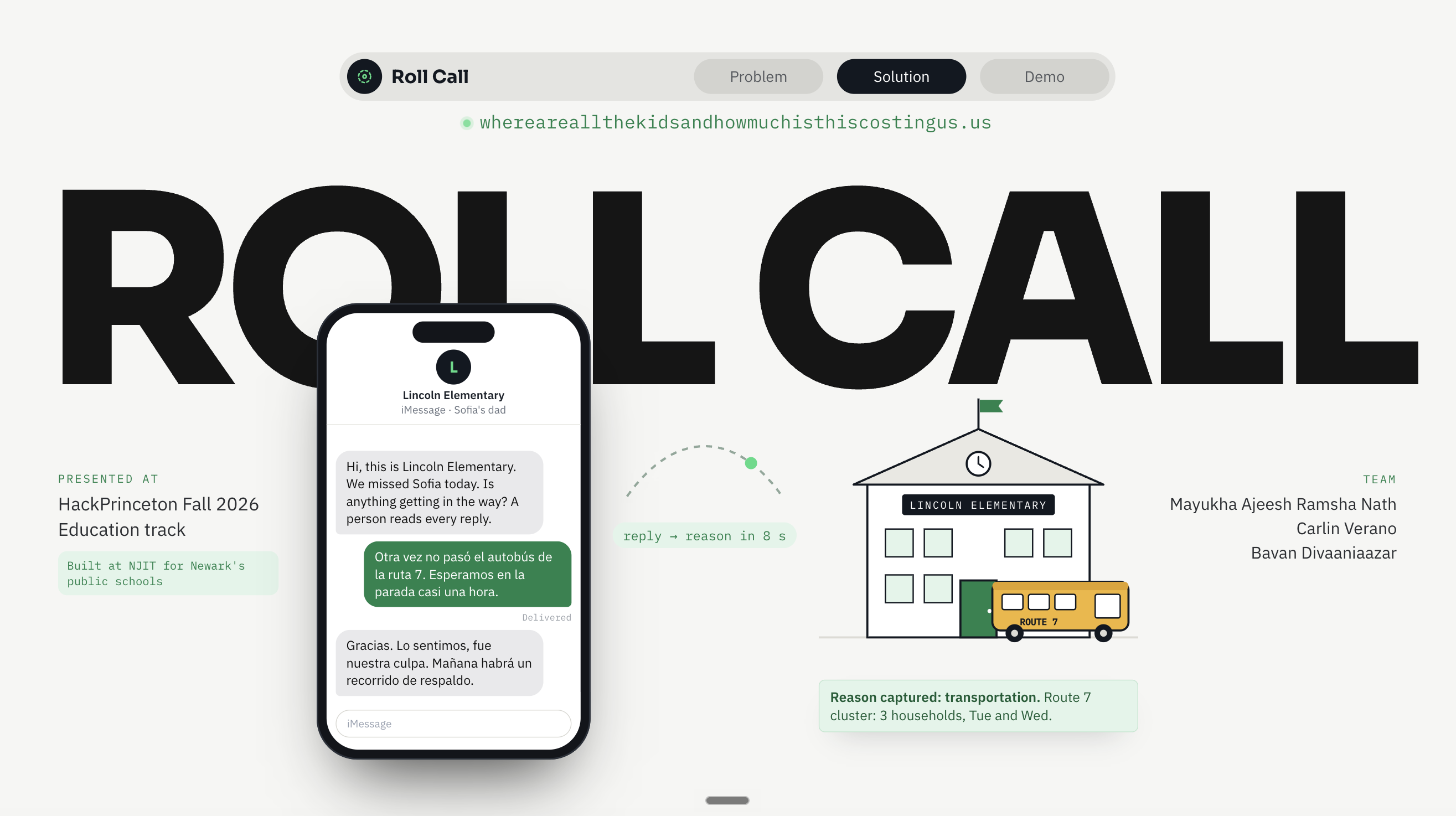
In one line: RollCall texts families after an absence, reads the replies, connects them across students who share a bus, a classroom or a household, and turns one shared root cause into one fix the school can make.
Inspiration
We built this for Newark. We're three NJIT students, and NJIT sits in the middle of Newark, where many public schools serve low-income families. In those homes, an absence is rarely a choice: a bus that never came, a parent's early shift, a sick little brother.
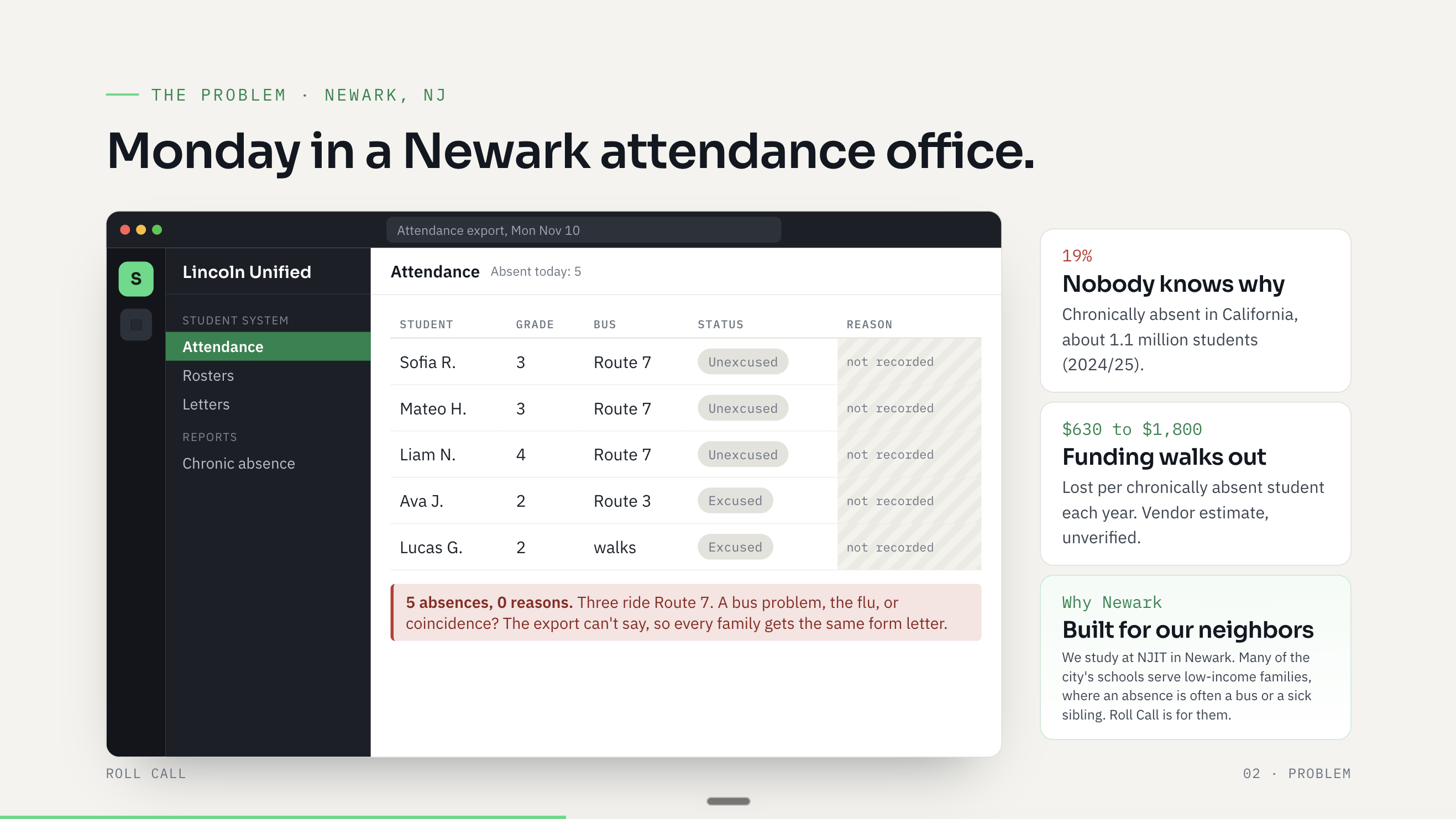
Schools know that a kid was out, not why.
- Attendance is recorded as "excused" or "unexcused," with no reason.
- So outreach is generic: the same robocall goes to the kid with the flu, the kid whose bus broke down, and the kid caring for a sibling.
- An absence the school caused, like a route that didn't run, can sit coded "unexcused" and push a family toward a truancy letter.
Two findings shaped RollCall:
- Texting works. A national IES trial of ~26,000 elementary students cut chronic absence by 2.4 to 3.6 percentage points, for under USD 9 per student per year.
- Absences aren't independent. Kids who share a bus, a classroom or a household miss school together for the same reason. One broken route looks nothing like thirty unrelated bad mornings, if you know both why each kid was out and who is connected to whom.
RollCall is roll call with a follow-up question: not just "who's missing?" but "what's getting in the way?"
What it does
| Step | What happens |
|---|---|
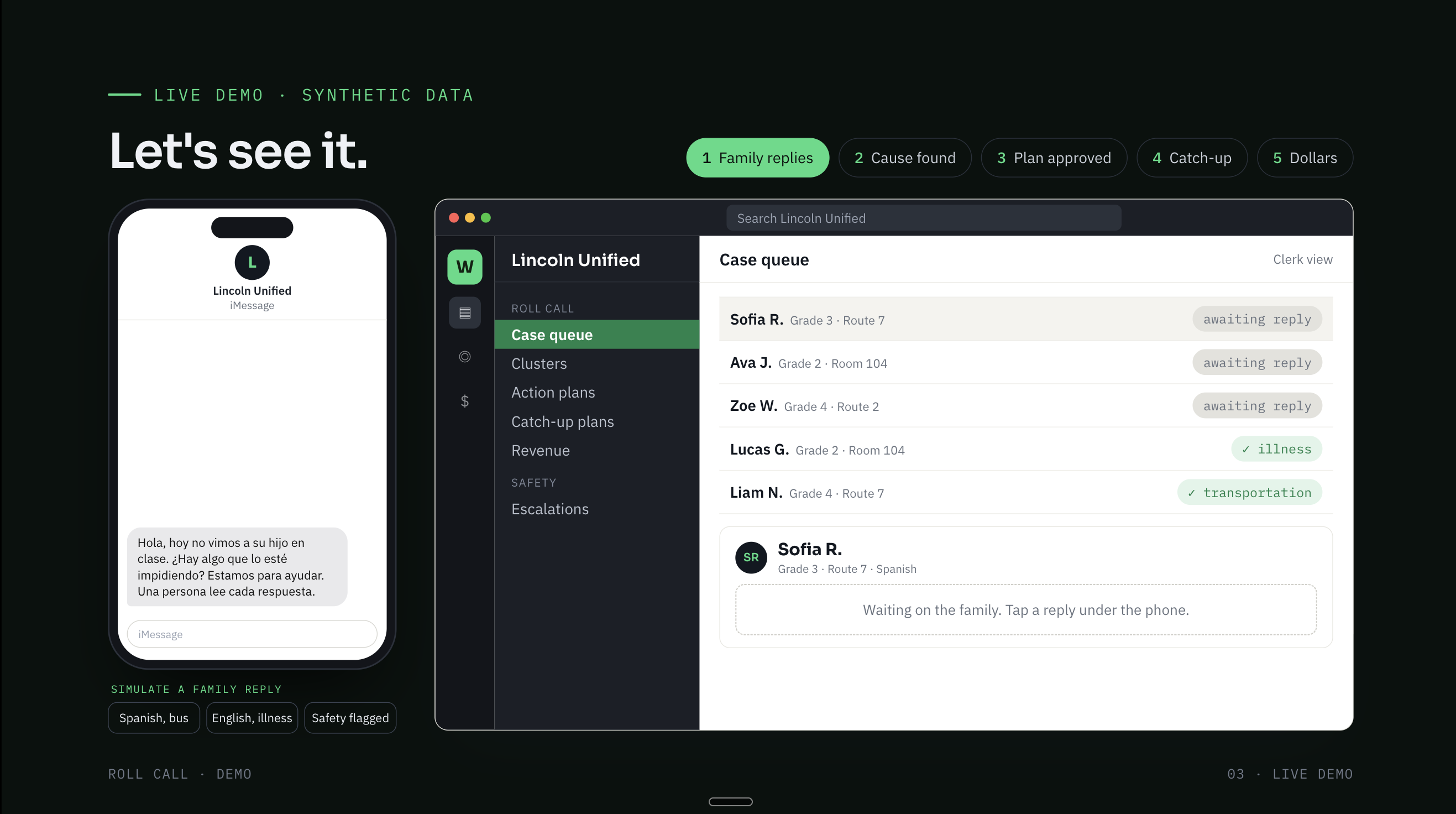
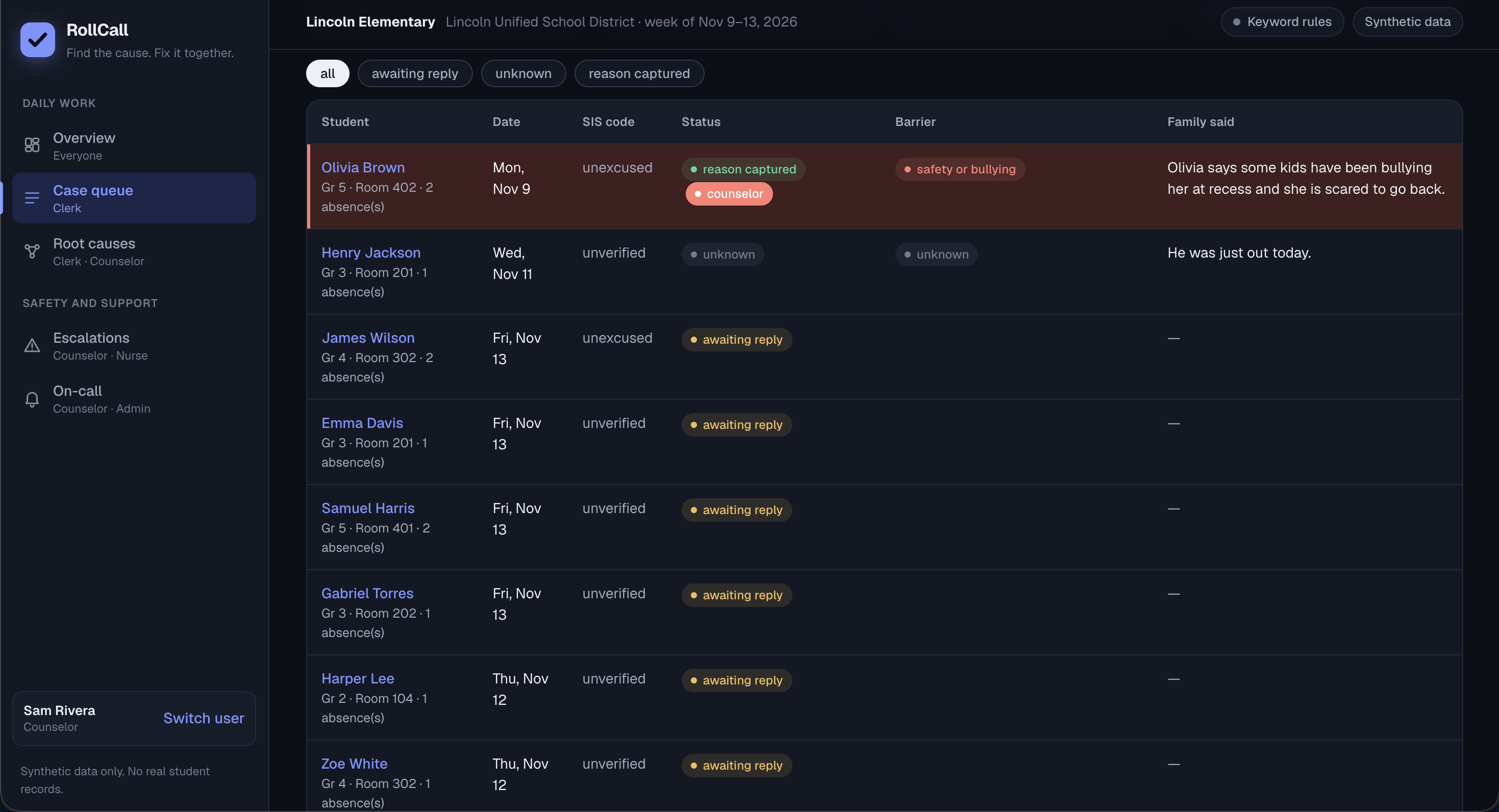
| 1. Ask | After an absence, RollCall texts the family over iMessage (Photon 2.0): one supportive, open question. No links, no requests for money or ID. |
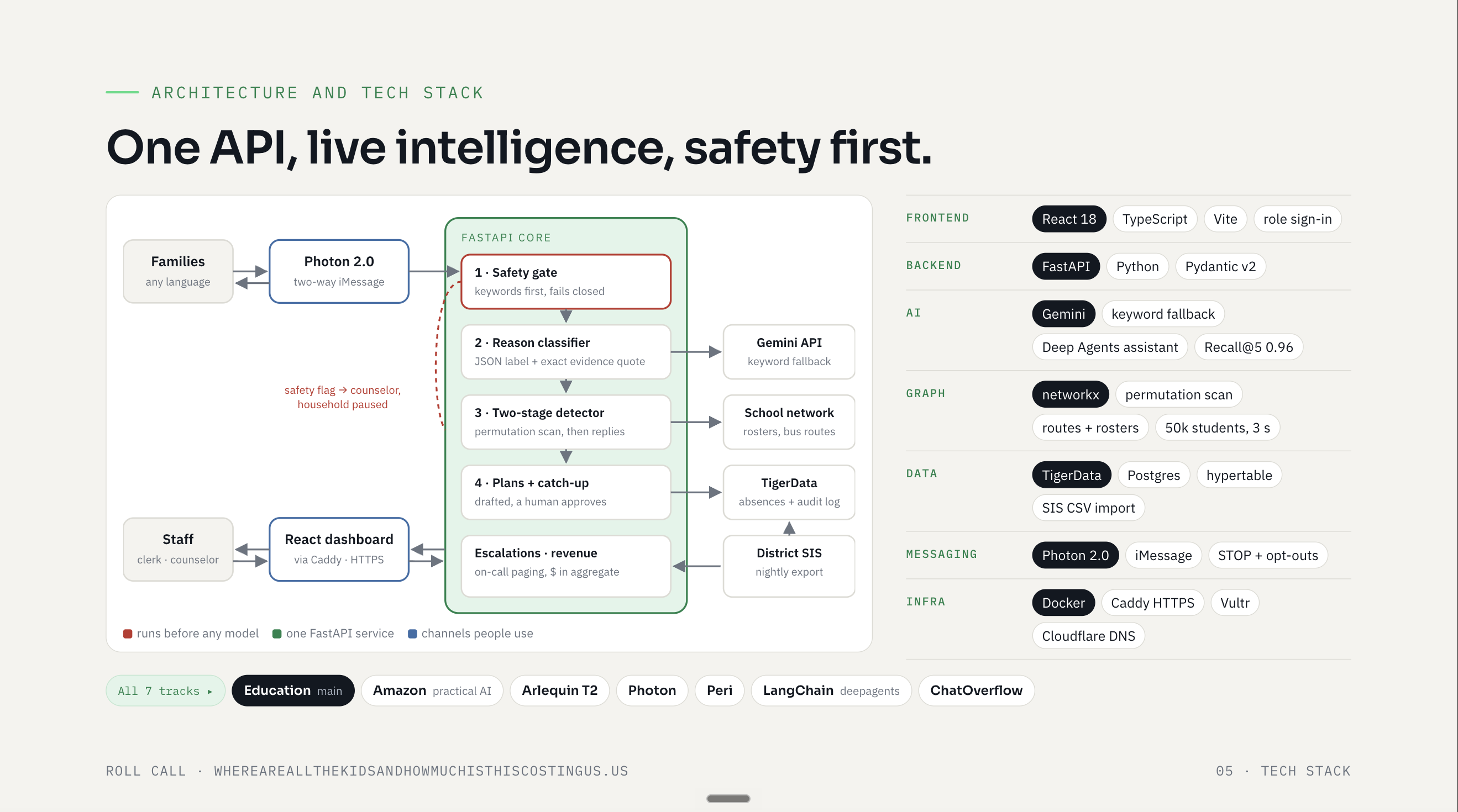
| 2. Understand | Gemini labels the barrier, gives a confidence score, and quotes the family's exact words as evidence. A keyword classifier takes over within 6 seconds if Gemini is slow. |
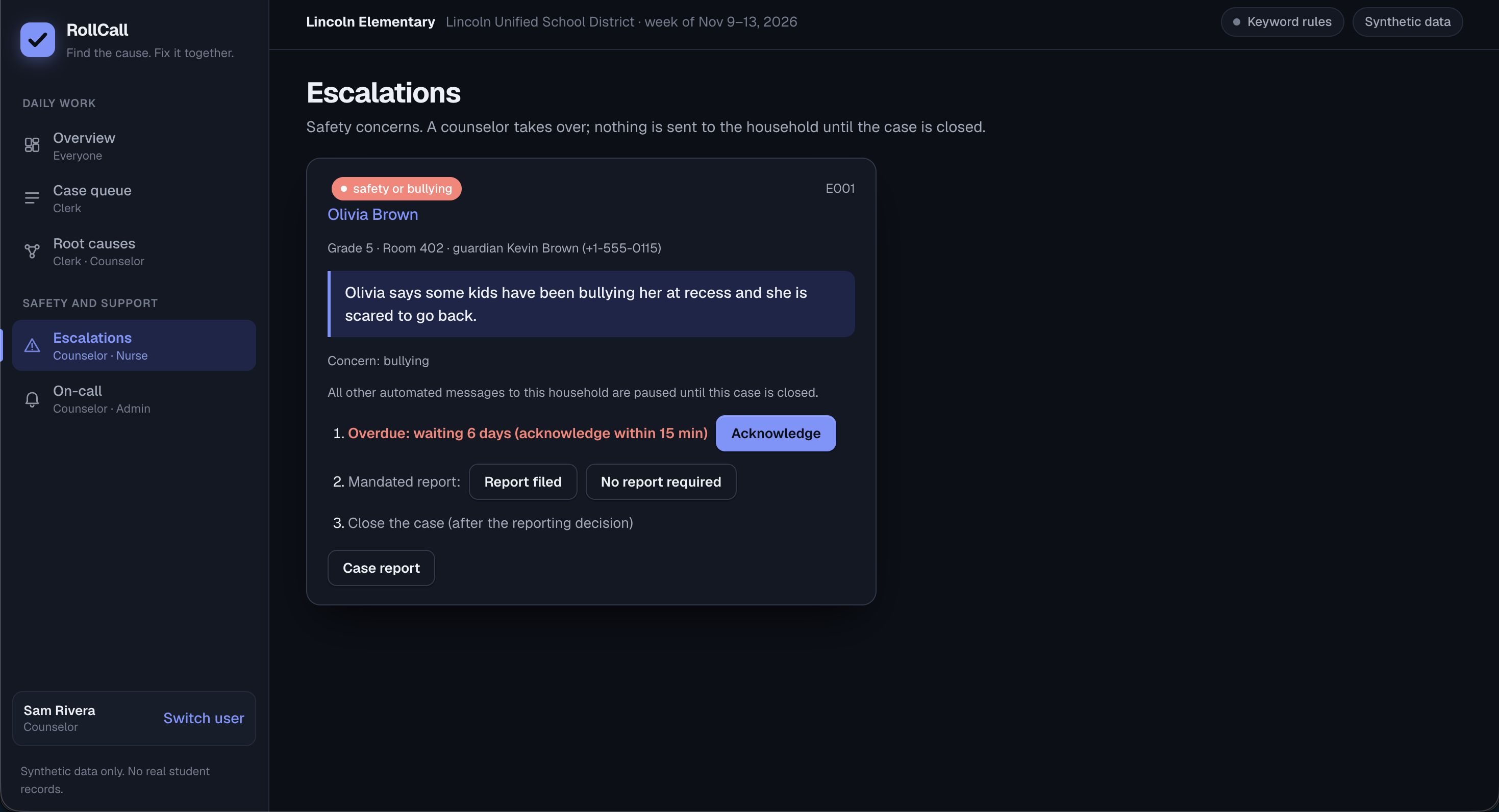
| 3. Protect | A keyword safety check runs before any model. Flagged replies get no automated answer: the on-call counselor is paged and all messages to that household pause. |
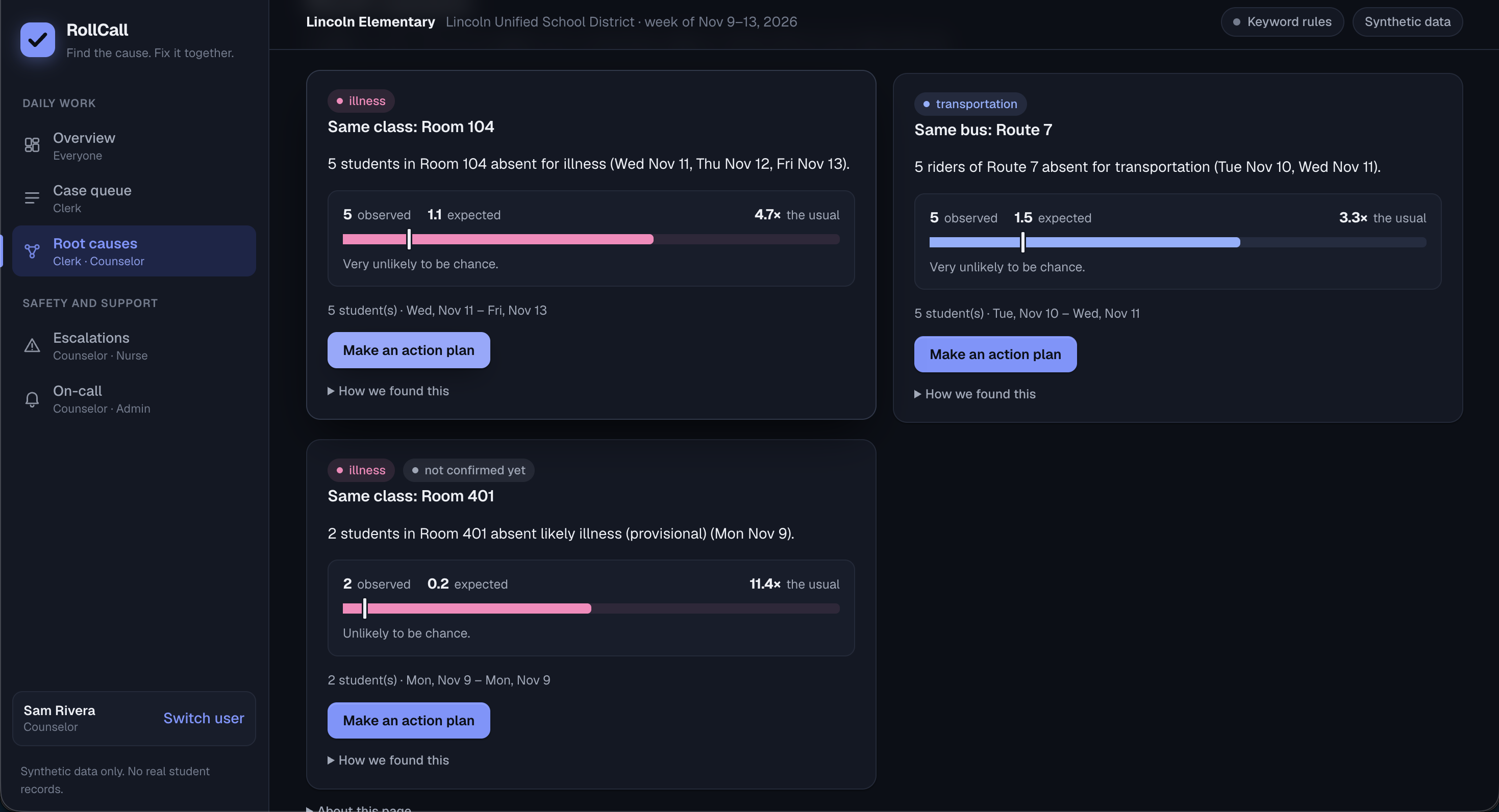
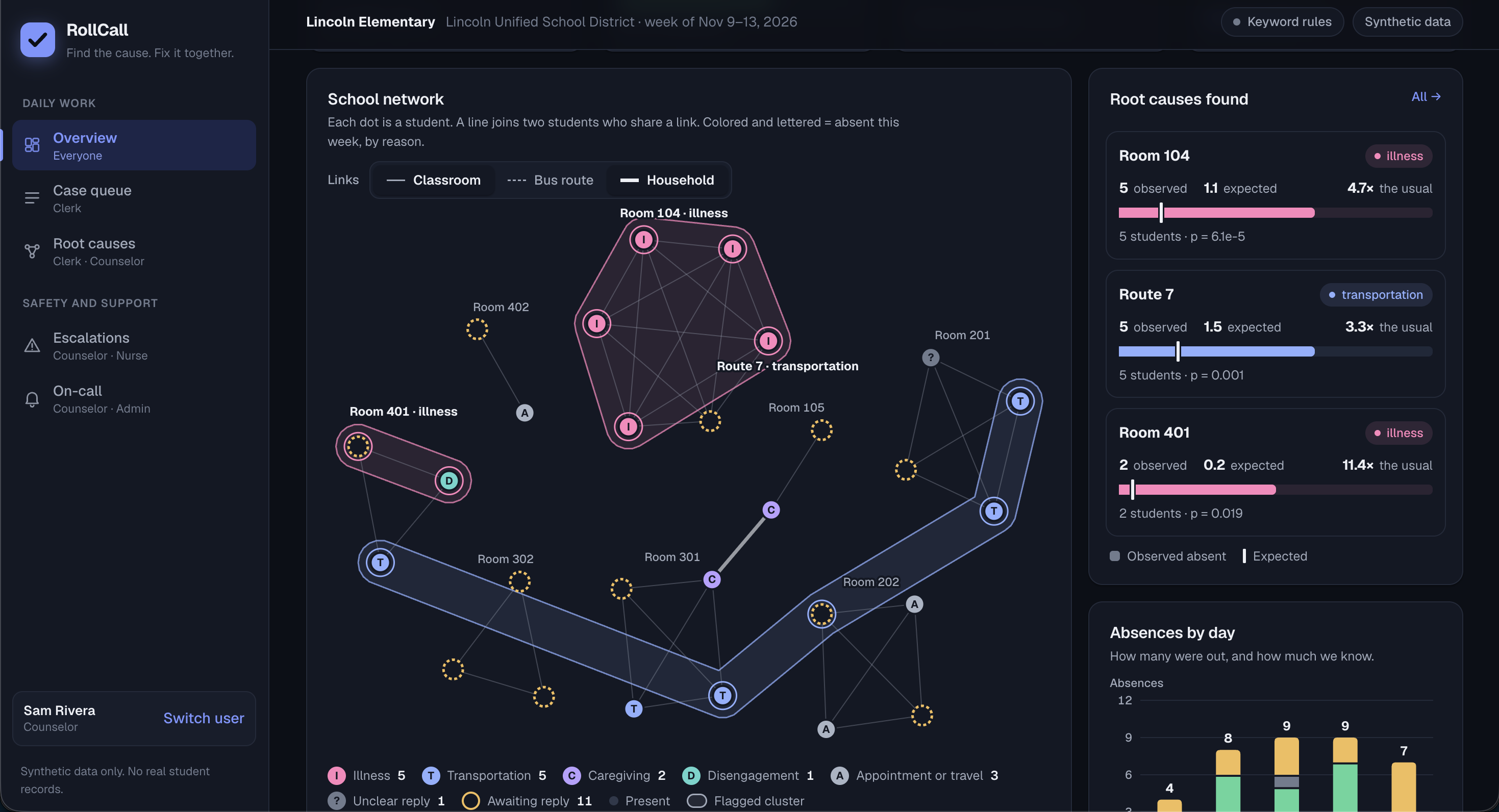
| 4. Find the cause | RollCall spots absence hotspots in a bus route, class or household, then uses the replies to name the cause: route failure, illness, caregiving. |
| 5. Act | It drafts a school action plan and a family message in the family's language. A clerk approves before anything is sent. |
| 6. Catch up | Students who missed class get a catch-up plan built only from the pacing guide, lighter after an illness. |
| 7. Learn | When a clerk corrects a label, similar replies are classified correctly next time. |
| 8. Explain | A counselor assistant answers "why are Route 7 kids out?" with cited messages. Read-only, it cannot send anything. |
| 9. Price it | A dashboard shows funding at risk and recovered by cause, in aggregate only. |
Barrier labels: illness · transportation · housing or food insecurity · caregiving · safety or bullying · disengagement · appointment or travel · unknown.
The one rule: revenue justifies the program. Risk of harm decides who gets help first.
How we built it
Stack at a glance
- Backend: one FastAPI service (Python, Pydantic) for messaging, classification, detection, plans and retrieval.
- Frontend: React 18 + TypeScript + Vite, with clerk, counselor, on-call and business-manager views behind a role-based sign-in.
- Data: absences in a TigerData (Postgres) hypertable; a continuous aggregate drives the daily timeline. The district's nightly attendance export comes in as a CSV.
- AI: Gemini for classification; LangChain Deep Agents for the counselor assistant; networkx for the school network.
- Messaging: Photon 2.0 two-way iMessage.
- Infra: Docker, Caddy (automatic HTTPS), Vultr, Cloudflare DNS, live at whereareallthekidsandhowmuchisthiscostingus.us.
Data (no real student records)
- To test the detector on a real school network, we used two public SocioPatterns datasets of face-to-face contacts recorded with wearable sensors: a primary school in Lyon and a high school in Marseille.
- We added bus routes, households and neighborhoods.
- A simulator spreads illness along contacts, breaks bus routes, closes roads, creates caregiving spikes and adds background absences. It writes family replies in several languages, with typos, one-word answers and label noise.
The two-stage detector
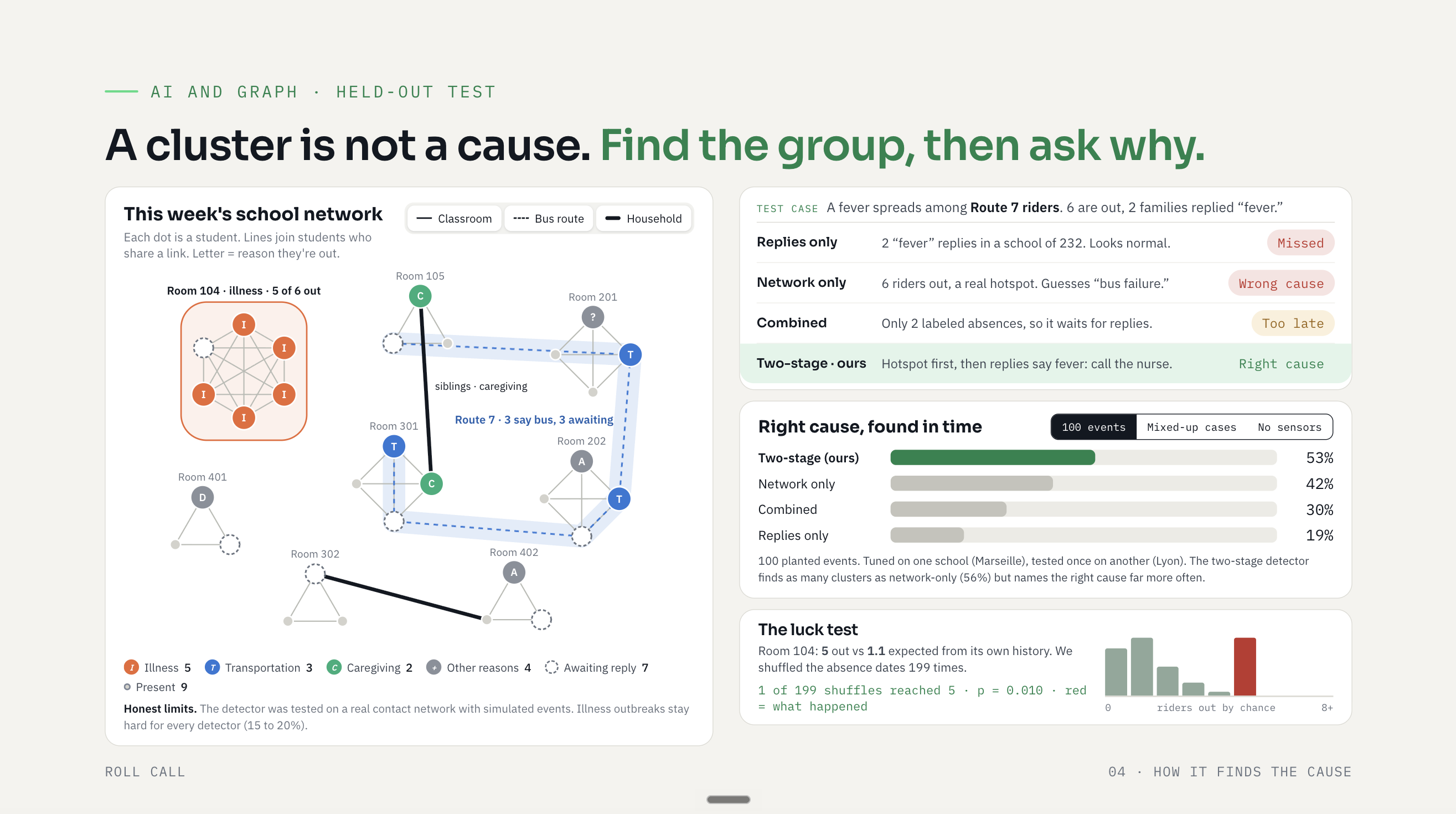
- Find the group. For every bus route, class section and household, we compare recent absences with that group's own baseline. To check whether a hotspot is just luck, we shuffle the absence dates 199 times and see how often chance scores as high as the real data. Then we correct for testing many groups at once (Benjamini-Hochberg).
$$p = \frac{1 + N_{\mathrm{hit}}}{1 + 199}$$
Here, N-hit is the number of shuffles that scored at least as high as the real data.
- Name the cause. Once a group is flagged, the family replies inside it pick the label. Until enough replies arrive, the cause stays provisional: the alarm holds and the explanation sharpens.
Pricing a cluster: weekly funding at risk is the daily funding rate times the total days missed by students in the cluster.
$$R = r \times D$$
Here, R is the funding at risk this week, r is the daily rate, and D is the total days missed in the cluster.
Does combining the layers matter? We tuned on Marseille and tested once on Lyon: 100 planted events, 30 of them deliberately confusing. Every detector was held to at most about one false alarm per 20 school days.
| Detector | How it works | Found the cluster | Right cause, in time |
|---|---|---|---|
| Replies only | Barrier counts across the school | 21% | 19% |
| Network only | Absence hotspots, ignores replies | 56% | 42% |
| Combined | Only counts absences that have a reply | 31% | 30% |
| Two-stage (RollCall) | Network finds it, replies name it | 56% | 53% |
- Confusing cases (a road closure that looks like a neighborhood problem, caregiving across a class, illness on a bus): two-stage 63% vs network-only 33%.
- Without sensors (only rosters, routes and households, which is what a school actually has): still 53%.
- Counselor assistant: Recall@5 of 0.96 (target 0.85), 0.99 across languages.
- Scale: a 50,000-student district in about 3 seconds per daily scan on a laptop.
Challenges we ran into
- Our first "combined" detector lost. Requiring a reply before counting an absence meant waiting on families who hadn't answered, so it found fewer clusters (31%) than the network alone (56%). Fix: let the network detect and the replies explain.
- Synthetic data can fool you. We tuned on one real school and tested once on another, pre-registered the confusing cases, and added label noise and background absences. The network is real; the absences are simulated. Illness outbreaks stayed hard for every detector (15 to 20%).
- Voice notes and SMS. We built and tested a voice pipeline (Gemini audio plus self-hosted Whisper), then pulled it: Photon's beta carries text and images only. The messaging layer is ready for SMS, which isn't shipped yet.
- Kids' data is sensitive. No real records, no friendship inference, no immigration status. Names become placeholders before any model call, and safety disclosures are visible only to counselors.
- Money can look punitive. Dollars appear only in aggregate, never per student, and never set priority.
- Texts can look like phishing. No links, no requests for money, passwords or ID, and families are told to verify by calling the school office. Every reply is treated as untrusted text.
- Demos fail on hackathon Wi-Fi. A demo mode replays the script with recorded model answers and no network.
Accomplishments that we're proud of
- Causes, not just counts. A clerk sees "Route 7 failure" or "illness in Room 104," the messages behind it, a drafted fix and a weekly price.
- An honest evaluation. A held-out ablation that tests whether each layer matters, including the detector that didn't work.
- Works with what schools already have. Rosters, routes and households perform as well as sensor data.
- Safety before automation. Every seeded safety message in our tests reaches a person with no automated reply, and the household's messages pause.
- A live, two-way loop. Parent texts → reason and evidence on the dashboard → cluster lights up → approved plan goes back in Spanish.
- It learns. After one clerk correction, the next similar reply comes back right.
What we learned
- "Why" is the missing signal. The same absence count can mean a flu, a broken route or a family in crisis, and each needs a different fix.
- Detecting and explaining are different jobs. The network notices that something is wrong; families say what it is.
- A simple threshold is just as fast. A plain absence-count alarm flags a spike as early as ours does (median lead of 0 days). It just can't name the cause, and the cause is what lets a school act.
- Design against your own simulator, or synthetic results mean nothing.
- A safe agent knows when to stop. Our most important feature hands a message to a person.
What's next for RollCall
- Pilot with a Newark school on its own attendance export: one clerk, one workflow, one metric.
- Model New Jersey's rules. New Jersey funds schools mostly by enrollment, not daily attendance, so in Newark an absence costs learning, staff time and chronic-absence accountability more than direct funding. California is only our reference state.
- Ship SMS and voice notes so every family can reply on any phone.
- Measure what matters: do families respond more, and do recovered days improve learning? The IES trial found no reading or math gain in its study year.
- Close the loop: check whether a cluster actually disappears after the school acts.
- Keep the safeguards: a human approves every plan, no friendship inference, no revenue-based priority.
Data and research: PPIC on chronic absenteeism in California · IES texting study summary · SocioPatterns contact networks: Lyon primary school (Stehlé et al., PLoS ONE 2011) and Marseille high school (Mastrandrea et al., PLoS ONE 2015), CC BY-NC-SA.
Built With
- caddy
- cloudflare
- deepagents
- docker
- fastapi
- gemini
- google-genai
- imessage
- langchain
- networkx
- numpy
- photon
- postgresql
- pydantic
- pytest
- python
- react
- scipy
- tigerdata
- timescaledb
- typescript
- uvicorn
- vite
- vultr
