-
-
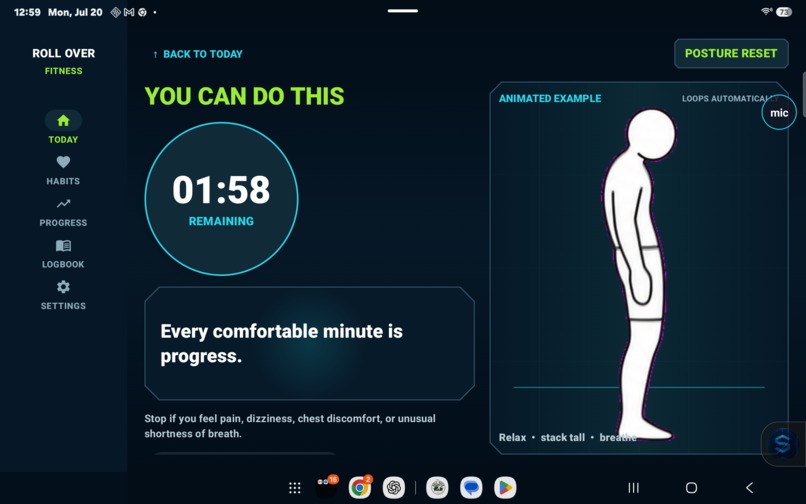
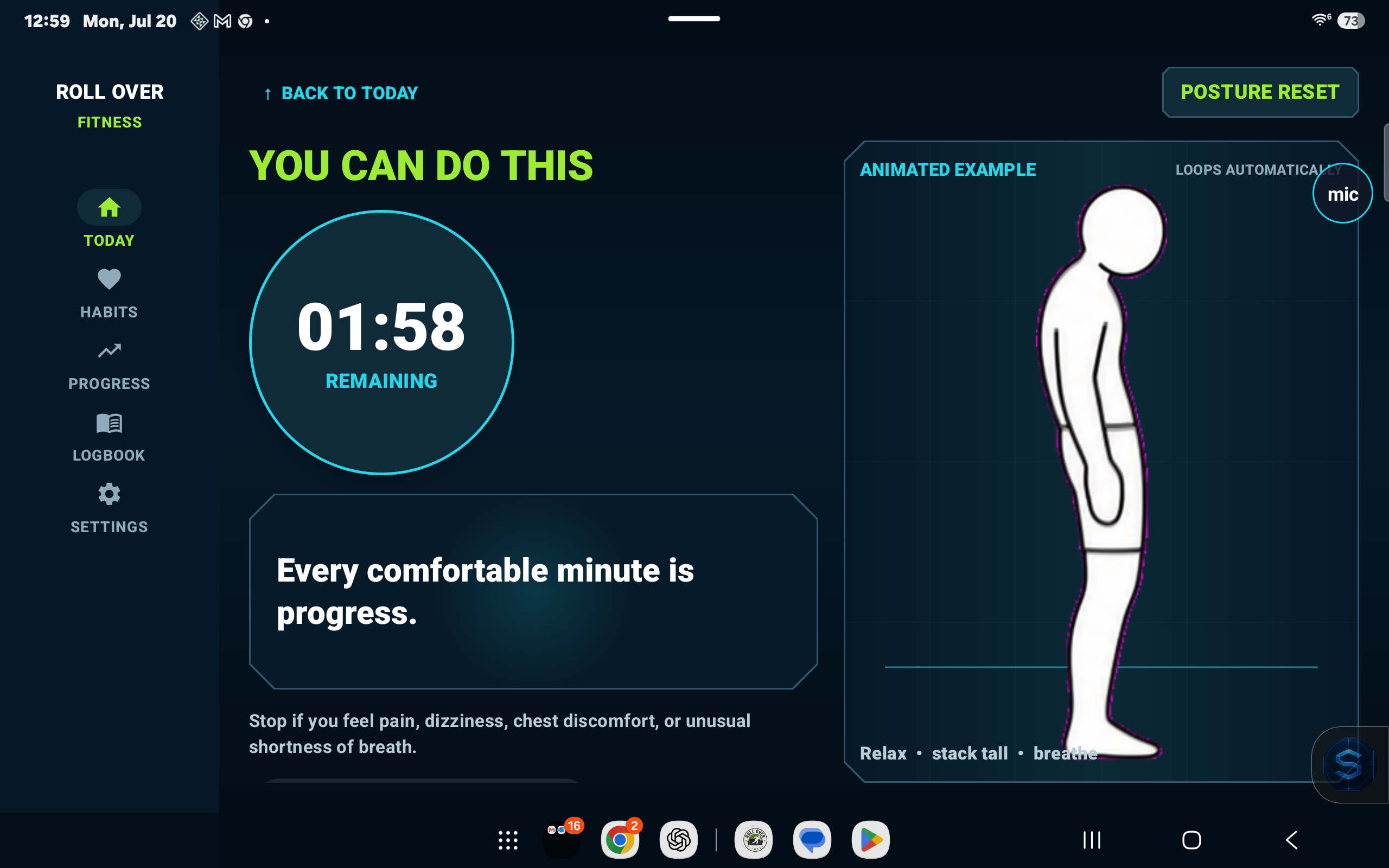
Animated example
-
Knowledge
Inspiration
Most fitness apps begin with the assumption that users are already capable of completing a beginner workout. But for many people, even a beginner program can feel physically overwhelming or emotionally intimidating.
I created Roll Over Fitness for people who need a step before “beginner.” It is a six-week movement-readiness program designed to help users gradually build mobility, stamina, confidence, and the habit of moving every day.
The goal is not to push users as hard as possible. The goal is to meet them where they are and prepare them to succeed in a traditional beginner workout program.
What it does
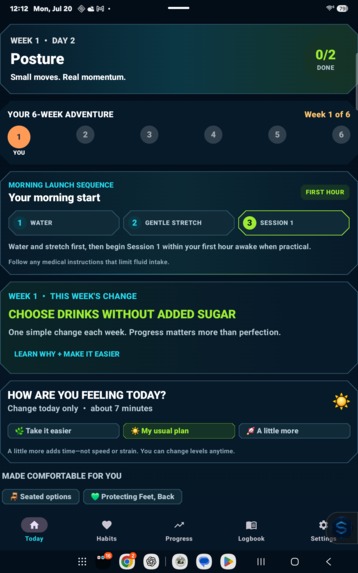
Roll Over Fitness creates a starting plan based on the user’s fatigue level, flexibility, need for chair support, mobility aids, movement restrictions, and sensitive body areas.
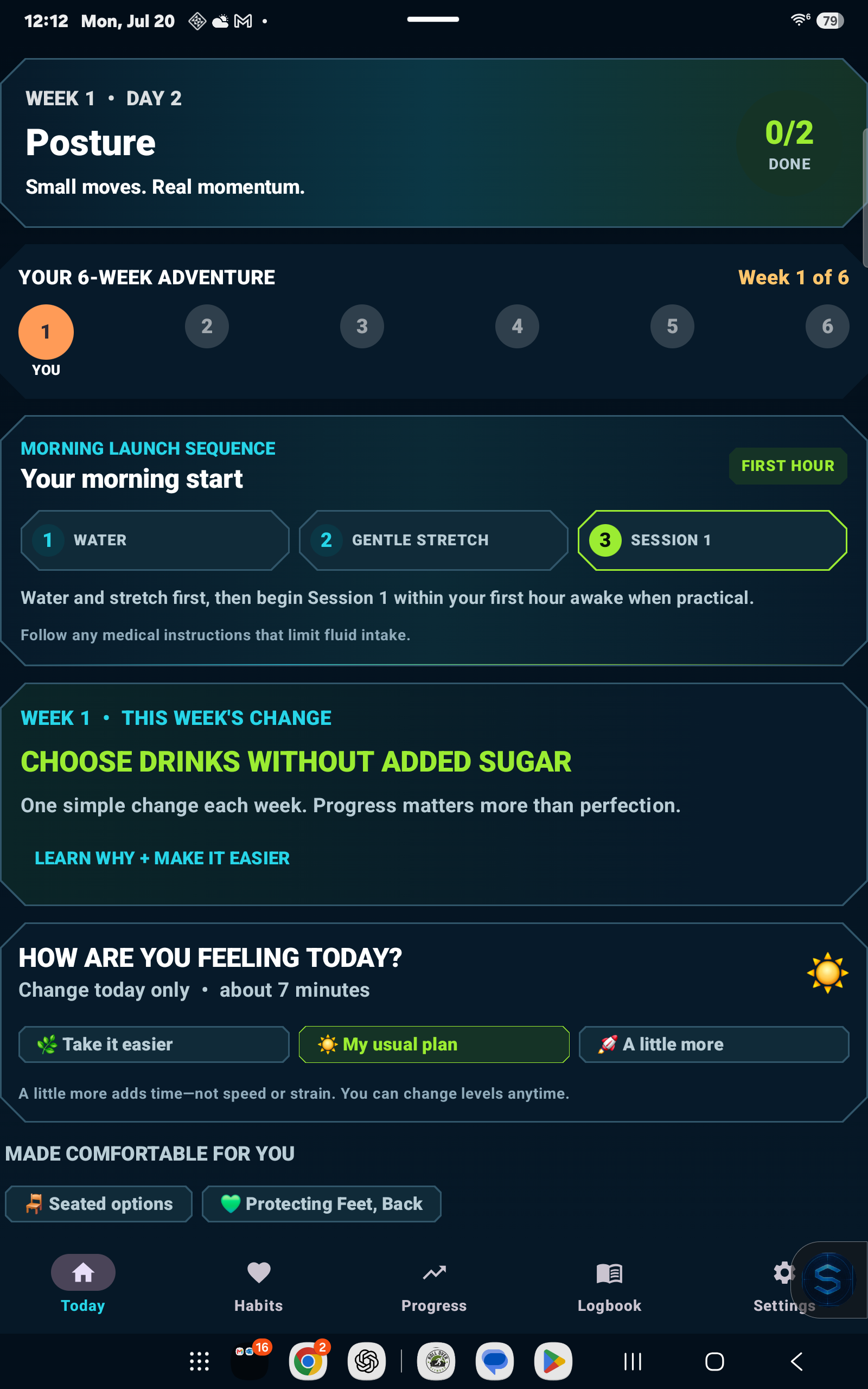
Each day includes short, approachable movement sessions. Users can select:
- Take it easier
- My usual plan
- A little more
This allows the workout to match how the user feels that day.
The app also includes:
- A complete six-week movement program
- Water and stretching reminders
- Timed workouts with extra-time recording
- Animated exercise examples
- Automatic logbook entries
- Progress and beginner-readiness milestones
- Weekly healthy-habit goals
- Nutrition education and food facts
- Supportive, rotating affirmations
- Advanced versions of Weeks 5 and 6 for areas that still need improvement
- Local-only storage with no account, advertising, or subscription
How I built it
I built Roll Over Fitness as a native Android application using Kotlin, Jetpack Compose, Material 3, Navigation Compose, Coroutines, and Android Data Store.
The project uses a modular architecture:
apphandles navigation, theming, and application statecore: modelcontains program content and domain modelscore: datamanages local persistence- Separate feature modules handle onboarding, Today, Progress, Logbook, Healthy Habits, and Settings
I used GPT-5.6 and OpenAI Codex throughout development. Codex helped translate my product ideas into Kotlin code, build the modular structure, diagnose bugs, create tests, refine layouts, and repeatedly install updated builds on a physical Android tablet.
This was not a single-prompt project. I tested each version, identified what felt confusing or weak, and directed the next iteration. GPT-5.6 and Codex accelerated the implementation while I made the product, safety, program, and design decisions.
Challenges I faced
One major challenge was making the app simple without making it feel empty or generic. I developed a dark navy, neon green, and cyan visual system that feels energetic while remaining readable and unintimidating.
Responsive design was another challenge. Some widgets changed appearance or became crowded when the tablet rotated. I had to create layouts that maintained the same theme and usability in both portrait and landscape orientations.
Workout timing also required careful work. The timer needed to survive app interruptions, continue counting forward after reaching zero, record extra exercise time, and automatically save completed activities to the logbook.
Creating smooth animated exercise examples was difficult as well. Early versions blinked or appeared glitchy, so the animation system was repeatedly refined and expanded across the movement categories.
Navigation testing exposed additional problems, including edit screens that trapped users without an obvious return path. Testing the app on actual hardware helped uncover issues that would have been easy to miss by looking only at the code.
What I learned
I learned that building a useful product requires much more than generating code. Clear product direction, repeated testing, empathy for the intended user, and attention to small interactions are essential.
I also learned how effective AI-assisted development can be when it works as a collaboration. Codex made rapid experimentation possible, but the strongest results came from giving specific feedback, testing every important flow, questioning weak decisions, and continuing to iterate, even understands my slang.
Most importantly, I learned that accessibility in fitness is not only about easier exercises. It is also about language, confidence, flexibility, safety, and helping users feel that showing up counts.


Log in or sign up for Devpost to join the conversation.