-
-
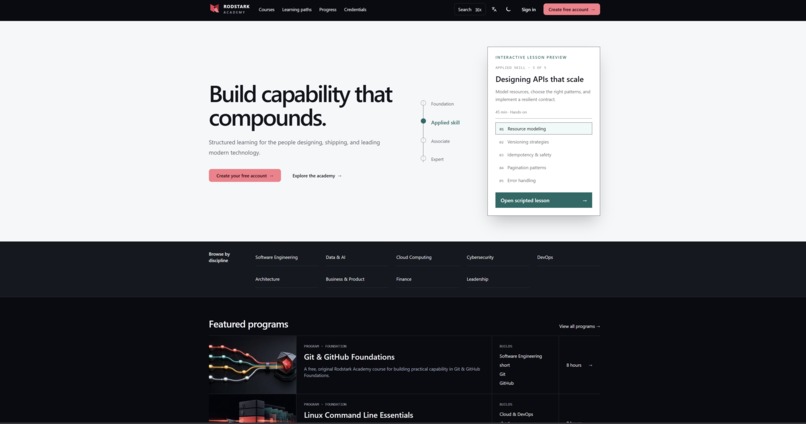
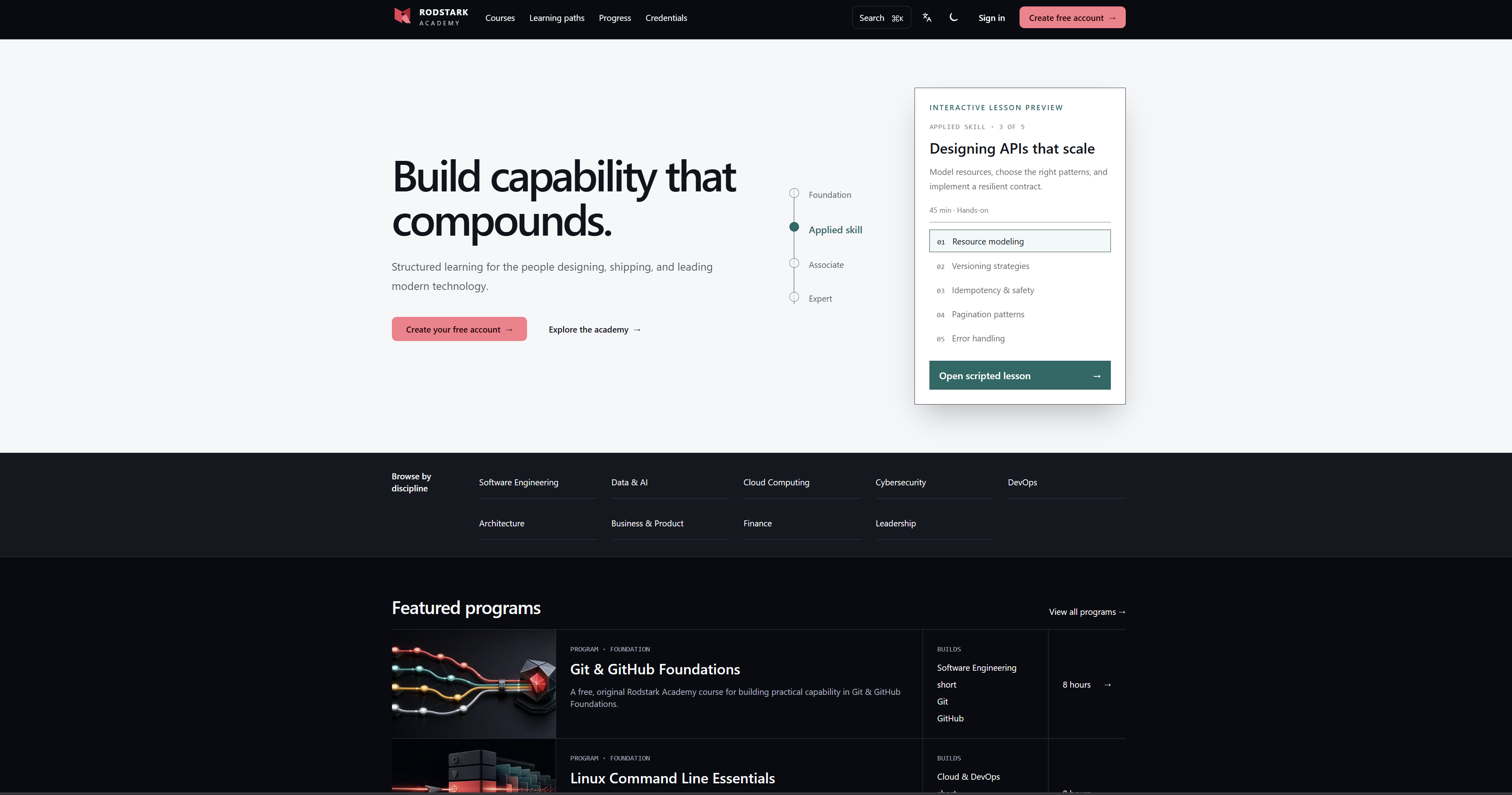
Landing Page
-
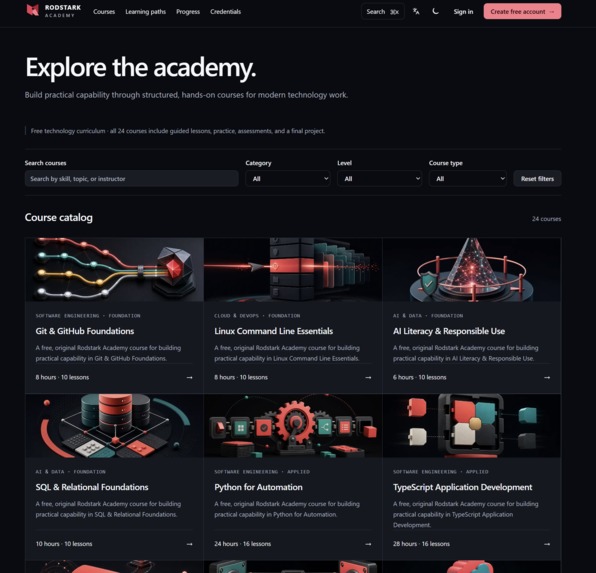
Courses
-
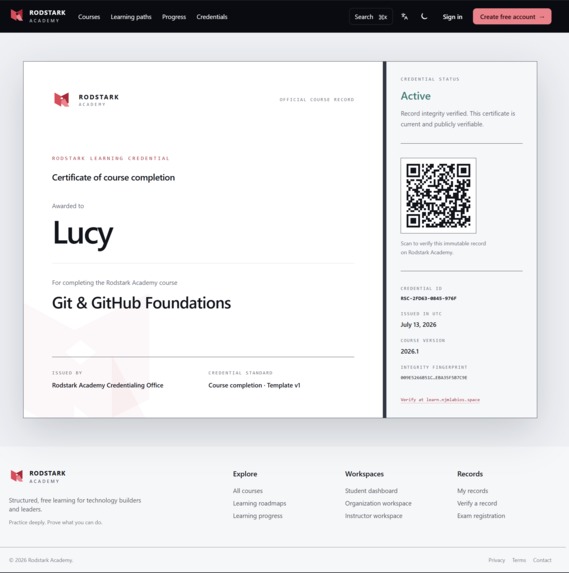
Verify Certificate
Inspiration
Technology education often falls into one of two extremes: short tutorials that teach isolated syntax, or expensive programs that remain inaccessible to many learners.
I created Rodstark Academy to bridge that gap. A free, production-oriented learning platform where people can develop practical skills through structured courses, guided learning paths, interactive lessons, assessments, projects, AI-assisted study tools, and independently verifiable credentials.
The goal was not to build another collection of videos. I wanted to create a complete learning ecosystem that treats education as an auditable journey:
Learn real-world technology. Build practical skills. Earn verifiable credentials.
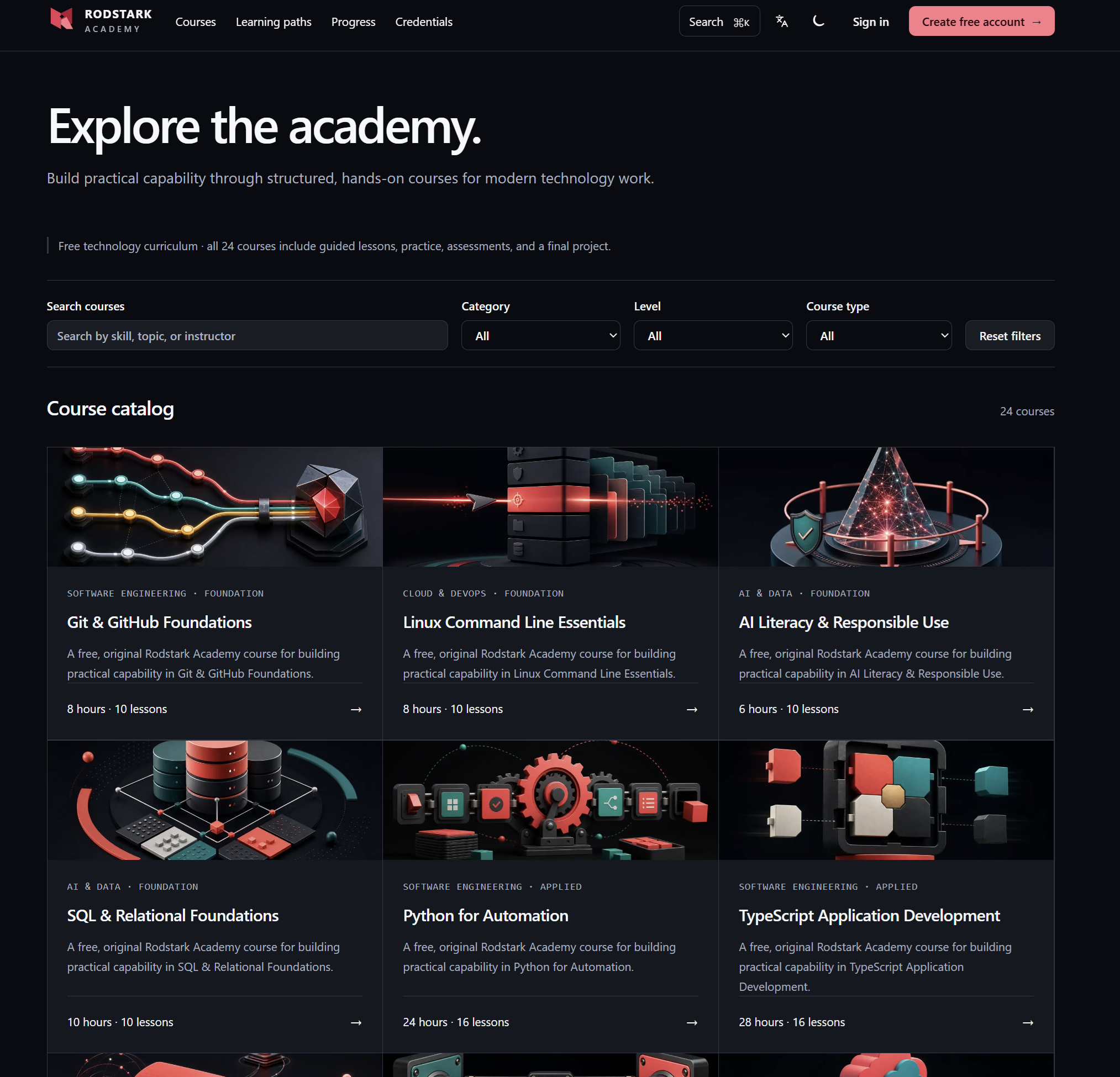
Rodstark Academy currently includes:
- 24 authored technology courses
- 420 structured lessons
- 8 learning paths
- 4 professional programs
- A comprehensive 2,400-hour E-Degree curriculum
- Interactive assessments and practical projects
- AI-powered learning assistance
- Community and enterprise workflows
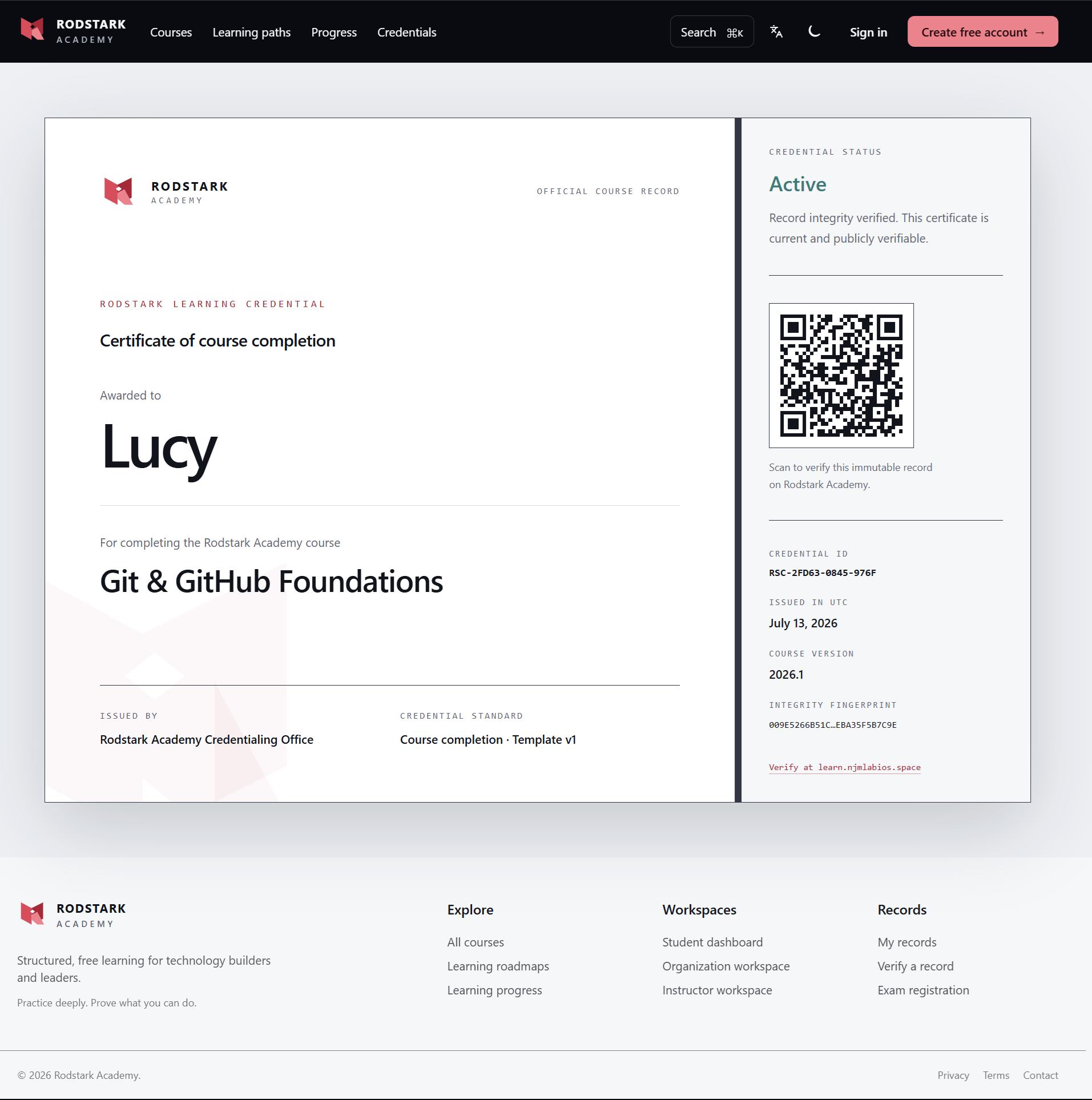
- Cryptographically verifiable badges and certificates
All learning content is currently available for free.
What It Does
Rodstark Academy provides learners with a structured environment for progressing from foundational concepts to professional-level technology skills.
Learners can:
- Explore courses across software engineering, artificial intelligence, cloud computing, cybersecurity, data, and emerging technologies
- Follow curated learning paths and professional programs
- Complete interactive lessons, assessments, and practical projects
- Track durable progress across courses and programs
- Use AI-powered study tools for contextual learning assistance
- Earn badges and certificates backed by independently verifiable evidence
- Verify credentials without relying solely on visual certificate files
- Participate in community-oriented learning workflows
The platform intentionally separates course completion from credential merit.
Completing lessons records academic progress, while certificates and badges require qualifying assessment or project evidence. This prevents credentials from becoming simple participation awards and makes them more meaningful to learners, employers, and educational organizations.
How I Built It
Rodstark Academy was built as a feature-first modular monolith using Next.js 16, React 19, and TypeScript.
The Next.js App Router powers both public and authenticated experiences. Server Components handle secure data rendering, while versioned route handlers expose the platform’s application programming interface through /api/v1.
The application is organized into:
- Domain-focused feature modules
- Application and infrastructure services
- Reusable accessible interface components
- Versioned API route handlers
- Deterministic curriculum synchronization scripts
- Forward-only database migrations
- Automated validation and test pipelines
Data and Security
Supabase PostgreSQL provides durable platform state, while Supabase Auth manages learner identity.
The database architecture uses:
- Row-level security for tenant and learner isolation
- Indexed relational structures
- Transactional PostgreSQL functions
- Append-only assessment and evidence ledgers
- Server-side role and organization authorization
- Forward-only schema migrations
- Encrypted enterprise webhook delivery
Sensitive mutations are authorized server-side rather than trusting client-provided roles or organization data.
Verifiable Credentials
One of the platform’s most important features is its credential evidence model.
Instead of treating a downloadable certificate as the source of truth, Rodstark Academy records immutable credential evidence in an append-only ledger. Credential records are cryptographically signed using Ed25519.
A badge or certificate is therefore derived from:
[
\text{Credential Validity}
\text{Verified Evidence} + \text{Cryptographic Signature} + \text{Active Lifecycle Status} ]
This allows credentials to be independently checked while keeping course completion, assessment evidence, issuance, revocation, and presentation logically separate.
Artificial Intelligence
Rodstark Academy uses the Vercel AI SDK to provide bounded and contextual AI study experiences.
The AI architecture supports:
- Vercel AI Gateway
- Direct OpenAI integration
- Explicit offline demonstration mode
- Stable generation identifiers
- Pseudonymized requests
- Persisted generation records
- Server-side validation and usage boundaries
The AI assistant is designed to support learning—not replace the learner’s work or automatically grant academic credit.
Enterprise Interoperability
The platform was also designed with future institutional and enterprise use in mind.
Its integration architecture supports:
- SCORM-ready content packages
- LMS-compatible exports
- xAPI-style learning statements
- Scoped API keys
- Signed and encrypted webhooks
- Retry policies and bounded delivery batches
- Dead-letter handling for failed integrations
- Multi-tenant organization isolation
Quality Engineering
The project includes automated validation for:
- Strict TypeScript correctness
- ESLint rules
- Unit and integration tests
- End-to-end browser tests
- Accessibility testing
- Curriculum integrity
- Brand asset consistency
- Documentation completeness
- Production build verification
The primary verification workflow runs:
npm run verify
npm run test:e2e
Testing is implemented with Vitest, Testing Library, Playwright, and axe-core.
Challenges I Faced
Designing a Large Curriculum Without Losing Consistency
Managing hundreds of lessons across multiple courses, paths, and professional programs created significant content-integrity challenges.
A lesson could be valid individually while still creating broken prerequisites, incorrect ordering, duplicated identifiers, missing assessments, or inconsistent program totals.
I addressed this by building deterministic content-validation and synchronization scripts. Curriculum data is checked before production builds and can be synchronized idempotently, meaning repeated synchronization produces the same valid platform state.
Separating Progress From Credential Trust
A conventional learning platform may issue a certificate immediately after a learner reaches the final lesson. That model is simple, but it does not prove competence.
The challenge was creating a system where progress remained user-friendly while credentials remained trustworthy.
I solved this by separating:
- Lesson progress
- Course completion
- Assessment submissions
- Project evidence
- Credential eligibility
- Credential issuance
- Credential verification
- Credential revocation
This produced a more complex domain model, but it made the credential system substantially more defensible.
Supporting Public Demonstrations Without Creating Fake Learner State
The platform needed to remain explorable even when authentication, AI providers, or cloud environment variables were unavailable.
However, demonstration data must never be confused with authoritative learner records.
I implemented a clearly labeled, read-only preview mode. Public preview content can demonstrate the product safely, but it cannot create progress, assessments, credentials, or other authoritative state.
Securing a Multi-Tenant Learning Platform
Educational platforms contain identity data, progress records, assessment evidence, administrative controls, and credentials. Multi-tenant support adds another layer of risk because data must remain isolated between organizations.
The solution required defense in depth:
- Supabase row-level security
- Server-side role validation
- Organization-scoped authorization
- Transactional database operations
- Append-only evidence records
- Restricted API keys
- Encrypted webhooks
- Non-cacheable sensitive responses
Making AI Useful Without Making It Authoritative
AI can explain concepts, provide examples, and guide learners, but it should not silently become the source of academic truth.
I had to design the AI system with clear boundaries. AI responses are contextual and assistive, while curriculum definitions, assessment rules, progress records, and credential decisions remain deterministic and server-controlled.
Balancing Scale, Performance, and Maintainability
The platform contains a large curriculum and several interconnected domains, including learning, assessment, credentials, organizations, AI, integrations, and administration.
Splitting everything into distributed microservices would have added operational complexity too early. Keeping everything in one unstructured application would have made the system difficult to evolve.
A feature-first modular monolith provided the appropriate balance: strong domain separation within one deployable Next.js application, with clear boundaries that can support future extraction if scale demands it.
What I Learned
Building Rodstark Academy reinforced that a learning platform is not primarily a content website—it is a system of records.
The most important lessons were:
- Curriculum content should be validated like source code
- Course completion and demonstrated competence are different concepts
- Credentials require lifecycle management, not just PDF generation
- Public demonstrations must never contaminate authoritative records
- AI should support deterministic educational systems rather than control them
- Multi-tenant authorization must be enforced at both the application and database layers
- Append-only evidence structures are valuable for auditability and trust
- Modular architecture matters even when an application is deployed as a single system
- Accessibility, security, testing, and operational documentation must be part of the initial architecture—not postponed until after launch
What's Next
The next phase of Rodstark Academy will focus on expanding the learning ecosystem while preserving its free and evidence-driven foundation.
Planned directions include:
- Additional technology courses and professional programs
- More advanced project-based assessments
- Improved AI study and curriculum navigation tools
- Richer learner analytics and progress insights
- Expanded community collaboration features
- Institutional and enterprise administration capabilities
- Broader LMS and learning-record interoperability
- Enhanced credential verification and evidence presentation
- Additional accessibility and localization support
Rodstark Academy is ultimately intended to demonstrate that high-quality technology education can be practical, accessible, secure, and verifiable—without placing essential learning content behind a paywall.
Built With
- agentic
- gpt5.6
- javascript
- next.js
- node.js
- react
- supabase
- typescript
- vercel

Log in or sign up for Devpost to join the conversation.