Inspiration
Inspiration
I get cybersick. I can't play VR games for more than 20 minutes without feeling nauseous, and every time I put on a headset I felt like I was racing against a timer. I didn't want to give up on VR, but every app I tried threw me straight into motion-heavy experiences with no warm-up. I wanted a gentler introduction, so I built the one I wished existed. I called it Roco.
What it does
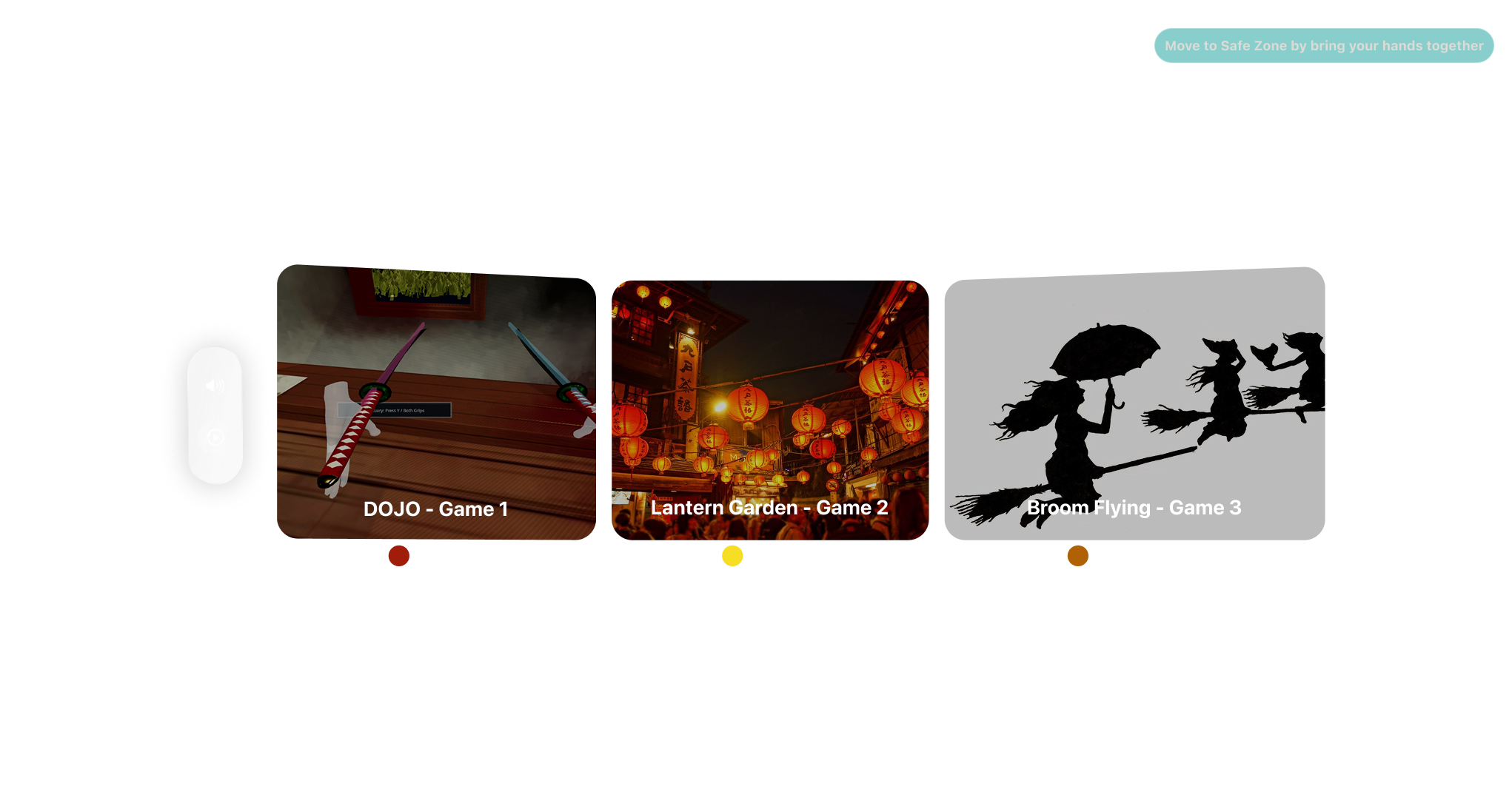
Roco is a web-based VR trainer built around three mini games, each adding a little more motion than the last:
- Fruit Slice (no movement). You stand in a still courtyard and slice tossed fruit with motion-tracked swords. The horizon never moves, so your brain learns that the view matches your head. Later levels add leaning, stepping and faster fruit.
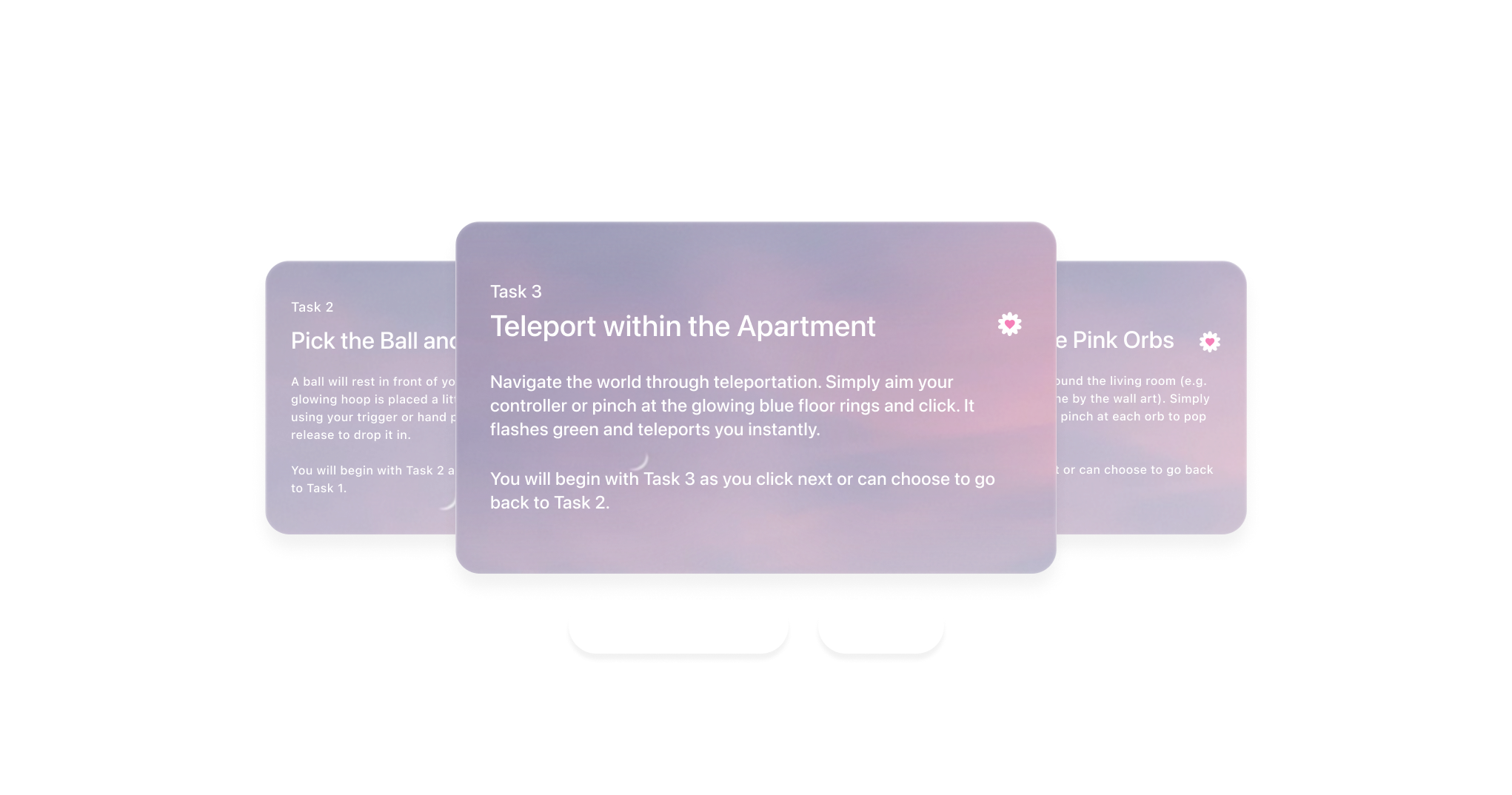
- Lantern Valley (movement in small doses). You teleport between glowing stones, then try a very short dash, then slow smooth walking with a tightening vignette and snap turns.
- Broom Flight (continuous motion). You glide, then race, on a broom that stays fixed in view as a visual anchor.
Other features:
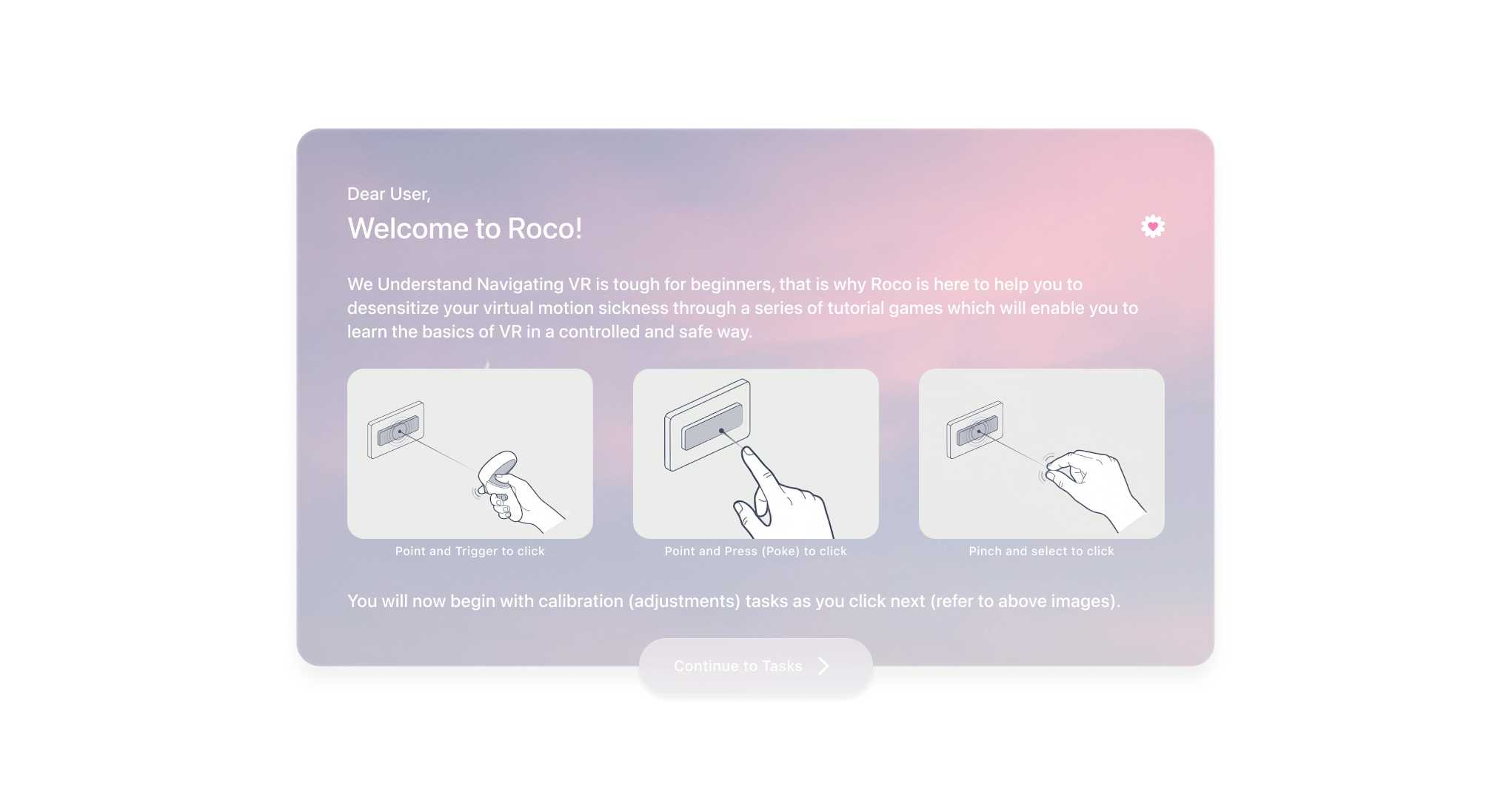
- Tutorials first. Controller and gesture tutorials run at the start of every session.
- Comfy Zone. One gesture takes you to a pink-sky refuge with a guided breathing bubble and soft noise at 15% volume.
- Progress gating. Levels unlock in order, and each one ends with an encouraging card.
- No install. It runs in the headset's browser, with no account.
How I built it
- Stack: React Three Fiber,
@react-three/xrand Tailwind CSS, deployed on Vercel. - Spatial UI: floating glass panels anchored in world space, never head-locked at close range.
- Environments: I loaded supplied GLB models and added a desktop fallback with WASD, mouse look and floor raycasting for testing.
- Comfort system: an adaptive vignette scales with speed and turn rate:
$$v(s) = v_{\min} + (v_{\max} - v_{\min}) \cdot \min\left(1, \frac{s}{s_{\text{cap}}}\right)$$
where \( s \) is the current speed and \( s_{\text{cap}} \) is the speed at which the vignette is fully closed.
- Breathing guide: the bubble follows a 4 second inhale and 6 second exhale, so one cycle takes \( 4 + 6 = 10 \) seconds, about 6 breaths per minute.
- Zero-latency rendering: poses come straight from the XR frame data, with no smoothing on the head or hands.
Challenges I ran into
- Making every level a real training step. My early drafts treated menus and customization as levels. I reworked each one into a graded exposure step.
- Building for a problem I have. Testing motion features can make me sick too, so I worked and tested in short sessions.
- Doing it all alone. Design, 3D, UI, audio and comfort tuning all landed on one person, so I cut scope and prioritized the Comfy Zone and the progression.
- Performance. Dropped frames cause discomfort, so I kept models light and reduced quality on weaker headsets.
- Browser limits. Audio autoplay is blocked, so the Comfy Zone sound starts after the first interaction. Safari on iPhone doesn't support the full experience.
- Honest messaging. I avoided promising a cure. The cards say things like "easing" and "getting used to".
- Original content. I used original names and designs instead of existing game brands.
Accomplishments that I'm proud of
- A clear progression from stillness, to teleporting, to continuous flight.
- A Comfy Zone that is one gesture away at all times.
- An encouraging tone that doesn't overclaim.
- Building something for a problem I live with, completely solo.
What I learned
- Comfort comes from gradual exposure, not from avoiding motion.
- A fixed visual anchor, like the broom, helps a lot with continuous motion.
- Small details, such as snap turning, a steady horizon and a vignette, matter more than visual polish.
- Safety messaging is part of the design. Roco is not medical treatment, and results vary.
What's next for Roco
- Real user testing with other cybersick players and comfort surveys
- More games and levels, including seated-only options
- Adaptive difficulty based on the user's comfort ratings
- Accessibility features such as one-handed play and subtitles
- Support for more headsets and browsers ## What it does
