Inspiration
We wanted to rethink how people manage their time. Traditional calendars are great for viewing events, but when plans change, users often have to manually rearrange tasks and find new time slots. We were inspired to build Rocky, an AI-powered calendar that lets people plan their schedules naturally through voice and spend less time organizing their lives.
What it does
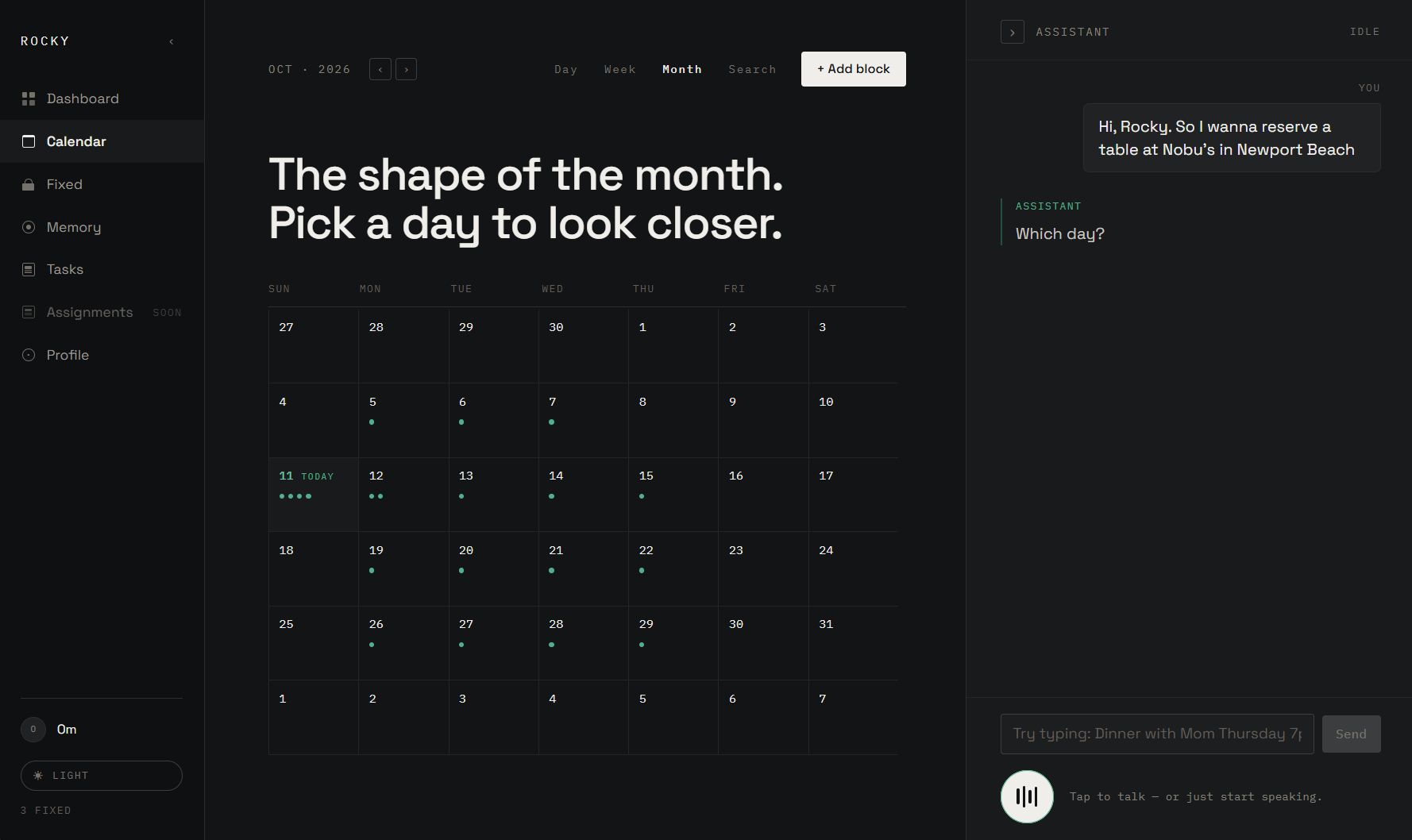
Rocky is a voice-driven, AI-powered personal calendar that turns natural language into scheduling actions. Users can ask Rocky to create tasks, schedule work, and reorganize their calendars around existing commitments. Its scheduling logic considers available time, deadlines, and conflicts to help create a realistic plan. Rocky also supports local storage, keeping calendar data on the user's device.
How we built it
We built Rocky using TypeScript and Vite for the application, with Dexie and IndexedDB for local data persistence. We integrated the OpenAI API to power an AI planner that uses tool calling to interact with calendar events and tasks. For voice interaction, Rocky uses browser speech recognition and supports transcription in the desktop application. We also use ElevenLabs for voice output when configured, with a system voice fallback. Electron provides a macOS desktop application.
Challenges we ran into
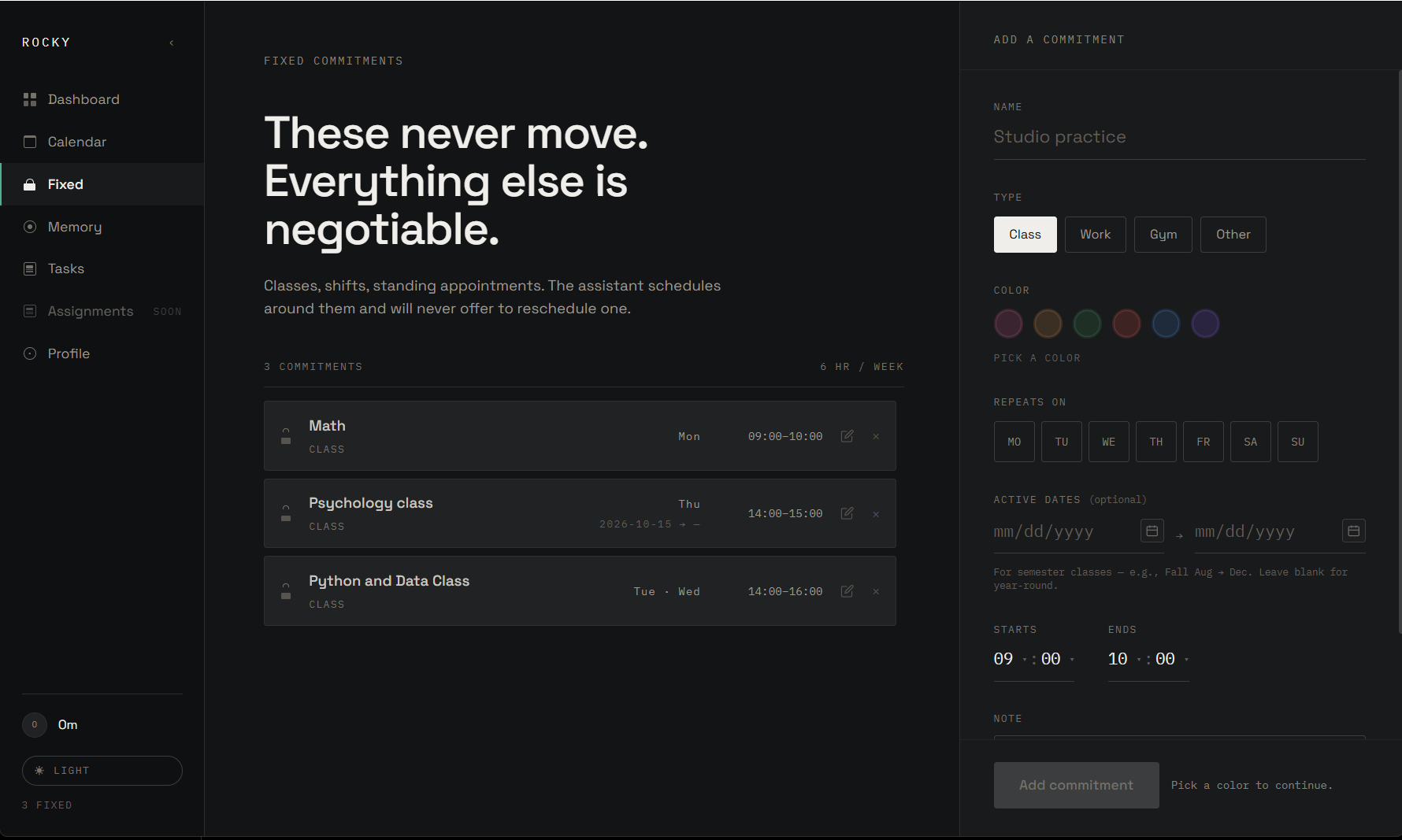
One of our biggest challenges was making scheduling more than simply placing tasks into empty time slots. The planner needs to account for fixed commitments, deadlines, and conflicts while attempting to find suitable alternative times for displaced tasks. Another challenge was connecting a conversational AI to real calendar operations so that user requests could lead to actual changes rather than just text suggestions. Supporting voice interactions across browser and desktop environments also required careful integration.
Accomplishments that we're proud of
We're proud to have built a working foundation for a voice-first scheduling assistant that connects natural-language requests to real calendar operations. Rocky combines AI-powered planning, task management, conflict handling, and local data persistence in one application. We're especially proud of the local-first approach, which keeps calendar information on the user's device while allowing the AI to help organize the schedule.
What we learned
We learned that building a useful AI assistant requires more than connecting a language model to an interface. The assistant needs well-defined tools, reliable data operations, and scheduling rules to turn its responses into meaningful actions. We also learned how important it is to handle edge cases, such as conflicting commitments and tasks that cannot fit before their deadlines. Separating the AI planning layer from the scheduling logic helped us build a more structured and maintainable application.
What's next for Rocky - Your week. Your voice. Your plan.
We want to make Rocky an even more seamless personal scheduling assistant. Our next goals include external calendar synchronization, wake-word activation, and streaming or interruptible voice conversations. We also want to continue improving scheduling reliability and the user experience. Our long-term vision is simple: users should be able to tell Rocky what they need to accomplish and let it help turn those intentions into a realistic plan.
Built With
- ai
- ai-agents
- calendar
- css
- dexie
- electron
- elevenlabs
- html
- indexeddb
- javascript
- local-storage
- natural-language-processing
- openai-api
- productivity
- react
- tool-calling
- typescript
- vite
- voice-recognition
- web-speech-api

Log in or sign up for Devpost to join the conversation.