-
-
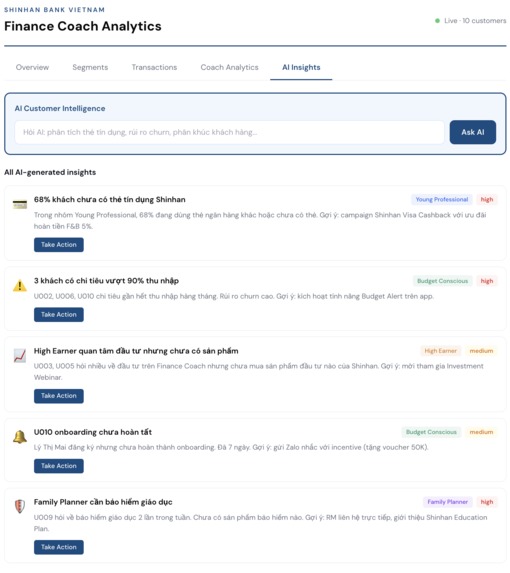
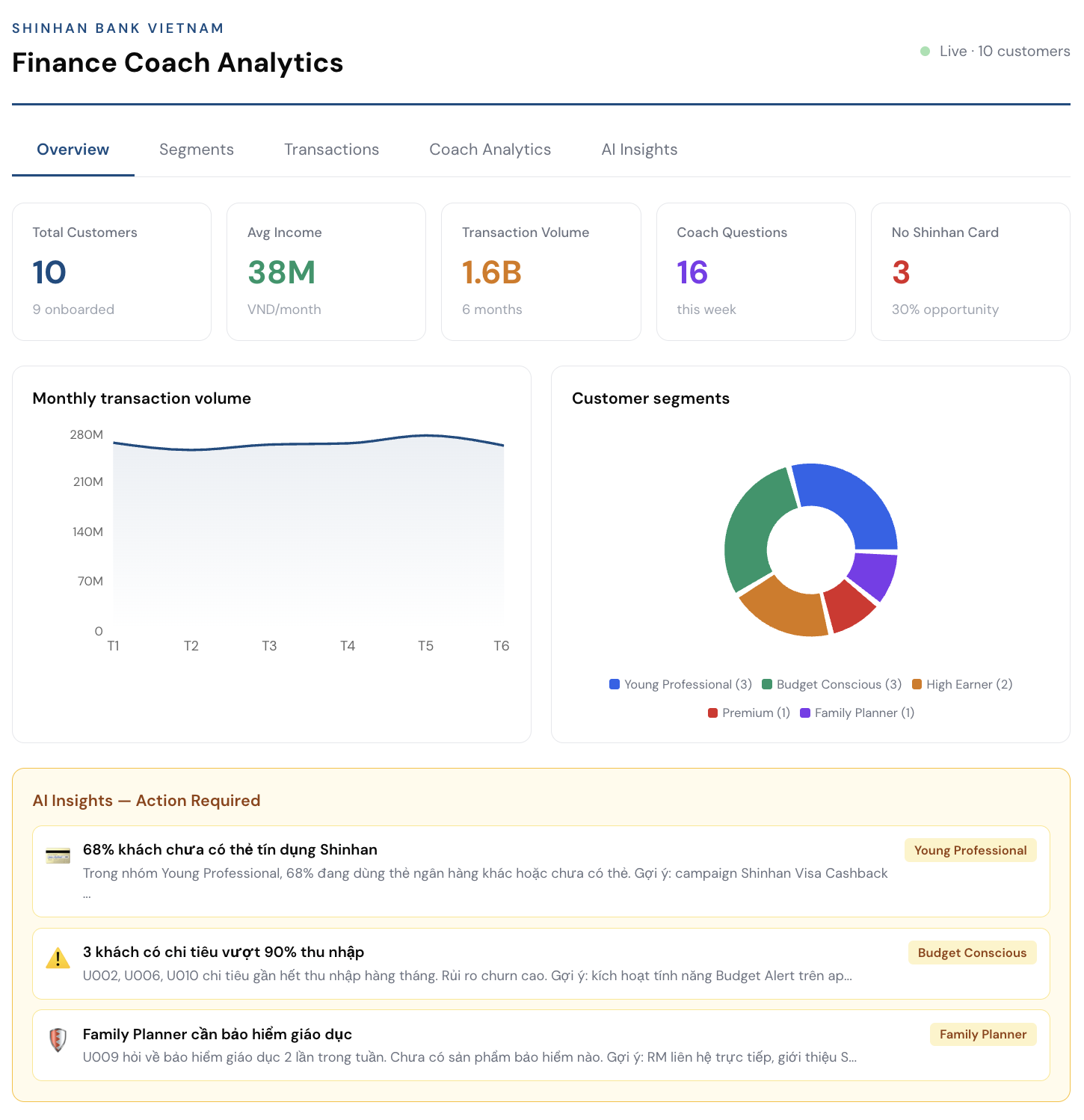
Banker View: Consumer Insights
-
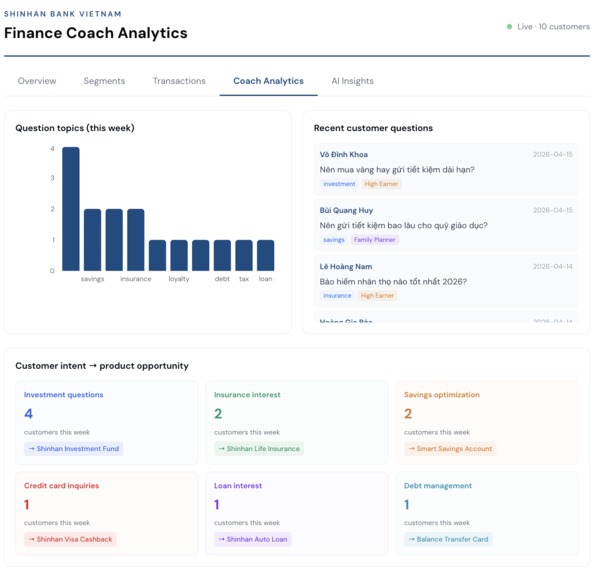
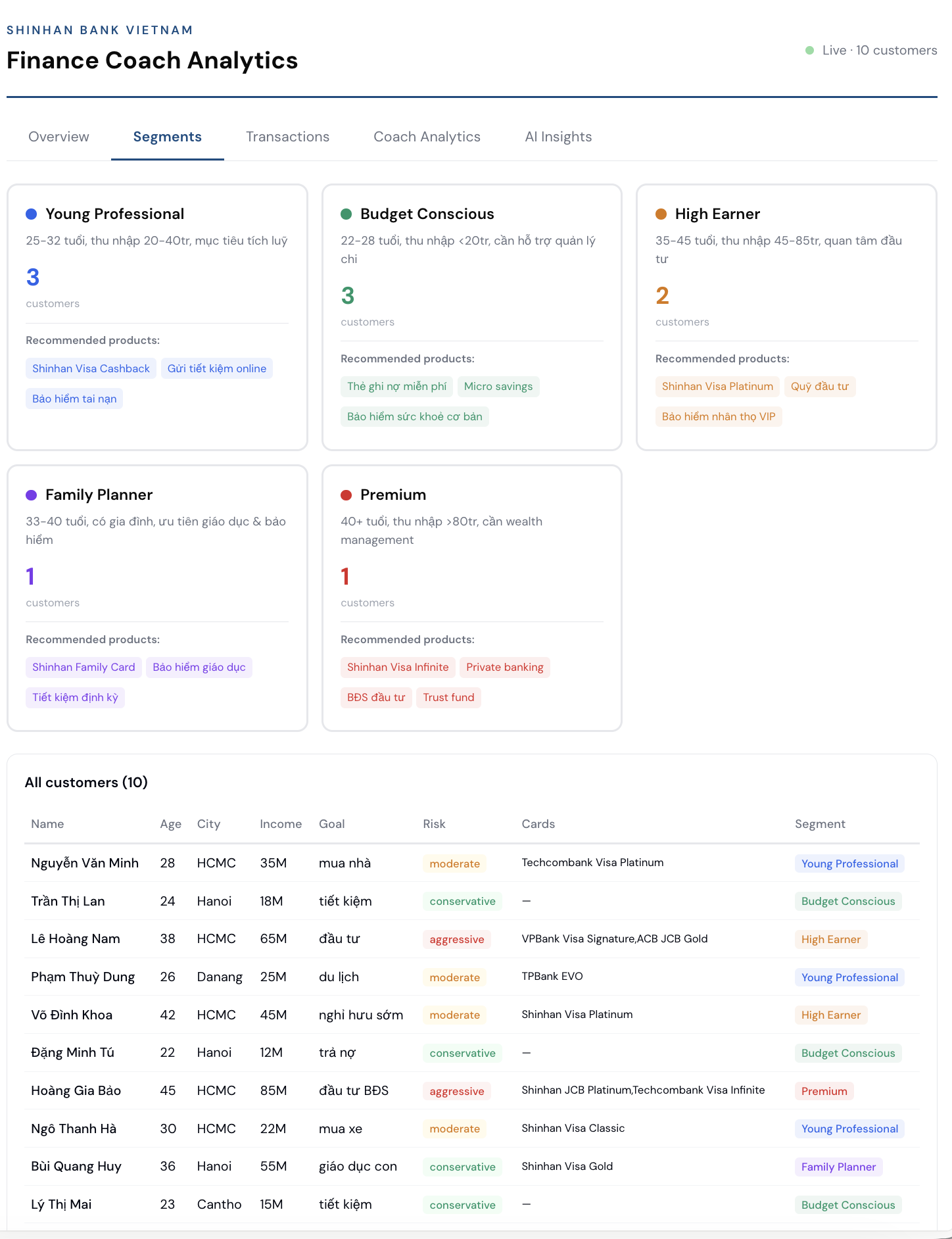
Banker View: Consumer Segmentation
-
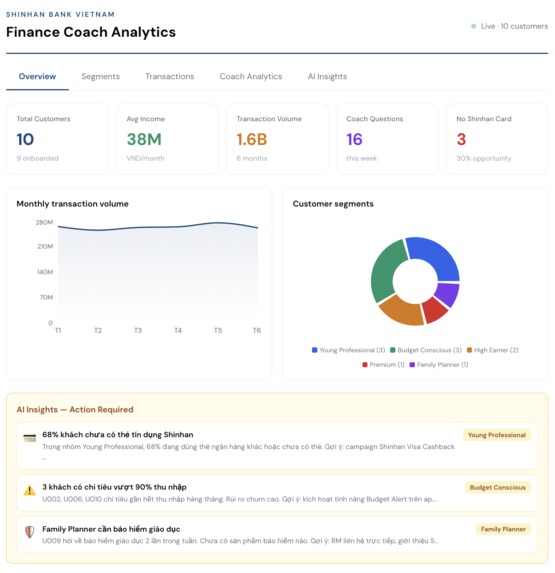
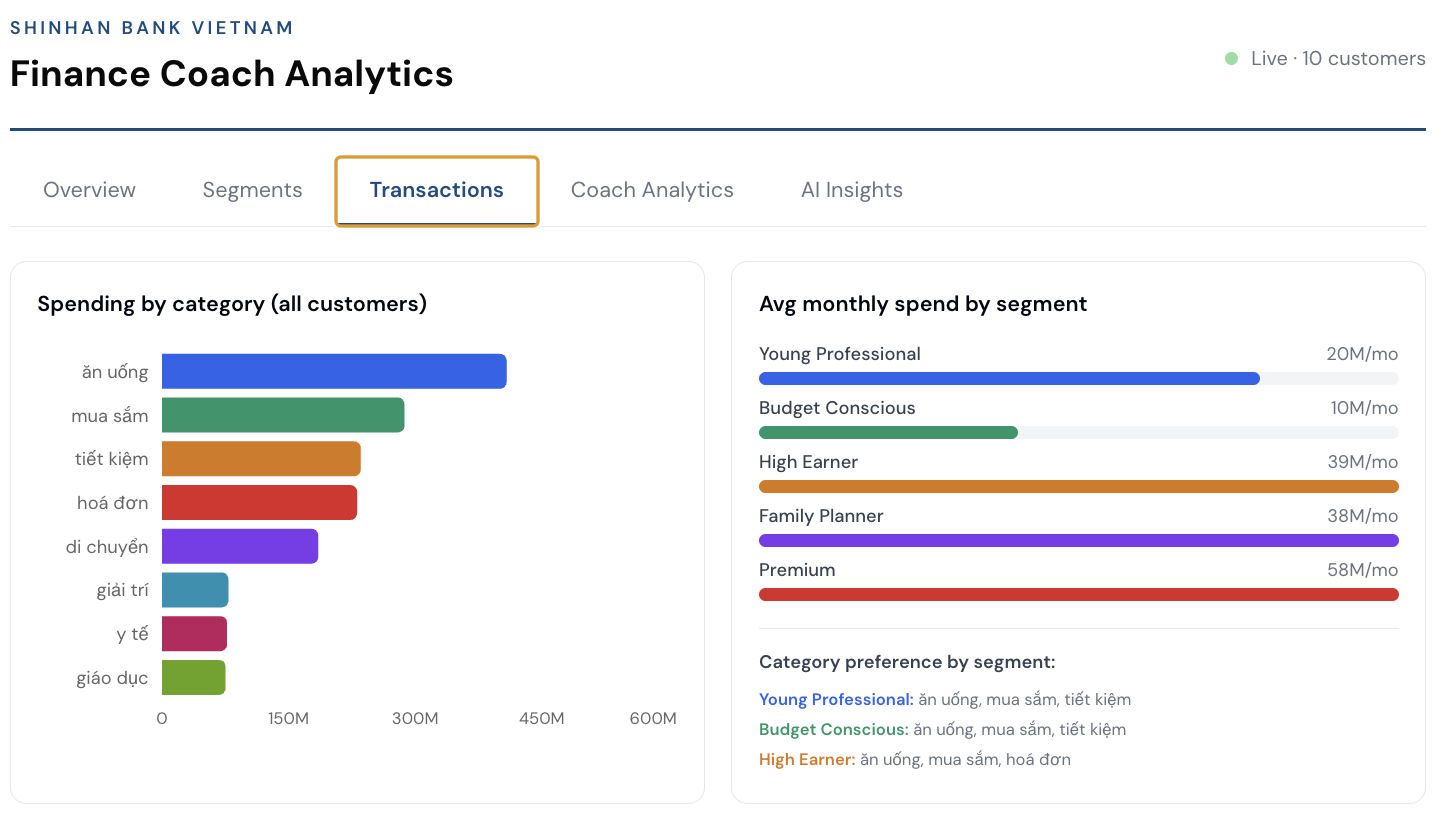
Banker View: Transaction Types Overview
-
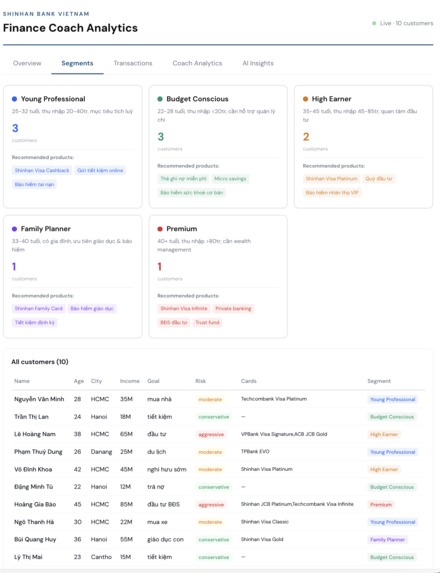
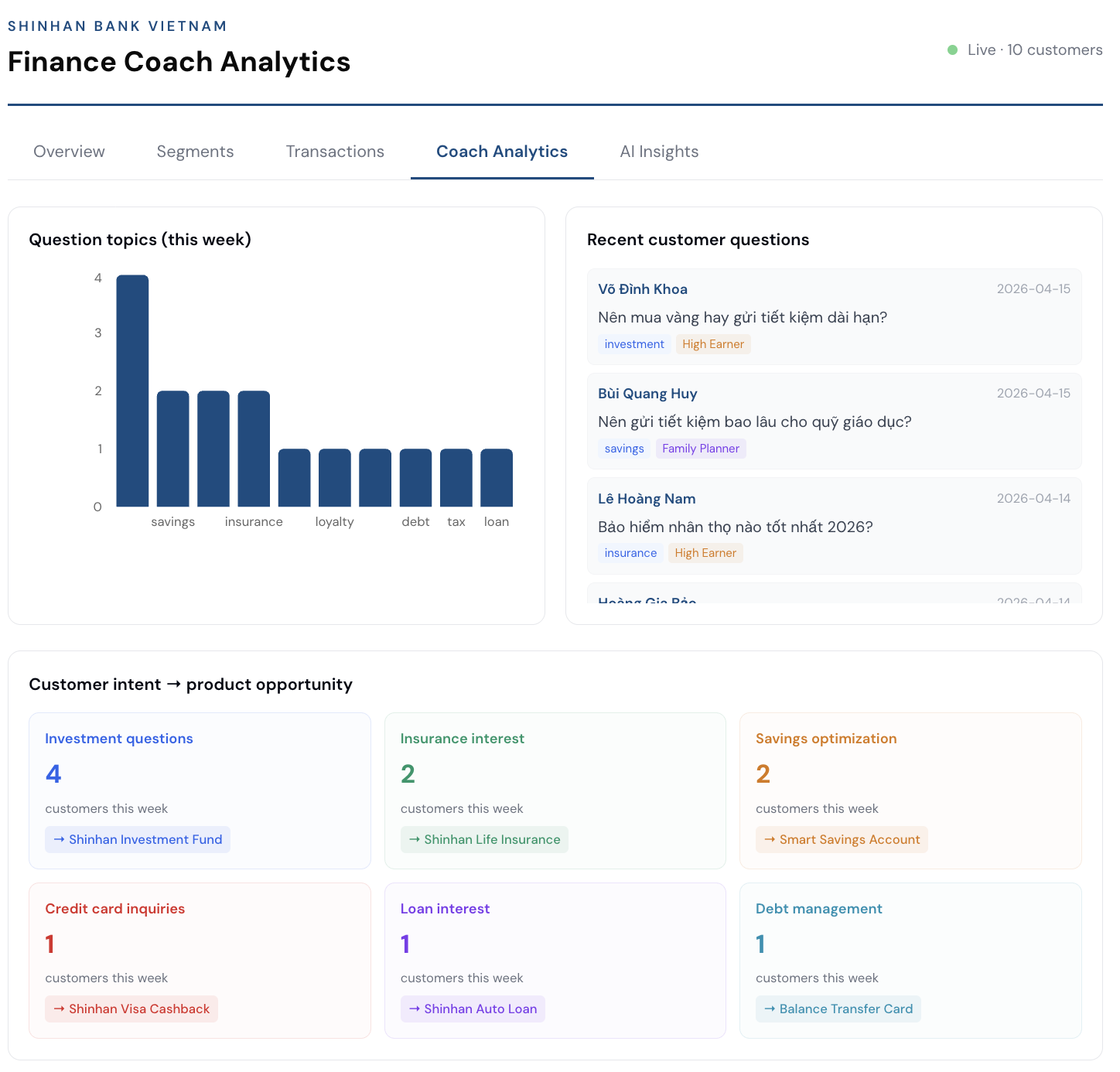
Banker View: Finance Coach Usage Analytics
-
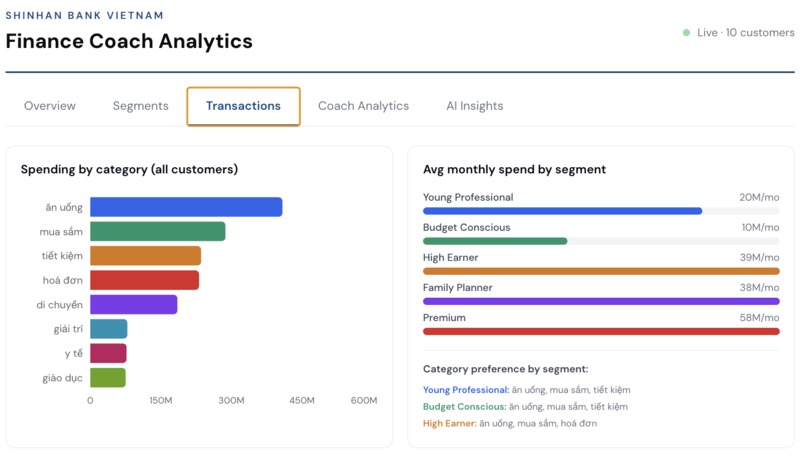
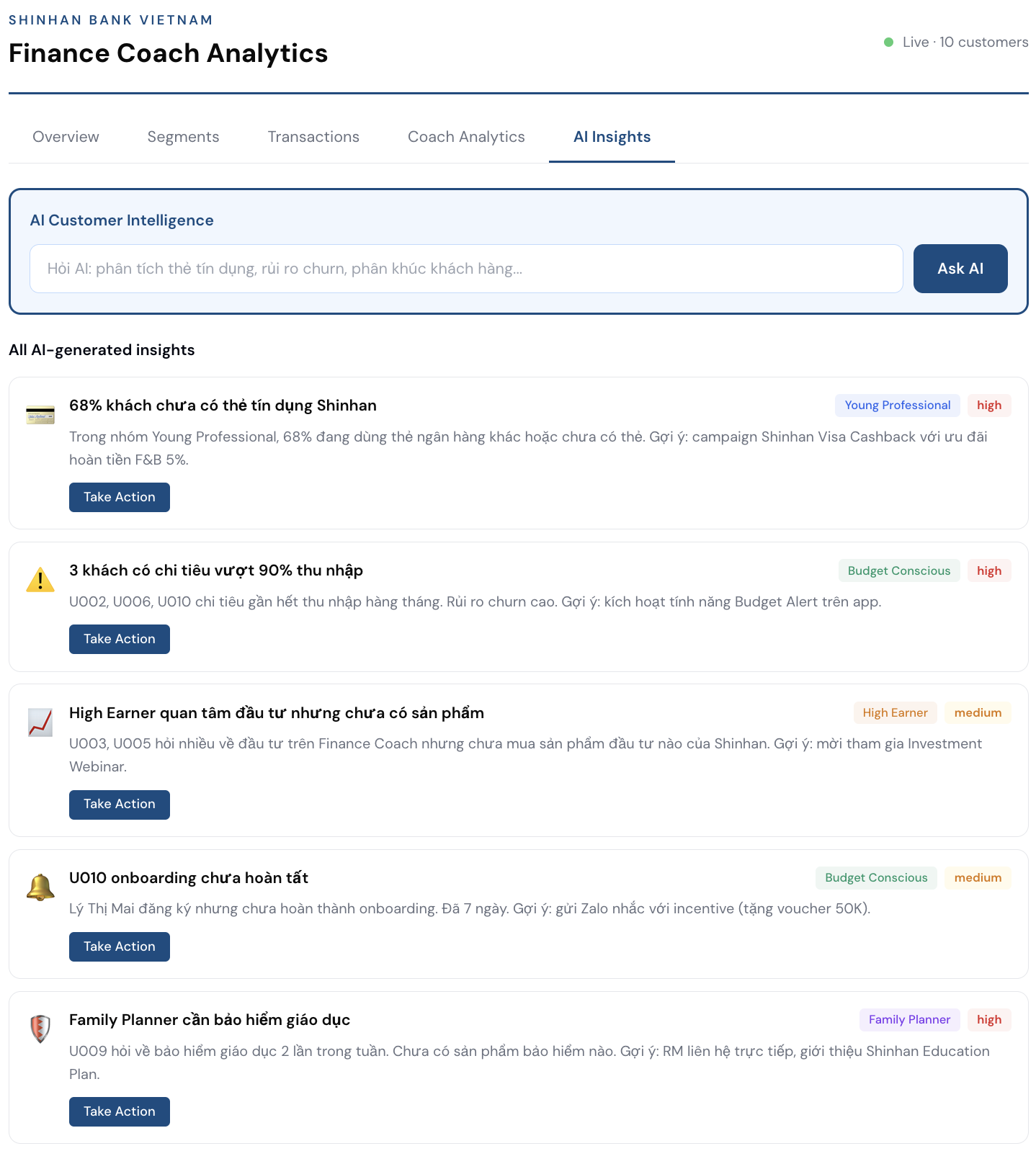
Banker View: Consumer Actionable Insights
-
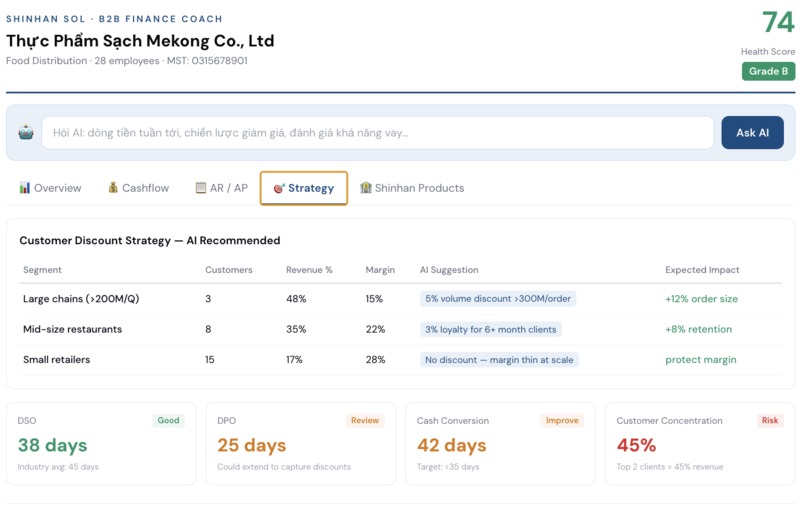
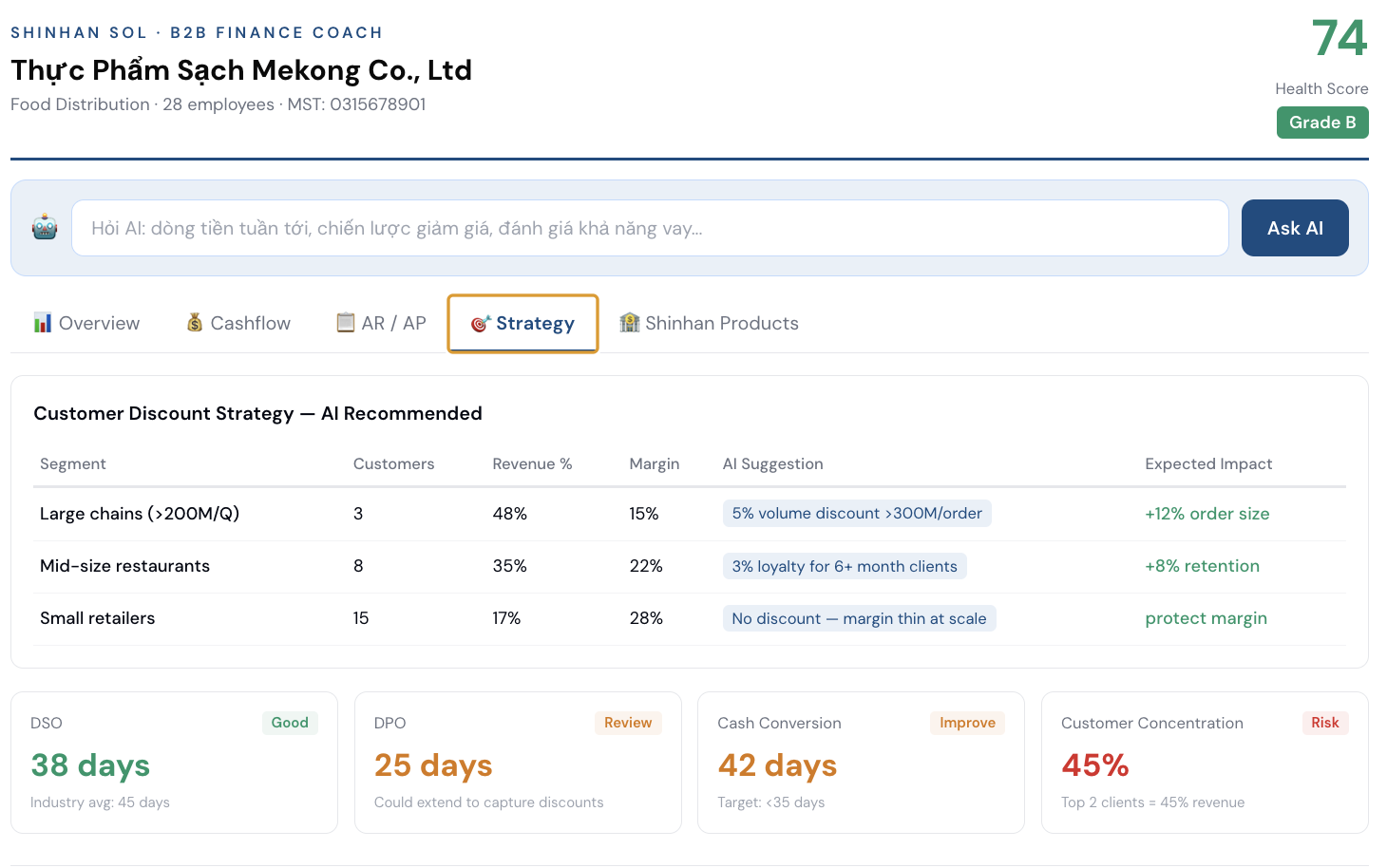
Banker View: Company Recommended Strategy
-
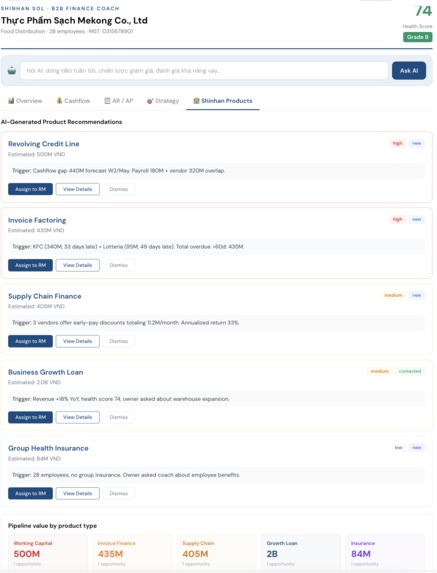
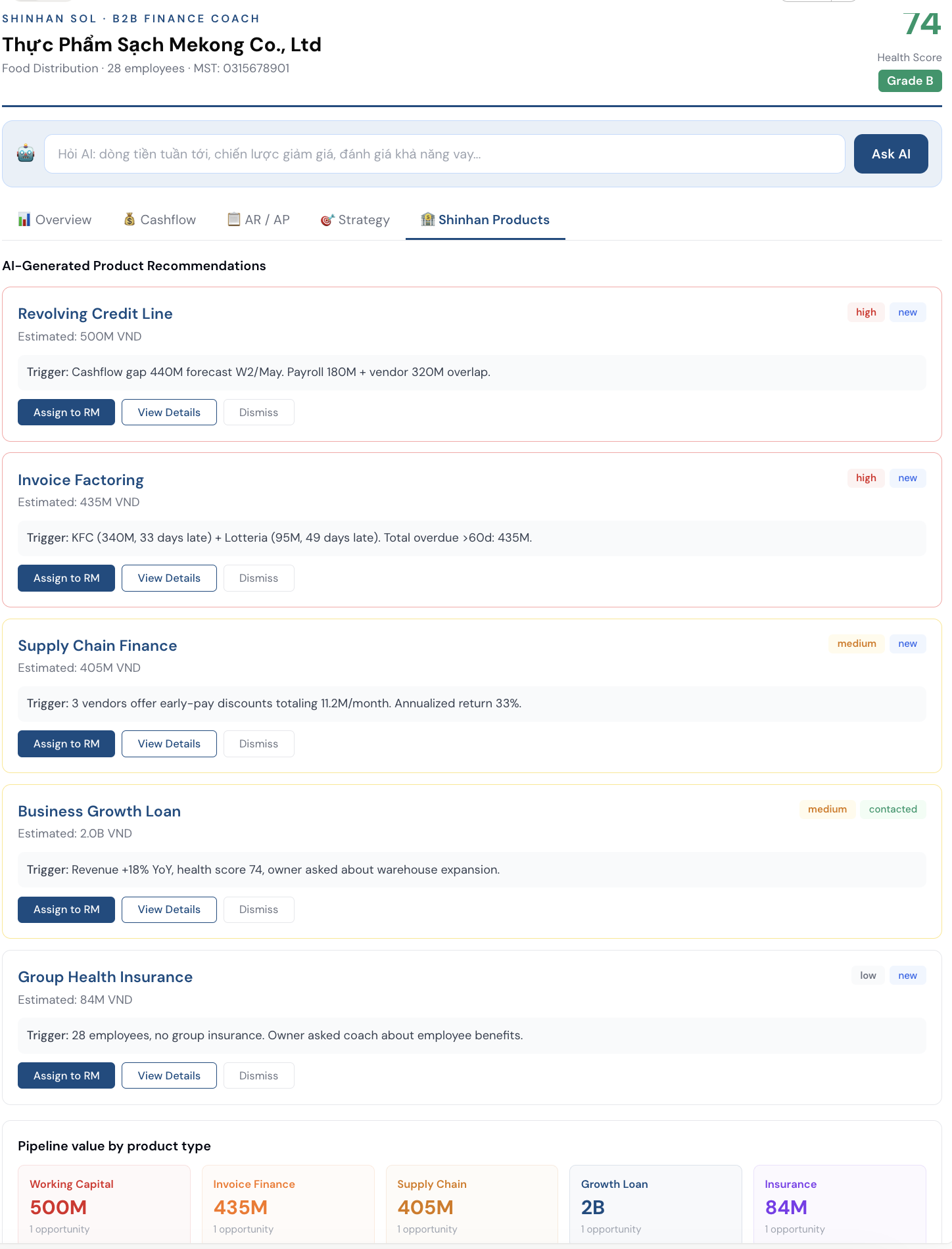
Banker View: Company Product Recommendation
-
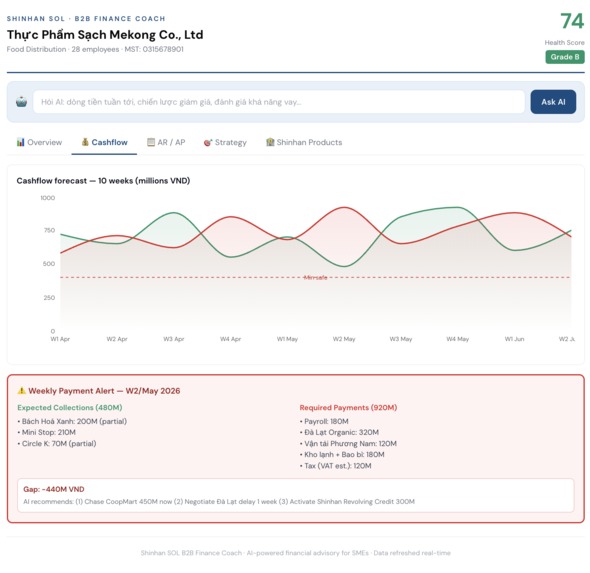
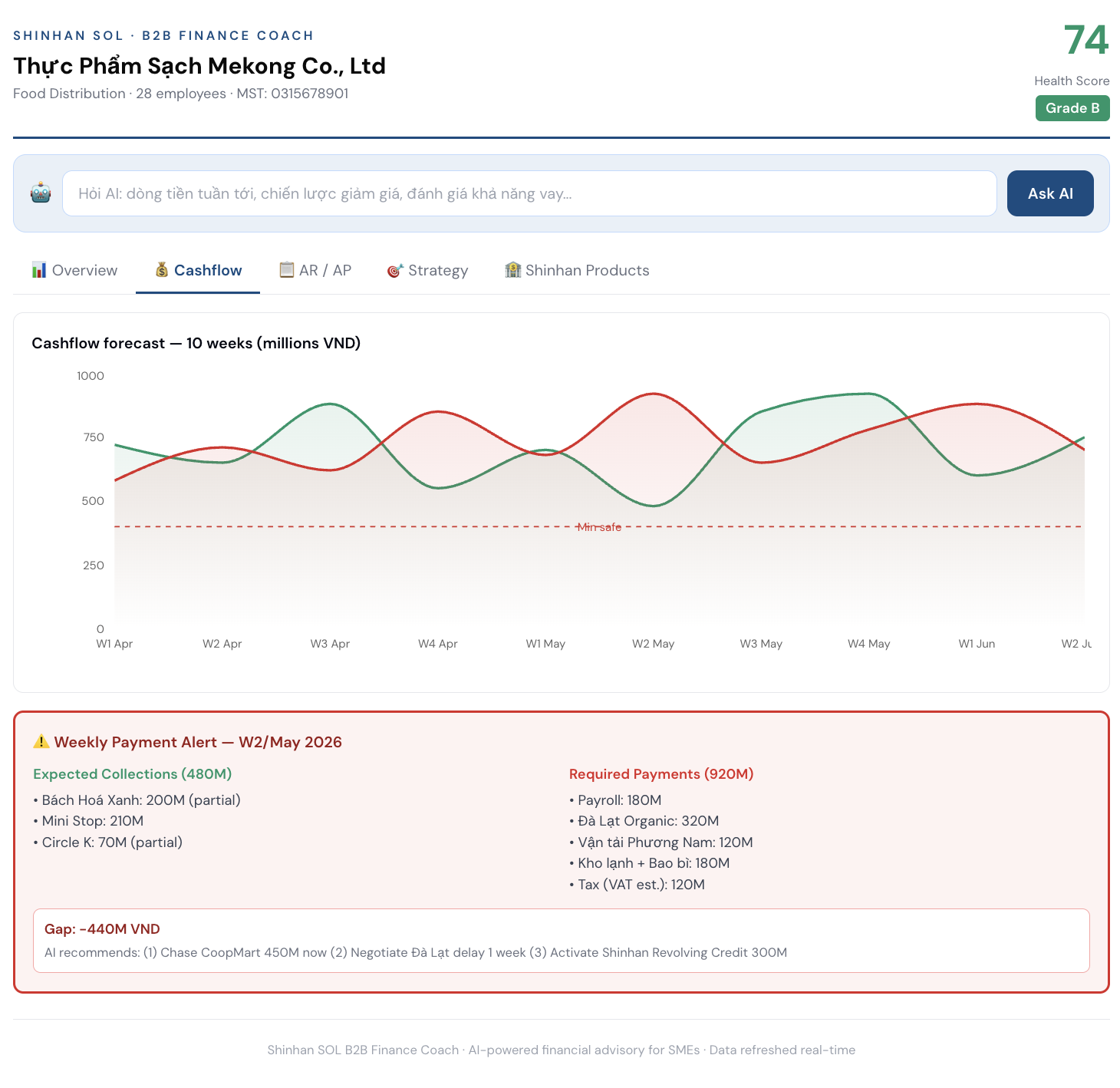
Banker View: Company Cashflow Management
-
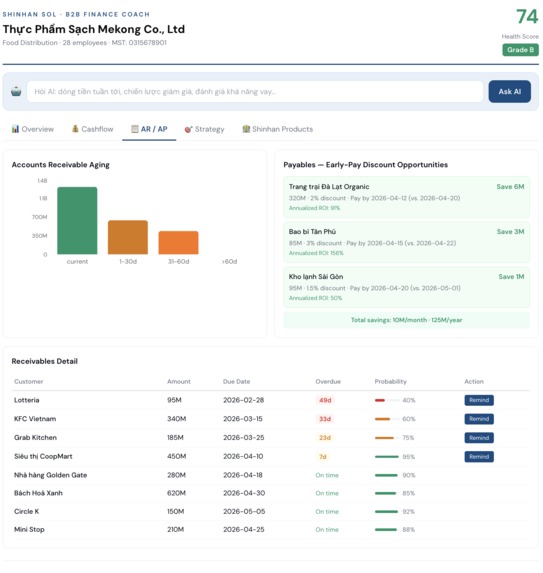
Banker View: Company Cashflow Management
-
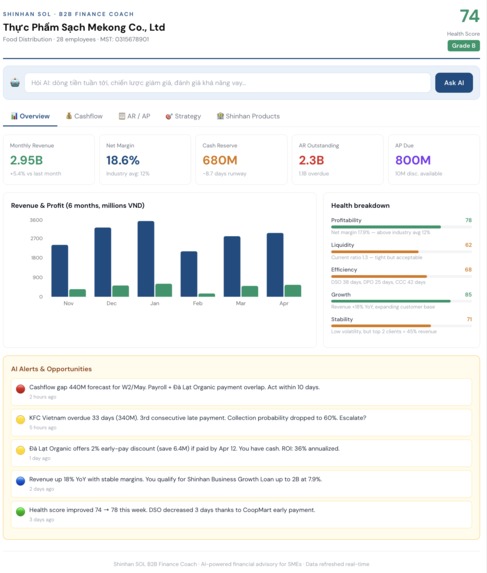
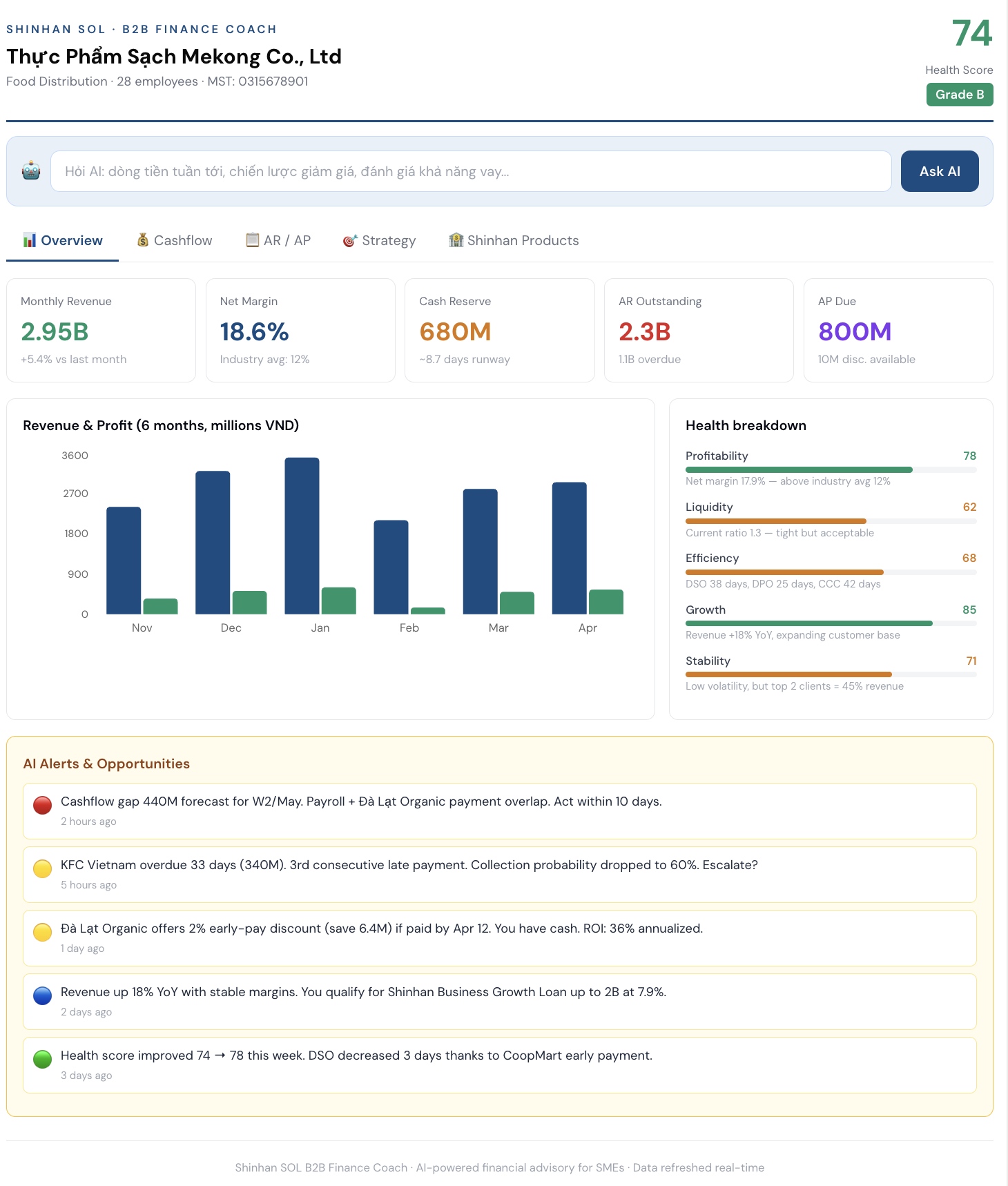
Banker View: Company Overviews & Actionable Alerts
Inspiration
Vietnam has over 70 million banking customers, yet financial literacy remains one of the lowest in Southeast Asia. According to S&P Global, only 24% of Vietnamese adults are financially literate — meaning 3 out of 4 people make financial decisions without understanding basic concepts like compound interest, inflation, or risk diversification.
The consequences are real and painful:
For consumers: Vietnamese lose an estimated 8,000–10,000 billion VND annually to financial scams and Ponzi schemes. Young professionals spend 90%+ of their income without savings plans. Credit card users pay billions in avoidable interest because they don't understand billing cycles. Loyalty points worth millions expire unused every month. People want to invest but don't know where to start — and fall prey to "get rich quick" schemes on social media instead.
For businesses: 900,000+ SMEs — the backbone of Vietnam's economy — operate in financial fog. 65% of SME owners don't know their real cashflow position until it's too late. Late receivables cripple working capital. Discount strategies are based on gut feeling, not data. Most can't produce proper financial reports, which means they can't access bank loans even when they qualify.
For Shinhan Bank: The SOL app processes millions of transactions, but this data sits dormant. Customers use SOL as a transaction pipe — transfer money in, transfer money out — without deeper engagement. The bank has rich intelligence about customers' financial lives but no mechanism to turn that intelligence into personalized guidance that builds trust, increases engagement, and naturally connects to the right products.
We were inspired by a simple question: What if every Shinhan customer — whether a 23-year-old fresh graduate or a 45-year-old factory owner — had access to a personal CFO that works 24/7, speaks Vietnamese naturally, and genuinely helps them build wealth?
Not a chatbot that answers FAQs. Not a dashboard that shows charts. An AI companion that knows your financial situation, proactively coaches you, catches problems before they happen, and connects you to the right financial tools at exactly the right moment.
What it does
SOL AI Finance Coach is a dual-purpose AI financial advisor (embedded in the Shinhan SOL Vietnam app via calling the APIs), serving both individual consumers and business owners/merchants through a single conversational interface.
For Consumers: Personal Finance Coach
Spending Intelligence — The coach automatically categorizes every transaction and delivers weekly insights: "You spent 8.5 million on dining this month — 40% more than last month. If you meal-prep twice a week, you could save 2 million/month. That's 24 million/year — enough for a Đà Lạt trip!" Financial Education on Demand — Users ask any financial question in natural Vietnamese and get clear, jargon-free answers with examples: "What's compound interest?" → explanation with a calculator showing how 5 million/month at 7% becomes 865 million in 10 years. The knowledge base covers investment basics, tax optimization, insurance concepts, and debt management — all localized for Vietnam.
Credit Card Optimizer — The coach knows every credit card in the Vietnamese market. Based on the user's actual spending patterns, it recommends the optimal card: "You spend 4 million/month on Grab and dining. The Shinhan Visa Cashback gives 5% on these categories — that's 200K cashback/month, or 2.4 million/year. Your current card gives 0."
Loyalty Program Tracker — Users register their loyalty programs (Lotusmiles, GrabRewards, Shopee Coins, bank points). The coach tracks balances, alerts before expiry ("Your 12,000 Lotusmiles expire in 30 days — enough for a domestic flight!"), and teaches combo-stacking: "Pay GrabFood with your Shinhan card → get GrabRewards + Shinhan points + cashback. Triple dip."
Deal Hunter — Real-time curated deals from banks, e-wallets, and apps — matched to the user's preferences. Not spam. Not generic. "You always order GrabFood at lunch. Today only: 50% off max 30K when paying with MoMo. Save 30K on lunch."
Smart Savings Challenges — Gamified savings with streak tracking: "7-day no-bubble-tea challenge: Day 4/7! You've saved 140K so far. Keep going!" Monthly challenges, leaderboards, and badges create daily engagement habits.
Investment Simulator — "I want to buy a house for 3 billion in 5 years, currently have 500 million" → the coach runs 3 scenarios (savings only, balanced fund, aggressive), shows monthly required savings for each, and explains the trade-offs in plain language.
For Businesses: SME Finance Advisor
Cashflow Forecaster — The coach analyzes business transaction history and predicts cashflow 30/60/90 days forward with three scenarios. Every Monday morning, the business owner receives a "Weekly Payment Report" via the SOL app: expected collections, upcoming payments, payroll, tax deadlines, and net cash position. If a gap is detected: "In 3 weeks you'll be short 250 million. Your client ABC has been late 8 out of 12 times — chase them now."
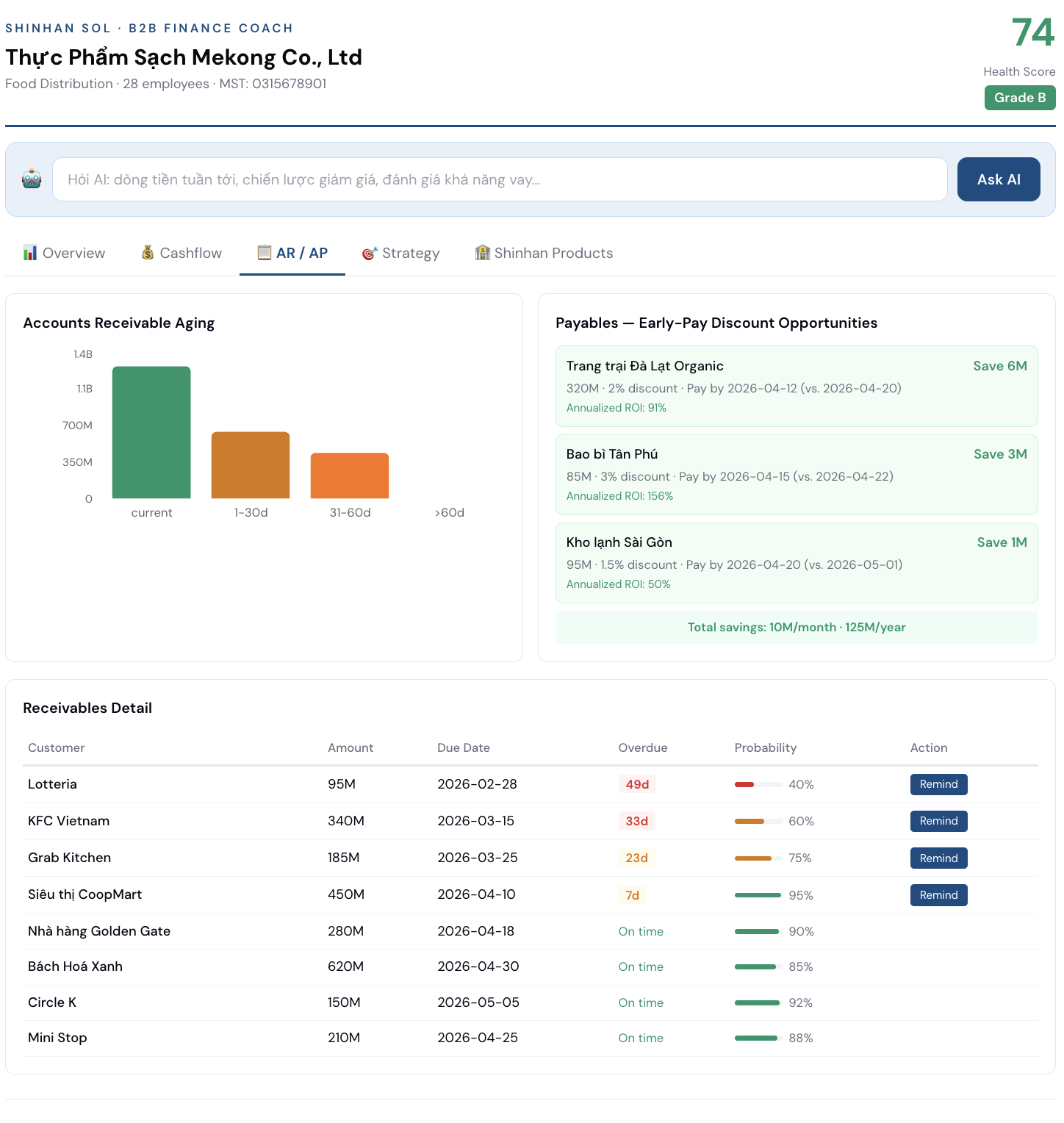
Receivables & Payables Manager — AI-powered aging reports with smart collection. The coach drafts polite collection reminders in Vietnamese, learns which clients pay late, and scores collection probability. For payables, it calculates whether early-payment discounts are worth taking: "Your supplier offers 2% discount for paying 20 days early. Annualized, that's a 36% return — take it."
Discount Strategy Advisor — This is unique. The coach analyzes a business's margins, customer segments, and seasonal patterns to recommend optimal discount strategies: "Your margin is 28%. Last July, revenue dropped 35%. Recommend: 5% discount for orders over 50 million for top 8 clients, 10% for first-time customers. Projected result: revenue up 26%, margin down to 24% — still healthy." Financial Health Score — A monthly health check calculating DSO (Days Sales Outstanding), DPO (Days Payable Outstanding), cash conversion cycle, burn rate, and runway. Displayed as a simple 0–100 score with clear explanations. A score of 80+ means the business is healthy. Below 40 triggers proactive coaching.
Automated Reporting — Monthly P&L summary, cashflow statement, and AR/AP aging — generated automatically from transaction data. Delivered as a chat summary or downloadable PDF. No accountant needed for the basics.
For Shinhan: Intelligent Product Matching
This is where the two sides create a flywheel that generates revenue:
The coach continuously analyzes every customer's financial behavior and maps signals to Shinhan products. Every recommendation is logged, tracked, and assigned to a Relationship Manager through the Banker Dashboard — giving Shinhan's sales team warm, contextual leads instead of cold calls.
How we built it
AI Agent Architecture — The coach is built on an open-source AI agent framework that connects large language models (Qwen) to Shinhan's data layer through structured skills. Each capability (spending analysis, cashflow forecast, credit card comparison) is a modular skill that can be developed, tested, and deployed independently.
Dual Schema Design — We designed two complementary data schemas: one for consumer financial coaching (personal transactions, spending categories, loyalty programs, user profiles) and one for business financial management (business transactions, receivables, payables, cashflow forecasts, health metrics, bank product recommendations). Both share a unified AI conversation layer.
RAG (Retrieval-Augmented Generation) — Financial knowledge, product details, and regulatory information are indexed in a vector database. When a user asks a question, the system retrieves relevant chunks and generates an accurate, sourced answer — not a hallucinated one.
Deterministic Financial Calculations — Critical insight: AI never calculates money. All financial math (PIT tax with 7 progressive brackets, compound interest, cashflow projections, loan amortization) is handled by deterministic code with full audit trails. The AI's role is to understand the question, call the right calculation function, and explain the result in natural language.
Banker Dashboard — A React-based analytics dashboard where Shinhan relationship managers see aggregated customer intelligence: segment distribution, product opportunities ranked by priority, risk alerts, and engagement metrics. AI-generated insights surface actionable recommendations: "68% of Young Professional segment don't have a Shinhan credit card — campaign opportunity."
Tech Stack: Golang backend (calculation engine, API), PostgreSQL + pgvector (data + embeddings), React frontend (dashboard), Qwen as AI Backend.
Challenges we ran into
Financial accuracy is non-negotiable. Early in development, we experimented with letting the LLM calculate tax amounts and investment returns. The results were occasionally wrong by significant margins — unacceptable for financial software. We redesigned the architecture so that all financial math is deterministic Golang code (tested with unit tests), and the AI only handles natural language understanding and response formatting. This "AI interprets, code calculates" principle became our north star.
Vietnamese financial terminology is messy. People say "thuế" (tax) to mean income tax, VAT, or corporate tax interchangeably. "Lãi" means both interest and profit. "Bảo hiểm" could be insurance or warranty. Training the NLP layer to disambiguate required extensive prompt engineering and a curated Vietnamese financial glossary with 500+ terms and their contextual meanings.
The cold start problem for businesses. Consumer spending data is available from day one (transaction history). But business cashflow forecasting needs categorized income/expense data that isn't available from bank transactions alone. We solved this with a progressive onboarding flow: the coach starts with what it can see (bank transactions), asks clarifying questions over time ("That 50 million from ABC Corp — is that a customer payment or a loan repayment?"), and builds a richer financial picture through conversation. After 2–3 weeks of use, forecasts become meaningfully accurate.
Balancing helpfulness with compliance. A finance coach must be helpful without crossing into regulated financial advice. We established strict guardrails: the coach provides information, education, and tools — but never says "you should buy this stock" or "this investment will return X%." Every investment-related response includes a disclaimer, and the system is designed to connect users with licensed Shinhan advisors for complex decisions.
Trust takes time. Vietnamese consumers are skeptical of AI financial tools — and rightfully so. Our approach: start with obviously useful, low-stakes features (spending summary, deal alerts, loyalty tracking) that demonstrate value immediately. Once users trust the coach with their spending data, they naturally progress to higher-value features (investment planning, loan readiness assessment). Trust is earned through consistent accuracy, not claimed through marketing.
Accomplishments that we're proud of
A complete dual-audience platform designed from the ground up. Most banking AI solutions serve either consumers OR businesses. We designed a unified architecture that serves both — with shared infrastructure but tailored experiences. A business owner can ask about their company's cashflow in the morning and their personal investment portfolio in the evening, in the same conversation thread. 12 consumer skills + 12 business skills = 24 AI capabilities — covering financial education, spending optimization, credit card comparison, loyalty tracking, cashflow forecasting, AR/AP management, discount strategy, health scoring, tax estimation, and automated reporting. Each skill has defined data schemas, API endpoints, calculation logic, and Vietnamese conversation examples.
The product recommendation engine that creates a genuine flywheel. We mapped 11 specific financial signals to Shinhan products with trigger logic, estimated deal sizes, and RM assignment workflows. This isn't a marketing bolt-on — it's intelligence that emerges naturally from helping customers manage their finances better. When the coach detects a cashflow gap and recommends a working capital loan, that's genuinely helpful for the business AND revenue-generating for Shinhan.
The banker dashboard turns customer intelligence into action. Relationship managers see a prioritized feed of opportunities with full context — not a spreadsheet of names to cold-call. "Customer ABC: revenue growing 30%, asking about expansion, health score 85 — suggest Business Growth Loan, estimated 2 billion" is dramatically more actionable than a generic lead list.
Vietnamese-first design. Every interaction, every example, every calculation uses Vietnamese currency (VND), Vietnamese tax brackets, Vietnamese banking products, and Vietnamese financial customs (Tết spending patterns, monthly salary cycles, BHXH/BHYT deductions). This isn't an English product translated — it's built for the Vietnamese financial ecosystem.
What we learned
Banks don't need more features — they need more context. Shinhan SOL already does transfers, payments, and account management well. What it lacks is the intelligence layer that converts transaction data into understanding, and understanding into timely action. The Finance Coach is that layer.
Financial coaching is a trust product, not a tech product. The technology behind the coach is sophisticated, but users don't care about RAG pipelines or vector embeddings. They care about: "Did it save me money today?" and "Can I trust this advice?" We learned to lead with tangible value (you saved 200K this week) and build toward deeper engagement (here's your 5-year wealth plan).
SMEs will share data if you give them value first. Business owners are protective of their financial data — until you show them a cashflow forecast that catches a problem they didn't see coming. The coach earns data access by demonstrating competence, not by demanding permission upfront.
The real competition is the spreadsheet, not other apps. Vietnamese SMEs don't use sophisticated financial tools. They use Excel, Google Sheets, and notebooks. The coach succeeds when it's easier than a spreadsheet for the tasks that matter: "How much cash will I have next week?" answered in 2 seconds via chat, versus 30 minutes pulling together three spreadsheets.
AI governance in banking is not optional — it's the foundation. Vietnam's AI Law (effective March 2026) requires transparency, explainability, and human oversight for AI in financial services. We designed compliance into the architecture from day one: all recommendations are explainable ("suggested because your DSO increased 15 days"), all calculations have audit trails, and no automated action happens without user confirmation.
Built With
- golang
- openclaw
- qwen


Log in or sign up for Devpost to join the conversation.