-
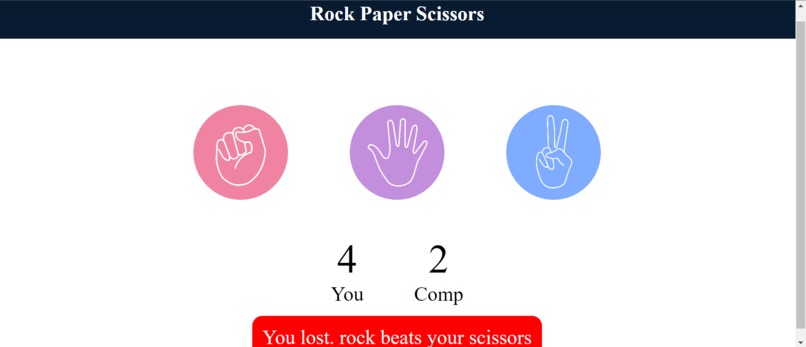
Rock paper scissor game

Inspiration
Since i was learning javascript, especially a new language or framework, creating a Rock Paper scissors game was a great way to practice my skills. It involves user input, conditional statements, and randomization, which are fundamental concepts in many programming languages.
What it does
A Rock Paper Scissors game simulates the classic hand game typically played between two people. The game involves each player simultaneously forming one of three shapes with an outstretched hand: rock (a fist), paper (an open hand), or scissors (a fist with the index and middle fingers extended, forming a V). The winner is determined by the rules: Rock crushes scissors (rock wins) Scissors cuts paper (scissors win) Paper covers rock (paper wins) The game can be implemented digitally, where the player chooses one of the three options, and the computer also randomly selects one. Then, the choices are compared to determine the winner
How we built it
Building a Rock Paper Scissors game can be relatively straightforward, especially if you're familiar with programming concepts
Challenges we ran into
Building a Rock Paper Scissors game can be a fun and educational project, but like any coding endeavor, it comes with its challenges. Here are some common challenges you might encounter and how to overcome them:
User Input Handling: One of the first challenges is handling user input. You need to ensure that the user's choice (rock, paper, or scissors) is valid and properly processed by your program. Implementing input validation to handle incorrect inputs such as typos or invalid choices is crucial.
Randomization: Since the computer's choice is typically randomized, generating random outcomes in a controlled manner can be tricky. You'll need to use a random number generator to select the computer's choice (rock, paper, or scissors) for each round.
Game Logic: Implementing the game logic to determine the winner based on the choices of the player and the computer is fundamental. You'll need to compare the choices and apply the rules of Rock Paper Scissors to determine the outcome of each round.
Accomplishments that we're proud of
Functional Gameplay: Successfully implementing the core mechanics of the game, including user input for their choice (rock, paper, or scissors), generating a random choice for the computer opponent, and determining the winner based on the rules of the game.
User Interface Design: Designing an intuitive and visually appealing user interface (UI) for the game, including buttons or other elements for players to select their choice, clear feedback on game outcomes, and any additional features such as score tracking or game rounds.
Code Structure and Organization: Writing clean, well-organized code that is easy to understand, maintain, and extend. This includes breaking down the game logic into modular components, using functions or classes where appropriate, and following best practices for coding style and documentation.
What we learned
Functional Game: Successfully implementing the Rock Paper Scissors game logic and creating a playable version of the game is a significant accomplishment, especially for beginners.
UI/UX Design: Creating an attractive and user-friendly interface that enhances the overall gaming experience can be a rewarding achievement.
Code Organization: Structuring the codebase in a clear and organized manner, using appropriate design #patterns and principles, demonstrates proficiency in software development practices.
Learning New Technologies: If you used new technologies or programming languages for this project, mastering them and applying them effectively to create a functional game is an accomplishment in itself.
Problem-Solving Skills: Overcoming challenges and finding solutions to various issues encountered during the development process demonstrates problem-solving skills and perseverance.
Lessons Learned: Programming Concepts: Developing a Rock Paper Scissors game project provides hands-on experience #with fundamental programming concepts such as conditional statements, functions, loops, and #randomization.
UI/UX Principles: Learning about user interface and user experience design principles through practical #application and feedback can improve your skills in creating intuitive interfaces.
Software Development Process: Going through the development process, from planning and designing #to implementation and testing, teaches valuable lessons about project management and software #development lifecycle. Debugging and Troubleshooting: Identifying and fixing bugs encountered during development enhances your debugging and troubleshooting skills, which are essential for any software developer. Community Engagement: Seeking help from online communities, forums, or resources and collaborating with others on the project can foster learning and skill development through shared experiences and knowledge exchange. Overall, building a Rock Paper Scissors game project is not only a fun and rewarding endeavor but also a valuable learning experience that helps in honing various technical and soft skills essential for software development.
What's next for ROCK PAPER SCISSORS
The future of Rock Paper Scissors can be quite exciting, with various avenues for growth and innovation. Here are some potential directions for the game: Multiplayer and Online Gameplay: Adding multiplayer functionality to Rock Paper Scissors, either locally or online, would enable players to compete against friends or strangers from around the world. Leaderboards and tournaments could further enhance the competitive aspect of the game.


Log in or sign up for Devpost to join the conversation.