Robust AI-Generated Image Detection — TikTok TechJam Track 5
Demo video: https://youtu.be/FO-r_WiiEUM
A binary detector for AI-generated images, built and measured around two questions: does it still work after the image has been through a real upload pipeline, and does it still work on a generator it has never seen?
The first question has a good answer — robustness augmentation removes 85.4% of the errors that transforms introduce. The second is harder, and the honest answer is partial. Our best detector, 99.8% accurate on its own dataset, scored at chance on images from a different generator. The evidence pointed to training-distribution shift rather than backbone choice, and adding a second training source removed that collapse for 0.47 accuracy points. But on a third generator neither model had seen — the held-out WildFake benchmark — both models transfer only partially, missing about 40% of AI images, and the mixed model becomes the less stable of the two under heavy degradation. Source diversity fixes the sources you mix in; it does not buy general cross-generator robustness. That arc, including the part that did not work, is the most important thing in this submission.
1. How the solution addresses the problem statement
A detector that only works on pristine files is not useful. Images that reach a platform have been compressed, resized, blurred, noised, colour-shifted and cropped first. So we measured the failure mode directly rather than reporting a single clean-set accuracy.
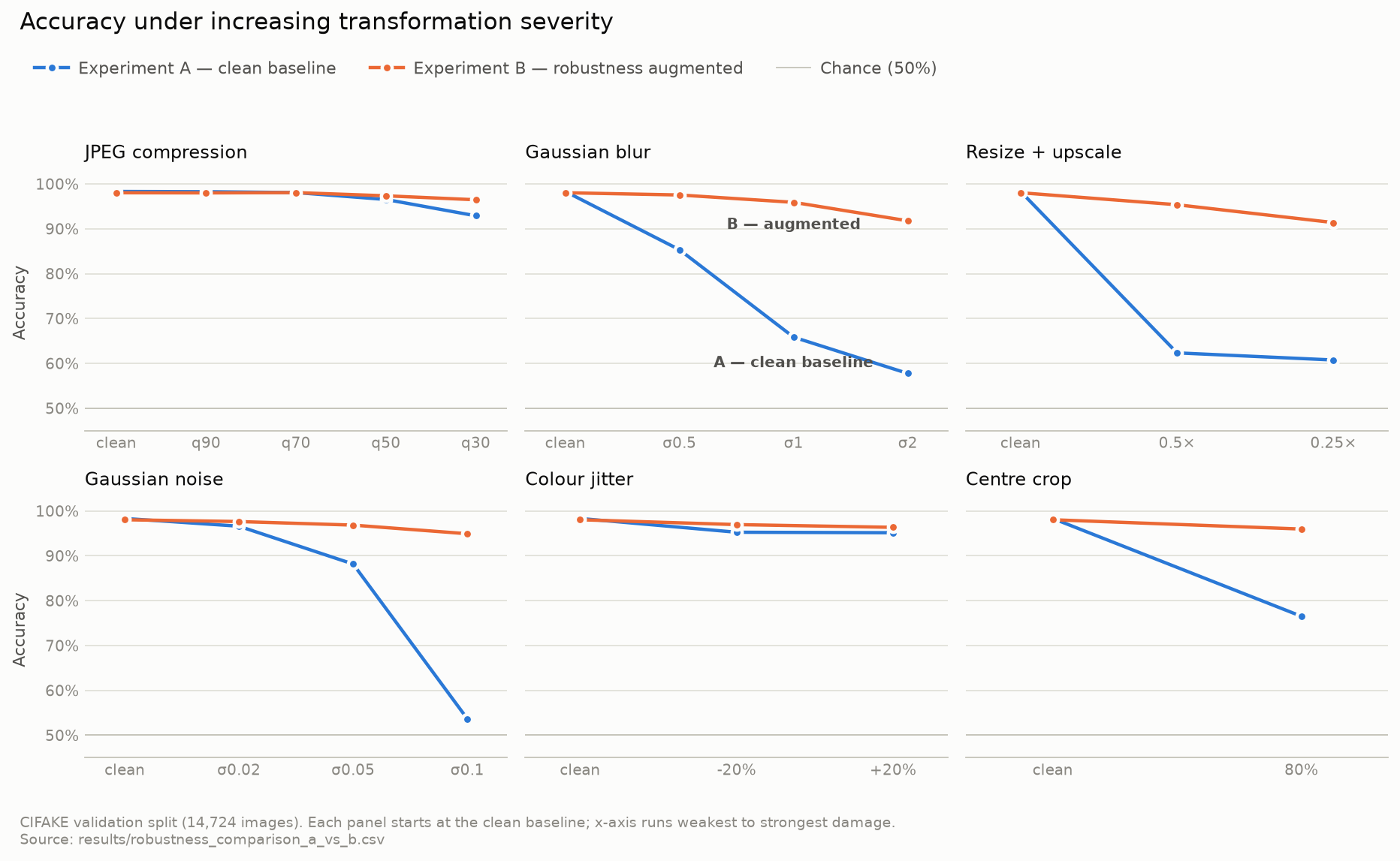
Our headline measurement is transformation flips: images the model classifies correctly when clean and incorrectly after a transform. Across 15 transformed conditions on 14,724 held-out CIFAKE validation images:
| Clean baseline (A) | Robustness-augmented (B) | |
|---|---|---|
| Transformation flips | 38,504 | 5,611 |
| Total misclassification events | 41,024 | 9,065 |
| High-confidence mistakes | 22,027 | 972 |
| Worst-condition accuracy | 53.67% | 91.37% |
Augmentation removes 85.4% of the baseline's flips. The baseline does not degrade gracefully — it collapses. Under Gaussian noise σ=0.10 its accuracy falls from 98.32% to 53.67%, barely above the 50% chance rate for a balanced binary task. Blur σ=2.0 takes it to 57.75% and resize 0.25× to 60.74%. The augmented model stays at 94.91%, 91.77% and 91.37% on those same conditions, and never drops below 91.37% on any of the 16 conditions.
The gap in confidence is larger than the gap in accuracy. Counting only errors where the model was emphatic and wrong (an AI image scored ≤0.05, or a real image scored ≥0.95), the baseline makes 22,027 and the augmented model 972 — a 23× difference. Calibration follows: in the augmented model's ≥0.99 score band, 99.0% of images really are AI-generated; in the baseline's >0.9 band, only 85.8% are. So the augmented model is better calibrated than the baseline in our in-distribution confidence analysis. That analysis was run on CIFAKE, where the augmented model was in-distribution; confidence bands on one dataset are not a calibration guarantee, and cross-domain the same scores become uninformative (see the collapse below).
Why the comparison is meaningful
We ran a three-arm ablation:
- A — clean baseline. Conventional preprocessing only: resize 256, centre crop 224, random horizontal flip, ImageNet normalization. A competent conventional classifier, deliberately not a strawman.
- B — robustness augmentation. Identical to A, plus randomized challenge-relevant degradation (JPEG, blur, resize, noise, colour jitter, crop) applied to 0–3 transforms per training image.
- C — consistency training. Identical to B, plus a penalty that pushes the model toward the same prediction on a clean and a damaged view of the same image.
Backbone, seed (42), epochs (5), batch size (32), learning rate (1e-4), weight decay (1e-4), mixed precision, and the train/val split are held identical across all three. Only the training method varies, so a difference between arms is attributable to the method rather than to a hyperparameter confound. Evaluation is equally controlled: both models see the same images in the same order under each condition, Gaussian noise is seeded per image so both receive identical noisy pixels, and checkpoint SHA-256 hashes are recorded with every run.
Validation, evaluation and inference all share one preprocessing function,
get_eval_transform() in src/data.py, imported by every path that scores a
model, so those cannot silently drift apart — a mismatch there produces no
error, only quietly worse accuracy. Training deliberately uses a different
transform (get_train_transform(), or get_robust_train_transform() for the
augmented arms), since that is where the augmentation is applied.
What this is for
The intended use is a lightweight triage signal, not proof that an image is synthetic. A platform could run it over uploaded images after the normal compression and resizing an upload pipeline applies — which is the regime the robustness work targets — and feed the resulting probability into moderation alongside provenance data, upload history and other signals, rather than treating it as a verdict.
Keeping EfficientNet-B0 rather than a larger backbone is what makes that feasible at platform scale: 1.14 ms per image, against 4.12 ms for ConvNeXt-Tiny for a difference in accuracy we could not distinguish from noise. At upload volumes that is the difference between a signal you can afford to compute on everything and one you cannot.
The false-positive analysis is the reason the output should not stand alone. Robustness training raises the clean false-positive rate from 1.97% to 2.69%, and every false positive is a real photograph flagged as synthetic. On a large platform that is a lot of people wrongly accused if the score is used as a decision rather than an input to one.
The trade we are not hiding
Robustness is not free. On clean images the augmented model has a higher false-positive rate: 2.69% versus the baseline's 1.97% (195 versus 143 false positives out of 7,261 real images), against a slightly lower false-negative rate (1.27% vs 1.41%). Augmentation shifts the decision boundary toward calling images AI-generated. The trade is strongly favourable overall, but it moves in the direction the challenge warns about — false accusations against genuine photographs — and we did not tune the threshold to compensate.
Beyond CIFAKE: SID_Set and the architecture choice
We also trained and evaluated on SID_Set — high-resolution images from a different generator (FLUX). Three robustness-trained architectures were run across the same 16-condition grid on the SID validation split: 5,099 images per condition, threshold 0.5, seed 42, checkpoint SHA-256 hashes recorded.
| Model | Clean acc. | Mean damaged acc. | Worst damaged acc. | Latency |
|---|---|---|---|---|
| EfficientNet-B0 | 99.78% | 99.73% | 99.43% (noise 0.10) | 1.14 ms |
| ConvNeXt-Tiny | 99.80% | 99.78% | 99.45% (noise 0.10) | 4.12 ms |
| DINOv2 ViT-S/14 | 97.35% | 96.26% | 85.23% (crop 0.80) | 4.34 ms |
ConvNeXt-Tiny came out marginally ahead and we did not choose it. Its lead is 0.05 percentage points of mean damaged accuracy, for 3.6× the inference cost (4.12 ms against 1.14 ms per image). A paired McNemar comparison across all 16 conditions finds no condition reaching p < 0.05 — the smallest p-value is 0.093 — so on 5,099 images per condition the two models are statistically indistinguishable. EfficientNet-B0 is the better trade-off and stays as the working architecture; ConvNeXt-Tiny is retained as a candidate for a later cross-generator comparison rather than discarded.
DINOv2 ViT-S/14 is dropped. Under crop 0.8 it falls 12 points below its own clean accuracy (85.23% against 97.35%), fails again under colour +0.2 (92.14%), and is the slowest of the three.
The SID A→B comparison: augmentation buys noise resistance, and shows up
under chained damage. A clean-trained SID baseline
(experiment_sid_a_clean_best.pt) has been evaluated against the
robustness-trained model on 5,099 SID validation images per condition.
Under single transforms the two are within ±1pp on 13 of 16 conditions. The entire gap sits in three: noise σ0.10 (56.85% vs 99.43%), noise σ0.05 (79.15% vs 99.63%) and JPEG 30 (96.35% vs 99.75%). At σ0.10 the clean-trained model's recall falls to 12.11% — it misses seven of every eight AI images — though its AUROC is still 0.9972, so the ranking survives and only the decision boundary has moved.
Under randomly chained damage (3 transforms per image, 5 trials, 25,495 pooled predictions) the separation is unambiguous: 82.997% against 99.078% pooled accuracy, false-negative rate 34.60% against 1.72%, clean-correct retention 83.04% against 99.14%, pooled AUROC 0.9873 against 0.9998. Trial standard deviation is 0.31pp and 0.07pp, so the 16-point gap is far outside run-to-run noise.
Single transforms understate what augmentation is worth; stacked damage — which is how real redistribution works — shows it.
The finding that matters most: cross-domain collapse, and the fix
Our SID models score at chance on CIFAKE. We took both EfficientNet-B0 SID models and ran them over the CIFAKE validation split — 14,724 images (7,261 real, 7,463 AI), the same 16 conditions, threshold 0.5, seed 42.
| SID-A (clean-trained) | SID-B (robustness-trained) | |
|---|---|---|
| Clean CIFAKE accuracy | 51.18% | 49.41% |
| Clean recall on AI images | 3.91% (292 / 7,463) | 0.21% (16 / 7,463) |
| Accuracy range, 16 conditions | 49.31% – 51.18% | 49.31% – 50.29% |
| AUROC range | 0.5079 – 0.6406 | 0.5015 – 0.6505 |
Predicting "real" for everything scores 49.31% here. Both models sit within two points of that floor, failing almost entirely by false negative — they call nearly every AI image real. Under noise 0.05 and 0.10 both detect zero AI images, out of 7,463.
It is not a threshold problem. AUROC starts near 0.635 clean and reaches 0.5015 under blur σ2.0 — random ranking. Sweeping the threshold over the clean predictions recovers at most 59.6% (SID-A) and 59.9% (SID-B). The scores carry almost no signal to recalibrate.
Transform robustness and cross-generator generalization are separate problems. A model can be 99.8% accurate under every transform in the grid on its own dataset and still be useless on an unseen generator. Nothing in the SID results predicts this, and nothing in our CIFAKE robustness work does either. For this challenge that is the consequential finding: a deployed detector meets generators absent from its training set, and our evidence says robustness augmentation buys resilience within a distribution, not across distributions.
It is not an architecture problem. We ran the same CIFAKE evaluation on ConvNeXt-Tiny — a different backbone family, 27.8M parameters against EfficientNet's 4.0M, and the model that scored best of all three on SID (99.80% clean). It collapses identically: 49.38% clean CIFAKE accuracy, 0.13% recall on AI images (10 of 7,463), never above 0.46% recall under any of the 16 conditions, and zero AI detections under noise 0.02, 0.05 and 0.10. Its accuracy never leaves a 0.10-point band around the 49.31% all-real floor — tighter to the floor than EfficientNet-B0.
Two architectures with different inductive biases, trained on the same data, fail in the same direction and to the same degree. That points at the training distribution rather than model capacity as the cause. Scaling the backbone is not a route out; changing the training data is.
Mixed training closes the gap on CIFAKE. Training on SID and CIFAKE together recovers almost all of the loss on CIFAKE: clean accuracy 49.41% → 97.19%, mean damaged accuracy 49.53% → 94.36%, AUROC from a 0.50–0.65 band to 0.958–0.996, recall on AI images 0.21% → 98.08%. Its worst condition is blur σ2.0 at 87.75%.
Under randomly chained damage on CIFAKE (3 transforms per image, 5 trials, 73,620 pooled predictions) the mixed model holds 84.33% pooled accuracy with AUROC 0.942 and a 25.79% false-negative rate, against the SID-only model's 49.66%, AUROC 0.515 and a 97.74% false-negative rate.
One caveat about how to read that table. The SID-only model's clean-correct retention (98.22%) is higher than the mixed model's (85.41%), and its accuracy under damage is marginally higher than its clean accuracy — a negative drop. Neither is robustness. It predicts "real" for essentially every image (recall on AI images 2.26%, false-negative rate 97.74%), so damage cannot change an answer that never depended on the input: it consistently keeps the real images it gets right and consistently misses the AI images. A constant classifier is trivially stable. Retention and drop measure consistency, not correctness. The mixed model loses 12.86 points from clean to chained precisely because it is making real decisions that damage can disrupt.
And it costs almost nothing on SID. The mixed model has now been evaluated on the SID validation split as well — 5,099 images per condition, the same 16 conditions. It gives up 0.47pp on clean images (99.78% → 99.31%) and 0.92pp at its worst condition (99.43% → 98.51% at noise σ0.10). No condition costs more than 0.92pp, and AUROC is essentially unchanged: 0.9998 against 0.9999.
Under chained damage on SID (5 trials, 25,495 pooled predictions) the gap is the same size: 99.03% against 98.63%, a 0.40pp difference, with AUROC 0.9997 against 0.9985 and near-identical false-negative rates (1.77% vs 1.83%). The cost of adding CIFAKE to training is therefore uniformly small across both regimes rather than concentrated anywhere. And the mixed model drops less from its own clean accuracy under chaining — 0.69pp against 0.75pp — so its lower absolute score reflects a lower starting point, not faster degradation. Unlike the CIFAKE chained comparison above, where the SID-only model's retention figures were an artifact of a constant classifier, both models here genuinely discriminate (pooled recall 98.23% and 98.17%), so the retention and drop columns mean what they appear to mean.
The third generator: what WildFake shows
We then ran the held-out benchmark — WildFake, COCO val2017 real photographs plus DALL·E Advanced images, 7,438 test images per condition, perfectly balanced so the all-real floor is 50.00%. Neither model has ever seen it. This is the real unseen-generator test.
| Clean acc. | Clean recall | blur σ2.0 | resize 0.25× | noise σ0.10 | |
|---|---|---|---|---|---|
| SID-only B | 78.00% | 56.63% | 74.93% | 74.98% | 73.06% |
| Mixed SID+CIFAKE B | 79.85% | 61.82% | 54.42% | 48.99% | 32.37% |
Both models transfer partially. 78–80% clean is real transfer — far above the 50% floor, far below the 97–99% they reach on familiar data. But recall is 56.63% and 61.82%: both miss roughly 40% of the DALL·E images even on clean inputs.
The mixed model is modestly better on clean and mildly damaged images — +1.84pp accuracy, +5.19pp recall, ahead on 11 of 16 conditions.
And dramatically worse under heavy damage. Under noise σ0.10 it falls to 32.37%, below the all-real floor, with AUROC 0.1446 — below 0.5 means the ranking is inverted, with AI images sorted below real ones. The same inversion appears at resize 0.25× (0.4887). The SID-only model stays between 72.34% and 78.00% across all 16 conditions with AUROC never under 0.9186.
The collapse is a false-positive collapse, which matters more than the accuracy drop alone suggests. The mixed model's false-positive rate reaches 48.86% (blur σ2.0), 59.48% (resize 0.25×) and 85.37% (noise σ0.10) — at the last, flagging 3,175 of 3,719 genuine photographs as AI-generated. Its recall stays higher than the SID-only model's throughout; it is not detecting less, it is over-flagging. The two models fail in opposite directions, and the mixed model's direction is the one the challenge warns against. A fixed five-chain grid on the same split reproduces the pattern: mixed leads on mild chains, collapses on the heavy downscale one (58.91% vs 72.90%, false-positive rate 34.96%).
What the four results say together
| SID (trained) | CIFAKE (trained, mixed only) | WildFake (unseen) | |
|---|---|---|---|
| SID-only B (EfficientNet-B0) | 99.78% | 49.41% | 78.00% |
| SID-only ConvNeXt-Tiny | 99.80% | 49.38% | — |
| Mixed SID+CIFAKE B | 99.31% | 97.19% | 79.85% |
Backbone choice was not the dominant factor. Two backbones from different families — 4.0M and 27.8M parameters — trained on the same data collapse to within 0.03pp of each other, both to a near-constant "real" prediction. Tripling the parameter count changed nothing we could measure, so the evidence points much more strongly to the training distribution than to architecture or capacity. Two architectures is strong evidence, not proof; a third family might behave differently, and we did not test one.
Within the datasets trained on, mixing is close to free and the gain is enormous — 0.47 points given up on SID, 47.78 points gained on CIFAKE.
On a third, unseen generator, mixing buys much less. Both models retain partial ability, and the mixed model's advantage shrinks from +47.78pp to +1.84pp.
And under damage on that third generator it costs stability. The mixed model is markedly less robust there than the model trained on one source.
So source diversity is not a general solution to cross-generator robustness. It reliably fixes the sources you mix in, at very low cost to the ones already there; it transfers only weakly to sources you leave out; and on those it may trade robustness away. The lever is real and worth pulling — but it acts on the training distribution, not on generalization in general.
A negative result: consistency training did not help
Experiment C is reported as a negative result.
Reproducibility caveat. Experiment C does not run through the current CLI.
train.pyhandlestrain_mode: consistency, butget_dataloaders()insrc/data.pyaccepts onlycleanorrobustand raisesValueError: Unknown train_mode 'consistency'before training starts. The C numbers below come from a separate, earlier run and cannot be regenerated withpython train.py --config configs/consistency.yamlas the repository stands. Experiments A and B run as documented.
Across the 16 single-transform conditions, C beat B in 9 and lost in 7, with a mean difference of −0.09 percentage points and a maximum absolute difference of 0.64pp. On the five chained conditions it lost in 4 of 5. On clean images C is 98.21% against B's 98.03%.
Differences that small, on a single validation split with one seed, are indistinguishable from noise. We cannot claim the consistency loss did anything. Essentially all of the robustness gain comes from augmentation (A→B); adding the consistency penalty on top (B→C) added nothing we can measure. Establishing whether a 0.64pp difference is real would need multiple seeds, which we did not have time to run.
2. Development tools used
- VS Code — primary editor
- Google Colab — GPU training and evaluation (mixed precision on CUDA); the CIFAKE experiments, the cross-domain runs and the mixed-model evaluations ran here
- Kaggle — dataset hosting for both CIFAKE and SID_Set, plus GPU notebooks: the SID architecture comparison (EfficientNet-B0 vs ConvNeXt-Tiny vs DINOv2) and the SID A-vs-B robustness evaluation were both trained and run on Kaggle
- Git / GitHub — version control, pull-request review across five people
- Git Bash on Windows — local shell
- pytest — automated tests (71 tests, all passing, covering the augmentation and consistency-loss modules, the metrics, the data pipeline, the model builder, the training loop, the evaluation runners and their multi-model checkpoint handling, and the inference CLI)
- Claude Code — development assistance
3. Models used
EfficientNet-B0 from torchvision.models, initialized with ImageNet
pretrained weights, with the 1000-class classifier replaced by a single-logit
nn.Linear(1280, 1) head for binary classification. Sigmoid is applied outside
the model; training uses BCEWithLogitsLoss.
- Measured parameter count: 4,008,829 (~4.0M). This is 0.20% of the challenge's 2B parameter limit. (Note: EfficientNet-B0 is commonly quoted at 5.3M; the single-logit head removes ~1.28M parameters from the original classifier, hence 4.0M here.)
- No external APIs. All inference runs locally from a checkpoint file.
One backbone is shared across all three CIFAKE experiments, so that ablation isolates training method rather than architecture.
Two further backbones were trained on SID_Set for the architecture comparison,
each with the same single-logit head: ConvNeXt-Tiny (torchvision,
27,820,897 parameters) and DINOv2 ViT-S/14 (loaded via torch.hub from
facebookresearch/dinov2, fine-tuned end to end with a linear head on its
embedding output). DINOv2 was dropped on the results above. Every model is
orders of magnitude below the 2B parameter limit, and all inference is
local.
The checkpoint we recommend
best_ultimate_ema_checkpoint.pth — the Ultimate hybrid, architecture
hybrid_effnet_dinov2, selected on the WildFake unseen-generator
evaluation. It fuses EfficientNet-B0 features with DINOv2 ViT-S/14
embeddings into a 1664-d vector (LayerNorm → 512 → 128 → 1) and was trained
with a domain-adversarial objective. The checkpoint records its own
architecture, so no --architecture flag is needed. Download:
https://drive.google.com/file/d/1_cW9gus31EVLPQYjW9bkCR6jkhVaWM78/view
It requires internet access on its first run. Building the hybrid calls
torch.hub.load("facebookresearch/dinov2", ...), which fetches DINOv2's
source from github.com/facebookresearch/dinov2 into ~/.cache/torch/hub/.
Without internet the first run fails; after one online run the cache is
primed and it works offline. All model weights come from the checkpoint —
only the source is fetched — but the fetch cannot be skipped.
Offline fallback: effnet_b0_sid_cifake_experiment_b_best.pt —
EfficientNet-B0 trained on SID_Set and CIFAKE together, SHA-256
9159a9d4ceb7fccd…, ~16 MB, download
https://drive.google.com/file/d/1bz3KfWIPr422c7rGM9hYH3zs6wSr7pc7/view.
No network dependency of any kind, and fully supported. It is the
checkpoint behind every number in this write-up: not the best on either
dataset alone — the SID-only model beats it by 0.47pp on SID — but the only
one that does not collapse on a dataset it was not trained on, at 99.31% on
SID and 97.19% on CIFAKE against the SID-only model's 99.78% and 49.41%.
Use it if the evaluation machine has no internet access.
Scope note: no evaluation of the hybrid is committed to the repository —
everything under results/ covers efficientnet_b0, convnext_tiny and
dinov2_vits14. Every figure in this document, WildFake included, describes
the EfficientNet-B0 models, not the hybrid.
4. Libraries and frameworks
From requirements.txt, which pins each package to the version our final
environment ran:
| Library | Version | Role |
|---|---|---|
| torch | 2.13.0 | model, training loop, AMP |
| torchvision | 0.28.0 | EfficientNet-B0, transforms |
| pillow | 12.3.0 | image I/O, degradation transforms |
| numpy | 2.5.2 | numerics |
| scikit-learn | 1.9.0 | metrics (AUROC, AUPRC, F1, confusion matrix) |
| pandas | 3.0.5 | manifest and results handling |
| matplotlib | 3.11.1 | robustness severity curves |
| tqdm | 4.70.0 | progress reporting |
| pyyaml | 6.0.3 | experiment configs |
| pytest | 9.1.1 | test suite |
No other dependencies. The robustness transforms (JPEG re-encode, Gaussian blur, resize-and-upscale, Gaussian noise, colour jitter, centre crop) are implemented directly on Pillow and torch rather than pulled from an augmentation library, so the exact challenge parameter values are reproduced rather than approximated.
5. Datasets
- CIFAKE (Kaggle) — 32×32 images, Stable Diffusion 1.4 as the generator. 68,712 training images and 14,724 validation images after 50/50 class balancing and a 70/15/15 split. The A/B/C ablation — and therefore the headline transformation-flip result — comes entirely from CIFAKE. The CIFAKE validation split also serves as the unseen-generator test set for the SID models, which is where the cross-domain collapse above shows up.
- SID_Set (Hugging Face, CC BY 4.0) — ~300K images generated with FLUX,
including a tampered class (real photographs with an AI-generated region
inserted). We did not use the full dataset. Our balanced binary
manifest has a 5,099-image validation split, which every SID number in
this submission is measured on; under the 70/15/15 split that implies a
total on the order of 34,000 images, not 300K. SID_Set results are
included in this submission: three
robustness-trained architectures evaluated across the 16-condition grid on
5,099 validation images per condition, reported above, plus a clean-trained
SID baseline compared against the robustness-trained model. Its tampered
images are routed to a dedicated
bonussplit and are excluded from binary training and evaluation, because a tampered image is mostly authentic pixels and training on it as "AI" risks pushing the model toward false positives on genuine photographs. - WildFake (COCO val2017 real images + DALL·E Advanced generated images) — held out from all training, per the challenge rules, and used only at the end as the cross-generator demonstration benchmark. Neither model was ever trained on it. Evaluated on the test split, 7,438 images per condition (3,719 real / 3,719 AI); results above.
To prevent the model learning file-format signatures rather than image content, every image from every dataset is re-encoded to standard JPEG (quality 95, alpha stripped) before training, and SHA-256 de-duplicated.
Limitations
We would rather state these than have a judge find them.
- On an unseen generator both models miss ~40% of AI images, and the mixed model is unstable under damage. On the held-out WildFake benchmark clean accuracy is 78.00% (SID-only) and 79.85% (mixed) — real transfer, well above the 50.00% floor — but recall is only 56.63% and 61.82%. Worse, the model we recommend is the less stable of the two there: under noise σ0.10 it falls to 32.37%, below the all-real floor, with AUROC 0.1446 (inverted ranking) and an 85.37% false-positive rate, against the SID-only model's 73.06% and AUROC 0.9811. Source diversity fixed the sources we mixed and did not confer general cross-generator robustness. One unseen generator, one seed — but a direct counter-example to the assumption that mixing generalizes.
- The augmentation effect is broad on CIFAKE but narrow on SID. The A→B flip result comes from CIFAKE alone: 32×32 images, one generator (SD 1.4), one validation split, one seed. On SID the two models are within ±1pp on 13 of 16 single transforms — the whole gap is additive noise — and clear separation only appears under chained damage (82.997% vs 99.078%).
- Consistency training produced no measurable improvement (above).
- The robustness gain costs clean-set precision — false-positive rate rises from 1.97% to 2.69%.
- 40 images are misclassified by the augmented model under all 16 conditions. No amount of augmentation moves them, which suggests label noise or intrinsic ambiguity in CIFAKE rather than a robustness failure. We did not open them to check.
- No per-source or per-generator error breakdown was possible. The
sourcecolumn in our prediction logs is null in 100% of rows, anddatasetandgeneratorare constant, so we cannot say which kinds of image fail. - Single seed, single split. Small differences between arms cannot be called significant.
- Model outputs are strongly bimodal — only 7.7–8.3% of predictions fall between 0.20 and 0.80. This is expected from a single-logit network trained to near-zero loss, and is only a problem for the baseline, whose confidence is also poorly calibrated.
- The tampered holdout has never been analysed. Tampered SID_Set images are
correctly routed to a dedicated
bonussplit and kept out of binary training and evaluation, but no evaluation entry point currently exposes that split (--splitaccepts onlyvalortest), and labels are emitted as float32 forBCEWithLogitsLoss, so a 3-class row would need explicit handling. The quarantine works; the analysis it enables is future work.
With more time, in priority order: diagnose why the mixed model inverts its ranking under heavy noise and downscaling on unseen data — that failure is specific, reproducible and currently unexplained, and it decides which checkpoint we should ship; add a third training source and re-run WildFake to test whether the diversity effect compounds or keeps trading robustness away; inspect the 40 persistent CIFAKE failures for label noise; and re-run the A/B/C ablation across multiple seeds.
Reproducibility
The repository README documents the full pipeline end to end — dataset
acquisition, manifest construction, the three training commands, the evaluation
grid, and inference — with every command verified against the actual CLI.
Per-condition metrics, the error analysis, and the design-decision log are
committed under results/; the analysis and plotting scripts under scripts/
regenerate the figures deterministically from the committed CSVs.


Log in or sign up for Devpost to join the conversation.