-
Intro
-
Robotica
-
3d interaction
Inspiration
As embodied artificial intelligence and humanoid robotics transition from research labs to industrial deployment in 2026—from Boston Dynamics' electric Atlas to Figure 02 at BMW and Agility Robotics' Digit in commercial logistics—we realized that traditional flat 2D web interfaces are no longer sufficient to represent physical intelligence.
We were inspired to build ROBOTICA: an immersive 3D spatial web experience where visitors don't just read about robotics—they feel the spatial depth, explore interactive hardware architectures, probe real-time particle fields, and manipulate visual memory spheres in a seamless, hardware-accelerated 3D environment.
What It Does
ROBOTICA blends high-performance 3D visual computing, scroll-driven temporal storytelling, and a modular e-commerce ecosystem:
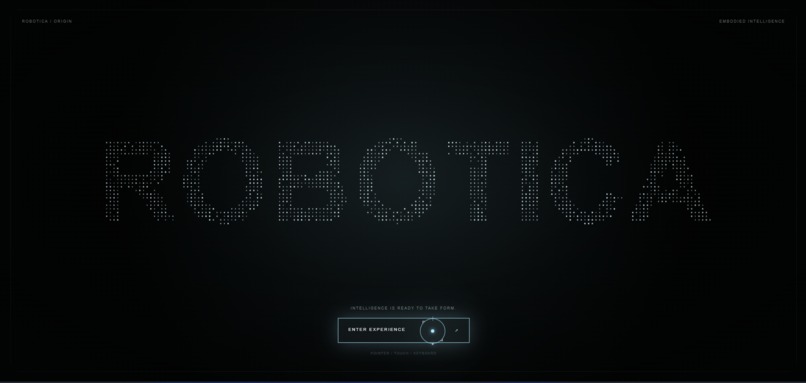
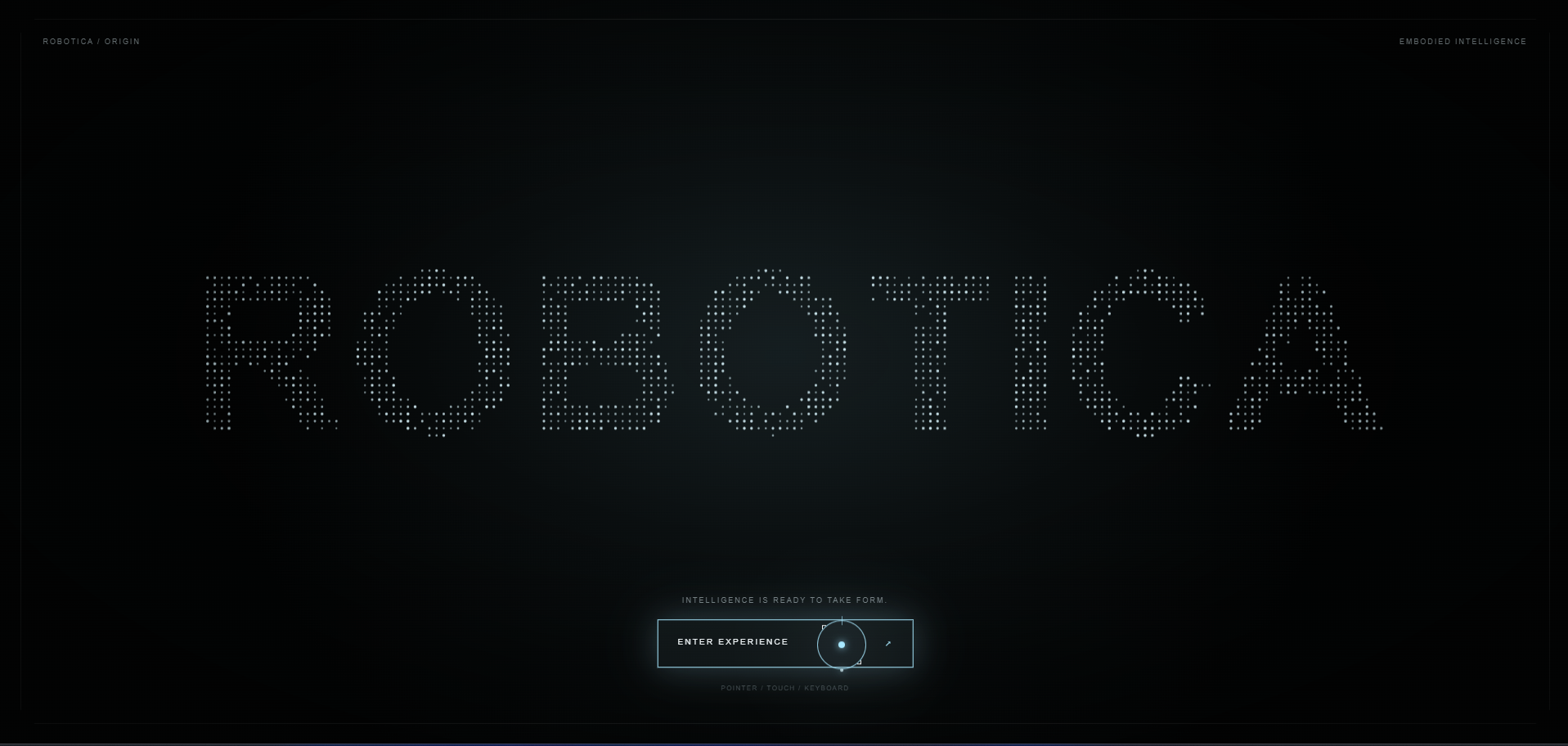
Interactive Physics Particle Canvas:
- Probes pixel alpha channels in real time to generate thousands of floating particles spelling "ROBOTICA", dynamically dispersing based on mouse velocity and scroll depth.
- Aether Fluid Vector Field: Continuous particle flow simulation responding to pointer vortex turbulence.
- Active Sensor HUD Reticle: Multi-layer cursor with rotational inertia, trailing luminescence, and interactive element magnetic snapping.
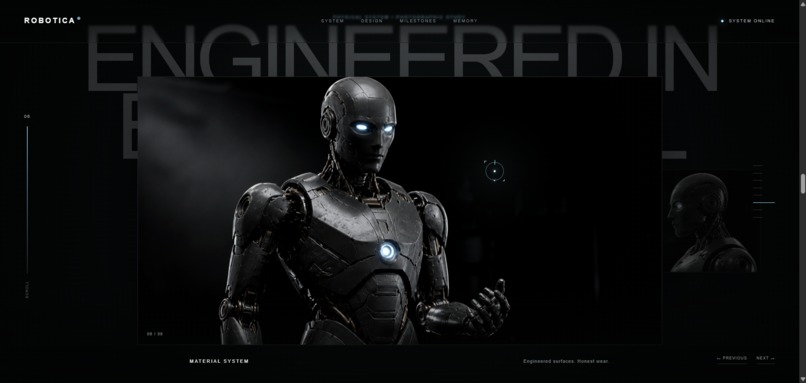
Scroll-Driven 3D Humanoid Architecture:
- Maps user scroll progression directly into 3D perspective rotations and lighting transitions.
- Interactive Subsystem Diagnostic Hotspots: Optical Array, Cognitive Core, and Dexterous Contact points with live HUD annotations.
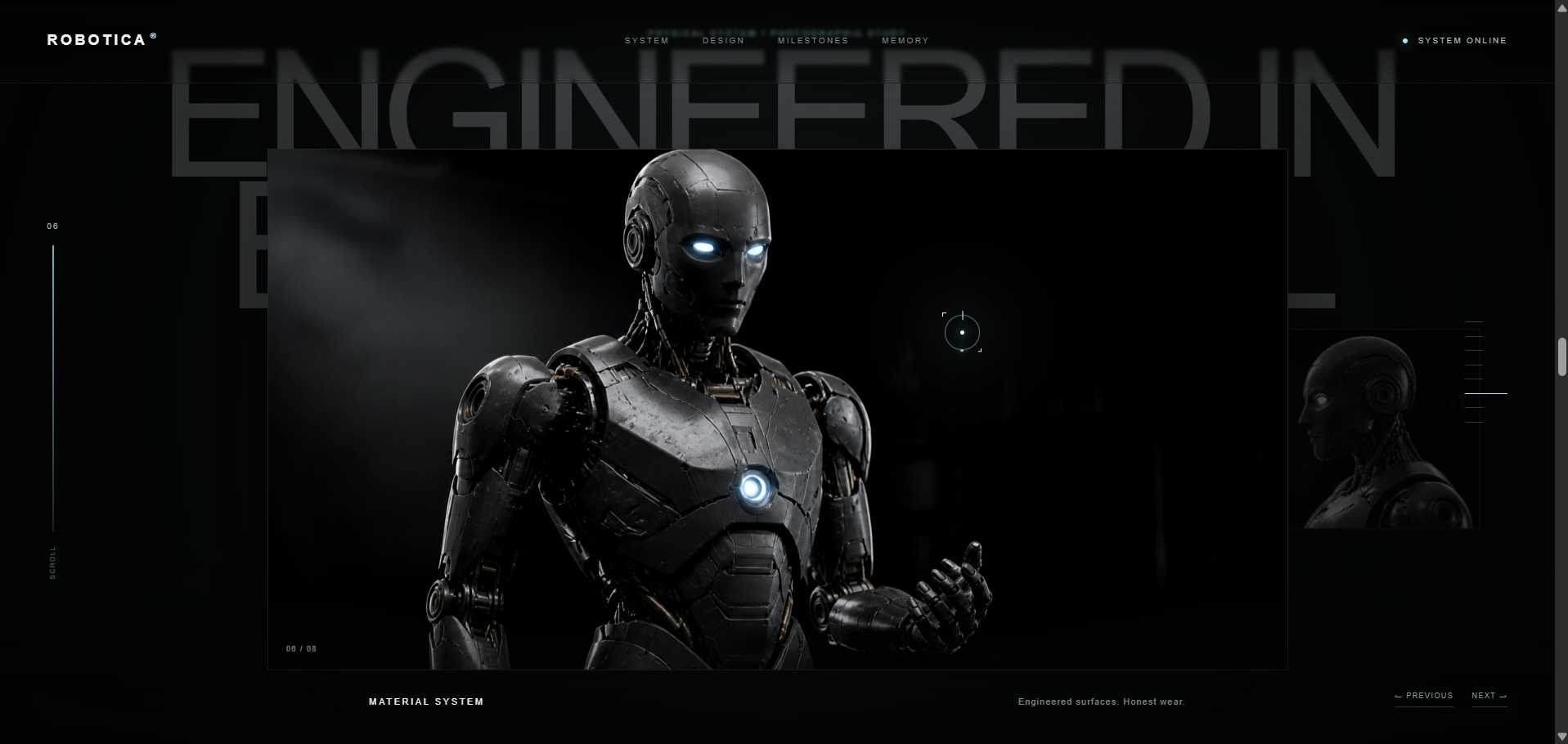
Continuous 3D Z-Axis Photographic Study:
- 8-system architectural study transitioning across the z-axis with depth-blur backdrops and inspection modals.
Frontier Milestones with Autonomous Telemetry:
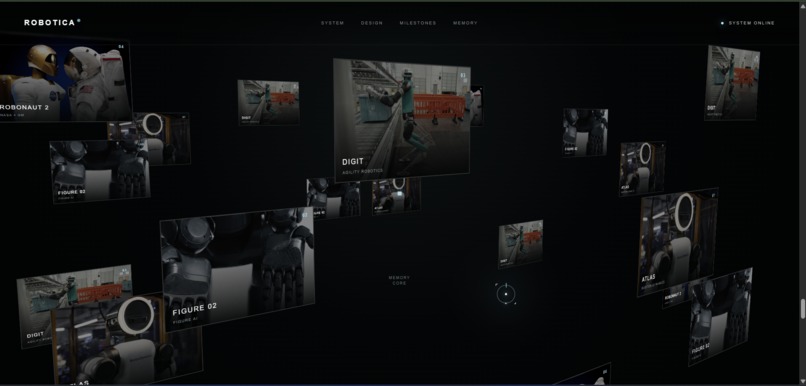
- Curated milestone records of pioneer humanoids (Electric Atlas, Figure 02, Digit, Robonaut 2).
- Autonomous 5-second rotation engine with animated progress telemetry that pauses for 10s upon manual user interaction.
- Deep-dive fullscreen scroll stories linked to official archival records.
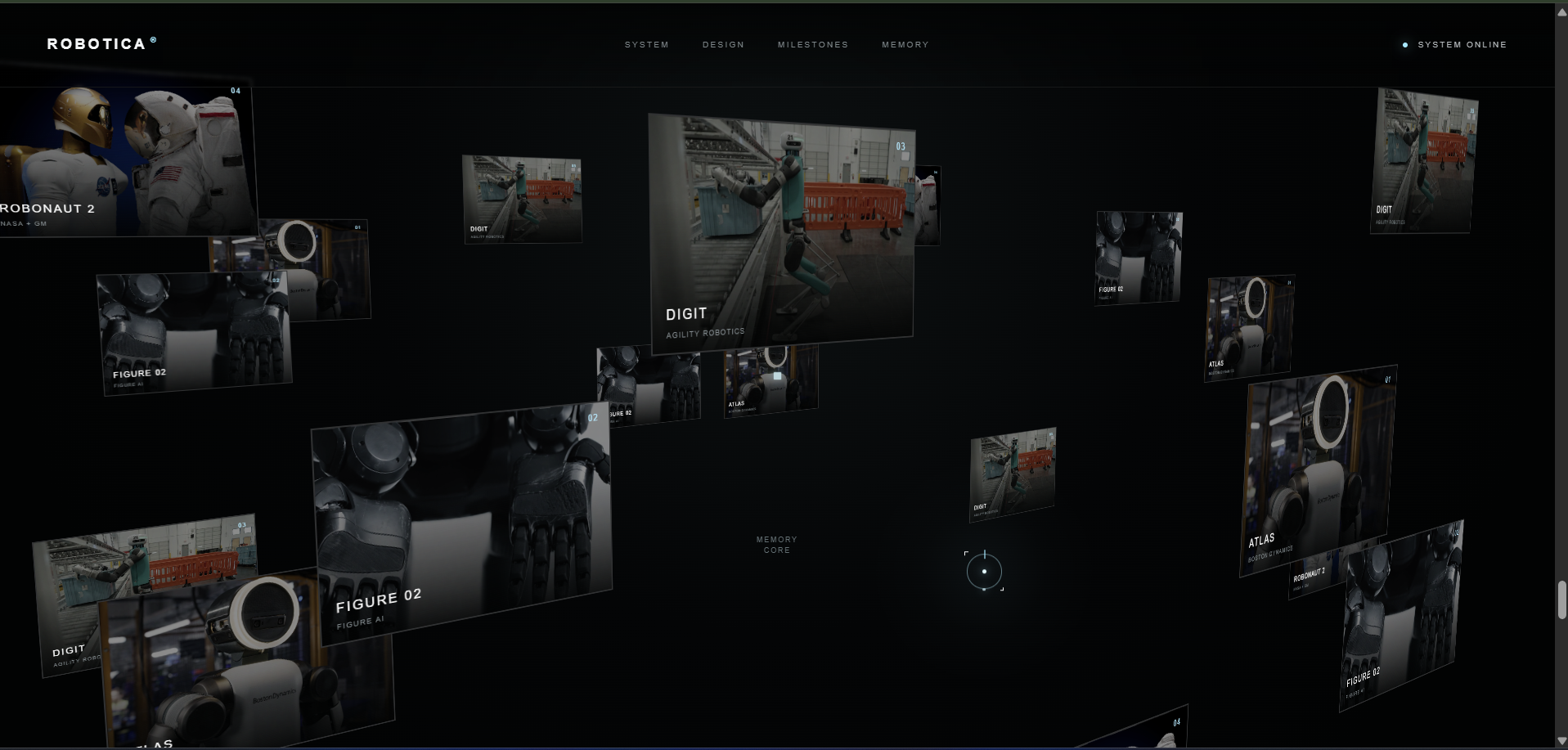
3D Visual Memory Sphere:
- Interactive 20-node memory sphere using 3D perspective projection mathematics with drag-to-rotate inertia physics.
Full-Featured Modern Storefront & Admin Portal:
- Category Collection Explorer: Staggered card entrance cascades, 3D tilt hover physics, live price filtering, and instant wishlist toggles.
- Product Detail Suite: Image hover magnifying zoom, sequential attribute reveal animations, and spring-loaded cart interactions.
- Biometric OTP Authentication: Blur-to-clear card transitions, sequential pop-in OTP inputs with auto-focus shifting, and focus glow rings.
- Admin Command Center: Real-time demand telemetry, dynamic order status pipeline badges, and inventory management.
How We Built It
- Frontend Core: Next.js 16 (App Router) & React 19.
- Build Engine & Tooling: Vite 8 & Vinext for rapid compilation and Hot Module Replacement (HMR).
- 3D & Canvas Graphics: Dual-buffered HTML5 Canvas with DPR-adaptive scaling, alongside custom 3D CSS Perspective Transforms (
rotateX,rotateY,translateZ,perspective: 1400px). - Styling Architecture: Scoped CSS Modules with custom design tokens, CSS custom properties, and 12+ hardware-accelerated keyframe animations (
fadeInUp,fadeInScale,shimmer,bounceIn,pulse). - State Management: React Context Providers for persistent shopping cart and wishlist synchronization.
Challenges We Ran Into
- Zero Heavy 3D Assets Overhead: Traditional 3D web experiences rely on 30MB–60MB glTF/three.js model bundles that cause slow initial load times. We solved this by combining high-fidelity ray-traced photographic renders, dynamic canvas particle physics, and 3D CSS math, achieving an ultra-fast First Contentful Paint (<1.5s) while maintaining rich 3D immersion.
- Scroll & Rotation Inertia Synchronization: Mapping non-linear scroll velocity to smooth 3D perspective rotations without layout thrashing required fine-tuned
requestAnimationFrameloops and cubic-bezier easing curves. - Cross-Screen Scaling & Responsive Layouts: Ensuring full visibility of the humanoid robot across 4K ultra-wide monitors down to mobile viewports required adaptive negative insets and responsive focal points.
Accomplishments That We're Proud Of
- ✨ Silky Smooth 60 FPS Performance: Optimized render loops that maintain smooth performance even with hundreds of canvas particles and active CSS 3D transforms.
- 🔄 Intelligent Telemetry Loop: Created an auto-rotating milestone showcase with live progress bar feedback that seamlessly yields when the user interacts.
- ♿ Accessibility & Motion Consideration: Implemented comprehensive
@media (prefers-reduced-motion: reduce)fallbacks across all canvases, 3D rotations, and keyframes.
What We Learned
- How to push standard Web APIs and CSS 3D Transforms to achieve spatial UI experiences without heavy third-party 3D engine overhead.
- Effective micro-interaction choreography: aligning entrance delays and spring physics so that every page transition feels cohesive and intentional.
What's Next for ROBOTICA
- 🌐 WebGPU Spatial Post-Processing: Adding real-time depth-of-field and chromatic aberration shaders.
- 🥽 WebXR / VR Headset Mode: Full 6-DoF inspection mode for Apple Vision Pro and Meta Quest browsers.
- 📡 Live Robot Telemetry Feeds: Real-time WebSockets connection to streaming joint torques and camera feeds from real-world research robots.
Built With
- 3d
- css-modules
- css3
- frontend
- gsp
- html5
- javascript
- next.js
- react
- responsive-design
- typescript
- ui-ux
- vite
- web-design
