About the Project
Inspiration
The potential of machine learning to interpret and interact with the physical world is vast and still largely untapped. Driven by a fascination for human-computer interaction, my project explores the integration of gesture recognition with real-time command execution, aiming to create an interface that is both intuitive and precise.
What I Learned
During this project, I deepened my understanding of NVIDIA's Lt4ml Docker image and deployed a custom implementation of NVIDIA's trt_pose_hand` as a custom image. The project sharpened my skills in neural network optimization for gesture recognition, pushing the boundaries of what's possible on edge devices like the Jetson Nano. I also learned to manage the intricacies of real-time data processing and the importance of efficient model inference in a constrained computational setting.
How I Built It
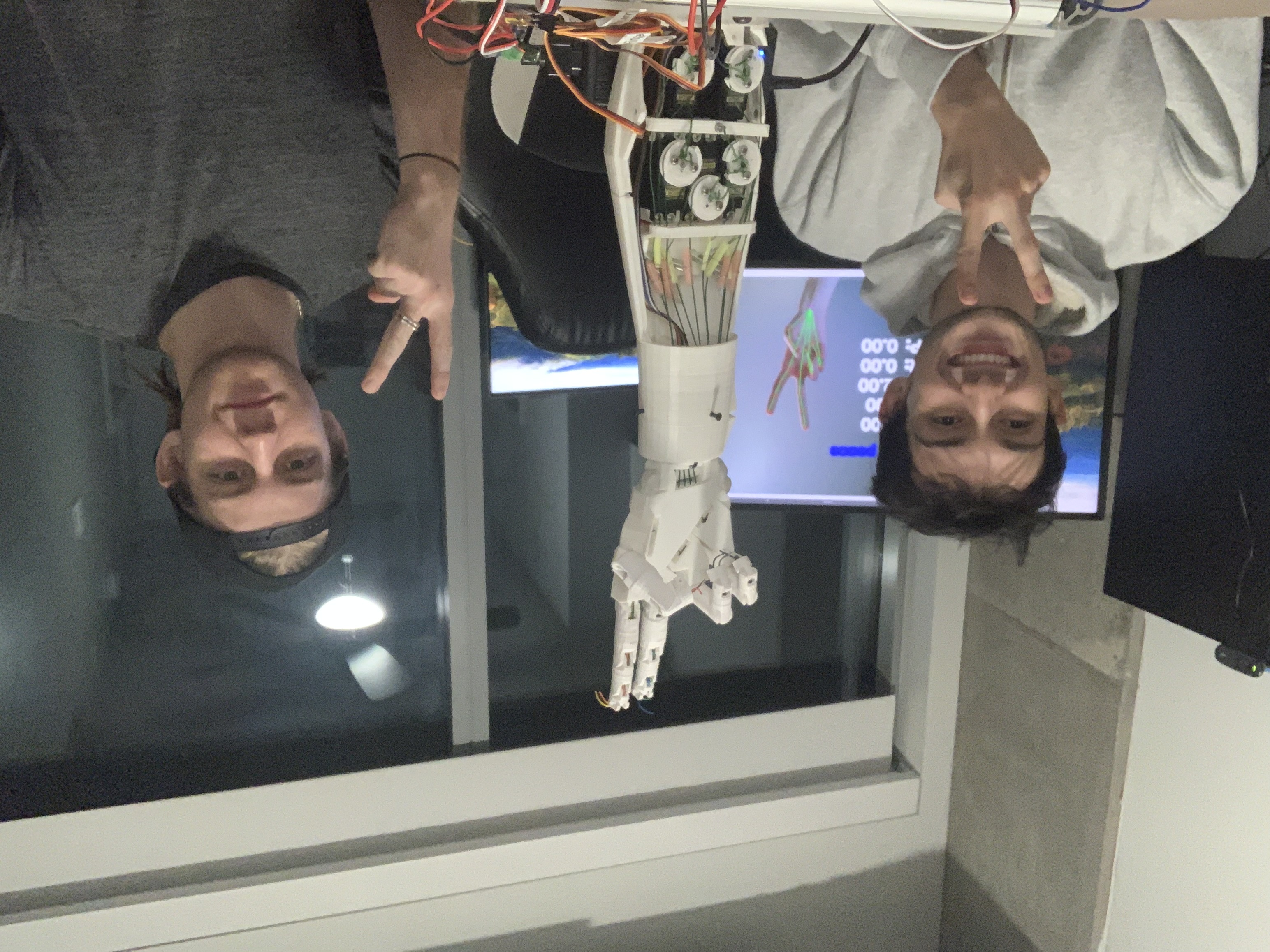
Leveraging the power of Docker, I crafted a custom container based on NVIDIA's Lt4ml image, tailored to run on a Jetson Nano. Within this container, trt_pose_hand serves as the cornerstone, modified to not only recognize hand gestures but also to evaluate the degree of each finger's bend and send that data to an esp32 that moves the servos
Docker: The Safety Net for Experimentation
You know how it is when you're deep into coding and suddenly everything goes kaput? Well, Docker was the superhero of the hour for me. Each time I managed to brick my image with some over-ambitious tweak, Docker saved the project. One command, and boom!—I was back to my last working setup. It's like having an unlimited undo button while you're figuring out how to get things just right.
Using Docker images was like building with Legos. I could snap together all the pieces of my project, and if something didn't fit, I could just pop it off and try a new piece. It's this modular magic that made Docker indispensable. Plus, it meant that once I had that perfect build, I could share it with anyone, anywhere, and they could recreate my setup in a snap. No fussing with dependencies or crying over version mismatches—Docker handled all the grunt work.
In a project where every millisecond of processing time counts, Docker's ability to keep things consistent and portable was a game-changer. It let me focus on the cool stuff, like teaching a robot hand to follow my lead, instead of getting bogged down in the mire of system configs and environment setups.
To ensure the system could operate in real-time, I optimized the model to run efficiently on the Jetson Nano's limited hardware, focusing on reducing latency and maximizing throughput. The containerized application captures gestures, processes them through the model, and outputs control signals for the esp32 to forward to the servos
Challenges Faced
One of the most significant challenges was optimizing the gesture recognition model to work within the constraints of the Jetson Nano's processing capabilities. It was crucial to achieve a balance between accuracy and speed to allow for real-time interaction without noticeable delays.
I also faced the challenge of ensuring that the system could gracefully handle edge cases, such as the absence of a hand in the camera's view, without compromising performance or stability.
Conclusion
This project underscores the versatility and efficiency that Docker brings to machine learning applications, especially in edge computing scenarios. It demonstrates how machine learning models can be optimized and deployed to interpret complex gestures in real-time, opening the door to a new realm of possibilities for human-computer interaction.
Built With
- arduino
- c++
- esp-32
- jetson-nano
- jupiter
- nano
- notebook
- nvidia-l4t
- platformio
- python


Log in or sign up for Devpost to join the conversation.