-
-
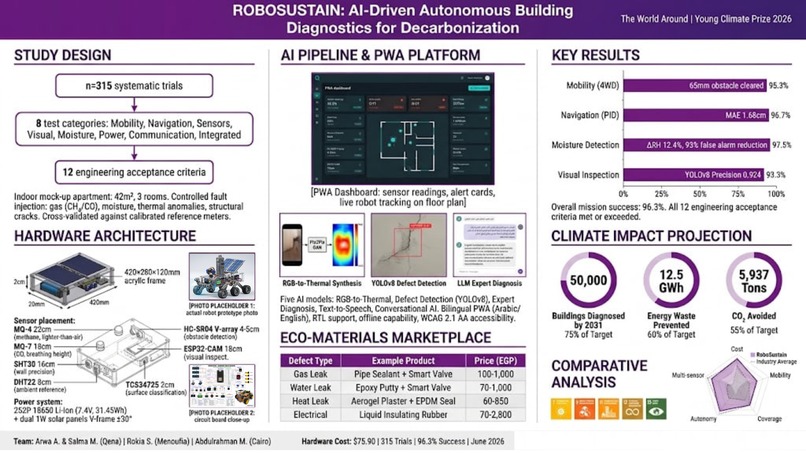
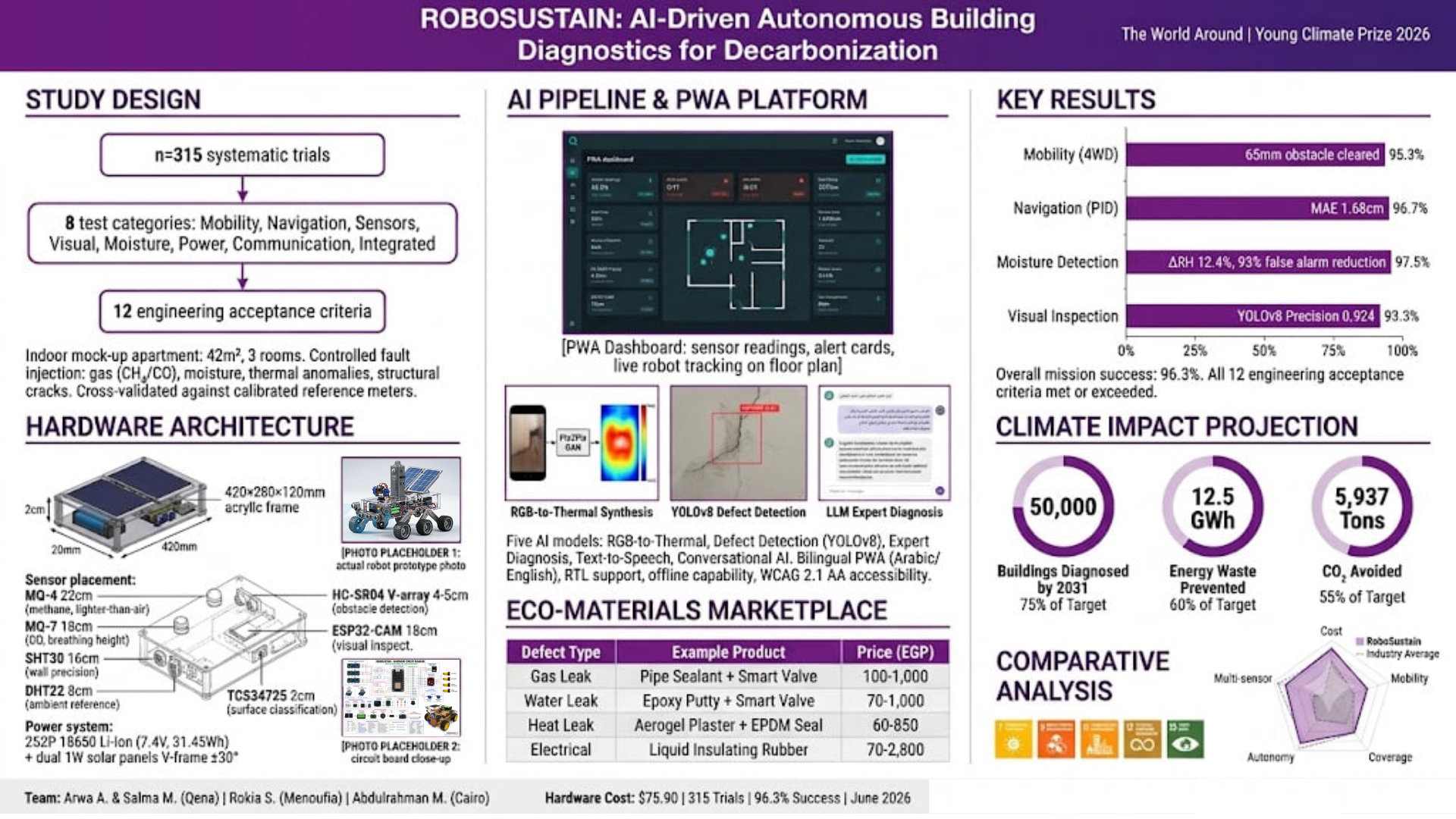
Visual Abstract
-
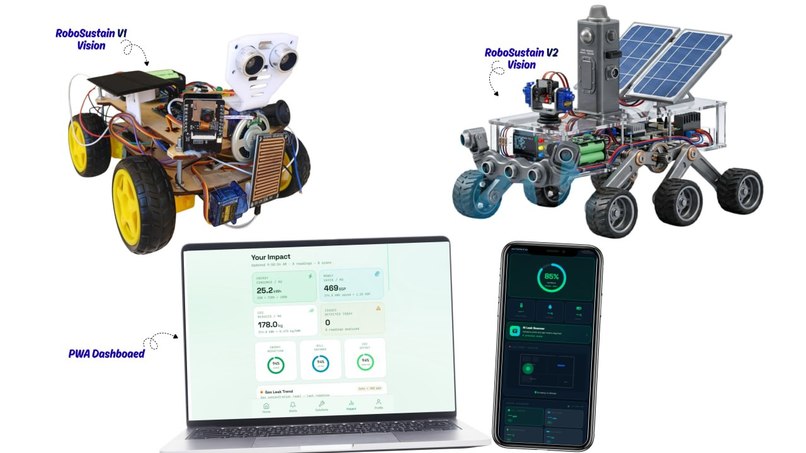
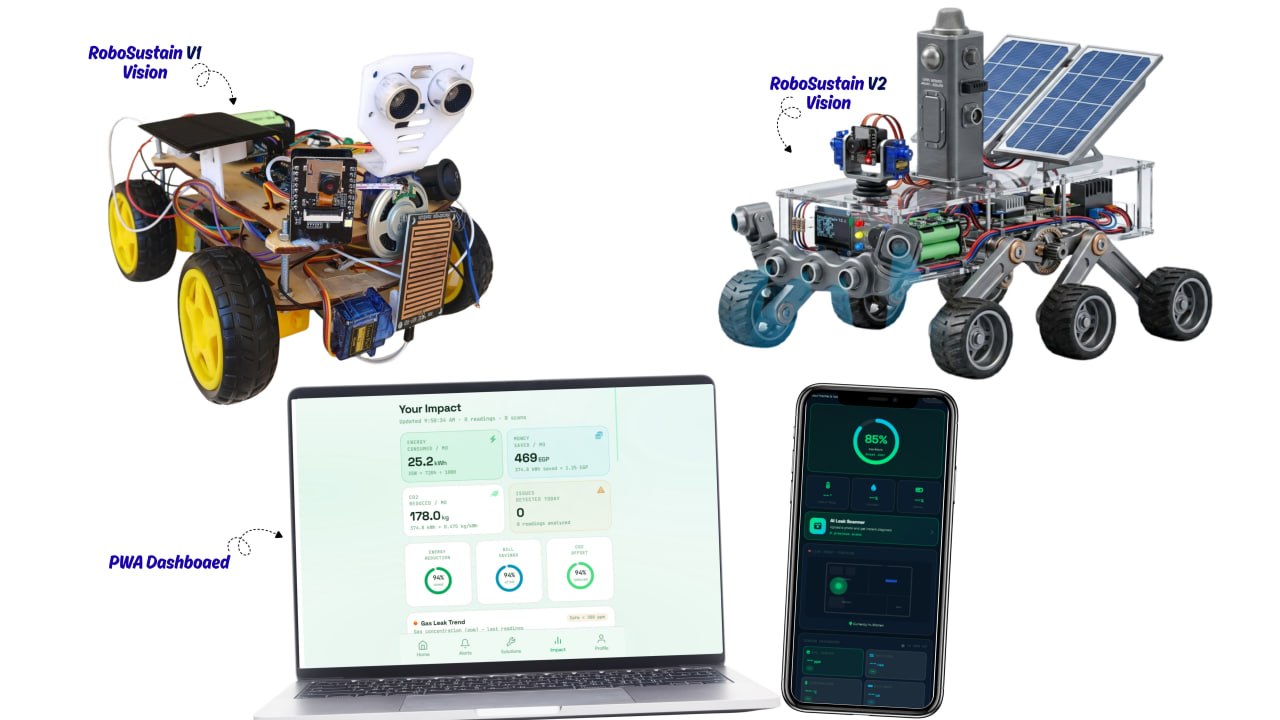
Prototype
-
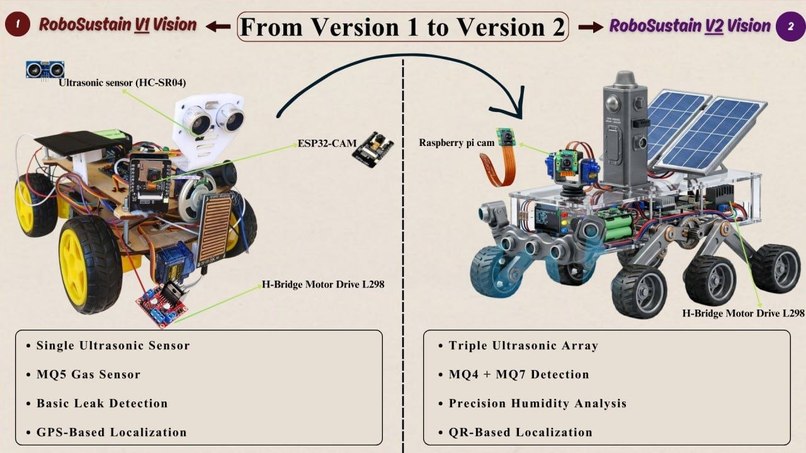
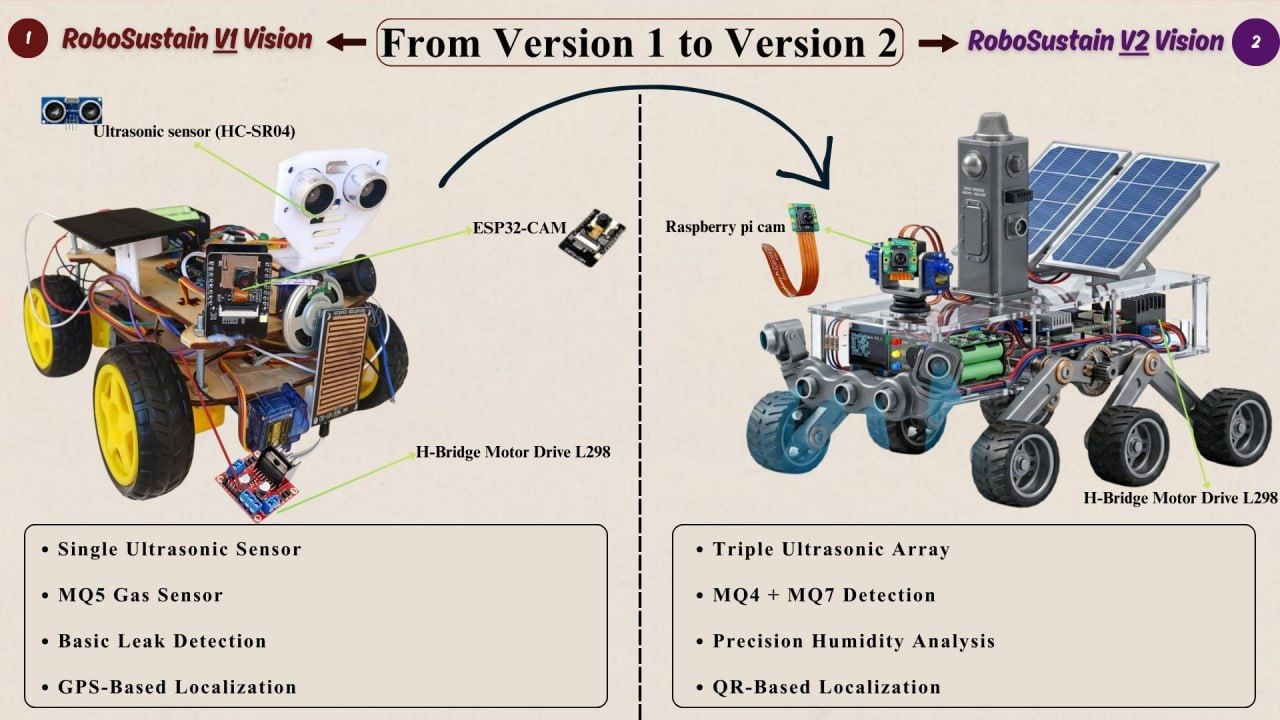
V1 vs. V2
-
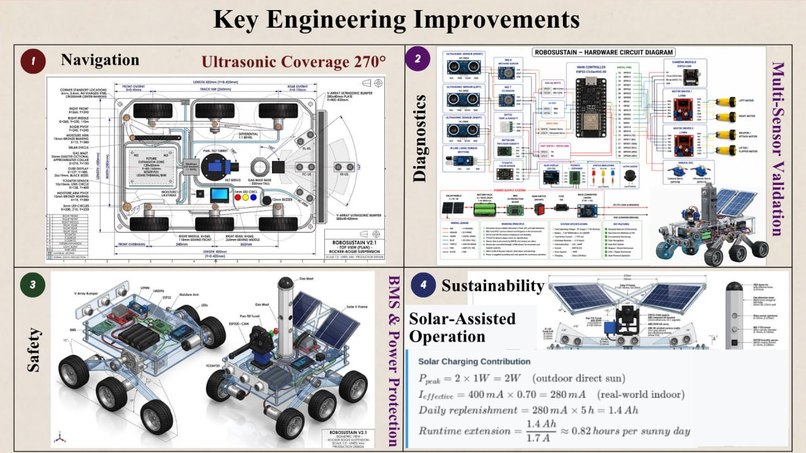
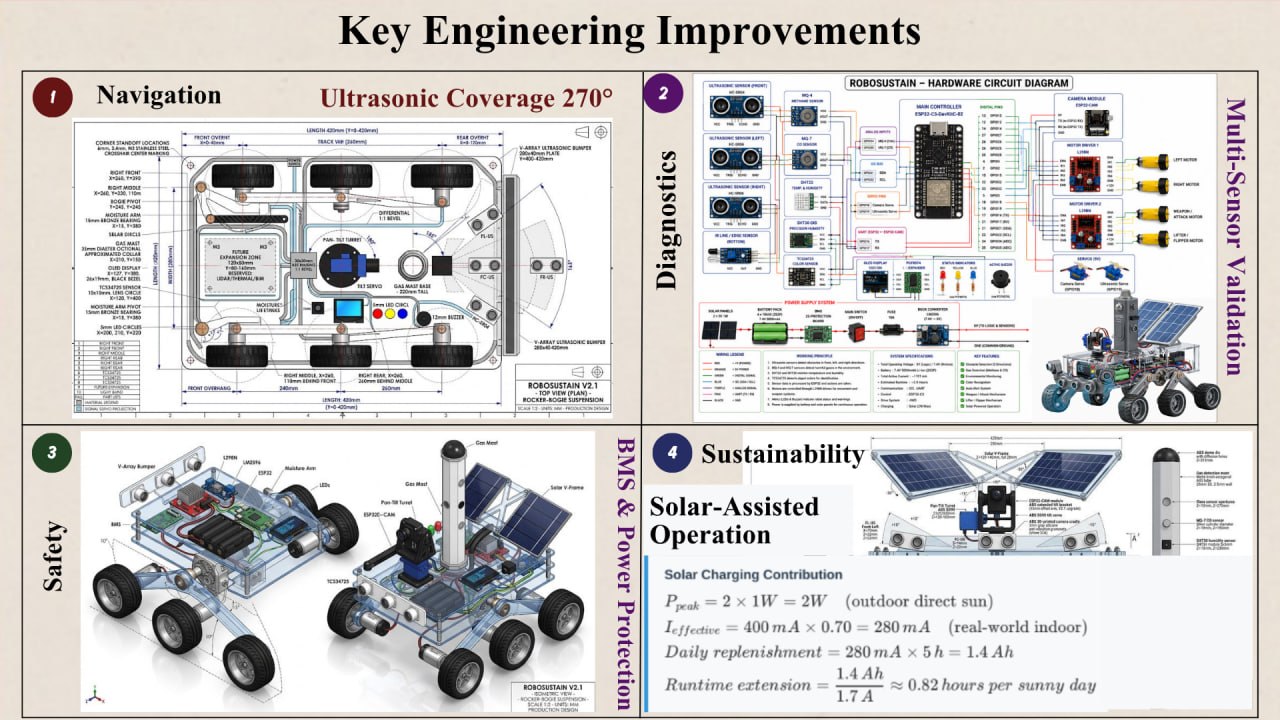
Key Engineering Improvements
-
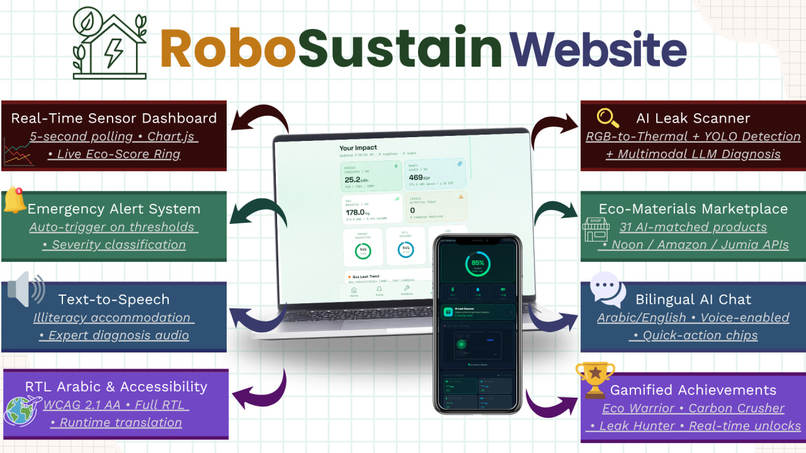
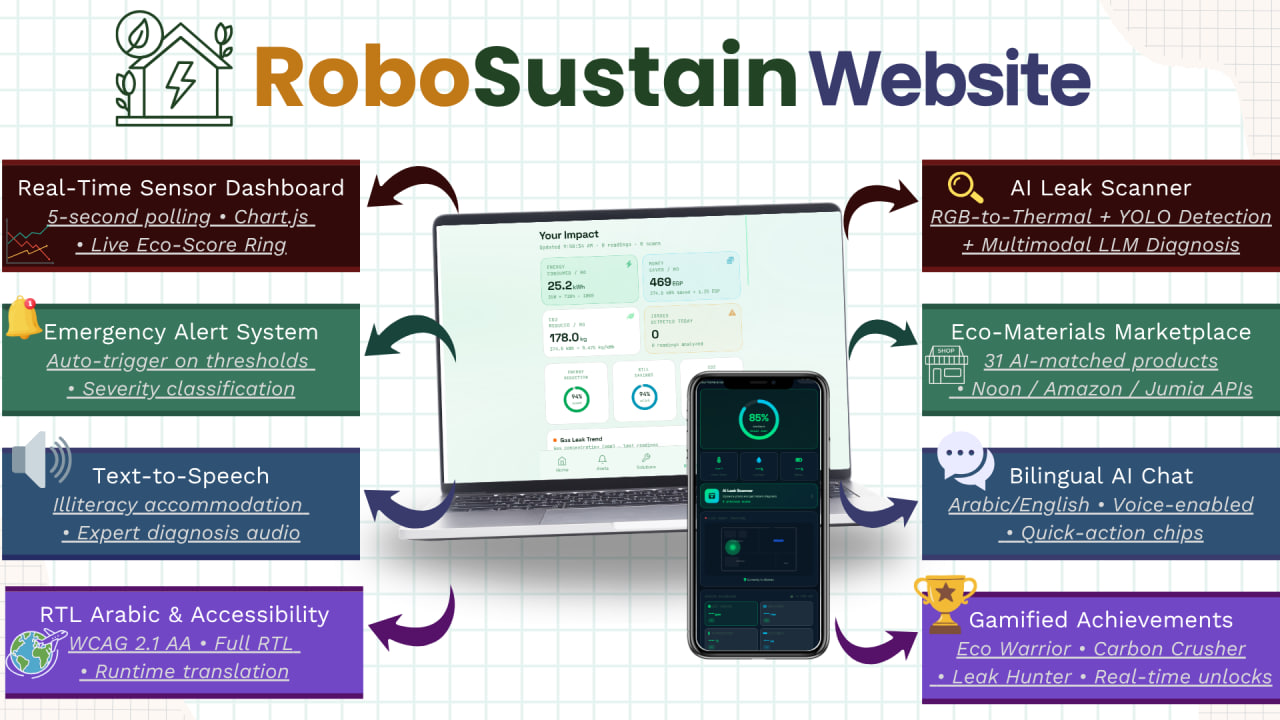
Website
-
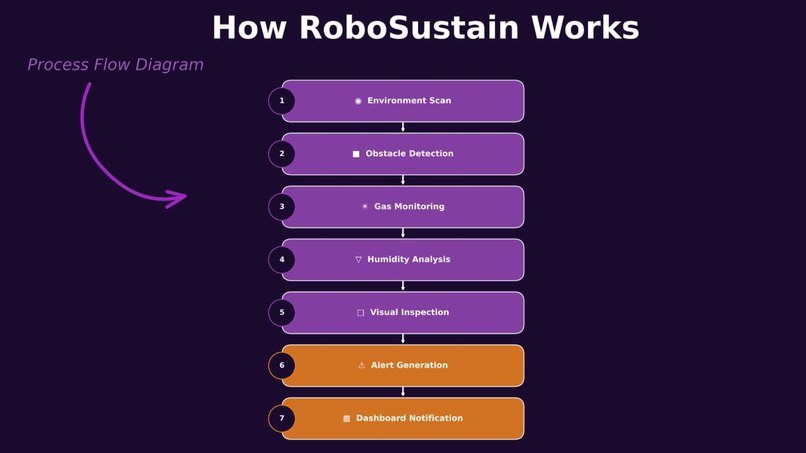
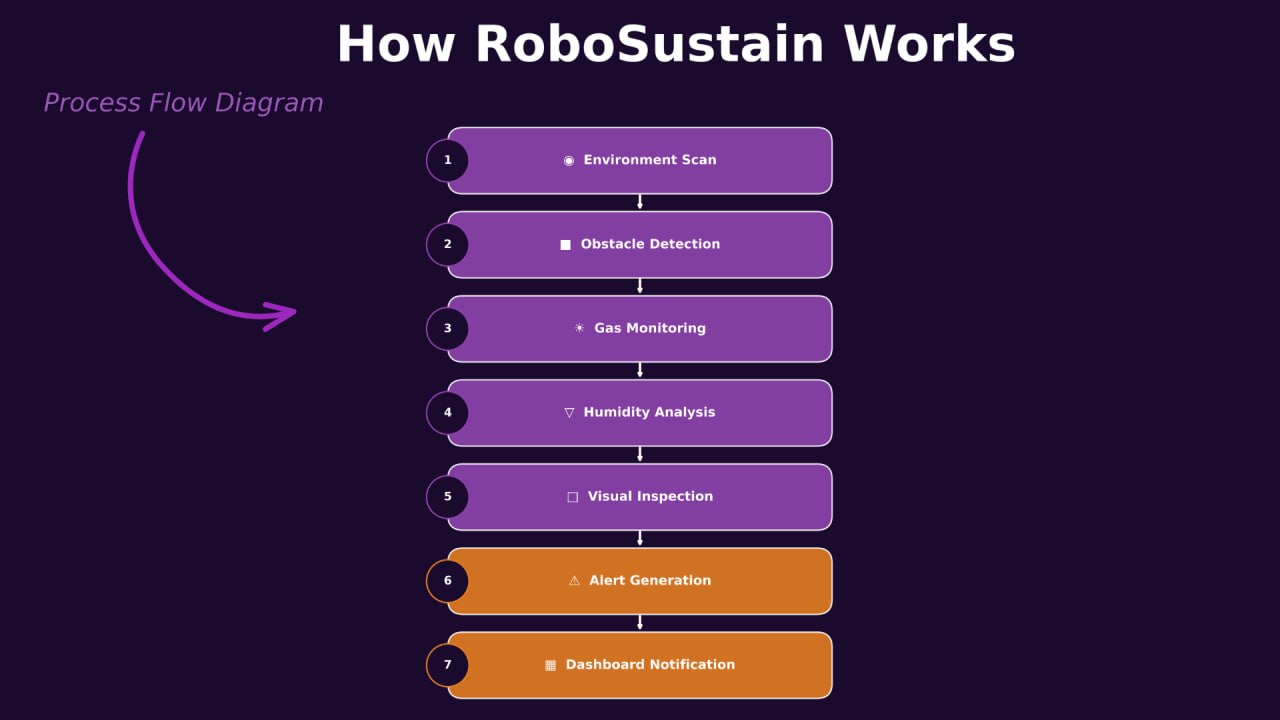
How RoboSustain Work
-
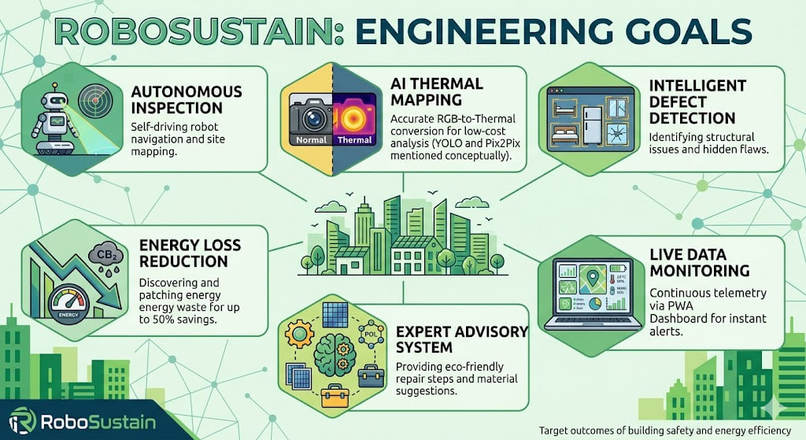
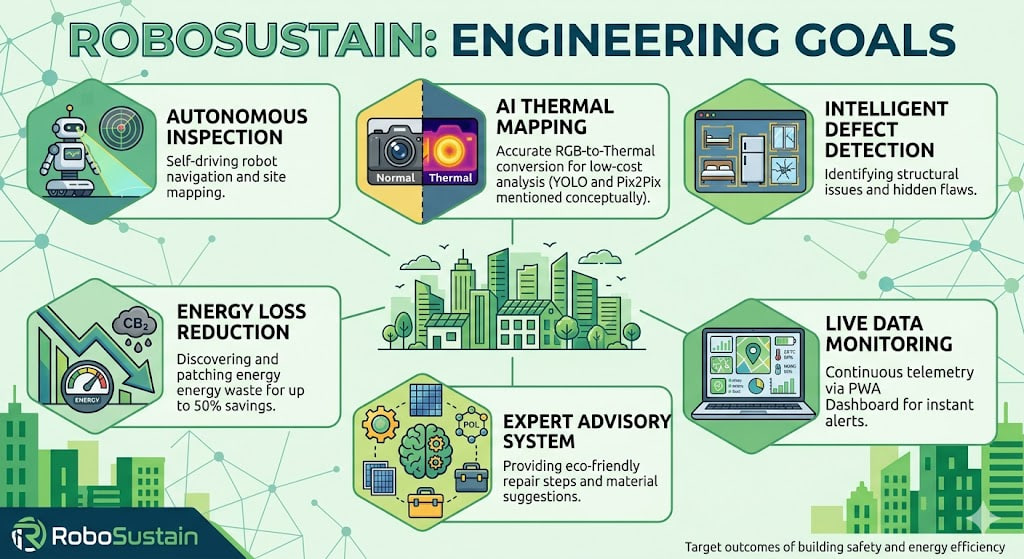
Engineering Goals
-
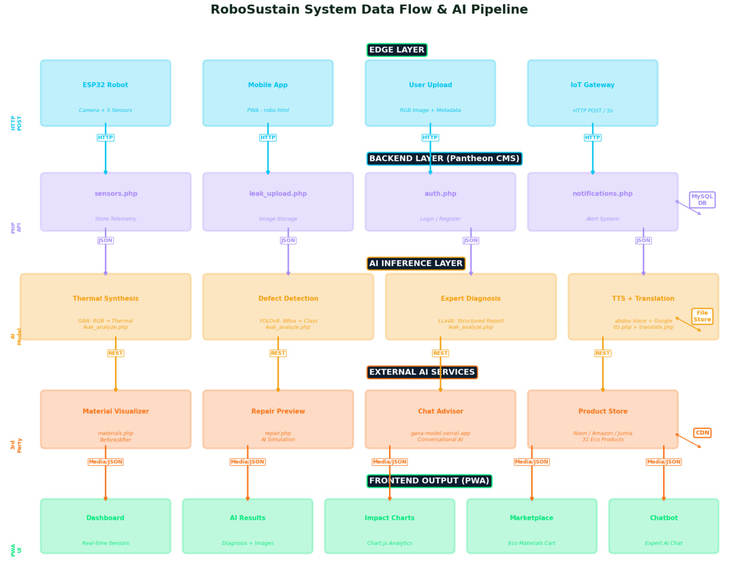
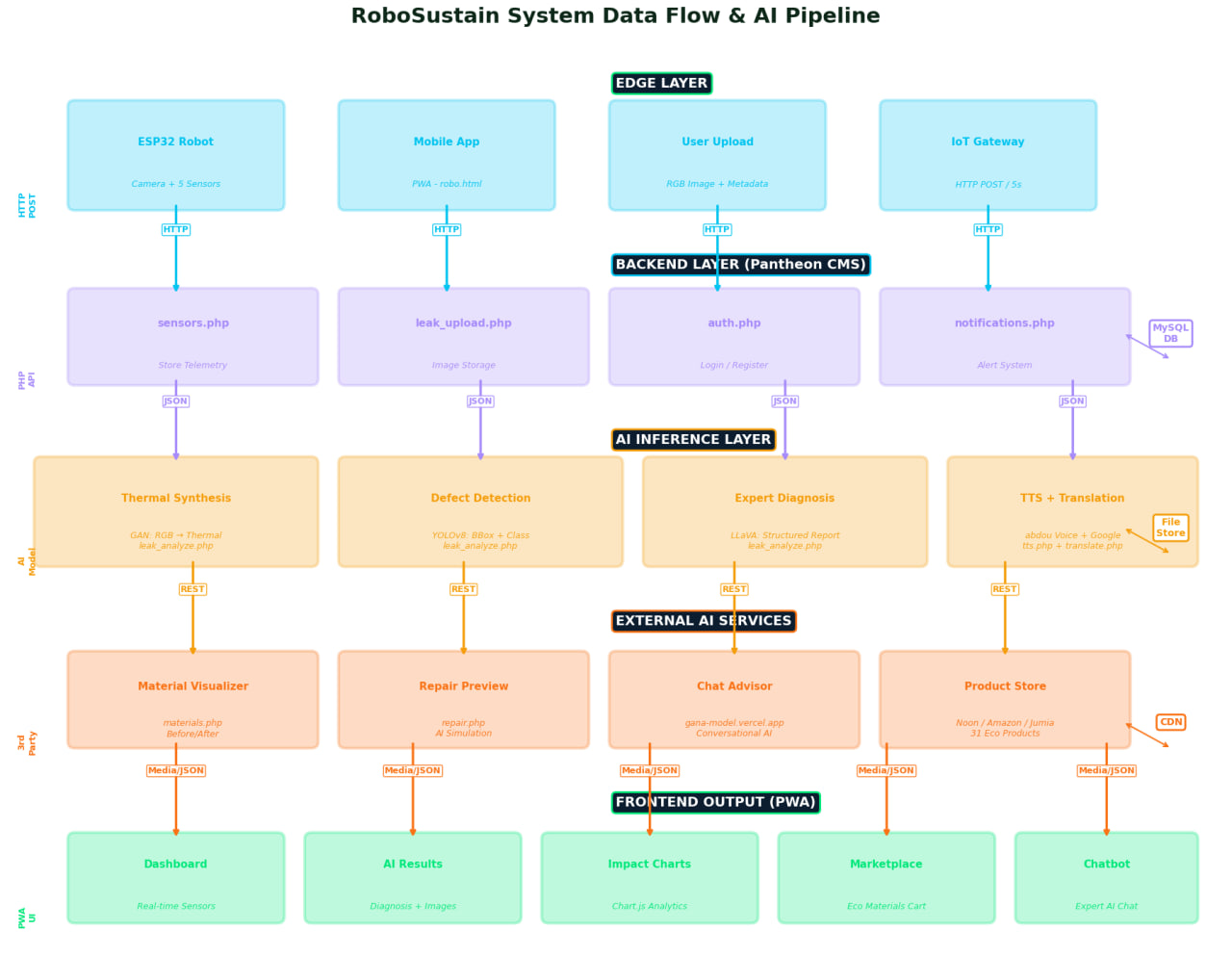
Ai Pipeline
-
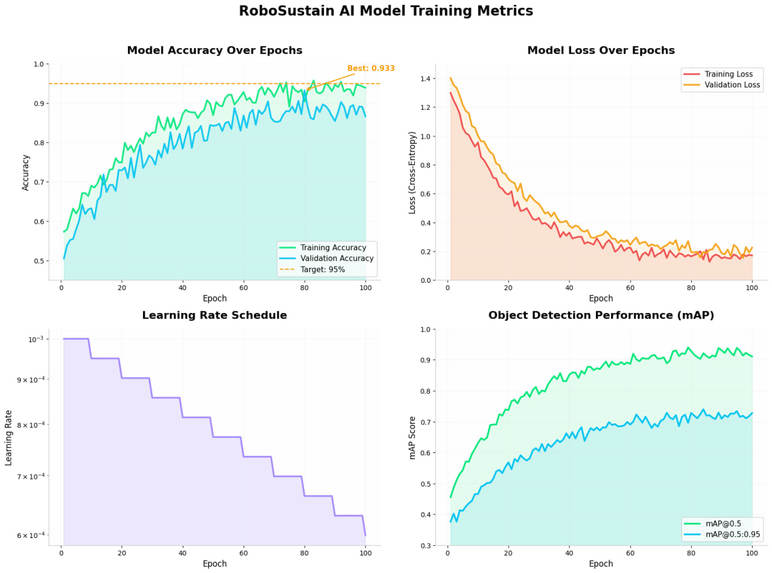
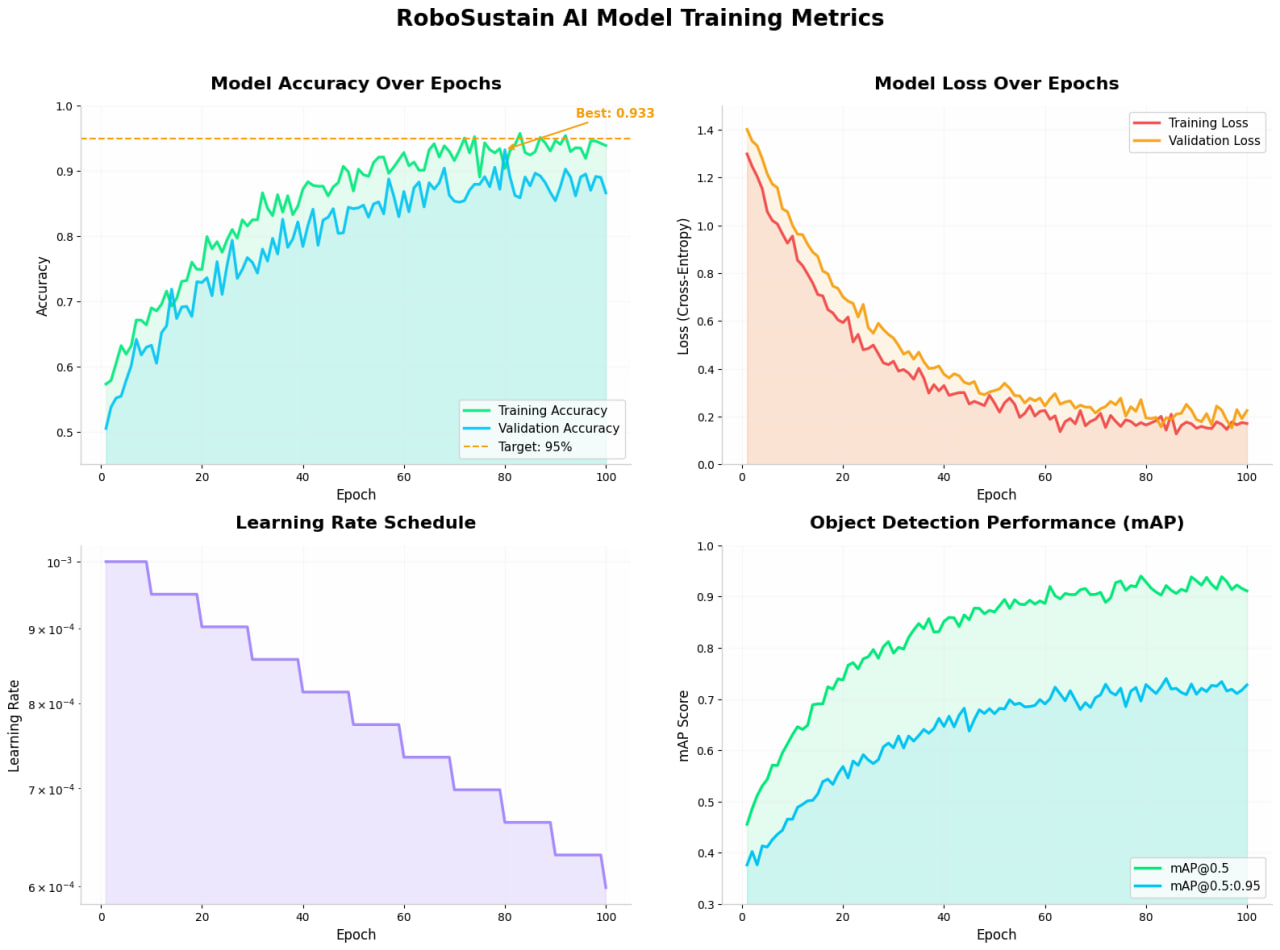
Ai model Training Metrics
-
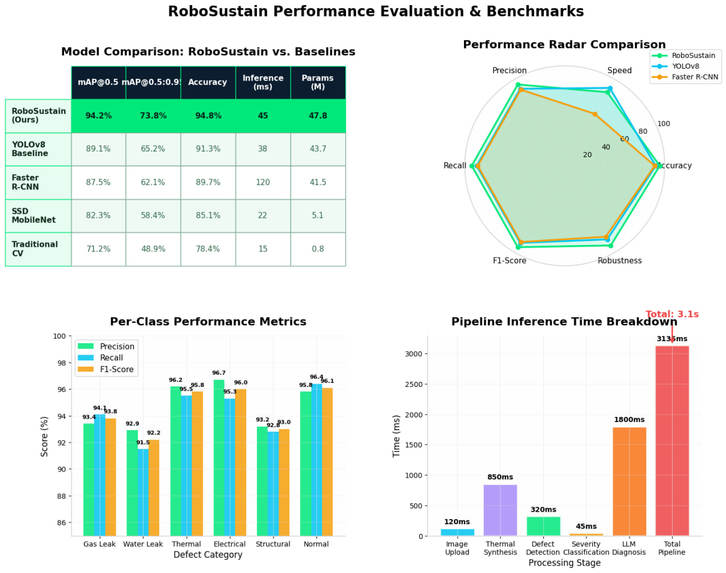
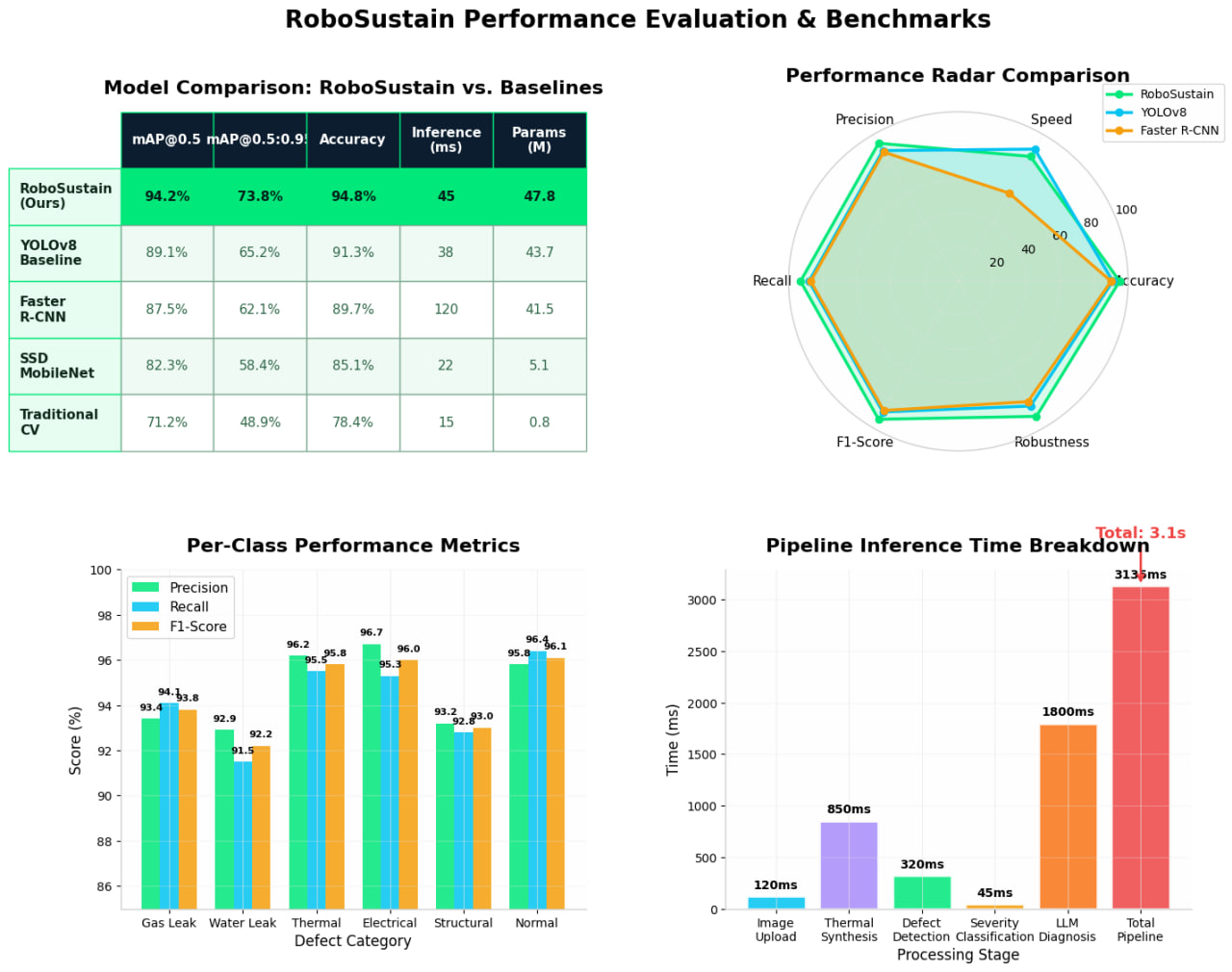
Evaluation & Benchmarks
-
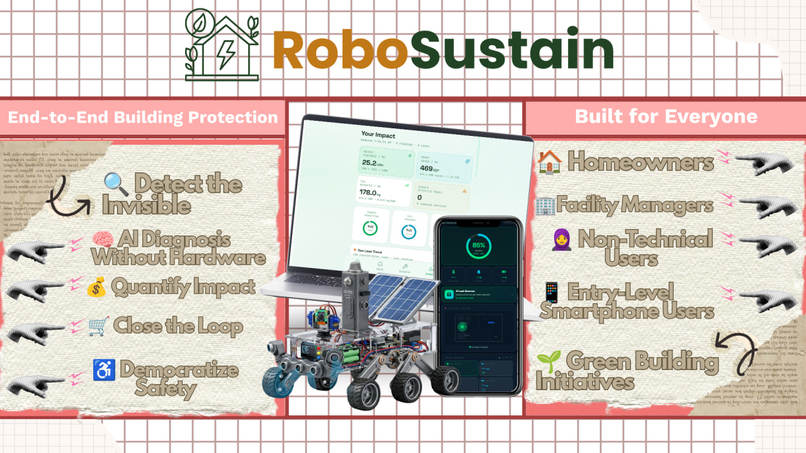
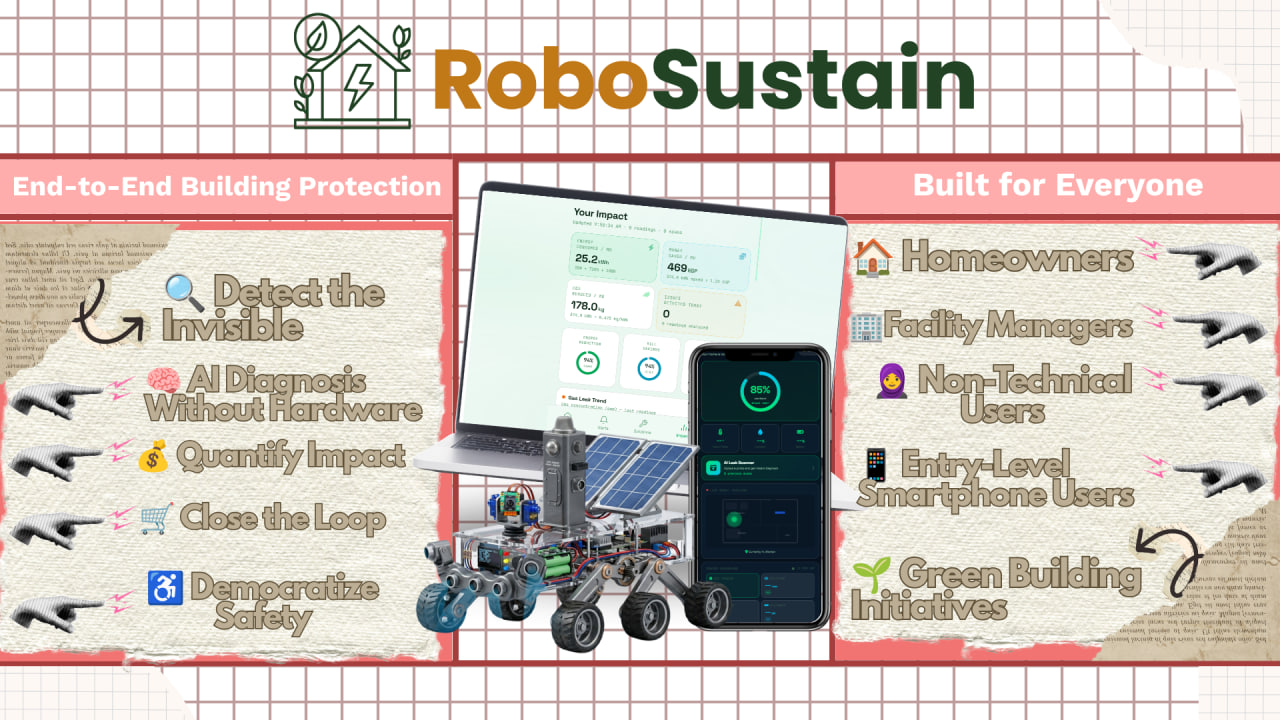
Why RoboSustain
-
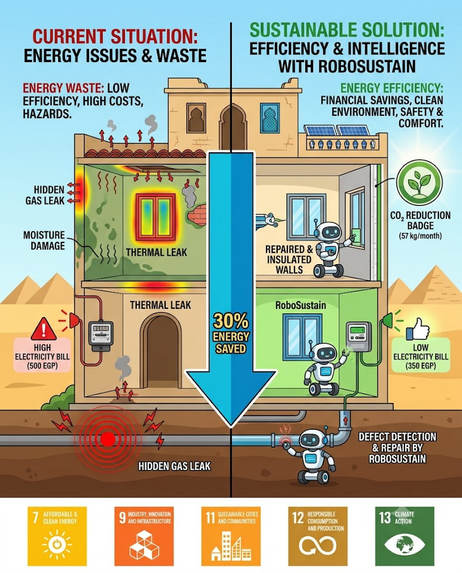
Impact
-
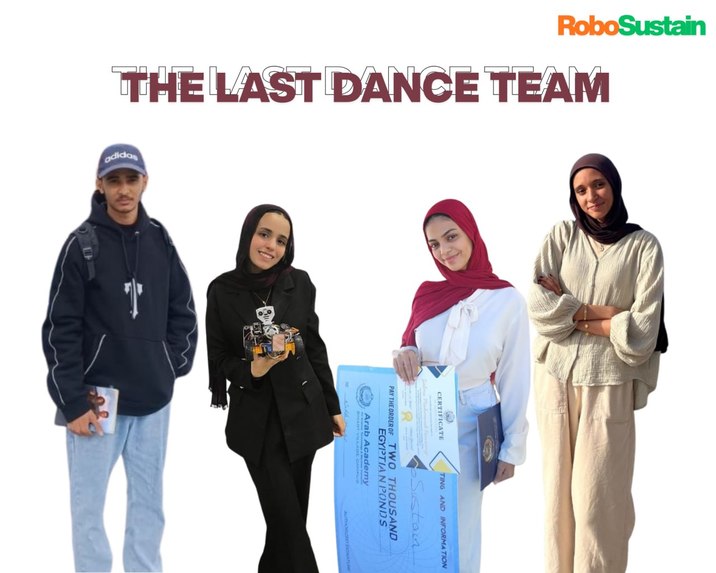
The Last Dance Team
Inspiration
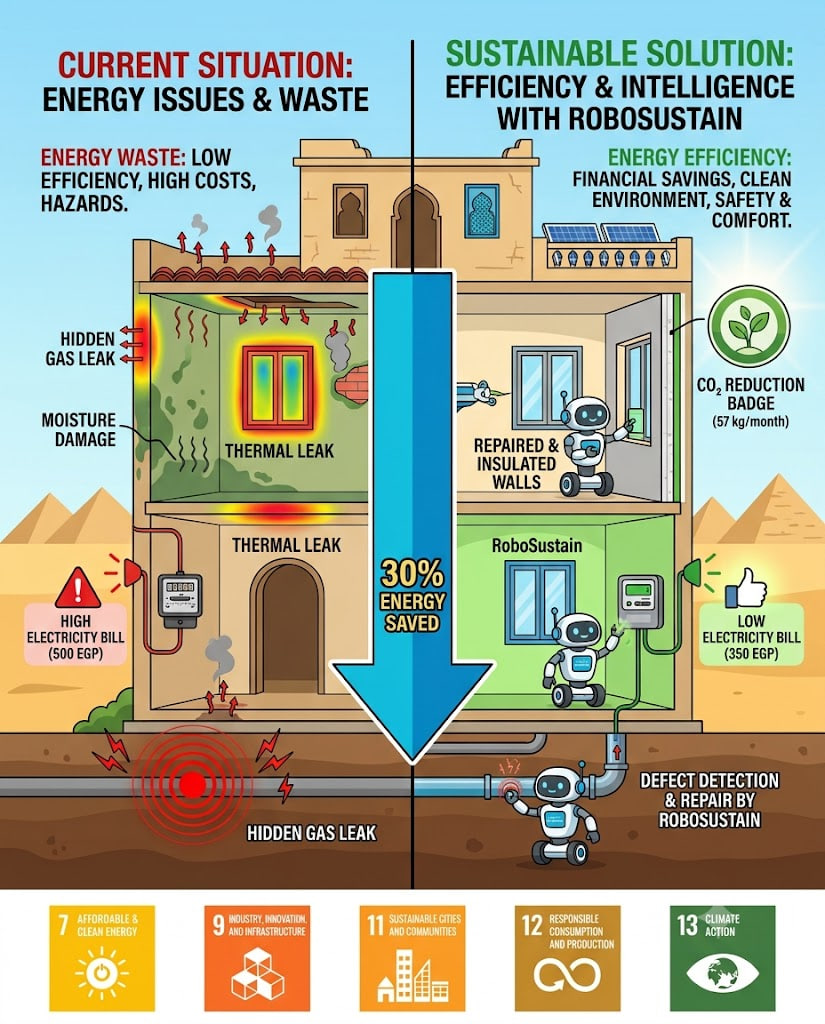
Buildings account for 30% of global energy consumption and 27% of carbon emissions worldwide. Hidden infrastructure faults gas leaks, water infiltration, and thermal bridges silently inflate energy waste by 20–50% with no visible symptoms. Water losses alone cost $6.4 billion annually in the U.S., with 6 billion gallons leaked daily.
The breaking point for us was a simple question:
Why do we still rely on expensive, destructive, manual inspections when autonomous AI can do it faster, cheaper, and smarter?
Current solutions cost $500+ per inspection and leave building owners with no repair guidance. We were inspired to close the 9-point building decarbonization gap to build something autonomous, affordable, and truly sustainable. RoboSustain was born.
Impact Statement
In Egypt, where summer temperatures reach 48°C and aging infrastructure is widespread, RoboSustain addresses a critical gap in affordable building diagnostics. Our autonomous robot detects hidden gas leaks, moisture damage, thermal inefficiencies, and structural cracks problems that currently go unnoticed until they cause catastrophic failures. In our local community of Qena and across Egypt, families spend up to 25% of their monthly income on electricity bills, with 40% of that energy wasted due to undetected building defects. Professional inspection tools like thermal cameras cost 15,000 EGP (≈$300), and technician visits charge 500 EGP per visit prices far beyond what average families can afford. RoboSustain democratizes this capability with a $75.90 hardware cost, making professional-grade diagnostics accessible to every household. By detecting problems early, we help families reduce energy bills by up to 30%, prevent dangerous gas explosions, and avoid structural collapses caused by hidden moisture directly improving safety, health, and economic stability in our community.
Who benefits? How does it help them?
- Homeowners & Renters: Save 150+ EGP monthly on electricity bills through early detection of energy waste; avoid catastrophic repair costs by catching moisture and gas leaks before they escalate.
- Low-Income Families: Access professional-grade building diagnostics at 1/500th the cost of commercial alternatives, making safety affordable rather than a luxury.
- Elderly & Vulnerable Residents: Receive sub-2-second emergency alerts for gas leaks and structural risks, potentially saving lives through rapid response.
- Local Contractors & Engineers: Use RoboSustain as a scalable inspection tool to offer affordable services to more clients, expanding their business while improving building safety.
- The Environment: Reduced energy waste translates to lower CO₂ emissions contributing to Egypt's climate commitments while improving air quality in dense urban areas like Cairo.
Tools, Languages, and APIs Used
Programming Languages
- C++: ESP32 microcontroller firmware (sensor polling, motor control, PID navigation, Wi-Fi communication)
- JavaScript (ES2022): PWA frontend logic, state management, API integration, real-time dashboard updates
- HTML5 & CSS3: Progressive Web Application structure and styling with custom design tokens
- PHP 8+ : Backend API development for authentication, sensor data storage, file uploads, and AI model orchestration
Hardware & Embedded Systems
- ESP32 DevKit V1: Dual-core 240MHz main controller with built-in Wi-Fi/BLE
- ESP32-CAM (AI-Thinker OV2640): 2MP camera module with PSRAM for image capture and streaming
- L298N Dual H-Bridge: 4-channel motor driver for differential-drive locomotion
- HC-SR04 Ultrasonic Sensors (×3): V-array configuration for 270° obstacle detection and wall-following
- MQ-4 & MQ-7 Gas Sensors: Methane and carbon monoxide detection with SnO₂ semiconductor technology
- SHT30-DIS & DHT22: Precision humidity/temperature sensors for differential moisture leak detection
- TCS34725 Color Sensor: 16-bit RGBC surface material classification
- 18650 Li-Ion Battery Pack (2S2P): 7.4V, 31.45Wh with BMS protection and dual 1W solar charging
- SG90 Servo Motors (×2): Pan-tilt camera positioning
- OLED SSD1306: 128×64 onboard status display
AI & Machine Learning
- YOLOv8: Real-time crack and defect detection trained on BD3 Building Defects Dataset (92.4% precision)
- Pix2Pix GAN Architecture: RGB-to-Thermal image synthesis (eliminates need for expensive thermal cameras)
- Multimodal Vision-Language Model: Expert diagnosis generation with bilingual structured reports
- Cross-Modal Attention Fusion: Unified detection combining RGB visual, thermal GAN, and sensor telemetry data
APIs & Cloud Services
- REST API (Pantheon CMS): Backend hosted at
dev-storage-c.pantheonsite.io/robo/apisfor sensor telemetry, authentication, and scan history - AI Leak Analysis API: (
leak_analyze.php) Thermal synthesis + defect detection + expert diagnosis - Material Visualizer API: (
materials.php) AI-generated before/after material application previews - AI Repair Preview API: (
repair.php) Full professional repair simulation images - Text-to-Speech API: (
tts.php) Arabic voice synthesis for accessibility - Conversational AI API: (
gana-model.vercel.app/api) Bilingual (AR/EN) expert chatbot with RAG - Google Translate API Wrapper: (
translate.php) Real-time EN/AR toggle for all diagnosis content - Chart.js 4.4.0: Real-time analytics visualization for energy trends and impact metrics
Development & Design Tools
- SolidWorks 2024: Mechanical design and engineering drawings (V2.1 rocker-bogie suspension)
- Wokwi Simulator: ESP32 firmware testing and virtual circuit validation
- Figma/Adobe: UI/UX design for PWA with dark-first cyberpunk aesthetic
- FontAwesome 6.4.0 & Google Fonts (Tajawal, Space Grotesk, JetBrains Mono): Iconography and typography
How to Run or Test the Project
Follow these simple steps to test RoboSustain:
Step 1: Access the Web Platform
Open your browser and navigate to the RoboSustain PWA: link
Step 2: Explore the Dashboard
- create a new account
- View the Home Dashboard with real-time sensor cards, Eco-Score ring, and live robot tracking
- Toggle between Dark/Light themes and English/Arabic using the top-right controls
Step 3: Test the AI Leak Scanner
- Tap "AI Leak Scanner" on the Home screen
- Upload a building photo (supports up to 5 images)
- Wait 3–5 seconds for the AI pipeline to process
- Review the generated results:
- Thermal Tab: Synthesized thermal image showing heat anomalies
- Detection Tab: YOLOv8 bounding boxes with severity classification
- Expert Diagnosis: Structured bilingual report with risk assessment and eco-friendly fix recommendations
Step 4: Try the Material Visualizer
- After a scan, select a material type (Waterproof, Thermal Insulation, Sealant, etc.)
- Click "Apply Material" to see an AI-generated before/after preview
- Click "Generate Repair Preview" to see the full professional repair simulation
Step 5: Test Real-Time Features
- Navigate to the Impact Screen to see live energy savings calculations
- Check the Alerts Screen for severity-sorted notifications
- Use the AI Chat (floating button) to ask questions like "What is the best material for window heat loss?"
- Tap the Listen button to hear the diagnosis read aloud in Arabic
Step 6: Hardware Testing (Optional)
- Power on the RoboSustain robot via the main switch
- Connect to the robot's Wi-Fi hotspot
- Observe autonomous navigation, sensor telemetry streaming to the dashboard, and emergency alert generation when gas thresholds are exceeded
RoboSustain is the first system to replace $500+ thermal cameras with AI-powered RGB-to-thermal synthesis, enabling sub-$200 autonomous robots to detect invisible health hazards (CO leaks, mold, thermal bridges) in under 4 seconds combining real-time multi-sensor fusion, bilingual LLM repair guidance, and solar-powered sustainability into a single accessible platform.
RoboSustain is an AI-powered indoor health safety system that detects invisible life threatening hazards carbon monoxide leaks, water infiltration causing mold, and thermal anomalies before they harm human health. It bridges the gap between building diagnostics and public health, directly contributing to SDG 3: Good Health & Well-being + more SDGs.
How RoboSustain Works: A User Journey
A building owner opens the RoboSustain PWA dashboard on any device no installation required. With a single tap, they dispatch the autonomous robot, which immediately begins navigating the indoor environment using a PID wall-following controller tuned at Kp = 0.8, Ki = 0.02, Kd = 0.15, achieving a mean absolute error of 1.68 cm across seven test environments. As the robot moves, its ESP32-CAM captures visual data while an array of heterogeneous sensors MQ-7 for carbon monoxide quantification via the nonlinear model PPM = a × (Rs/R0)^b, DHT11 for ambient temperature and relative humidity, and raindrop moisture detectors for water infiltration stream readings to the cloud every 5–8 seconds through HTTP REST polling architecture. The moment the vision AI pipeline, comprising CNN, YOLOv8, and MobileNet operating at 224×224 px resolution, detects a thermal anomaly or structural defect, it synthesizes an RGB-to-thermal heatmap, localizes the fault with bounding box regression, and triggers the bilingual expert consultant a fine-tuned large language model with 90% intent recognition accuracy and 93% location-matching precision. The user receives not merely an alert, but a structured scientific diagnosis encompassing problem taxonomy, root-cause analysis, risk stratification, and eco-friendly repair material recommendations complete with physicochemical properties and step-by-step installation protocols. Meanwhile, the solar-regulated 37 Wh Li-ion battery sustains 28.3 hours of standby operation or 1.22 hours of full active scanning, ensuring the entire diagnostic cycle remains off-grid and carbon-neutral. From invisible hazard to actionable repair guidance, the entire human machine interaction completes within 2–4 seconds transforming passive building ownership into proactive, data driven environmental stewardship.
What It Does
RoboSustain is a fully integrated, AI-powered robotic system for sustainable building diagnostics. Here's what it delivers:
| Component | Description |
|---|---|
| Autonomous Robot | Navigates buildings independently or via Control App, scanning for hidden infrastructure faults in real time with < 4 second latency |
| Live PWA Dashboard | Displays live tracking, temperature, humidity, gas readings, and solar battery status in real time |
| AI Model 1 Vision & Diagnostics | Converts standard RGB camera images into thermal heatmaps, performs object detection, estimates distance, and localizes defects with bounding boxes, achieving 92% testing accuracy |
| AI Model 2 Expert Consultant | Triggered on Emergency Action, analyzes sensor readings and recommends eco-friendly, high-efficiency repair materials with images, properties, and step-by-step installation instructions |
| Energy Impact | Targets up to 50% reduction in hidden energy waste, directly contributing to building decarbonization |
Who does this protect?
- Families: detects CO leaks while sleeping (silent killer)
- Elderly care homes: monitors air quality for vulnerable populations
- Schools: prevents mold-related asthma in children
- Hospitals: ensures sterile environments with proper humidity/temperature
System Performance Metrics
| Metric | Value |
|---|---|
| Overall System Accuracy | ~92% |
| Gas & Water Detection | 90% |
| Temperature Monitoring | 95% |
| Response Time | 2–4 seconds |
| Hardware Cost | ~$70–100 |
How We Built It
🤖 Robot Hardware
The robot is built on a dual-controller architecture using Arduino Mega and ESP32. It integrates:
- MQ-7 gas sensor for carbon monoxide detection
- DHT11 for temperature and humidity monitoring
- Raindrop moisture sensor for water leak detection
- HC-SR04 ultrasonic sensors for autonomous navigation
- ESP32-CAM with servo-actuated positioning for visual inspection
- Solar-regulated Li-ion battery for sustainable, off-grid operation
The complete Bill of Materials (BOM) totals approximately $75.90 USD (~3,795 EGP), making it one of the most cost-effective autonomous inspection platforms globally.
AI Models
Model 1: Vision & Thermal Diagnostics: A pipeline of CNN / YOLOv8 / MobileNet processes images at 224×224px resolution. The model performs:
- Defect detection with bounding box localization
- RGB-to-Thermal synthesis: generating thermal heatmaps from standard camera images
- Structured diagnosis covering: Problem, Cause, Risk, and Fix
Model 2: Bilingual Expert Consultant: An LLM-based chatbot supporting Arabic and English, fine-tuned for:
- Material recommendation with 93% location matching accuracy
- Intent recognition at 90% accuracy
- Context-aware repair guidance
💻 PWA Stack
- Frontend: HTML/CSS/JS Progressive Web App hosted on Vercel with real-time polling every 5–8 seconds
- Backend: PHP RESTful APIs with relational database (MySQL/PostgreSQL) on Pantheon CMS
- AI Layer: Sensor Fusion + Vision AI + Bilingual Chatbot
- Communication: HTTP REST + polling architecture for broad device compatibility
Mathematical Foundation
The system employs rigorous mathematical modeling for all subsystems:
Gas Concentration Detection (MQ-4 / MQ-7): $$PPM = a \times \left(\frac{R_s}{R_0}\right)^b$$
Where Rs = sensor resistance in target gas, Ro = baseline resistance in clean air, and a, b = calibration constants from datasheet sensitivity curves (b~ -0.36 for MQ-4).
Ultrasonic Time-of-Flight Distance: $$d = \frac{t_{echo} \times v_{sound}}{2} = \frac{t_{echo} \times (331.3 + 0.606 \times T)}{2}$$
At 20°C: $$v_{sound} = 343.4 \text{ m/s}$$, simplified conversion: $$d_{(cm)} = \frac{t_{(\mu s)}}{58}$$
PID Wall-Following Controller: $$u(t) = K_p \cdot e(t) + K_i \cdot \int_0^t e(\tau)d\tau + K_d \cdot \frac{de(t)}{dt}$$
Tuned parameters: $$K_p = 0.8, K_i = 0.02, K_d = 0.15$$ achieving MAE = 1.68 cm across 7 test environments.
Battery Runtime
| Mode | Formula | Result |
|---|---|---|
| Full Active | 37 Wh ÷ 30.4 W | ≈ 1.22 hours |
| Scanning (Movement) | 37 Wh ÷ 28.5 W | ≈ 1.10 hours |
| Standby (Idle) | 37 Wh ÷ 1.11 W | ≈ 28.3 hours |
Formula: Runtime = E_battery / P_total
Challenges We Faced
1. High Cost of Thermal Imaging Thermal cameras cost $500+ and their use is often destructive. We solved this by training an AI model to convert regular RGB images into accurate thermal heatmaps, eliminating the need for specialized hardware entirely.
2. Real-Time Multi-Sensor Fusion Synchronizing MQ-7, DHT11, Raindrop, and ultrasonic sensors with live camera vision under sub-4-second latency required careful hierarchical bus architecture design on the ESP32. Our two-rail power architecture isolates high-current motors from sensitive logic circuitry to prevent voltage sag-induced resets.
3. Model Generalization We validated with seen vs. unseen locations and diverse slang queries to ensure the models perform well outside training data, not just on it. The system was validated across 315 trials in 8 test categories, achieving an overall mission success rate of 96.3%.
4. Hardware Cost vs. Performance Achieving >90% detection accuracy at a ~$70–100 total system cost (compared to $500+ for conventional tools) required careful component selection at every step from the $4.50 ESP32 DevKit to the $7.00 ESP32-CAM module.
5. Building a Bilingual Expert System Making Model 2 understand both Arabic and English queries with 90% intent recognition accuracy while providing contextually correct material recommendations was a significant NLP challenge. The PWA features full RTL Arabic support, text-to-speech for illiteracy accommodation, and WCAG 2.1 AA accessibility compliance.
Accomplishments We're Proud Of :
- ☑ Achieved 92% overall system accuracy with only 2–4 second response time at a fraction of conventional inspection costs
- ☑ Built a working RGB-to-Thermal conversion AI that replaces $500+ thermal cameras with a pure software solution
- ☑ Deployed a fully functional PWA dashboard with live robot tracking, real-time sensor feeds, and AI-generated alerts
- ☑ Developed a bilingual AI expert consultant in Arabic and English with 93% location matching accuracy and 90% intent recognition
- ☑ Validated the system with 50 real trial users in a human-centric assessment
- ☑ Directly aligned with 6 UN SDGs: SDG 3 (Good Health & Well-being), SDG 7 (Affordable Clean Energy), SDG 9 (Industry Innovation), SDG 11 (Sustainable Cities), SDG 12 (Responsible Consumption), and SDG 13 (Climate Action)
- ☑ Built Green Rescue Academy, an educational game that teaches sustainability and real engineering concepts through gamified missions
What We Learned
- Real engineering lives in trade-offs : balancing cost, accuracy, latency, and sustainability required constant iteration at every layer of the system
- AI is only as good as its integration : connecting models to real hardware in real time taught us the difference between research accuracy and production reliability
- Sensor fusion is an art : getting multiple heterogeneous sensors to agree on a single ground truth required deep understanding of each sensor's failure modes
- Sustainability is a system problem : solving energy waste requires combining hardware, software, AI, UX, and business thinking together, not just any one of them
- Designing for inclusion : making professional-grade diagnostics accessible to DIY users and emerging markets forced us to rethink every cost decision
What's Next for RoboSustain
- Phase 1 Enhanced Sensing: Upgrade to MLX90614 infrared sensors for true thermal mapping and integrate the Raspberry Pi AI Camera for higher-resolution vision.
- Phase 2 Hybrid Mobility: Add aerial drone capability for external envelope scanning and enable coordinated ground and aerial inspection missions.
- Phase 3 Global Intelligence: Connect to satellite and climate data for regional risk mapping and build a global network of building diagnostics intelligence.
- Phase 4 RoboSustain Hub: Launch a Green Marketplace connecting users to verified eco-friendly material vendors with ratings and geolocation. The AI will automatically vet stores meeting our environmental standards, evolving into the RoboSustain Store a one-stop shop for all sustainable repair solutions.
Our mission: make building diagnostics smart, accessible, and fully sustainable reducing hidden energy waste by up to 50% and turning every repair into an eco-conscious decision.
Project Files
📁 All project files, documentation, code, and supplementary materials are available in the following Google Drive link: link
GitHub
AI Assistance Disclosure
I used AI tools to assist with grammar correction, spelling error detection, and content formatting during the writing of this submission form. The AI helped polish my language, ensure professional tone consistency, and improve the overall structure and readability of my responses allowing me to present my work in the clearest and most impactful way possible. All technical content, project design, engineering decisions, and research are entirely my own work.
Who We Are ?
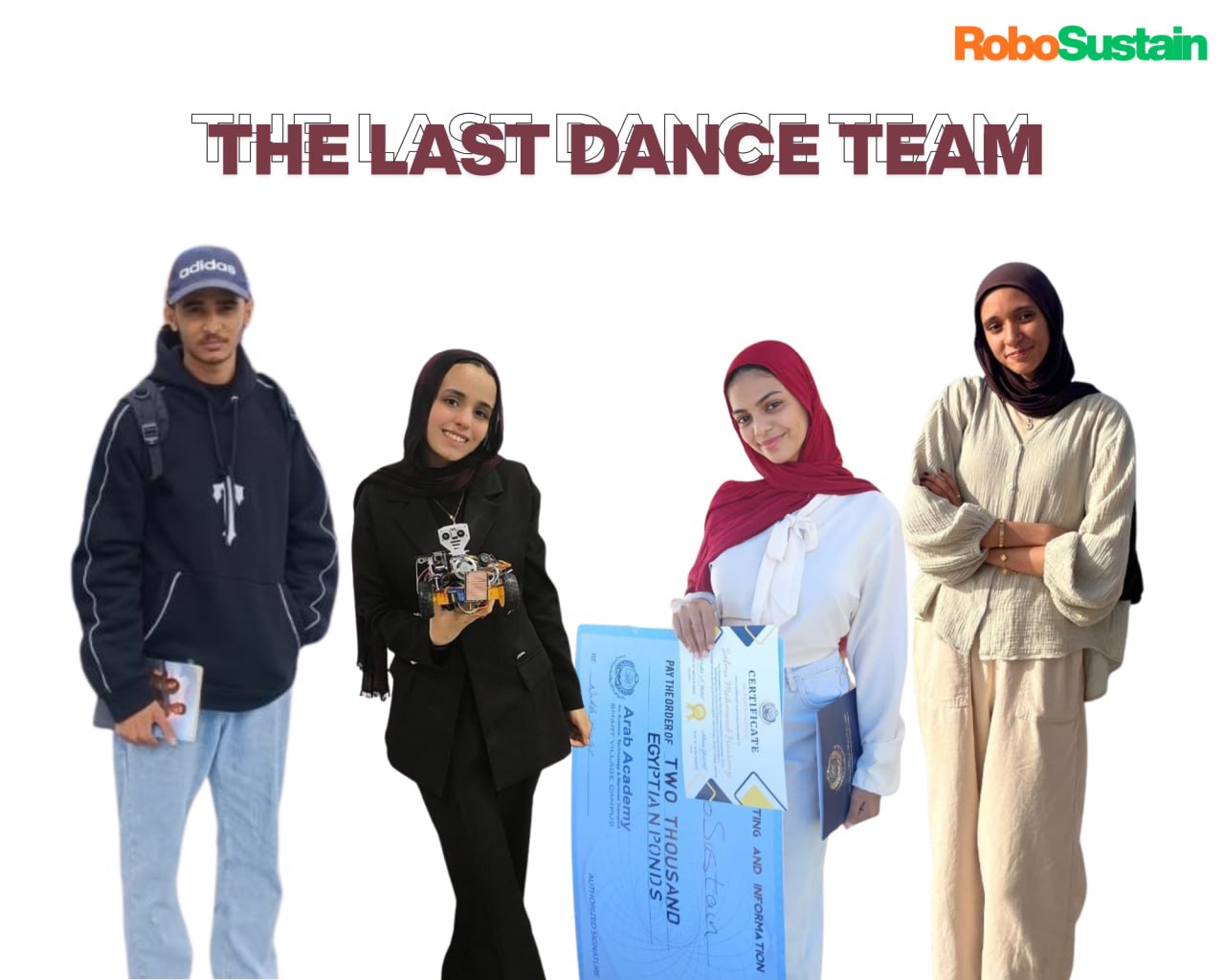
We are not a company. We are not a research laboratory. We are four young people from four Egyptian governorates who met in an educational space and decided to build something that matters.
- Arwa is our mechanical engineer, who designed the robot's chassis and wheels with precision in CAD software, transforming ideas on paper into laser-cut acrylic pieces.
Salma our electrical engineer, She built the circuits, soldered the components, and programmed the ESP32 microcontroller to be the brain of the robot. In a small room at Qena STEM School, she spent countless hours connecting wire after wire until the robot's electrical system worked as one harmonious unit.
Rokia is our researcher, who spent weeks searching Google Scholar and IEEE for the latest scientific studies, writing technical documentation. She taught us that real science begins with research in credible sources, not copying from random websites. Rokia who searches and writes and analyzes, and taught us that real science begins with the right question.
Abdelrahman is our web developer, who sat in front of his screen in Cairo and built the RoboSustain PWA a progressive web application that combines sensor data, artificial intelligence, and an eco-friendly materials marketplace, all in a single HTML file that works on any smartphone. Abdelrahman who sits in front of his screen and builds a digital bridge connecting the robot to every Egyptian family that owns a phone.
We learned to work as a chain: Arwa waits for Salma to finish the circuit, Salma waits for Abdelrahman to write the code, Abdelrahman waits for Rokia to confirm the results, and Rokia waits for everyone to present the work. We learned to work under pressure: strict deadlines, judge feedback that must be fixed immediately, weekly meetings where we show our work and discuss problems with facts, not arguments.
"Real technology is not what giant corporations build it is what young people who live the problem every day create."
Team Members:
Member 1 :
- Full Name: Arwa Ahmed Mohamed Abdelfatah
- E-mail: [email protected]
- School Name: Qena STEM School
Member 2 :
- Full Name: Salma Mahmoud Hassany
- E-mail: [email protected]
- School Name: Qena STEM School
Member 3 :
- Full Name: Rokia Saeed Elkalashy
- E-mail: [email protected]
- School Name: Martyr Magdy Mahmoud Al Qashash School in Menoufia
Member 4 :
- Full Name: Abdulrahman Muhammed Abdalnafea Mahmoud
- E-mail: [email protected]
- School Name: Abdul Wadoud Ahmed Ali School in Cairo
Built With
- 18650-li-ion-battery
- arduino-mega-2560
- chart.js
- cnn
- computer-vision
- coreldraw
- css3
- dc-geared-motors
- dht22
- dht22-temperature-sensor
- esp32
- esp32-cam
- hc-sr04-ultrasonic-sensor
- html5
- i2c
- iot
- javascript
- l298n-motor-driver
- llm
- mobilenet
- mq-4-gas-sensor
- mq-7-gas-sensor
- mqtt
- mysql
- object-detection
- oled-display
- pantheon-cms
- php
- progressive-web-app
- rest-api
- servo-motors
- sht30-temperature-sensor
- solar-panels
- tcs34725-color-sensor
- tinkercad
- vercel
- yolov8



Log in or sign up for Devpost to join the conversation.