-
-
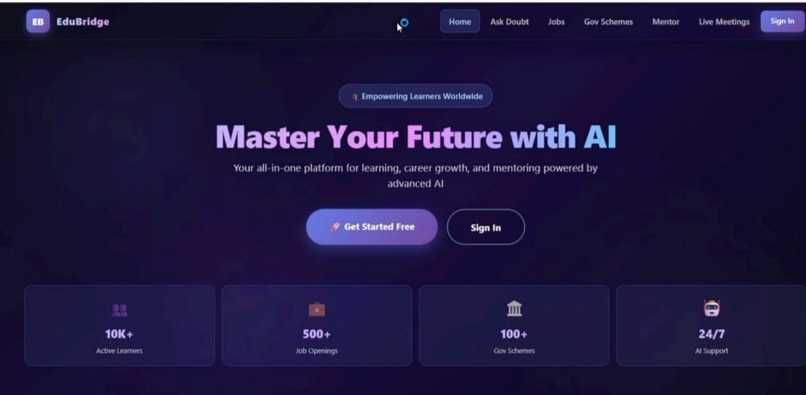
Dashboard
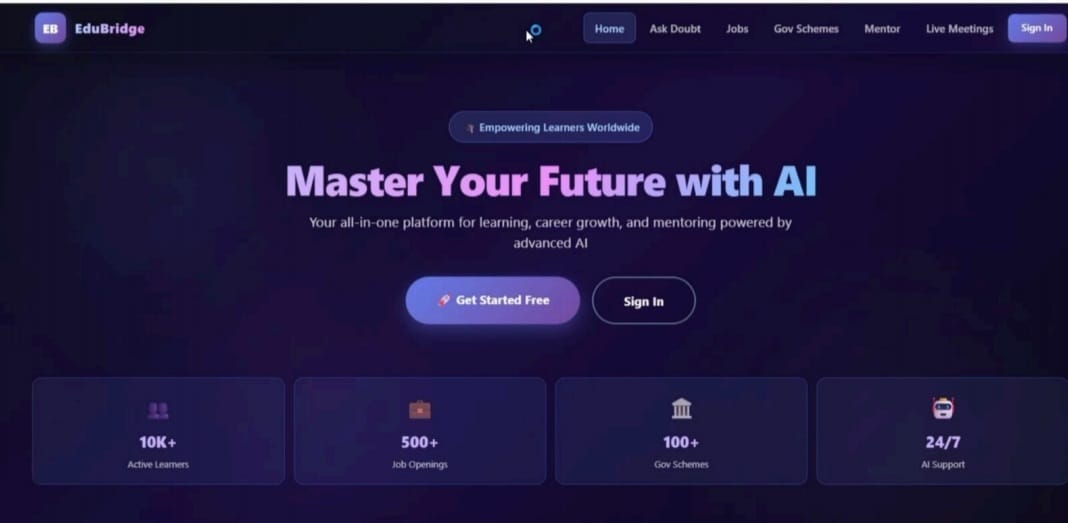
Inspiration Our journey was sparked by the pervasive challenges in modern education—specifically the widening divide in access to quality learning resources and career guidance. We observed how students in underserved regions struggle to compete in an increasingly complex world due to high costs and the limited availability of personalized tutoring. Inspired by Nelson Mandela’s belief that "Education is the most powerful weapon which you can use to change the world," we set out to build RoboGenesis. Our goal was to create a platform that democratizes education by bridging the gap between digital AI intelligence and physical robotic interaction
What it does RoboGenesis acts as an "AI Super Platform" designed to revolutionize both learning and career development. Key features include:Intelligent Tutoring: Provides 24/7 multi-modal doubt resolution for students.Career & Scheme Guidance: Offers AI-enhanced job searches and matches users with eligible government schemes to break information barriers.Document-Based Learning: Transforms static PDFs into interactive tools with intelligent Q&A.Real-time Mentoring: Features AI mentors capable of emotion detection and progress tracking during live sessions.
How we built it Building a unified, multipurpose automated EdTech platform required a robust and scalable architecture. The Tech StackWe utilized a modern stack to ensure high performance: Backend: FastAPI (Python) for the core logic, with OpenAI and Anthropic powering our LLM inference. Data Management: PostgreSQL for relational data and ChromaDB for vector embeddings to support Retrieval-Augmented Generation (RAG).Frontend: A responsive UI built with React 18, Vite, and Tailwind CSS. Vision & Speech: Integrated OpenCV for computer vision and Azure Cognitive Services for speech-to-text capabilities.
Challenges we ran into Integrating hardware with sophisticated AI logic presented several hurdles: Technical Complexities: Managing LLM hallucinations and ensuring real-time performance across an asynchronous architecture was a primary risk. We mitigated this through RAG with source transparency. Data Processing: To maintain our goal of processing 10,000 documents per hour, we had to optimize our Celery task queues and Redis caching. Ethical Concerns: Ensuring GDPR compliance and PII (Personally Identifiable Information) redaction was essential for protecting student data.
Accomplishments that we're proud of Impactful Metrics: Achieving an average doubt-resolution time of less than 2 minutes. Scalability: Designing a system capable of supporting over 1,000 concurrent users with 99.9% uptime. Holistic Value: Creating a competitive moat by integrating multi-modal tutoring with practical career and government scheme navigation
What we learned: This project taught us that "falling fast" and iterative testing are vital when working with LLMs. We learned how to transform traditional, inefficient doubt resolution into a value proposition that increases learner retention. Most importantly, we realized that technical excellence must be balanced with an intuitive UI/UX to ensure high user adoption.
What's next for RoboGenesis Our roadmap is divided into clear phases for global expansion: Phase 1: Focus on mobile app development, peer-to-peer mentoring, and institutional integrations. Phase 2: Introduce gamification, AI-powered course creation, and multi-language support. Phase 3: Launch an integration marketplace and expand the platform to a global student population of over 2 billion.


Log in or sign up for Devpost to join the conversation.