Inspiration
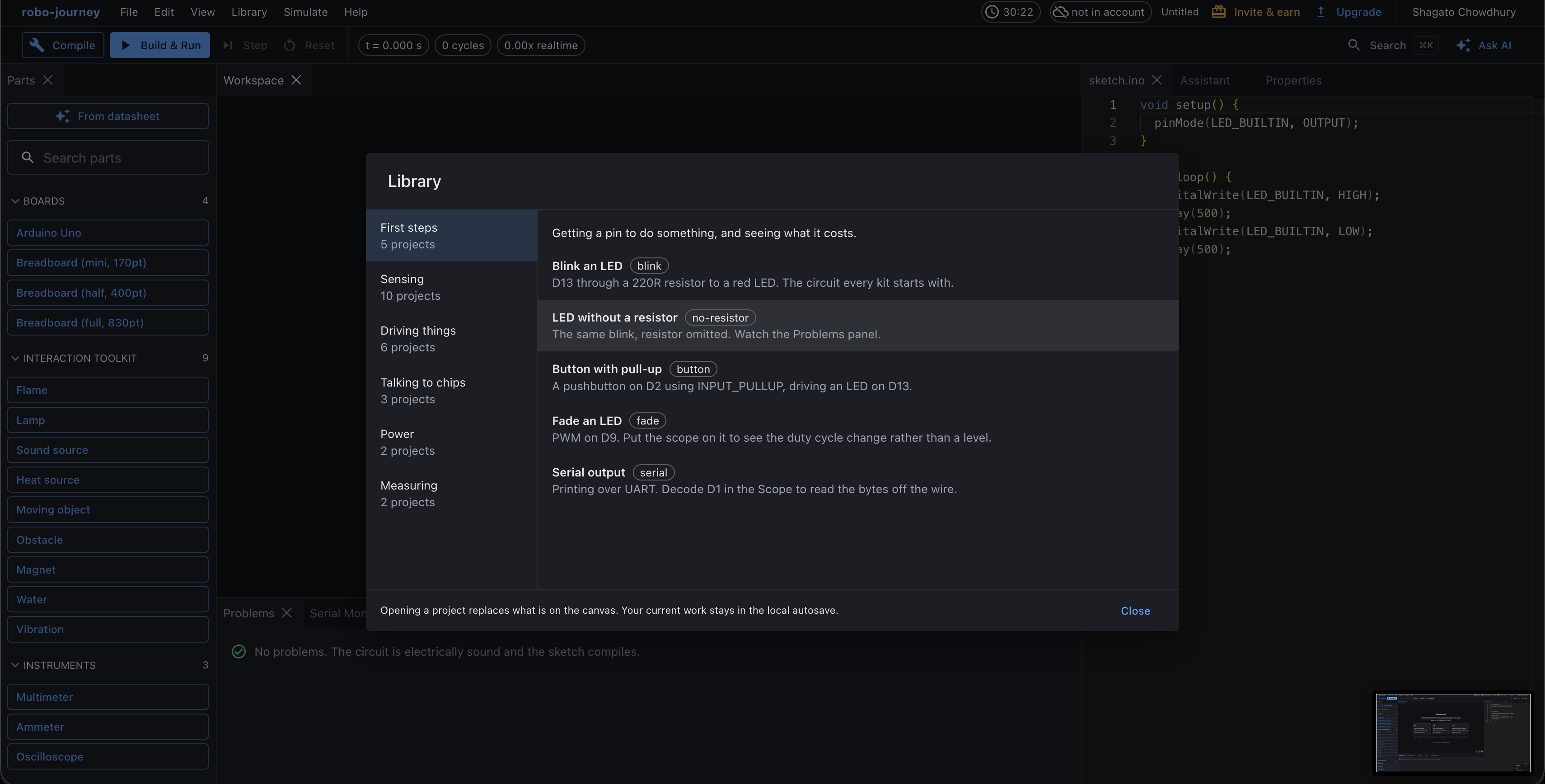
Every beginner blows up the same first circuit: an LED with no series resistor, a missing pull-up, a 3.3 V sensor on a 5 V pin, a servo that browns out the regulator. Those are electrical faults — and every simulator I could reach for runs that sketch happily and shows a glowing LED.
The existing tools each solve half the problem:
| Tool | Real firmware? | Real electricity? |
|---|---|---|
| Wokwi | yes — cycle-accurate AVR core | no analog simulation |
| Tinkercad Circuits | no — approximates the MCU | partial |
| Proteus VSM | yes | yes — commercial, and not in a browser |
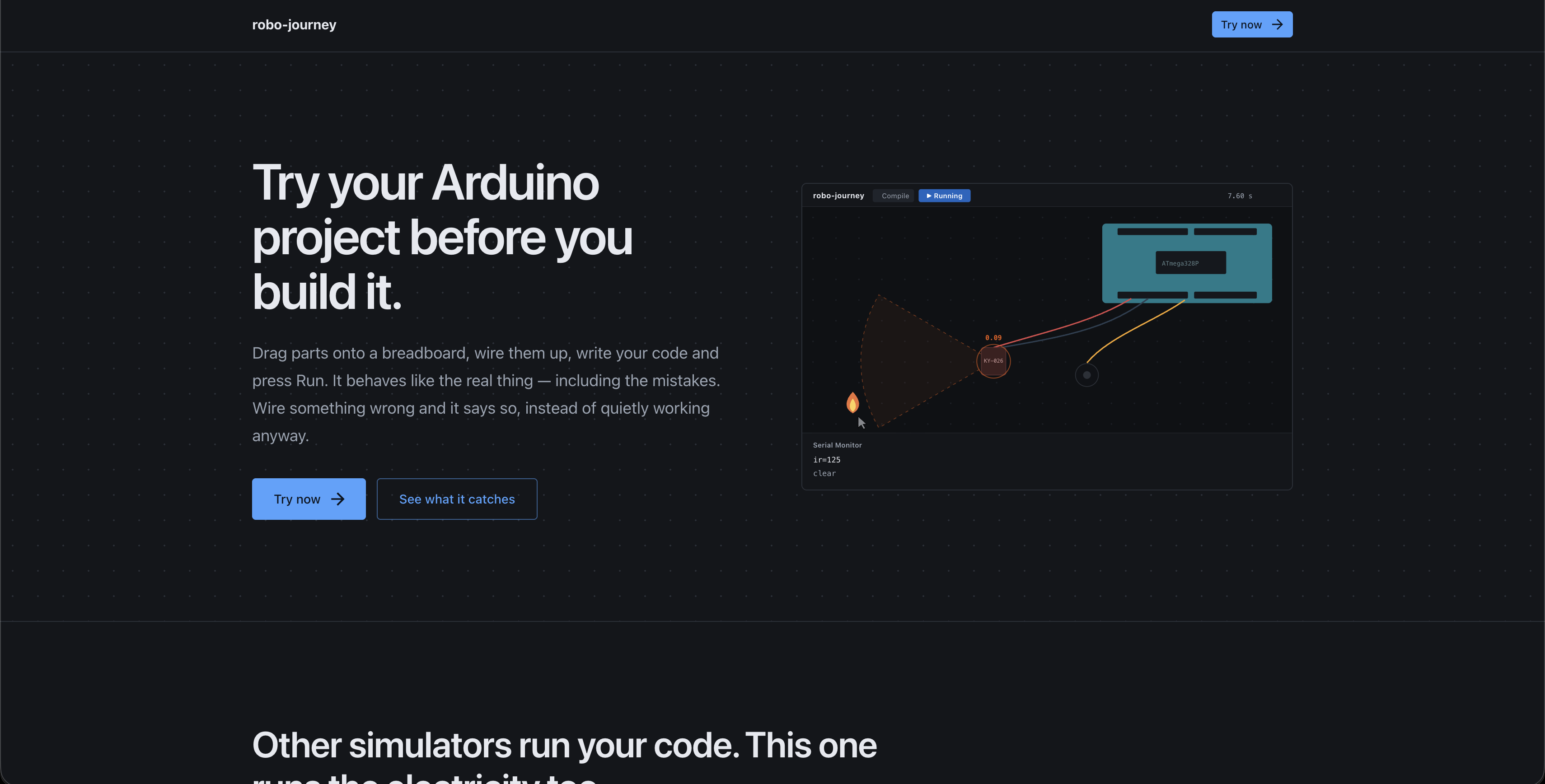
So a student debugs a simulation that cannot reproduce the bug they actually have. Robo-Journey exists to close that gap: simulate the firmware and the electricity, in a browser, for free.
What it does
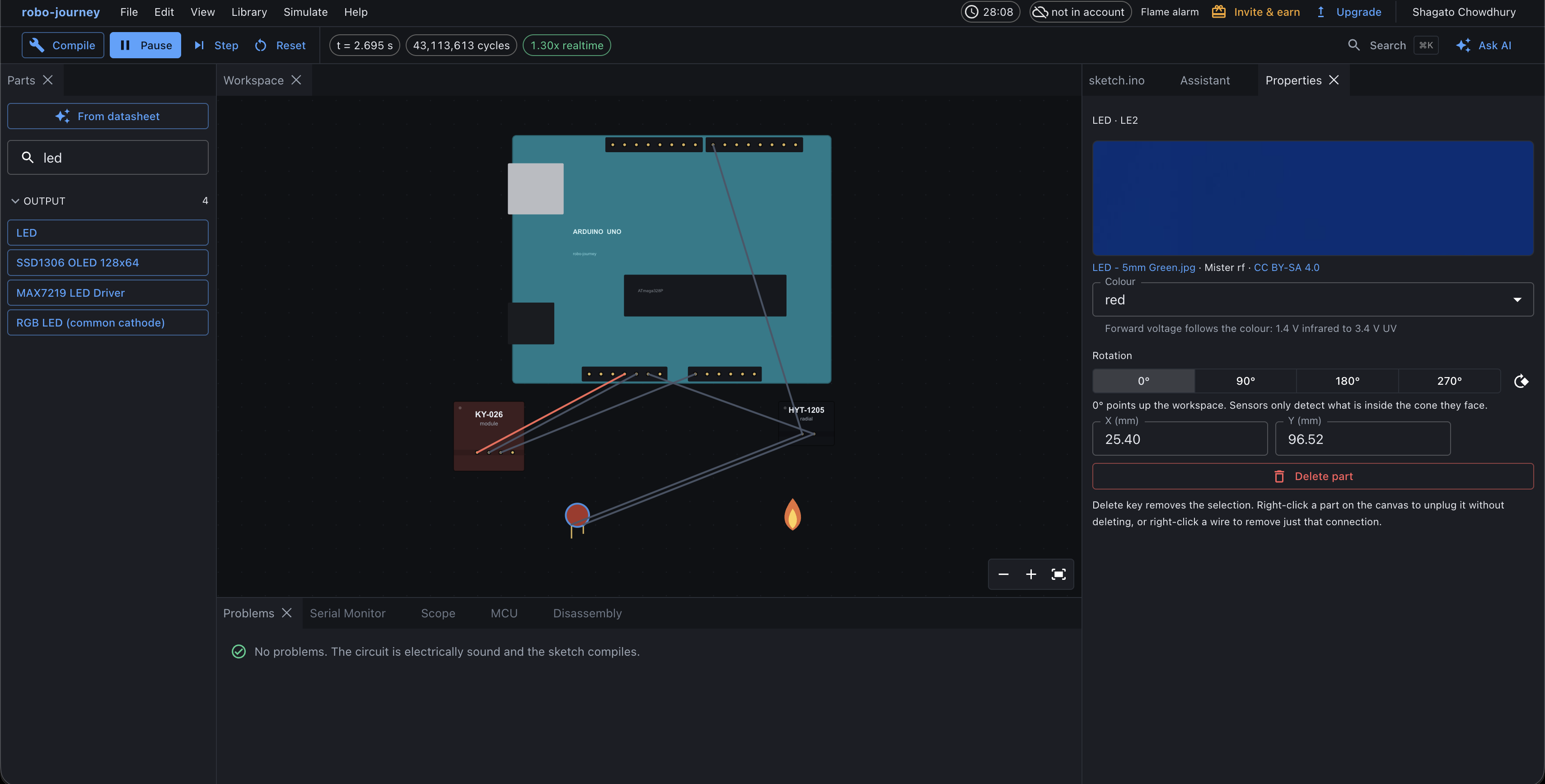
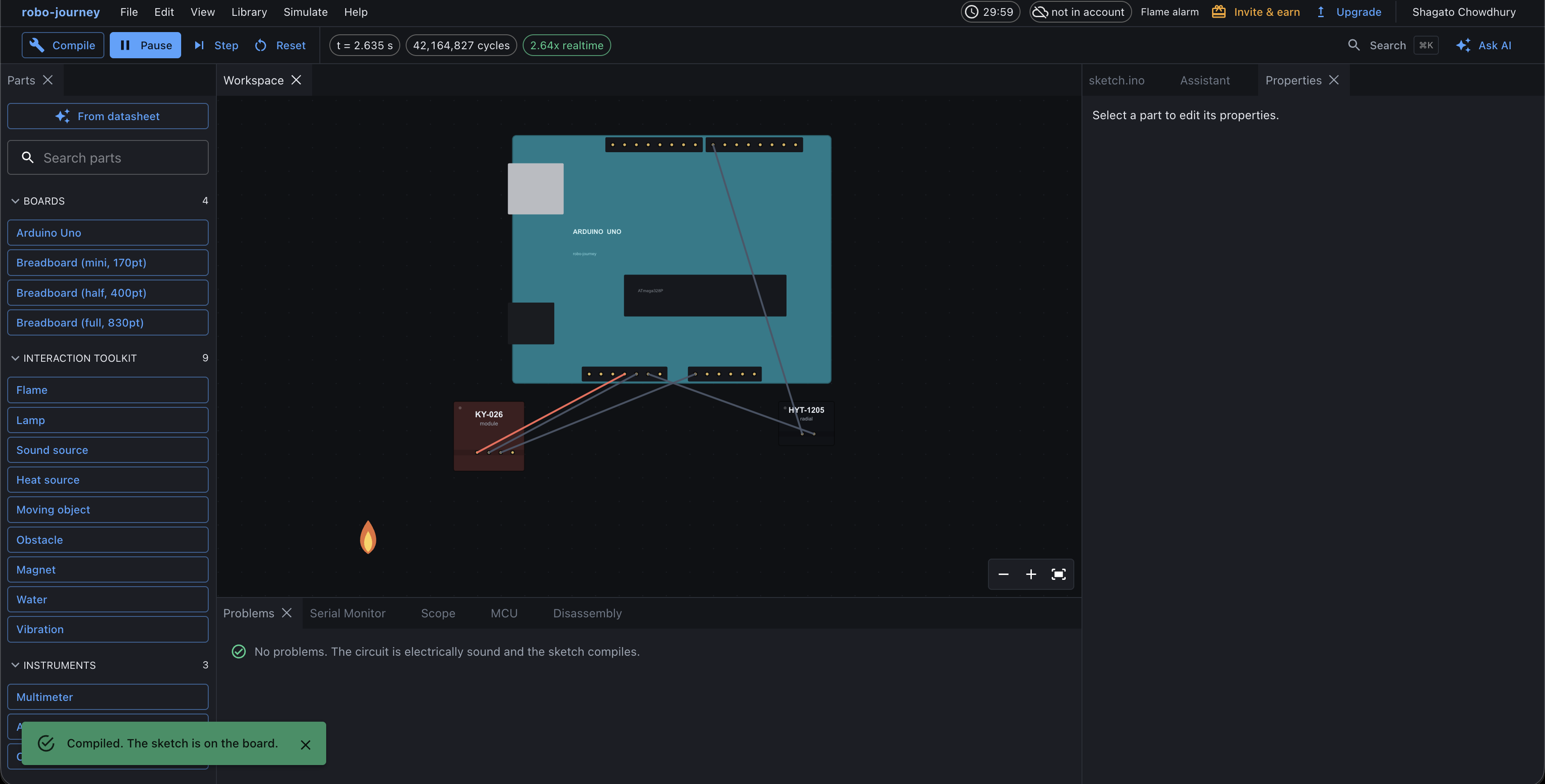
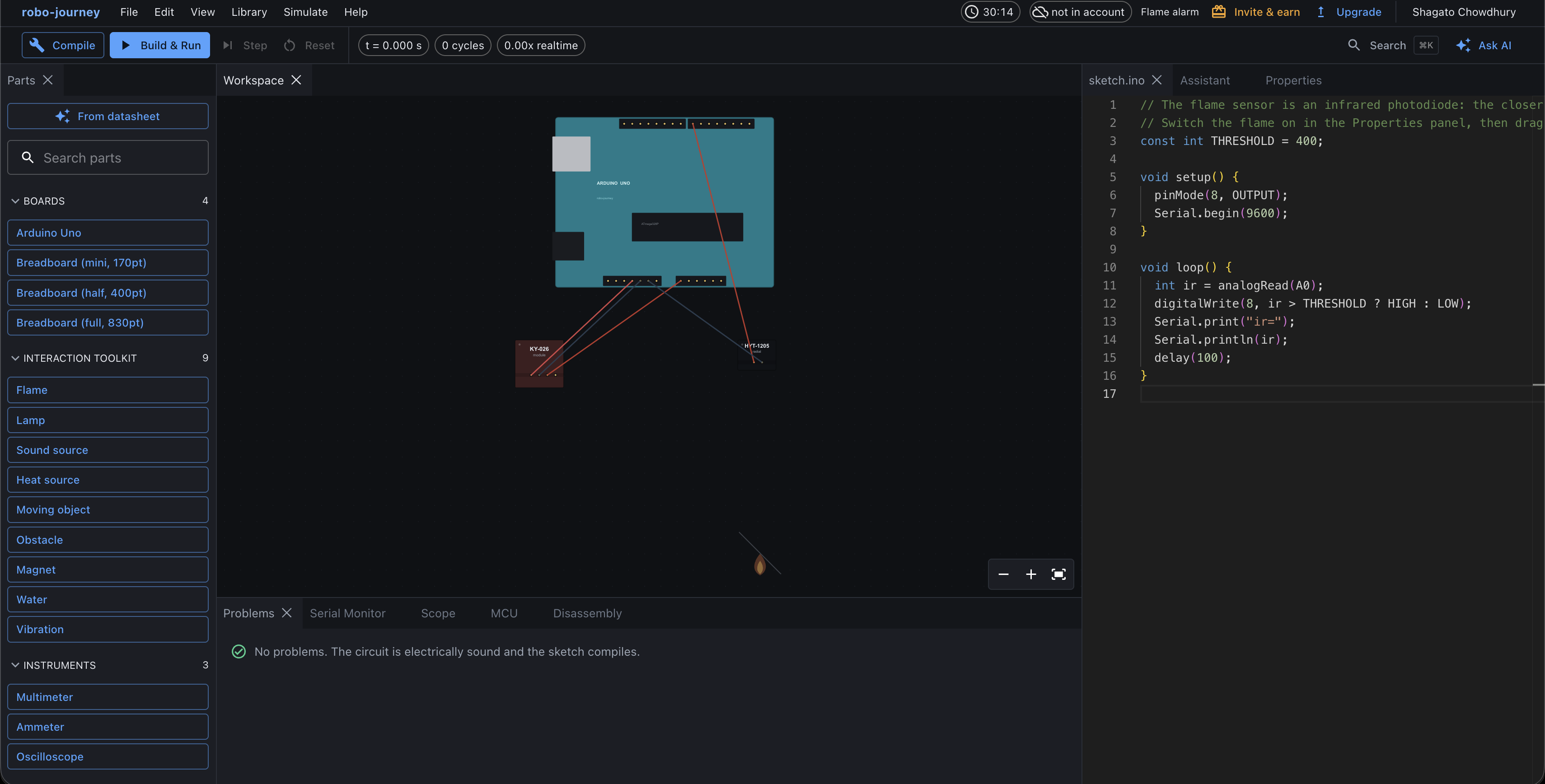
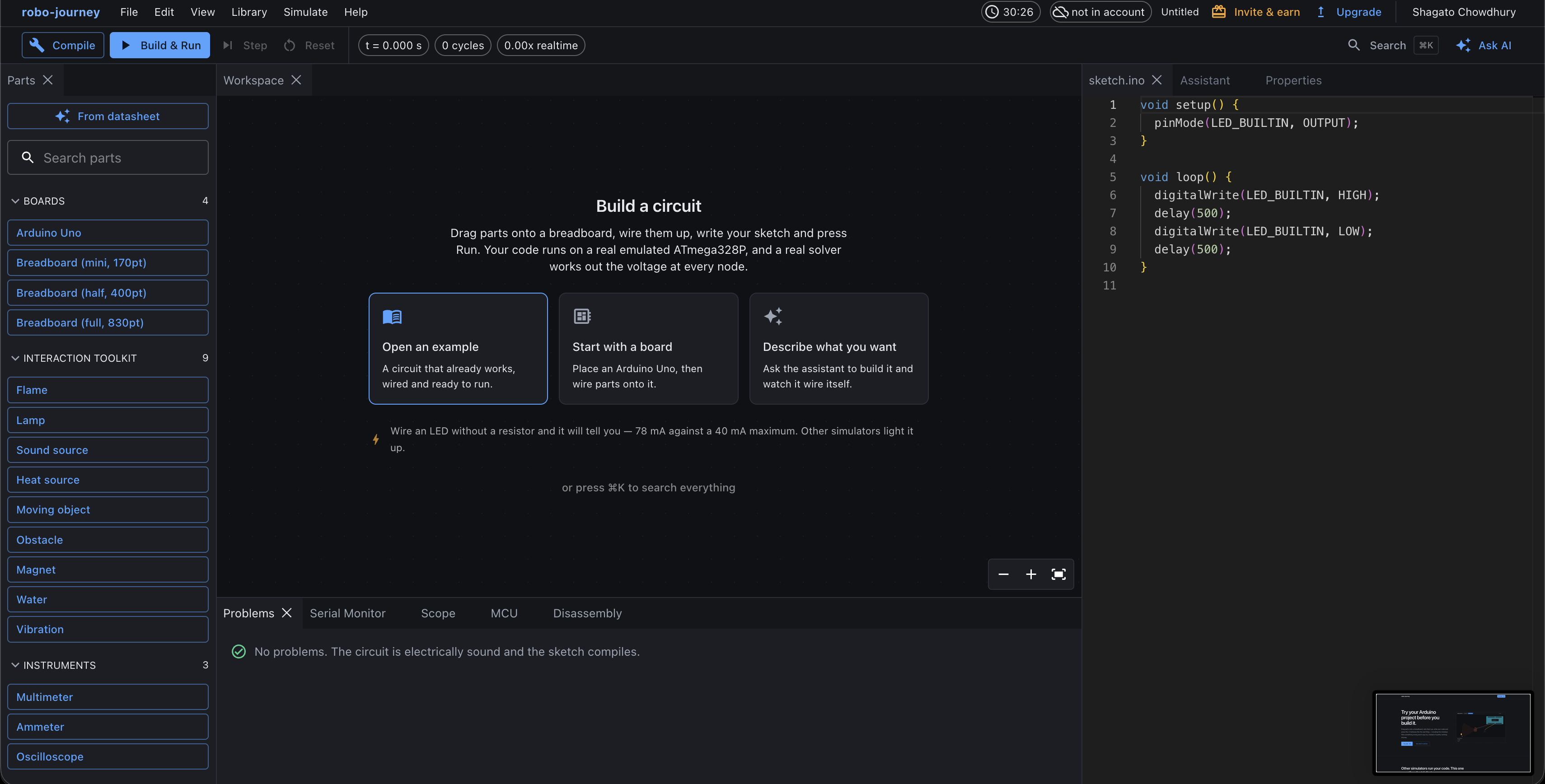
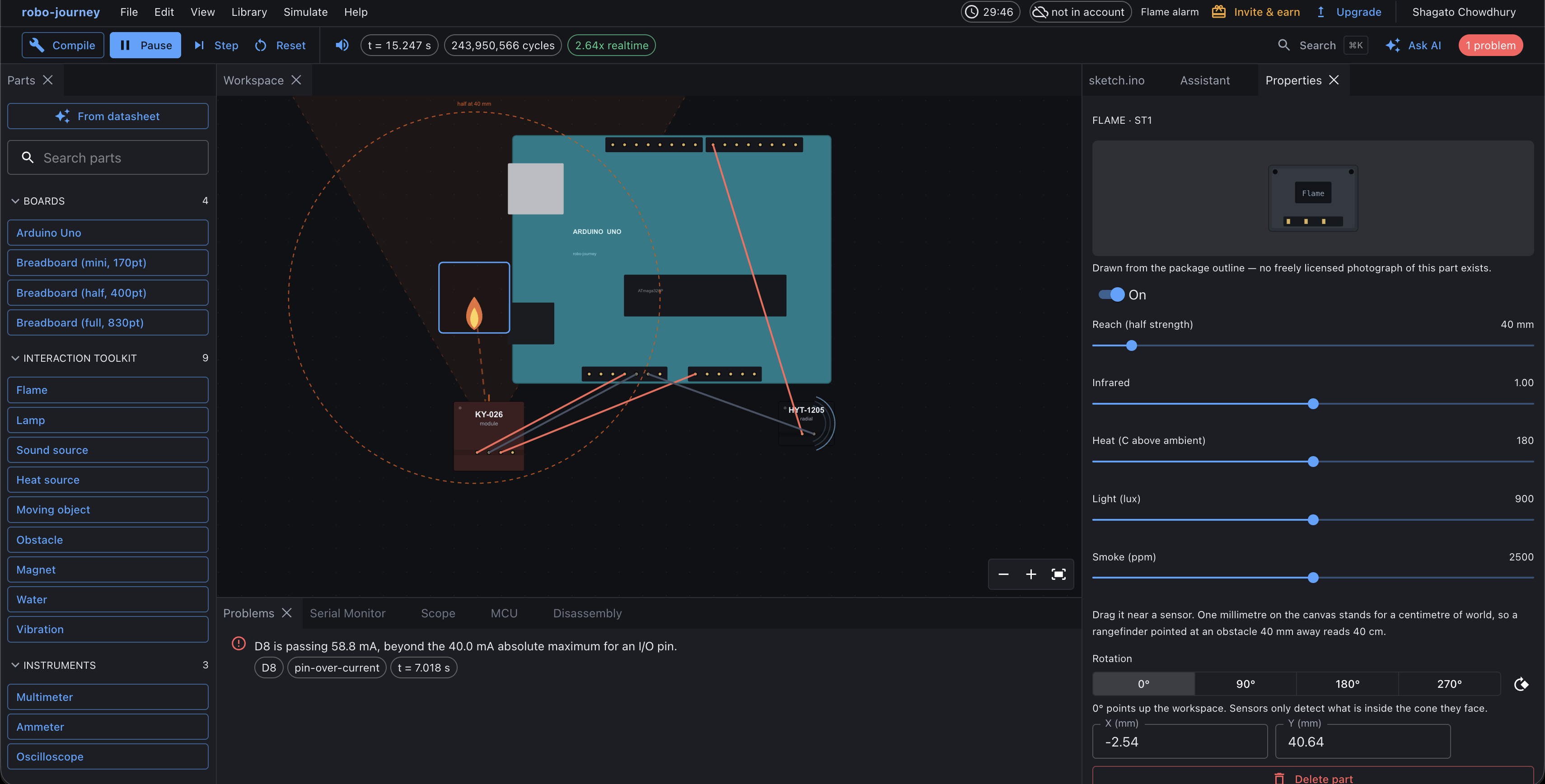
You write an Arduino sketch, wire a circuit on a breadboard, and press Build & Run.
- The sketch is compiled by real
arduino-cliin a pinned, network-isolated Docker image, and loaded as Intel HEX — the same bytes a programmer streams to the bootloader, with every record checksum verified. - Those bytes execute cycle-accurately on an emulated ATmega328P with genuine peripherals — GPIO, timers, USART, SPI, TWI, ADC, EEPROM, watchdog.
- Each pin is coupled to a modified nodal analysis (MNA) circuit solver with Newton-Raphson for nonlinear parts, so what leaves the pin is a voltage, not a bit.
That coupling is the whole point. A pin is not HIGH or LOW, it is a stamp: driven high means 25 Ω
to the rail, a pull-up means 36 kΩ, tri-state means 100 MΩ of leakage. digitalWrite(13, HIGH)
into an LED does not put 5.00 V on the pin — it puts about 4.65 V, because ~14 mA through the
output stage costs a third of a volt, exactly as a real Uno measures. Coming back in, the input
latch compares against V_IL (0.3·VCC) and V_IH (0.6·VCC); between them the reading is genuinely
undefined, so the simulator holds the previous level like a real Schmitt trigger and raises a
floating-input fault instead of quietly guessing.
Main features:
- Hardware-accurate co-simulation — event-driven, so the analog solver re-solves the instant a pin changes rather than on a fixed clock.
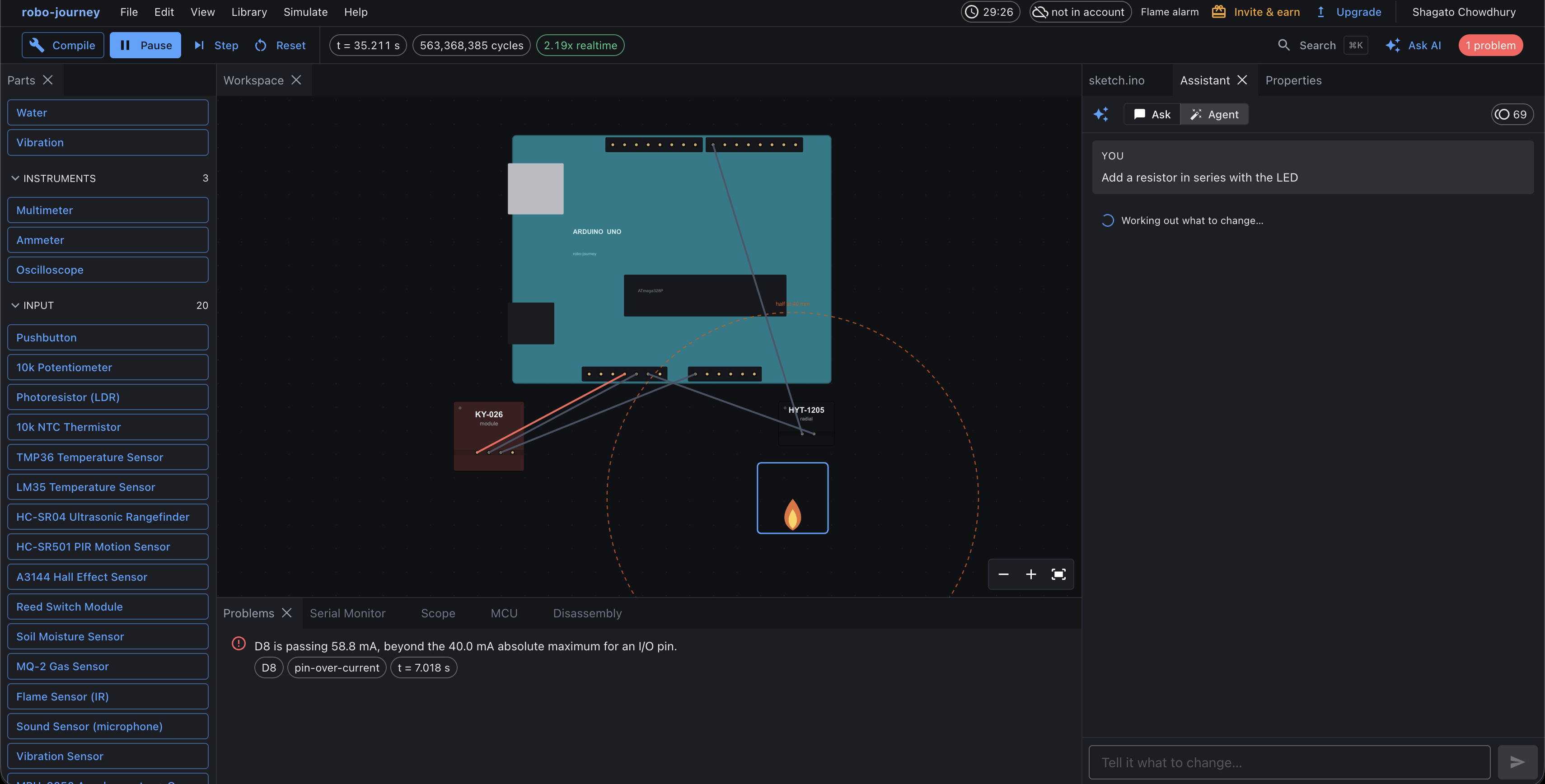
- Fault detection — over-current, floating inputs, absolute-maximum-rating violations, caught as electrical events rather than as a mysteriously wrong output.
- Instruments, not just output — oscilloscope and logic analyser on uPlot, a named register inspector, a live disassembler, and breakpoints.
- A serial decoder that reads the wire. avr8js models the USART behaviourally — it reports the
byte written to UDR and never touches D1, which makes the most common serial fault of all, a
mismatched baud rate, impossible to observe. Here the TX waveform is synthesised from UBRR and
the U2X multiplier read straight from the registers, so
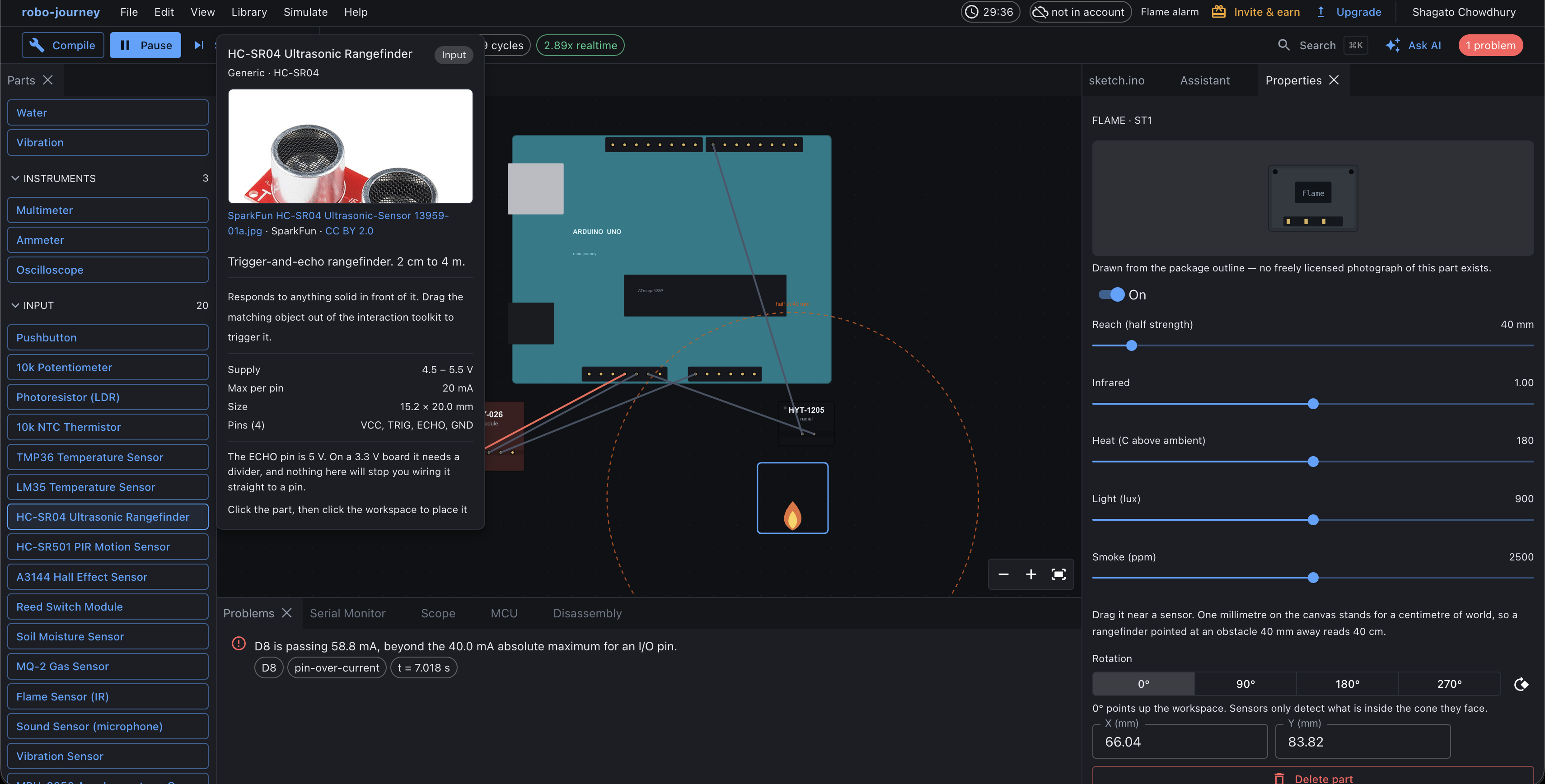
Serial.begin(9600)really does put 104 µs bits on the wire, and the decoder reads bytes back off the voltage. - Components from datasheets. A component is data, not code: a manifest describes its package, pins, per-pin electrical model, behaviour archetype, absolute maximum ratings and provenance. Paste a datasheet and Gemini returns a manifest, which is parsed by zod, then checked against physics (V_IL above V_IH, a pin sourcing 40 amps, a reserved I²C address, an active part with no ground) before it is allowed near a circuit.
- Never gates on sign-in. Local autosave works signed out; an account only adds sync across machines. A seat queue lets ten people simulate at once and admits everyone else automatically.
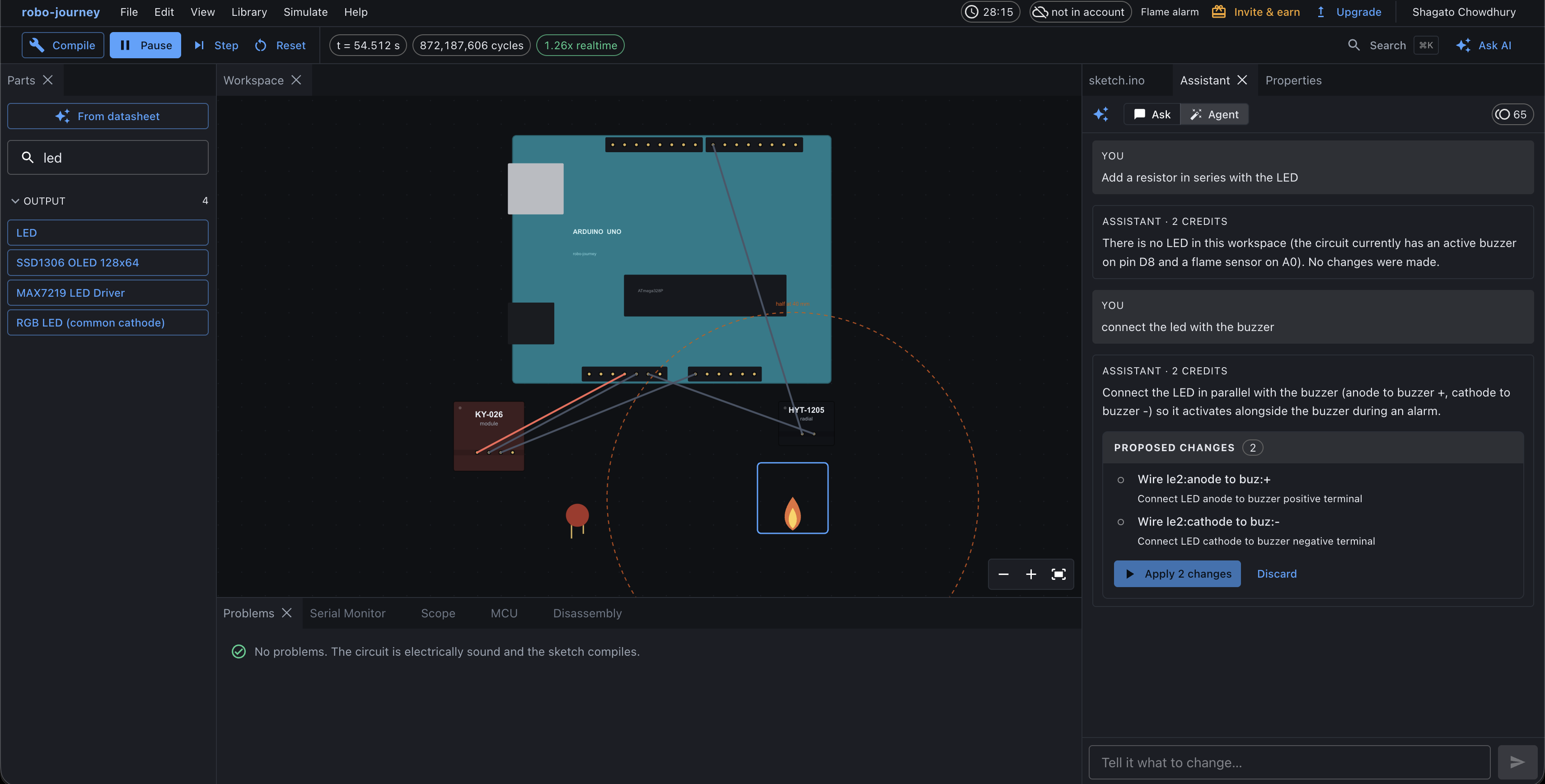
- An assistant with a safety rail — Ask answers questions about your circuit; Agent returns structured actions that are checked and shown as a plan before a single step is applied.
How I built it
A TypeScript monorepo, deliberately layered so the engine never depends on the app: packages/ sim-core/ the engine — no DOM, no framework, runs headless src/mcu/ avr8js binding, Uno pin map, Intel HEX loader src/analog/ MNA solver, LU decomposition, Newton-Raphson, device models src/sched/ event-driven co-simulation loop src/faults/ over-current, floating input src/netlist/ union-find nets and breadboard topology parts/ component SDK, part library, project model compile-service/ Fastify server + arduino-cli wrapper + diagnostics parser datasheet/ datasheet → validated component manifest accounts/ Postgres accounts, sessions, seat queue, credits assistant/ Gemini calls, server-side only apps/ studio/ dockview shell, Konva canvas, Monaco editor, xterm serial
sim-core never imports React and never touches window. That one constraint keeps headless
testing cheap and makes a future desktop port a packaging step rather than a rewrite.
Deployment is a single docker compose up, or one bootstrap command on a fresh server that brings
up Caddy with an auto-renewing certificate — and refuses to take port 443 from a site already
using it.
Challenges I ran into
- Timing fidelity is fragile in both directions.
delay(500)measures 500.008–500.012 ms in simulation, because the Arduino core spins until the timer0 millis() tick advances and then costs a few more cycles in the loop. There is a test asserting that overshoot is non-zero: if it ever became exactly 500.000000 ms, we would have lost fidelity, not gained accuracy. - Every digital edge is a discontinuity. Trapezoidal integration carries the previous step's current into the next one, which is meaningless across a jump and shows up as ringing on exactly the edges this simulator exists to get right. The fix was declaring discontinuities and forcing one damped Backward Euler step before returning to second-order accuracy.
- SPICE's default tolerance is not good enough here. At
RELTOL = 1e-3a 5 V loop closes KVL only to ~6 mV — wider than an ADC least significant bit, so a simulated multimeter would disagree with a simulatedanalogReadon the same node. At1e-9the residual is ~1e-11 V for three extra Newton iterations. - Trusting an LLM with physics. Datasheets quote milliamps, microseconds and kilohms; the
schema wants amps, seconds and ohms — and a 20 mA pin recorded as 20 A passes every structural
check while browning out a board the real part would not. So extraction is never trusted: every
generated manifest carries an
unresolvedlist naming each value the datasheet did not state and the assumption made instead, and stays unverified until a human says otherwise. A populatedunresolvedlist is a successful extraction; a silently invented number is a failed one nobody will catch. - Concurrency in the seat queue. Two service instances each seeing nine seats taken would each admit someone into the tenth. Every reconcile pass now runs in a transaction holding a Postgres advisory lock, so "ten" means ten no matter how many processes are serving. ## Accomplishments I'm proud of
- An HC-SR04 built entirely from its datasheet measures 580.1 µs at 10 cm, 2320.1 µs at 40 cm
and 8700.1 µs at 150 cm — exact against the module's own 58 µs/cm — with real compiled firmware
calling
pulseInand printing the right distance. pinMode(OUTPUT)produces an observable glitch. Setting DDRB while PORTB is still 0 drives the pin LOW for ~50 cycles beforedigitalWriteraises it. That is real — a latch or MOSFET gate would see it — and the simulator does not smooth it away.- Performance. A ~55-node circuit with 14 LEDs and 6 dividers simulates at 2.05× real time on an M-series Mac, so the TypeScript solver has roughly 2× headroom; the Rust/WASM port stays in reserve.
- The verification gate.
npm run verifytypechecks every package and runs the suite — including a full-spine test that compiles Blink through Docker and asserts the emulated D13 toggles at 1 Hz, plus the account and queue suites against a real Postgres and Redis brought up for the run and taken away afterwards. ## What I learned Fidelity is a design constraint, not a feature you add later. Almost every hard bug came from a place where a shortcut had been taken — a behavioural USART, a logic-level pin, a loosened solver tolerance — and each one silently removed exactly the class of failure a student most needs to see. Modelling a pin as an impedance rather than a boolean changed more about what this tool can teach than any amount of UI work would have. I also learned to make the security boundaries structural rather than remembered: the Gemini key lives in a server-side package the browser bundle cannot import, session tokens are stored only as SHA-256 hashes, and a wrong password and a missing account return the same message and pay the same hashing cost — so neither the response nor its timing reveals which addresses are registered. ## Technology stack Simulation: TypeScript,avr8js(cycle-accurate AVR core, MIT), a hand-written MNA solver with LU decomposition and Newton-Raphson, Intel HEX loading. Frontend: React 19, Vite, Zustand, Konva (breadboard canvas), Monaco (editor), dockview (panels), uPlot (scope and logic analyser), xterm.js (serial), Comlink (worker boundary), MUI. Backend: Node 20, Fastify, Docker (arduino-cli,--network none), PostgreSQL, Redis, Caddy + Let's Encrypt. AI: Google Gemini for datasheet extraction and the in-app assistant, with zod schema validation and a physics validator in front of anything it returns. Testing: Vitest — unit, integration, full-spine Docker compile tests, and performance benchmarks that assert the requirement rather than the measured figure, so they survive a slow CI box. ## Intended audience Students learning embedded systems, self-taught makers without a parts drawer, and instructors who want a class of thirty to hit real electrical failures — a browned-out regulator, a floating input, an LED drawing 60 mA — without thirty destroyed Arduinos. It is equally useful to anyone prototyping a circuit before ordering parts. ## What's next A Tauri desktop shell (the engine is already framework-free, so it is a packaging step), teaching hooks — guided lessons that assert on the waveform, not on the code — and a Rust/WASM solver port when circuits get big enough to need it.
Built With
- arduino
- arduino-cli
- atmega328p
- avr8js
- caddy
- circuit-simulation
- comlink
- docker
- dockview
- fastify
- google-gemini
- konva
- material-ui
- monaco-editor
- node.js
- postgresql
- react
- redis
- typescript
- uplot
- vite
- vitest
- xterm.js
- zod
- zustand

Log in or sign up for Devpost to join the conversation.