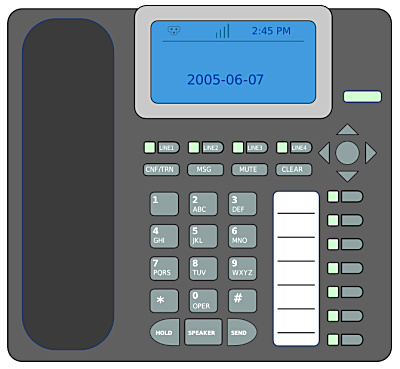
This solution: Blocks ALL unwanted calls. Allows all wanted calls. Stores ALL messages. No calls are lost. Is easy to use. Is easily implemented with off-the-shelf technology.
Option 1. Telephone Company Service (Software only):
All phone companies, land line mobile, VoIP, must provide a blocking service that allows customers to load by phone or internet all the phone numbers they wish to accept. These numbers would be stored in an “Allowed Calls Phone Numbers” folder on the phone company's server. The “Allowed Call Phone Numbers” folder can also be updated from phone numbers stored in common email Contact lists such as Outlook. Only calls from numbers on this list will be sent to the customer's phone.
All other calls will be sent to a “Blocked Calls” message folder on the phone company's server. The caller can leave a message in this folder. One email per day will be sent to the customer's email address if there are any messages in the “Blocked Calls” message folder. The customer can access the Blocked Calls message folder over the Internet or by telephone, and listen to the blocked call messages, if any, and delete the message from the “Blocked Calls” folder. The customer can also add a phone number from the “Blocked Calls” message folder to his “Allowed Call Phone Numbers folder” so that phone number is ‘allowed’ in the future.
The telephone company can charge a reasonable fee for this service.
Option 2. Answering Machine (hardware and software):
An alternative is a home answering machine that performs the same functions.
The answering machine will have the ability to store and update a list of “Allowed Calls Phone Numbers”. One possible device for this would be a Flash Drive. The answering machine will have two answering machine message files – one for Allowed Calls messages, and one for Blocked Calls messages.
All incoming calls will be checked against this list. If the incoming call is not from a phone number that is on the “Allowed Calls Phone Numbers” list, the phone will not ring, and the call will be answered and routed to the answering machine’s Blocked Calls messaging function. Ideally, the answering machine will detect blocked calls and answer them before any extension phones can ring.
If the call is from a number that is on the “Allowed Calls Phone Numbers” list, the phone will ring. If the phone is not answered, this call will be routed to the answering machine’s Allowed Calls message function.
When the Blocked Calls messages in the answering machine are listened to, there will be an option to add the phone number of that call to the “Accepted Phone Number” list.
A software option will be provided that allows the “Allowed Calls Phone Number” list that is stored on the flash drive, to be updated from computer-based email programs, such as Outlook.

Log in or sign up for Devpost to join the conversation.