Inspiration
I once sent out 47 job applications and heard back from 2.
Not because I wasn't qualified — but because my resume was quietly, invisibly terrible. Buzzwords where impact should have been. Vague verbs where numbers should have lived. "Responsible for managing" instead of "cut delivery time by 40%."
Every resume tool I tried gave me green checkmarks and told me I was doing great. I wasn't. I needed someone to just tell me the truth.
That's what inspired RoastMyResume — the feedback your recruiter was too polite to give you, followed immediately by the fix.
What it does
RoastMyResume has three core modes:
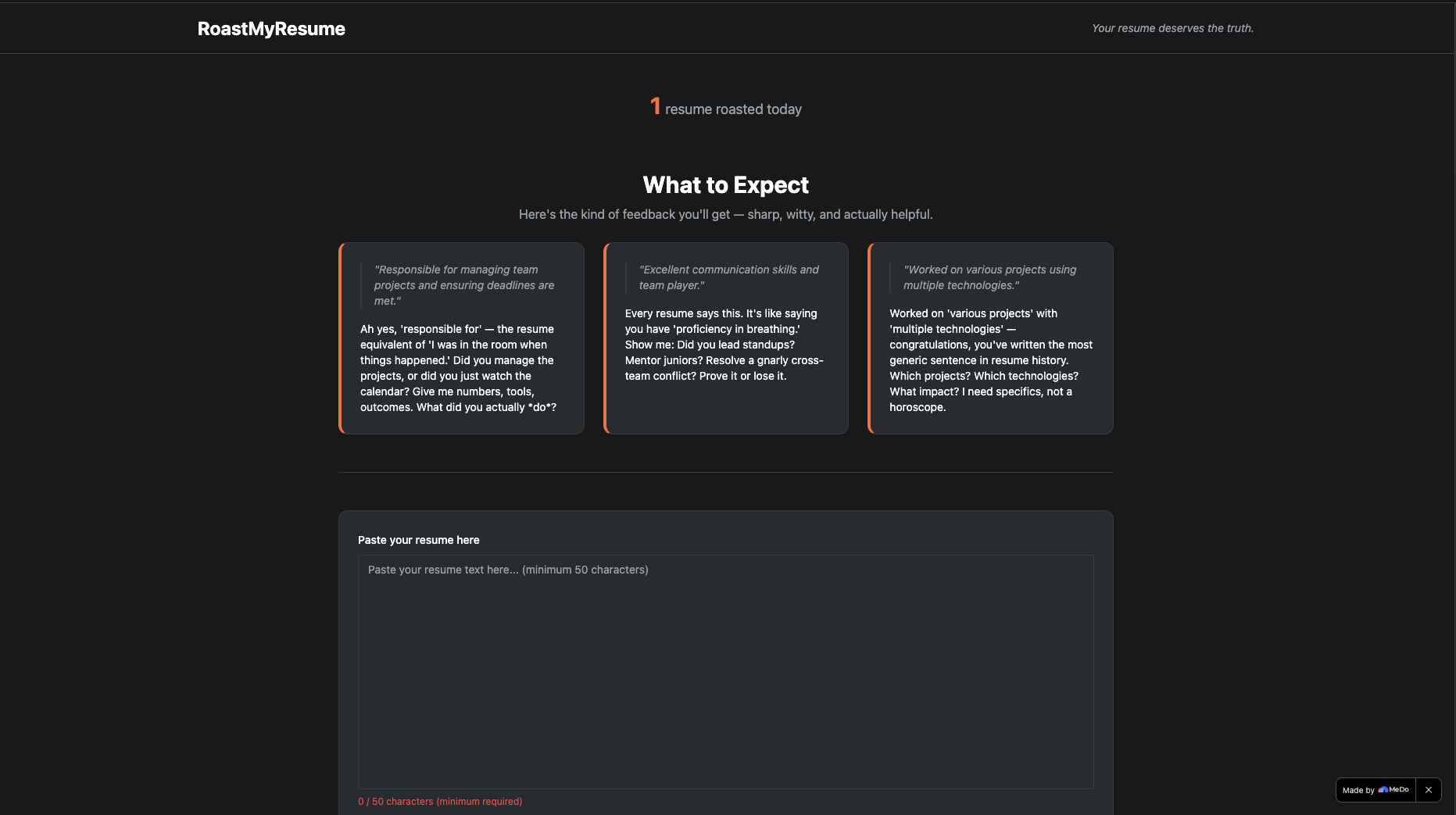
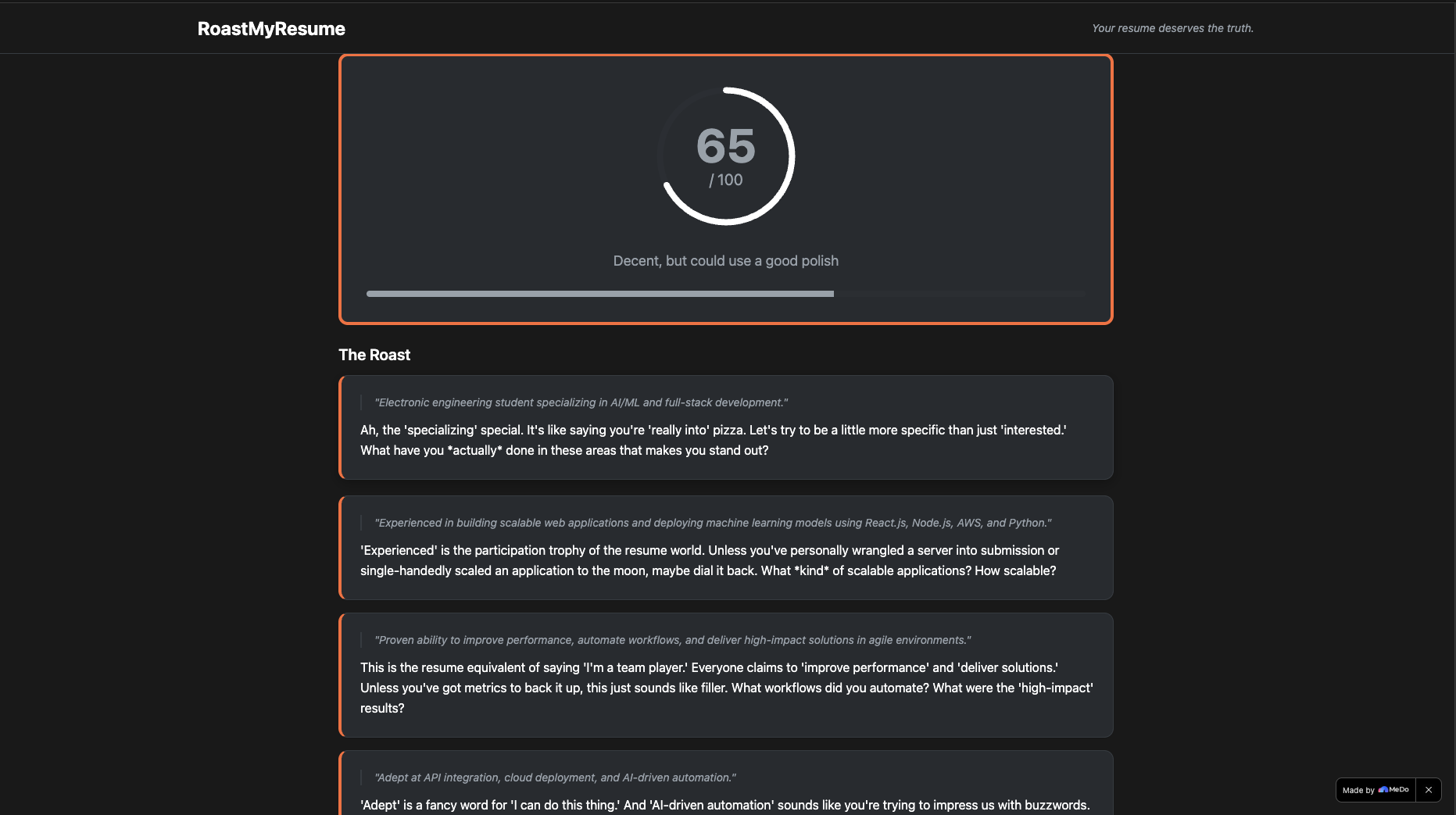
Roast Mode — paste your resume, get a brutally honest line-by-line critique. Every weak bullet point, vague claim, and hollow buzzword gets called out with a Roast Score out of 100 (lower = more roastable). The AI identifies specific anti-patterns:
- Passive voice disguising lack of ownership
- Unquantified impact ("improved team morale" vs "reduced churn by 23%")
- Buzzword soup ("synergized cross-functional stakeholder alignment")
- Generic responsibilities that could belong to anyone
Fix Mode — every roasted line gets rewritten with strong action verbs, quantified results, and recruiter-friendly framing. You see the before and after side by side.
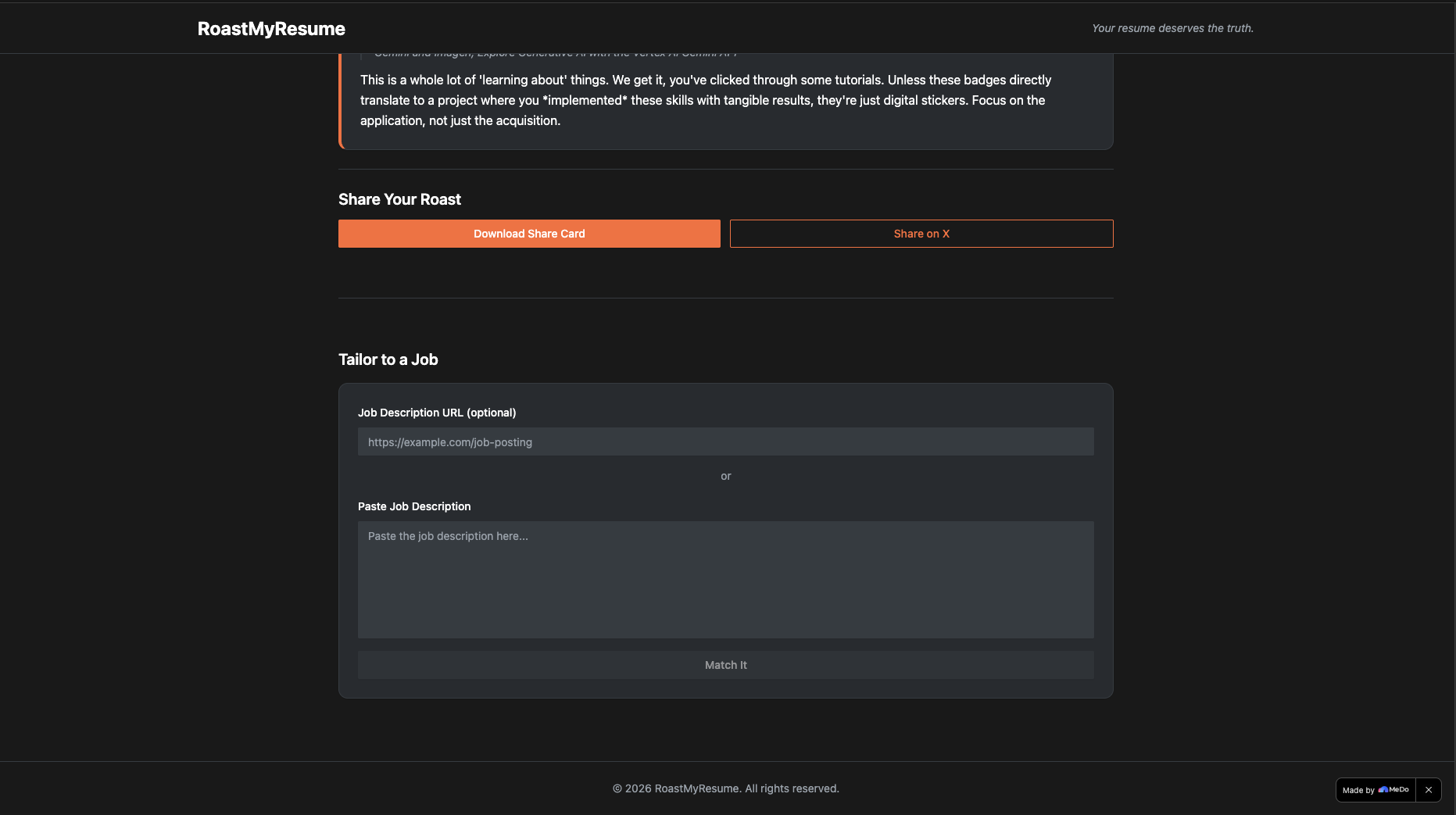
Job Match Mode — paste a job description (or drop in a URL), and the app rewrites your entire resume to be tailored for that specific role, surfacing the most relevant experience and mirroring the language the ATS is scanning for.
The Roast Score is computed as a weighted penalty function across $n$ resume lines:
$$S_{roast} = 100 - \frac{1}{n}\sum_{i=1}^{n} w_i \cdot p_i$$
where $w_i$ is the severity weight of the detected issue in line $i$, and $p_i \in [0, 10]$ is the penalty score. A score below 40 means your resume is on fire. 🔥
How we built it
The entire app was built using MeDo — conversationally, with zero manual coding.
The process looked like this:
Turn 1 — Core architecture: I described the full app in natural language. Two modes, a scoring system, side-by-side diff view, dark UI with orange accents. MeDo generated the full-stack scaffold: a React frontend, Node.js API layer, and MeDo's own AI backend handling the roast logic.
Turn 2 — Roast engine depth: I asked MeDo to make the critique more specific — detect passive voice, flag unquantified bullets, identify buzzword density. It rewrote the prompt engineering and added pattern-matching logic across the resume structure.
Turn 3 — Job Match Mode: Described the feature: user pastes a job description, AI rewrites the resume to mirror the role's language. MeDo added the UI panel and wired up the additional context window in the multi-turn chat flow.
Turn 4 — Polish: Added the animated Roast Score meter, shareable roast card generator (1200×630 for X/LinkedIn), mobile responsiveness, and PDF export via a third-party API.
Turn 5 — Deploy: One-click deploy to a public URL through MeDo's built-in deployment. Total build time: ~2.5 hours.
Challenges we ran into
Tone calibration was the hardest problem. The line between "brutally honest" and "just mean" is thin. Early versions of the roast engine were demotivating rather than useful — the kind of feedback that makes you close the tab, not fix your resume. Getting MeDo to nail the voice of a sarcastic-but-constructive senior engineer took several prompt iterations.
Quantifying what can't be quantified. The Roast Score formula needed to feel fair. If someone's resume is in a field where quantification is genuinely hard (academia, creative roles), the penalty weights needed to adjust. We had to add role-context detection so the scoring doesn't punish a poet for not having "reduced churn by 23%."
PDF export edge cases. Resumes come in every shape — two columns, tables, Unicode characters, emoji bullets. The PDF export broke on complex layouts until we added a plaintext normalization pass before rendering.
Context window management for long resumes. Very long resumes (~4 pages) exceeded the ideal context for a single-pass roast. We restructured the multi-turn flow so MeDo processes resumes in sections and then synthesizes a holistic score at the end.
Accomplishments that we're proud of
Built a full-stack, deployed, production-quality web app in under 3 hours — entirely through conversation with MeDo. No IDE. No Stack Overflow. No Stack Overflow at 2am.
The roast engine can identify 7 distinct anti-patterns in resume writing, each with a different severity weight and a specific, actionable fix — not generic advice.
The Job Match Mode does something most resume tools don't: it doesn't just keyword-stuff your resume, it rewrites bullets to sound like the company's own language, which is what actually passes ATS filters.
The shareable roast card feature turned out to be organic marketing — users screenshot their roast scores and post them. The app promotes itself.
We kept the math honest. The Roast Score isn't a fake "AI confidence" number — it's a transparent weighted penalty function that users can understand and contest.
What we learned
Vibe coding is a real skill. The quality of what MeDo builds is directly proportional to the clarity of your thinking. If you can't describe the feature precisely in plain English, the output will be vague. The constraint forced us to think like product managers before we thought like developers.
Multi-turn context is the superpower. The app we ended up with wasn't the app from Turn 1 — it was the app that emerged from 5 iterations of "yes, but also..." That's not how traditional coding works. It's closer to design thinking.
Honesty is a product differentiator. Every resume tool in the market is optimistic to the point of uselessness. There's a real market gap for tools that tell the truth. Users don't want to feel good — they want to get hired.
The roast-to-fix pipeline is more important than the roast alone. Early testing showed that pure critique without an immediate fix left users frustrated. The value is in the paired flow: here's what's wrong, here's the better version, right now.
What's next for RoastMyResume
Interview mode — once your resume is fixed, practice answering questions about it. The AI knows your resume and asks the hard questions recruiters actually ask.
Industry benchmarking — compare your resume's Roast Score against anonymized resumes in your field. Where do you rank in the $n$-th percentile?
$$\text{Percentile} = \frac{\text{rank}}{n} \times 100$$
Chrome extension — highlight any job posting and get an instant gap analysis: here's what's missing from your resume for this specific role.
Before/after public gallery — opt-in wall of roasted → fixed resume lines. The best transformations are genuinely funny and educational.
Team plan — companies upload job descriptions, candidates apply through the tool and get auto-screened by fit score before a human even looks.


Log in or sign up for Devpost to join the conversation.