Roam
Conquer the roads.
PRISM Track: Software & Technology
The Problem
Learning to drive is usually measured in hours and miles, but those numbers do not tell the whole story.
A new driver might have dozens of hours behind the wheel and still have almost no experience driving on highways, at night, through complicated intersections, in poor weather, or along unfamiliar roads. At the same time, traditional navigation apps treat every driver the same. They can tell you the fastest route, but they cannot tell you whether that route is appropriate for your current level of driving experience.
That creates a gap between navigation and driver development.
New drivers need a way to understand not only where they are going, but also how challenging the drive will be for them and what they should practice next.
Our Solution
Roam is a personalized driving coach that helps newer drivers understand route difficulty, track real driving experience, and gradually build confidence behind the wheel.
Instead of simply asking:
“How do I get there?”
Roam asks:
“Am I ready to drive there?”
Before a drive, Roam analyzes the route and the conditions surrounding it to estimate how difficult that trip may be. It then compares those conditions against the driver's previous experience.
After the drive, Roam records meaningful driving experience and uses it to build a clearer picture of the driver's progress over time.
The goal is not to scare drivers away from difficult roads. It is to help them recognize gaps in their experience and intentionally practice the skills they need.
How Roam Works
Routes
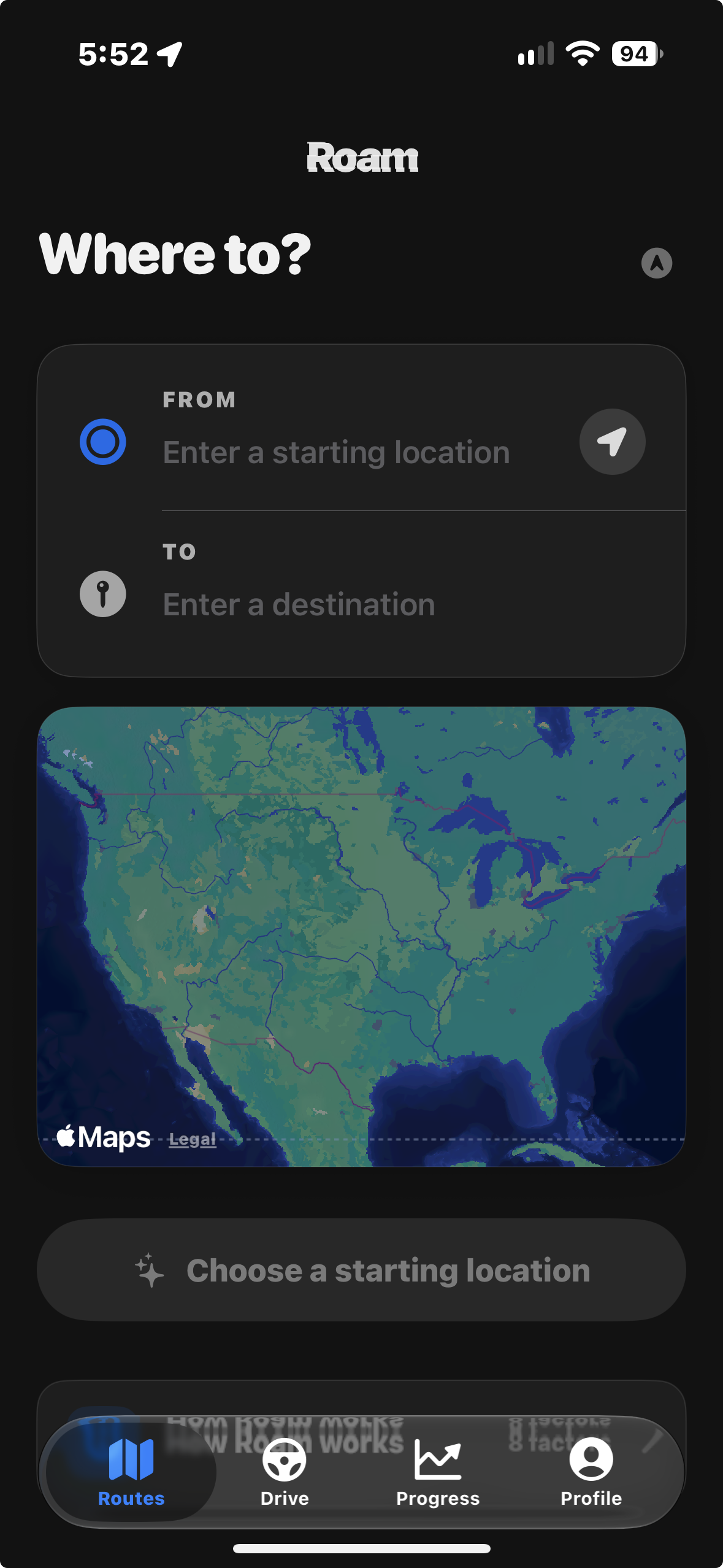
Drivers can enter a destination and view an analysis of the trip before leaving.
Roam evaluates characteristics of the route such as road types, distance, driving conditions, and environmental context. It combines route information with outside data such as current weather and road information to estimate the difficulty of the drive.
That analysis becomes more useful when combined with the driver's history.
A highway-heavy route, for example, may be relatively easy for an experienced highway driver but much more challenging for someone who has mostly practiced on neighborhood streets.
Roam is designed around that difference.
Drive
Roam can also record actual driving sessions using signals available on the driver's device.
During a drive, the app uses location and motion data to identify driving patterns and record experience such as total distance and the types of conditions the driver encountered.
The purpose is not to act as an emergency system or constantly police the driver. Roam is built as a coach, not a cop.
The information becomes feedback that can help drivers understand where they are improving and where additional practice may be useful.
Progress
Driving improvement is difficult to represent with a single number, so Roam tracks experience across multiple dimensions.
A driver can build evidence of experience through areas such as:
- Total validated driving distance
- Highway driving
- Night driving
- Exposure to more challenging routes
- Driving consistency over time
Roam then turns that history into progress insights rather than relying only on raw hours behind the wheel.
This allows drivers to see what kind of experience they are actually gaining.
What Makes Roam Different
Most navigation apps optimize the route.
Roam focuses on the relationship between the route and the driver.
Two people can receive the exact same directions while having completely different levels of preparedness for that trip. Roam treats driving difficulty as something personal rather than universal.
At the same time, many existing tools for young drivers are centered around surveillance, alerts, or parental monitoring.
Roam takes a different approach.
The product is designed primarily for the driver, giving them information they can use to make their own decisions, practice intentionally, and become more capable over time.
How We Built It
Roam is built as a native iOS application with a lightweight backend for route analysis.
The app combines several different types of information:
- Route data to understand the structure of an upcoming trip
- Live weather information to add environmental context
- OpenStreetMap data to enrich the route with additional road information
- GPS and device motion sensors to record driving sessions
- Historical driving data to compare upcoming trips against previous experience
The route-analysis backend processes the information needed to evaluate a trip and returns a difficulty assessment to the app.
The driving experience itself follows a local-first architecture. Most personal driving information stays on the device rather than requiring a permanent cloud account.
This architecture was intentional. A driver coaching application can collect sensitive location information, so Roam was designed to minimize the amount of data that needs to leave the device.
Design Philosophy
From the beginning, one principle guided the product:
Coach, not cop.
Driving apps for newer drivers can easily become intimidating. Constant warnings, red alerts, and surveillance-style interfaces can make the product feel like punishment rather than support.
Roam instead uses a calmer visual system focused on progress, preparation, and improvement.
The app is intended to make drivers curious about what they should practice next rather than afraid of making mistakes.
Challenges
One of the biggest challenges was defining what actually makes a route “difficult.”
Difficulty cannot be determined by a single factor.
A route may become more demanding because of highway driving, unfamiliar road environments, weather, time of day, or a combination of smaller factors. More importantly, the same route can represent different levels of difficulty for different drivers.
That meant Roam could not simply assign roads fixed difficulty scores.
The system had to be designed around both route characteristics and driver experience

Log in or sign up for Devpost to join the conversation.