Inspiration
Road to H1 Chinese – Mandarin Edition was inspired by a close friend’s dedication to learning Chinese. Seeing how traditional methods lacked context and personalization, we set out to build an AI-powered platform that makes Chinese learning more engaging, accessible, and effective for university students.
What it does
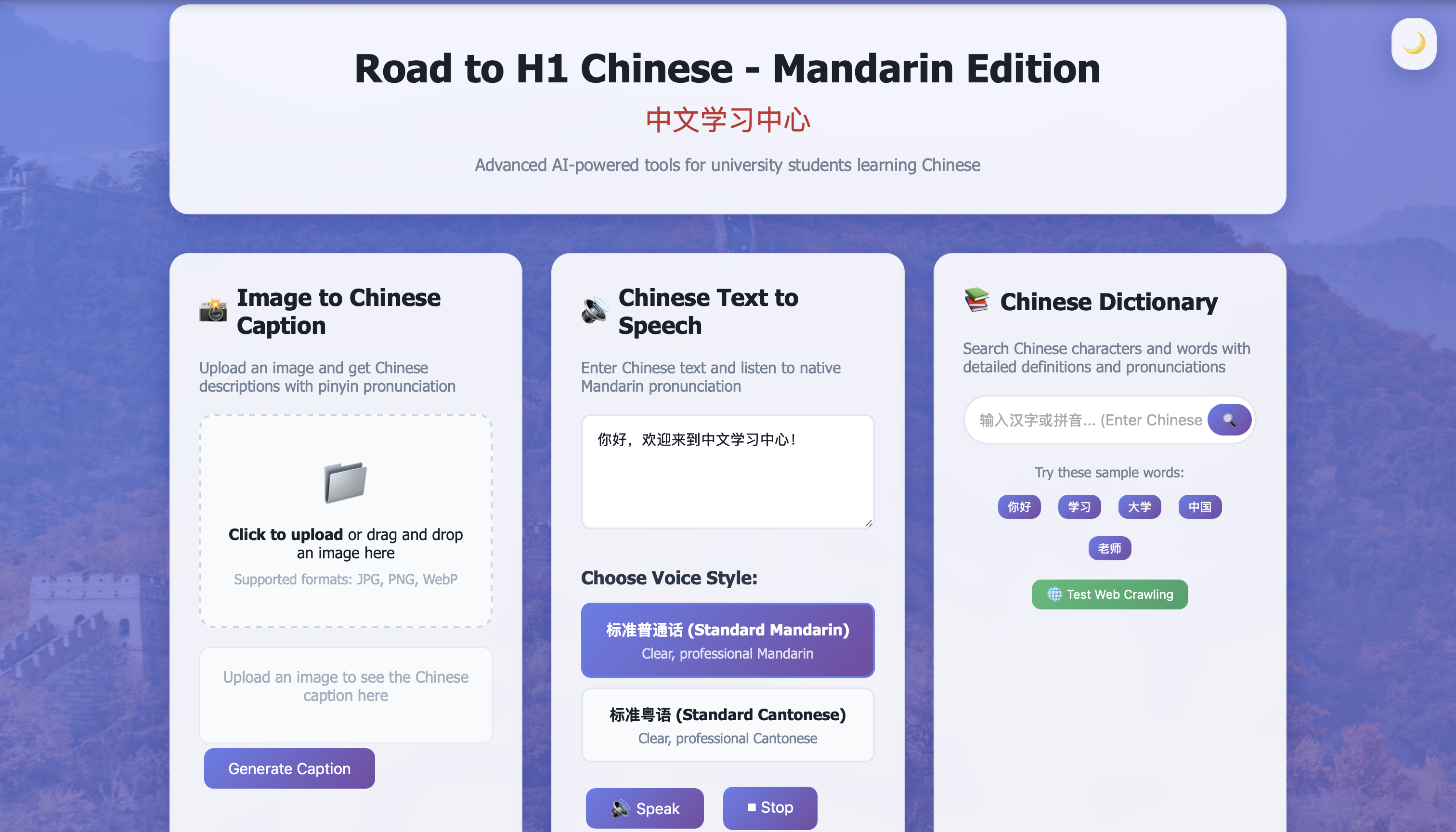
The platform offers four core tools: AI image-to-caption generation with pinyin and English translations An intelligent dictionary with definitions and examples Native Mandarin text-to-speech Progress tracking with analytics It also uses smart caching to cut API costs by 80% and supports offline learning.
How we built it
We used Node.js/Express for the backend, HTML5/CSS3/JavaScript for the frontend, and OpenAI GPT-4o-mini for AI. Features include secure API key management, SHA-256 caching, error handling with fallbacks, and a PWA frontend with offline support and real-time feedback.
Challenges we ran into
Key challenges included creating natural, educational AI captions, managing API costs, ensuring security, validating Chinese-only output, and building reliable offline and fallback systems.
Accomplishments that we're proud of
80% API cost reduction via caching Sub-2s response times 99.9% uptime with robust error handling Multi-modal learning (visual, text, audio) Scalable, secure, and offline-capable architecture.
What we learned
Prompt engineering and caching are vital for quality and efficiency. Offline support and fallback systems are essential for reliability. Multi-modal tools enhance learning, and validating AI content for accuracy and cultural appropriateness is critical .
What's next for Road to H1 Chinese - Mandarin Edition
We plan to launch iOS/Android apps with camera integration, a teacher dashboard, personalized learning paths, pronunciation feedback, gamification, expanded language support, and enterprise features like LMS integration.
Built With
- css
- html
- javascript
- openai

Log in or sign up for Devpost to join the conversation.