-
-
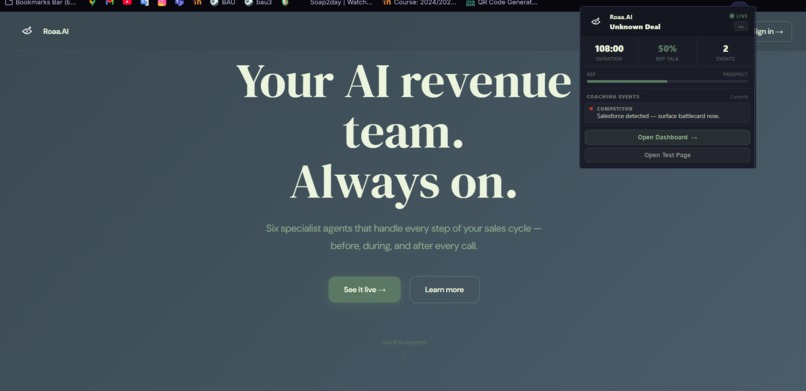
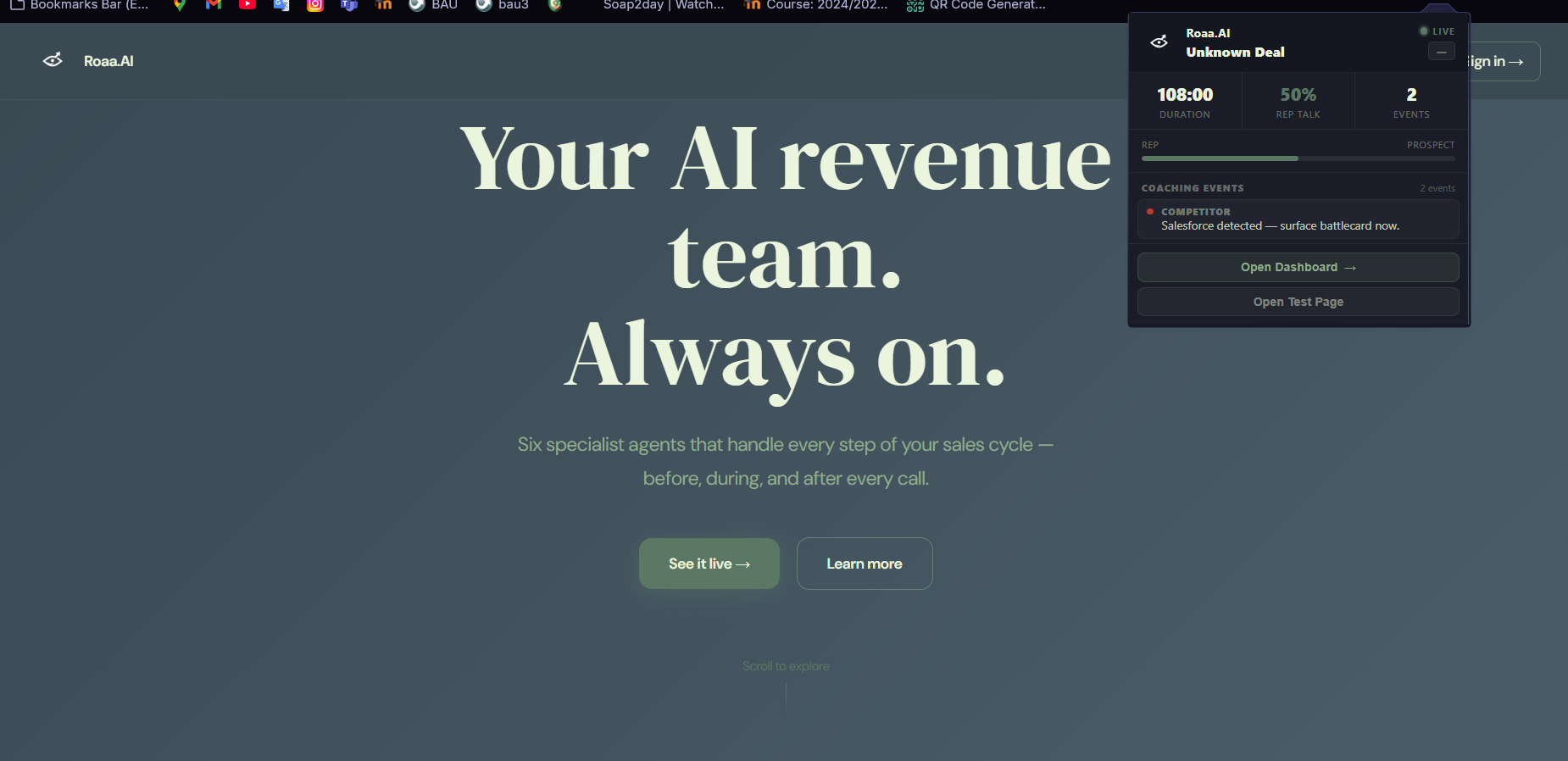
Roaa.AI with Chrome extension
Inspiration
Every day, sales reps lose deals they didn't have to lose. Not because they weren't good enough. Not because the product wasn't right. But because nobody told them the champion got promoted. Nobody flagged that the competitor just submitted a proposal. Nobody noticed the deal was dying until it was already dead. The signals were always there. They were just invisible. We asked ourselves one question: "What if a rep never missed a signal again?" That question became [Roaa.AI]
What It Does
RoaaAI is a closed-loop multi-agent platform that automates the entire B2B sales cycle. Six specialist AI agents, each owning one phase, working together in real time with no human in the loop.
Before the call: the Pre-Call Agent researches the prospect, detects funding events, role changes, and competitor moves, then delivers a voice brief to the rep 20 minutes before every meeting.
During the call: the Live Call Coach listens in real time via a Chrome Extension, pushing intelligent coaching cards to the rep's screen in under 2 seconds. Not keyword matching. Real AI reasoning, in the moment.
After the call: three agents fire simultaneously. Deal health is scored 0–100. Salesforce is updated within 60 seconds. A full meeting summary lands in the rep's inbox before they've closed their laptop.
Between calls: the Deal Intelligence Agent monitors every active deal 24/7, watching for champion changes, competitor proposals, and funding events. High signals fire instant Teams alerts.
Across the pipeline: the Forecasting Agent reasons across every deal, calculates commit and at-risk forecasts, and pushes priority updates back to the other agents. The loop closes itself.
All six agents communicate via A2A protocol on Amazon Bedrock Agent Core. Every handoff is automatic. Every insight is real.
How We Built It
It started with one question: "If this frustrates us every day, imagine how many people feel the same way?"
We didn't open a code editor first. We sat with the problem. We watched how reps prepared for calls or didn't. We traced where deals slipped, not from lack of effort, but from lack of the right signal at the right moment. We watched CRM data get entered wrong, late, by people who had long stopped caring.
Then we started building. And we didn't stop for a week.
We chose Amazon Bedrock Agent Core as our runtime not for functions with names, but for autonomous specialists that could be deployed, monitored, and scaled independently. We used the Strands Agents framework for each agent's reasoning loop and designed a strict A2A protocol so every inter-agent handoff was typed, traceable, and real.
Model selection was deliberate. Nova Lite for speed. Nova Pro for deep post-call analysis. Nova Premier for pipeline reasoning. Nova 2 Sonic for real-time voice coaching speech-to-speech, no text conversion, under 700ms latency.
The Chrome Extension alone required solving problems nobody documents Shadow DOM injection, WebSocket session management, and Content Security Policy blocking browser speech recognition silently. Every edge case, we fixed and moved forward.
We connected Salesforce, Microsoft Teams, AWS SES, DynamoDB, Amazon Transcribe, and Serper into one coherent system. EC2 for persistent WebSocket streaming. Amplify for the frontend. Bedrock Agent Core for every agent. The stack grew because the problem demanded it. Never for its own sake.
Challenges We Ran Into
Building something real always fights back.
Amazon Nova Act wasn't a Bedrock model ID it was a separate browser automation SDK entirely. We had designed around it before discovering the discrepancy. We corrected course, rebuilt the tool layer, and kept moving.
Salesforce authentication failed repeatedly across OAuth flows, SOAP endpoints, and Connected App configurations. The account locked from too many failed attempts mid-debug. We unlocked it, reset the security token, and got it working. That half-day taught us more about enterprise API authentication than any documentation ever could.
The Chrome extension's Web Speech API was silently blocked by Teams' Content Security Policy. No error thrown just silence. We diagnosed it through console archaeology, rebuilt the transcription layer around caption detection, and then engineered auto-enabling logic so the user never has to touch a setting manually.
App Runner's stateless architecture made Nova 2 Sonic's bidirectional streaming impossible each audio chunk could land on a different container instance, breaking the open session. We migrated to EC2, restructured session management, and unlocked the full Nova 2 Sonic pipeline. The right infrastructure for the right tool.
A2A inter-agent routing was firing calls to localhost instead of deployed AgentCore endpoints because the registry loaded URLs at import time, before environment variables had initialized. A lazy-loading fix resolved it but finding that root cause required tracing a call path across three layers of abstraction at midnight. Every one of these challenges made the system stronger. None of them stopped us.
Accomplishments We're Proud Of
We're proud of all of it. Not just the milestones the small moments too, because that's where real work lives. We're proud of the moment Salesforce went green after days of auth failures. We're proud of the first coaching card that slid in from the top-right corner of a live Teams call. We're proud of the post-call email that landed in an inbox with a real Nova AI analysis of a real conversation not a template, not a placeholder, actual intelligence.
We deployed six agents to Amazon Bedrock Agent Core each with its own runtime endpoint, each independently invokable, each producing structured JSON logs in CloudWatch. That is not a demo. That is infrastructure. We built a full B2B SaaS product landing page, login, protected dashboard, five internal pages, real-time WebSocket feeds, and a Chrome extension in one week. While debugging Salesforce auth, rewriting the transcription pipeline, and migrating cloud providers mid-build. We replaced generic placeholder data with real MENA companies, real deal dynamics, real call transcripts, and real contract redlines. Noon Commerce. Tabby. Careem. Because every person who looks at this product deserves to see something that feels true. We are proud of every mistake too. Because every mistake was proof we were building something that pushed back and that is the only kind of thing worth building.
What We Learned
We learned that the hardest part of building a product is never the code. Technically, we deepened fluency in multi-agent orchestration, Bedrock's streaming APIs, WebSocket lifecycle management, browser extension architecture, and production AWS deployment across six interconnected services. We learned the difference between a model ID and a browser automation SDK the hard way. We learned that stateless infrastructure and persistent bidirectional connections are fundamentally incompatible and why that matters at 2am on day five. But the lessons that will stay longer than any of that are the others. We learned that communication between two builders matters more than the quality of any single contribution. A misunderstood requirement costs more time than a hard bug. A clear decision made together moves faster than a perfect decision made alone. We learned time management not as a productivity framework but as a survival skill knowing when to push through, when to step back, and when to commit to a direction even without full certainty. We made mistakes that cost us hours. We reversed decisions. We hit walls that looked like endings. None of it was reason enough to stop because mistakes are not failure. Mistakes are evidence that you are trying something real. Every bug fixed, every dead end reversed, every wrong assumption corrected was a proof of work that no shortcut could replicate. We learned that the best teams are not the ones who don't struggle. They are the ones who struggle and keep building anyway.
What's Next for Roaa.AI
Roaa.AI is the beginning of something greater.
The next chapter starts with one goal: put this in the hands of every B2B sales team in the world.
We start in MENA a market that has been underserved by enterprise software for too long, where the next generation of great companies is being built right now, and where the hunger for tools that actually work is real and urgent. We know these buyers. We know these deals. We understand the dynamics of selling across this region the relationships, the timelines, the trust that has to be built before a contract is signed.
From there, the vision is global. Six agents become a platform. A platform becomes a category. A category becomes the standard for how revenue teams operate not just in MENA, but everywhere a rep is about to walk into a call unprepared, file a note from memory, or lose a deal to a signal they never saw.
Roaa.AI has a working system, a real product, a target market, and two founders who will not stop. The first design partners come next. Then the seed round. Then the first customers who will look at what this does for their pipeline and wonder how they ever sold without it. The question we started with doesn't get answered by us. It gets answered by everyone who uses what we built. Who built this? We did.
Built With
- a2a
- amazon-dynamodb
- amazon-ec2
- amazon-eventbridge
- amazon-ses
- amazon-transcribe
- aws-amplify
- aws-lambda
- bedorck-agent-core
- chrome-extenstion-mv3
- fastapi
- microsoft-teams
- nova-lite
- nova-premier
- nova-pro
- python
- react
- salesforce
- sonic2
- starnds


Log in or sign up for Devpost to join the conversation.