-
-
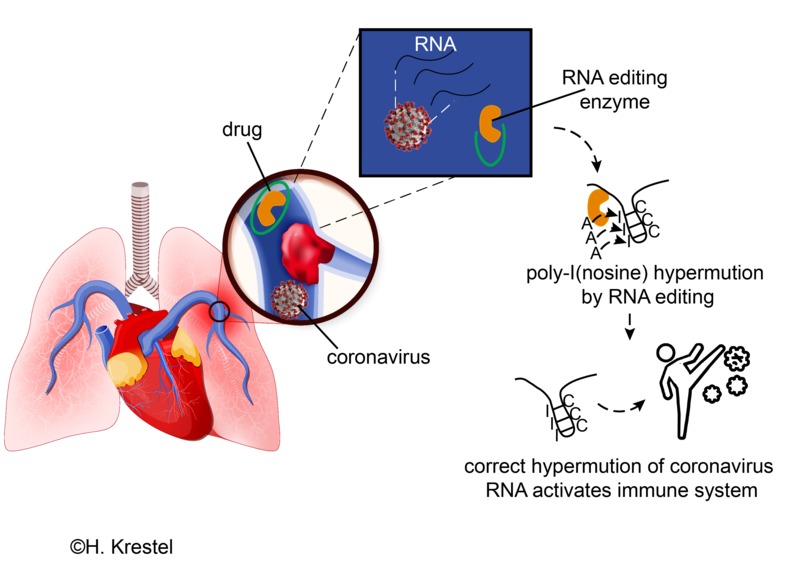
Correct hypermutations introduced in coronavirus RNA may activate immune system and curb attack on respiratory tract and blood coagulation.
Corona Virus is a RNA virus and infection of tissue/cells depends on replication of its RNA in the cytoplasm of cells of the host and not being recognized by the viral defense system of the host. The viral defense system consists of soluble receptors, two of them called RIG-1 and MDA5, that are able to recognize particular RNA, respectively RNA structures, and elicit a interferone-mediated immune response, which should halt virus replication. It is unknown how well corona virus RNA is recognized by these viral receptors but it is for example known that double-stranded RNA structures consisting of poly-inosine:cytosine can be recognized by MDA5 and activate the inflammatory immune response (Kato H et al. Differential roles of MDA5 and RIG-I Helicases in the recognition of RNA viruses. Nature 2009). The research idea now consists of editing the RNA of the virus by deamination of adenosine to inosine by adenosine deaminase acting on RNA (ADAR) in the known mechanism called RNA editing. This should facilitate formation of poly-inosine:cytosine dsRNA stretches and hence improve the cellular inflammatory immune response and curb infection, or spreading of the virus within the host respectively. Editing of endogenous mRNA (in Alu elements of its 3'UTR) of the host normally protects from inflammatory autoimmune responses (Krestel H, Meier J. RNA Editing and Retrotransposons in Neurology. Frontiers in Molecular Neuroscience 2018). Hypermutations introduced by RNA editing may under certain circumstances be proviral such as in measles virus, hepatitis or influenza virus. Coronavirus-RNA editing interaction has to be understood and ADAR delivery and action has to be engineered such that generation of poly-inosine:cytosine dsRNA stretches will be preferred over interference with endogenous mRNAs/small RNAs or introduction of proviral hypermutations.
The research idea is exemplified in the attached figure. Attached is an official introductory video about RNA editing from Walter Jahn.


Log in or sign up for Devpost to join the conversation.