-
-
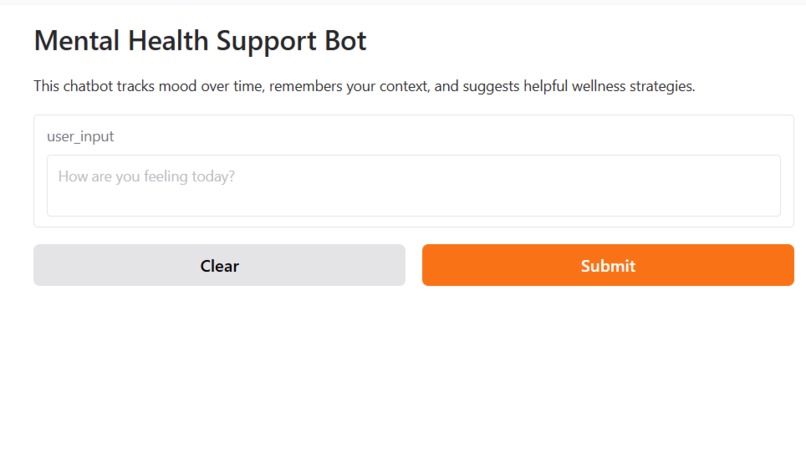
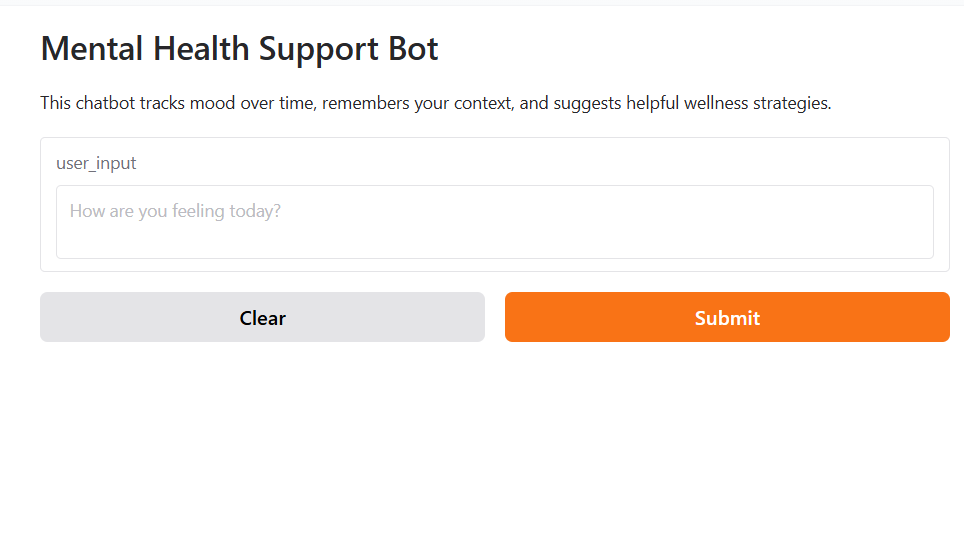
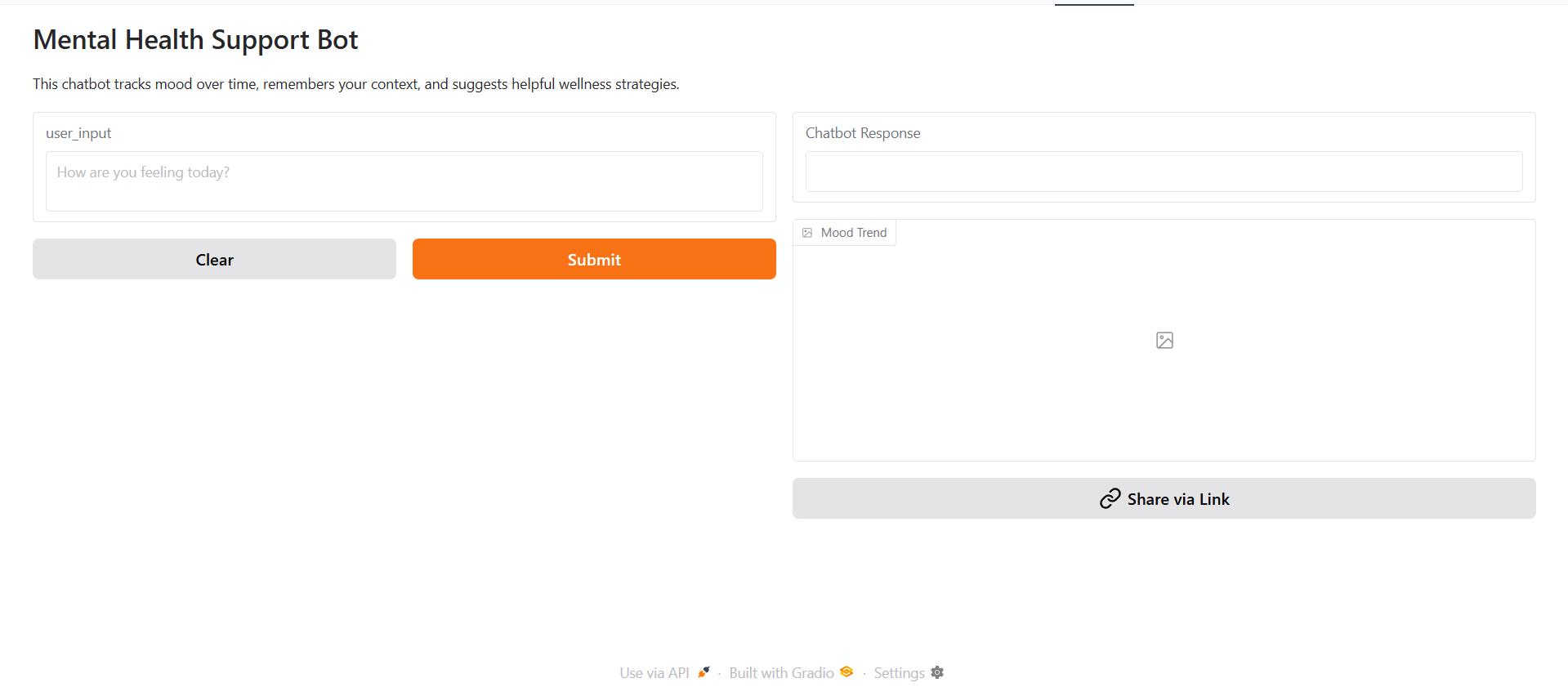
User Input UI
-
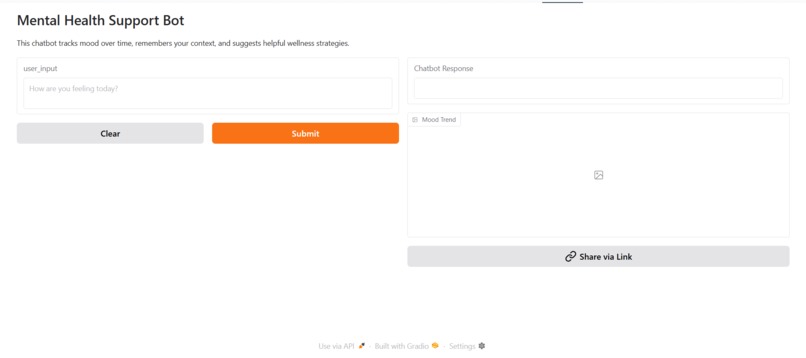
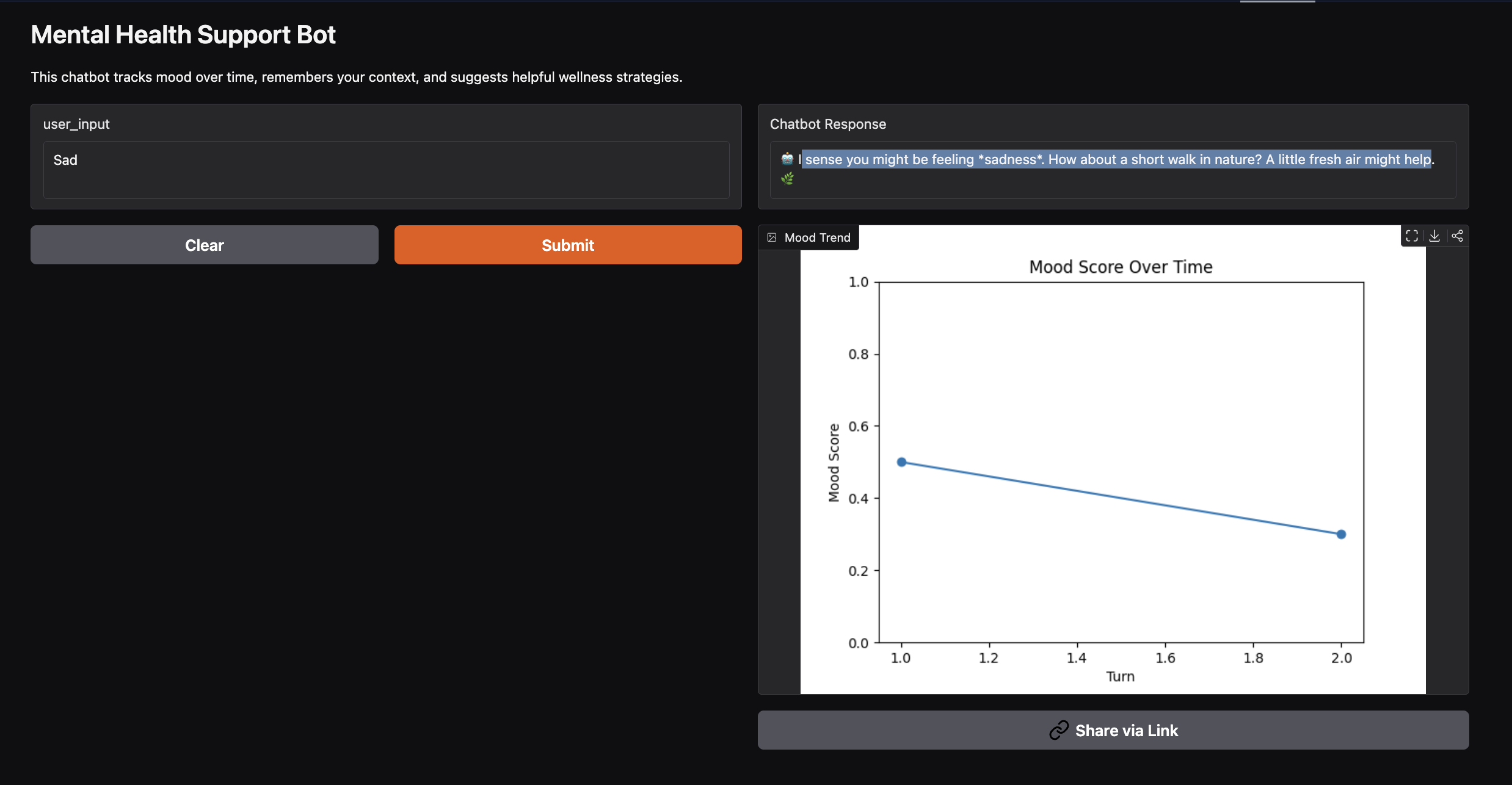
Full UI
-
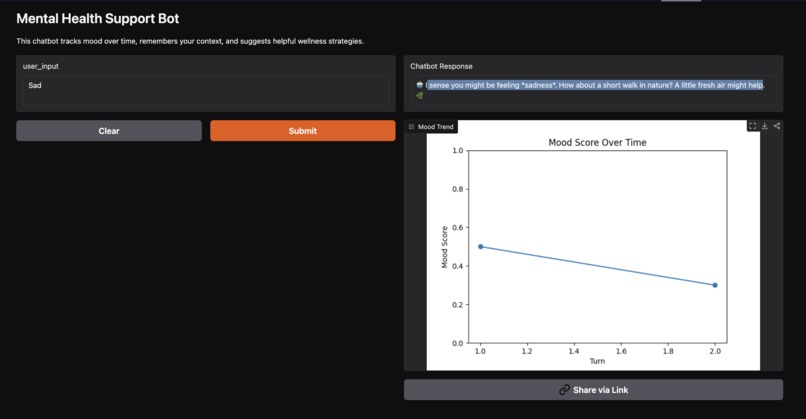
Demo Screenshot
🧠 Inspiration
Mental health care is essential but still inaccessible to many. We wanted to explore whether AI could gently guide users toward emotional wellbeing — not with generic tips, but through personalized, learned support. Reinforcement learning gave us a way to model helpful decision‑making, while GPT enabled rich emotional understanding.
💬 What it does
Our chatbot listens to the user, detects their mood using GPT‑3.5, and selects a wellness strategy using a PPO‑trained reinforcement learning agent. It also:
- Maintains conversation context across turns
- Tracks mood score trends visually
- Remembers suggestions given to avoid repetition
- Runs live on Hugging Face Spaces with an intuitive Gradio UI
🔧 How we built it
- Created a custom Gym environment to simulate emotional state and reward improvements
- Trained a PPO agent using stable‑baselines3
- Used OpenAI GPT‑3.5 to classify mood from natural text input
- Mapped moods to scores (e.g., sadness = 0.3, joy = 0.9)
- Integrated everything into a Gradio chatbot interface
- Deployed publicly via Hugging Face Spaces
🧱 Challenges we ran into
- Git LFS issues while pushing trained models
- GPT’s mood classification sensitivity required prompt tuning
- PPO agent needed careful reward shaping to perform well
- Visualizing mood charts in Gradio without crashes
- Handling multi‑turn conversations and maintaining session memory
🏆 Accomplishments that we’re proud of
- Built and deployed a live mental health agent powered by reinforcement learning
- Achieved real‑time mood detection + PPO suggestion integration
- Created a meaningful use case combining language models and RL
- Made the interface user‑friendly and expressive with emoji, charts, and chat history
📚 What we learned
- How to design a Gym environment for non‑game, human‑centered goals
- Best practices for deploying ML apps on Hugging Face Spaces
- How GPT can be used not just for generation, but semantic classification
- Combining symbolic reward learning with fuzzy language input
🚀 What’s next for RL‑Powered Mental Health Support Bot
- Add 👍 / 👎 feedback for learning from real users
- Use GPT‑3.5 to generate full empathetic responses
- Store and visualize long‑term mood history per user
- Add offline fallback using a local Hugging Face model
- Integrate external wellness APIs like Calm or Headspace
- Open‑source the project for research and community use

Log in or sign up for Devpost to join the conversation.