-
-
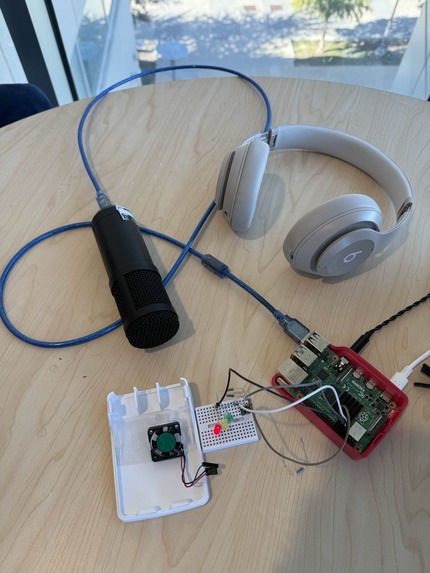
Working Product

Inspiration
Since the COVID-19 pandemic, Generation Z has struggled to create meaningful connections with others due to isolation and numerous crises. This is where a conversational coach such as RizzBot can help break the ice.
What it does
RizzBot listens to users' conversations and provides in-ear suggestions powered by generative AI. These suggestions aim to boost conversation response quality and create deep social bonds with others. Feedback on conversation quality is given through LEDs.
How we built it
Audio captured from a USB microphone is transcribed into text using OpenAI Whisper API. The text input is then sent to Gemini API alongside various chat prompts to enhance response quality. Next, the response is converted back into an audio file via OpenAI Audio API, which is broadcasted to a Bluetooth device or audio jack.
Challenges we ran into
Some challenges we encountered whilst working on RizzBot are latency, prompt specificity, and hardware constraints. RizzBot's latency induced by API calls and audio processing may create some awkward silences within conversations. Prompt engineering was also heavily emphasized, as it directly affected the quality of the responses. Another challenge we faced was accessing the raspberry pi over the network, but we were able to quickly solve this issue by introducing our own hotspot.
Accomplishments that we're proud of
We are proud that our application's entire pipeline is functional, from microphone input to output to the user's device.
What we learned
We learned of the importance of prompt engineering when using generative AI, as vague prompts compromised the tone and appropriateness of suggested responses.
What's next for RizzBot
A major point of improvement for RizzBot is latency. We attempted to remediate this with a real-time model, with mixed success. Another future idea is to analyze tone and inflections of the input audio, as this will allow for more relevant and appropriate responses. Our final future idea would be having a display for the user to allow for easier conversation, and also be inclusive for those who are hard of hearing. This would sort of be like a teleprompter.
Built With
- gemini
- openai
- python
- raspberry-pi


Log in or sign up for Devpost to join the conversation.