-
-
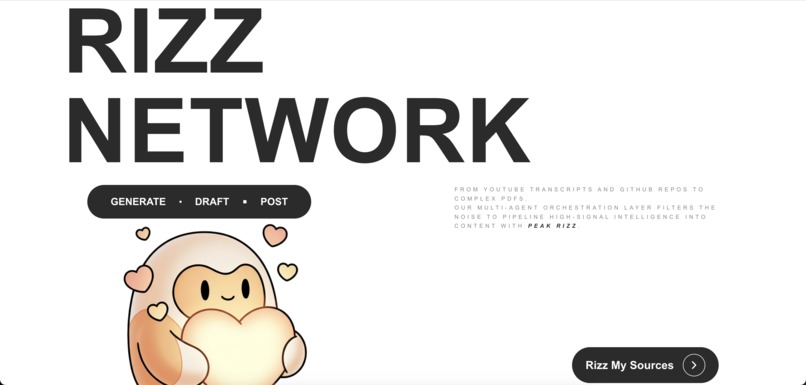
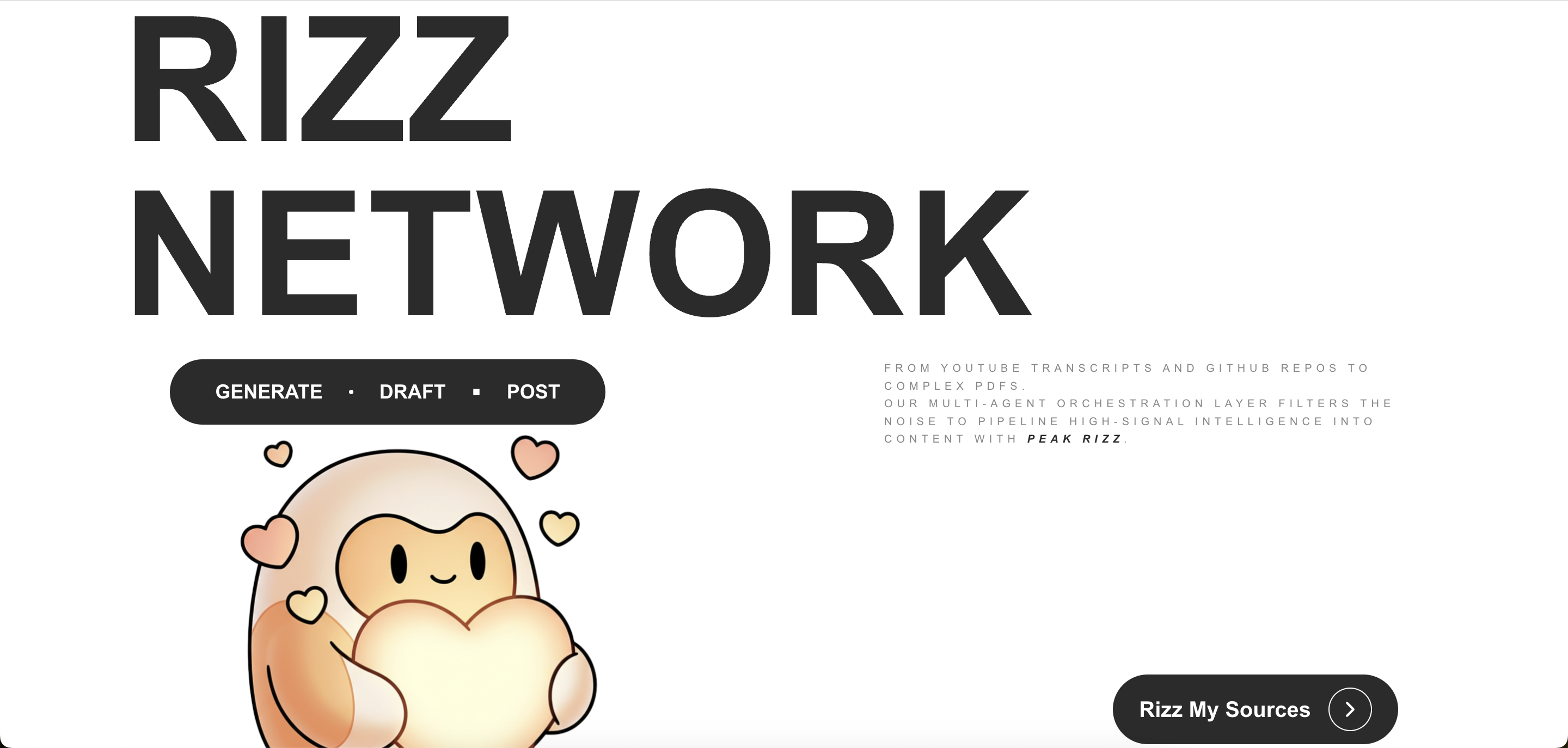
Landing Page
-
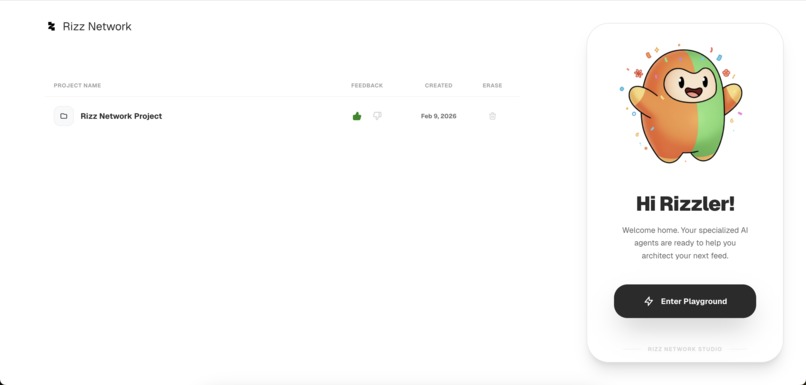
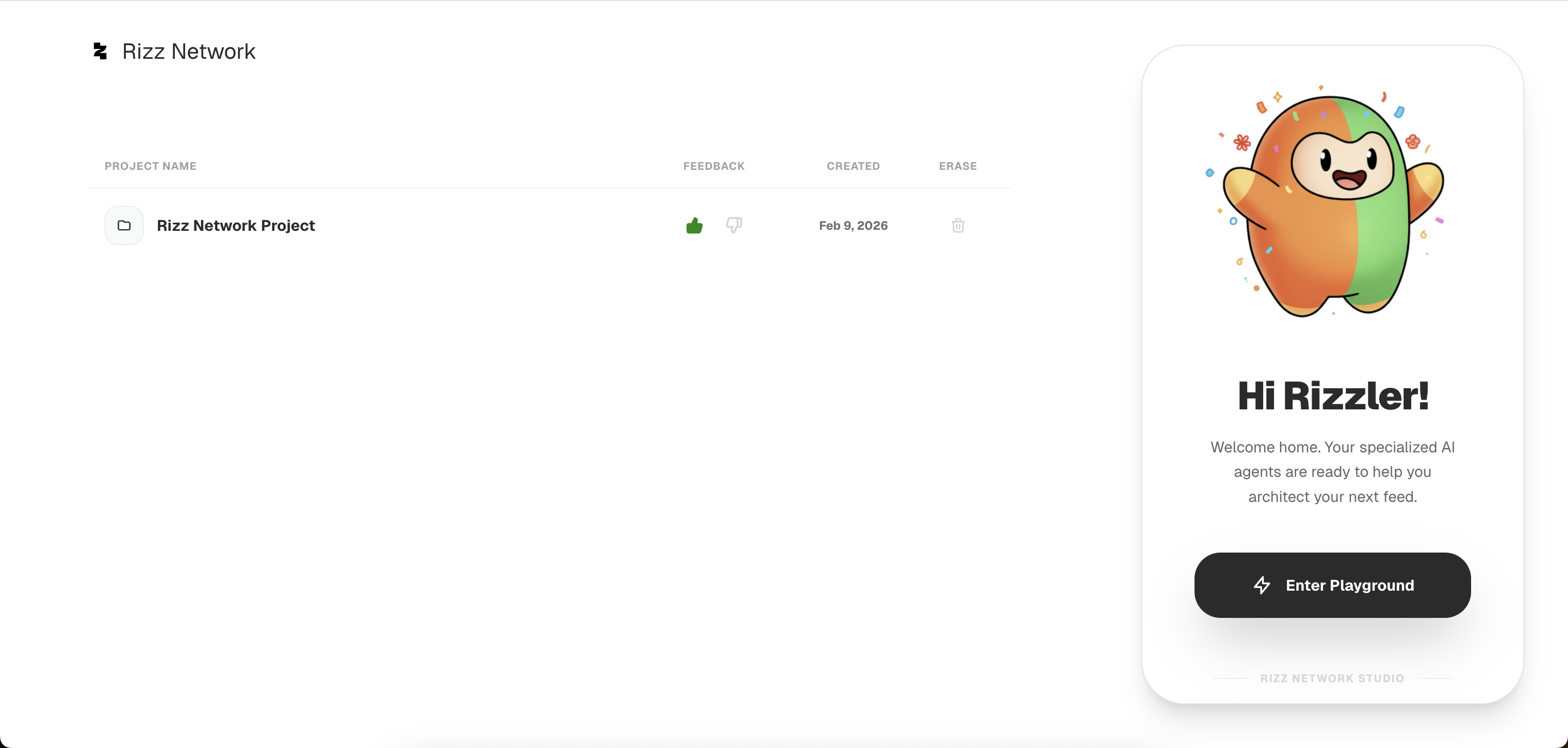
User Home Page with folder structure
-
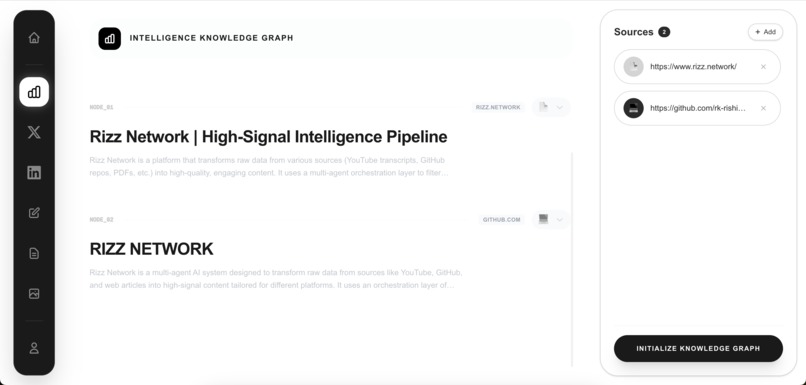
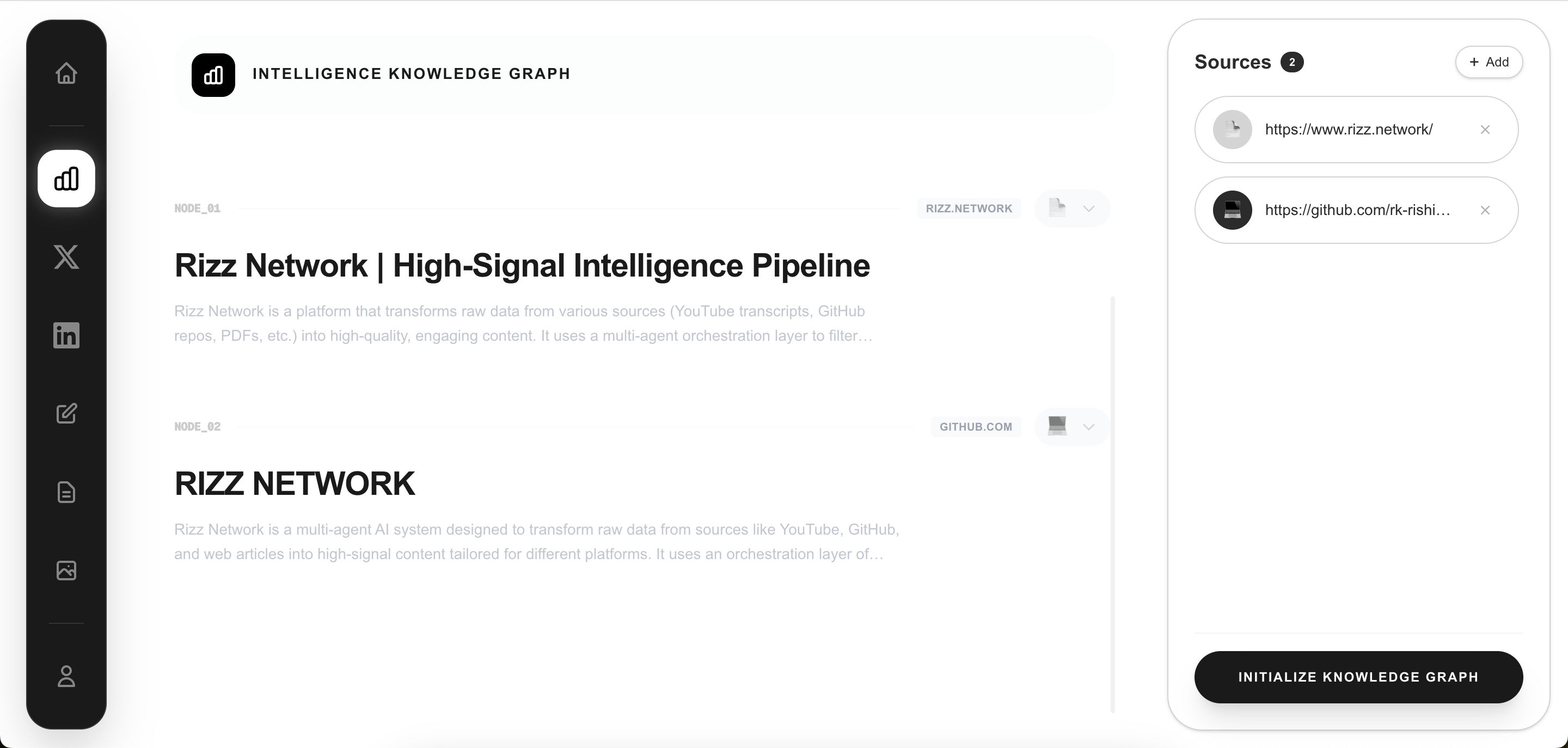
Knowledge Graph Creation
-
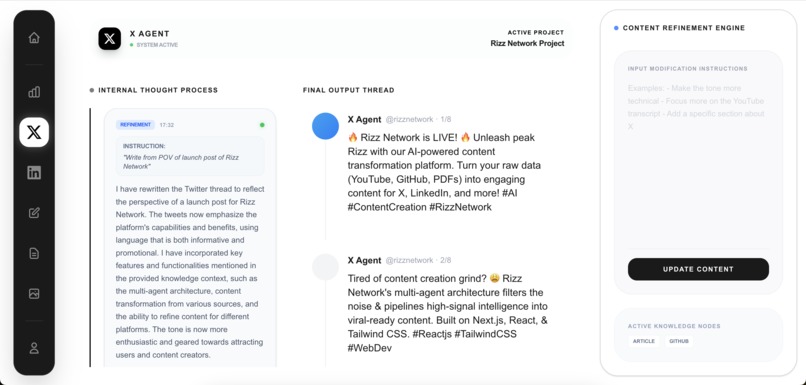
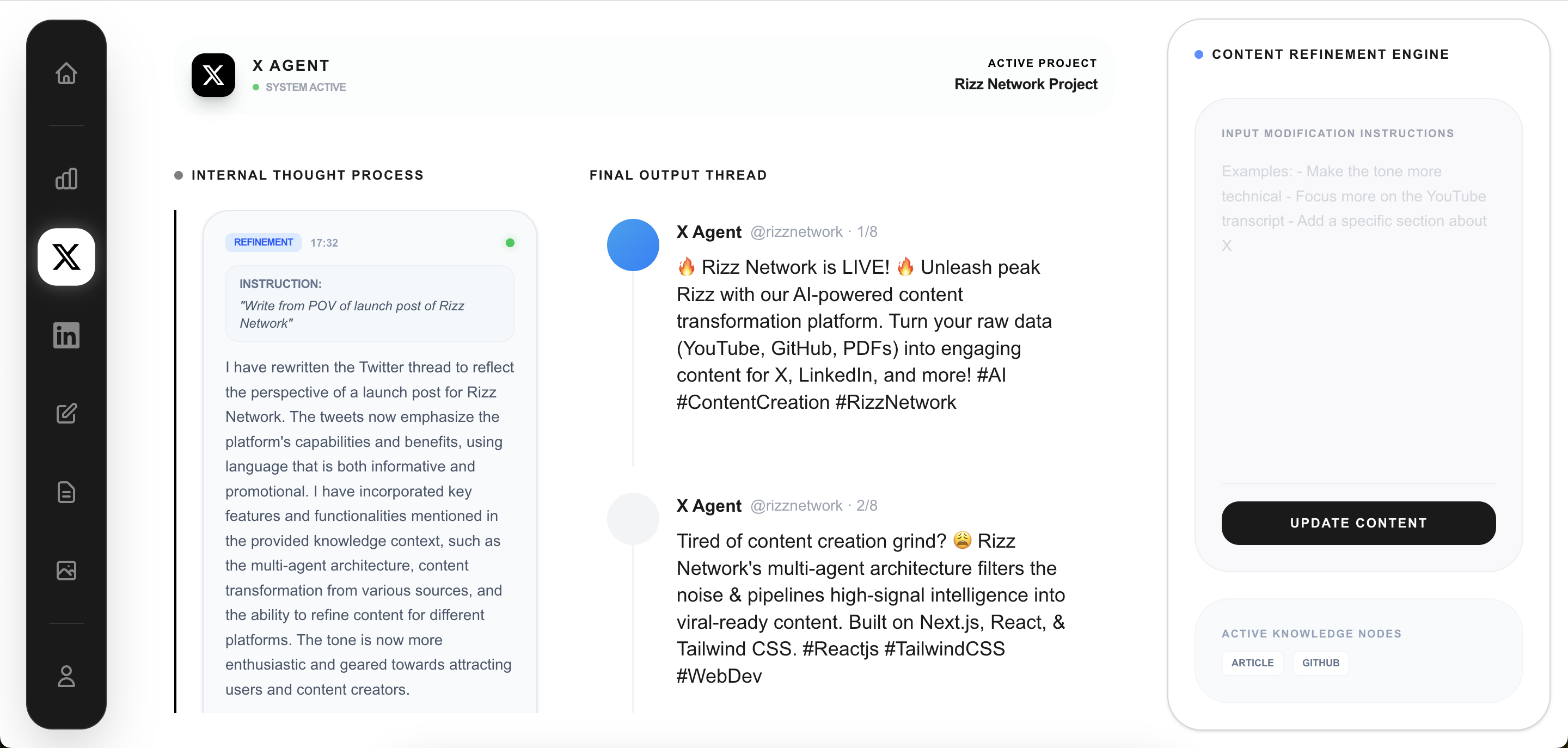
X Post Example
-
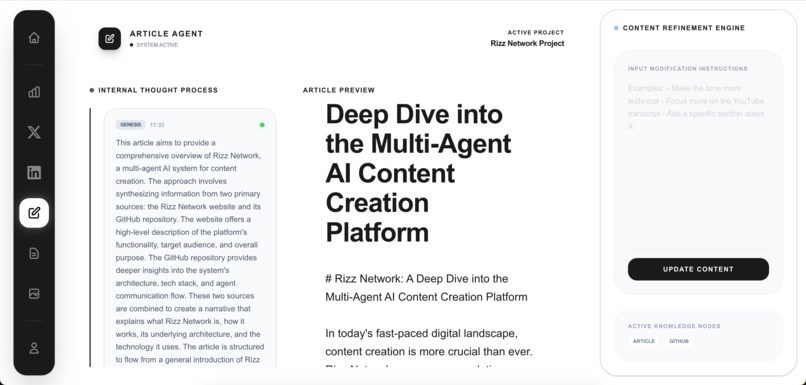
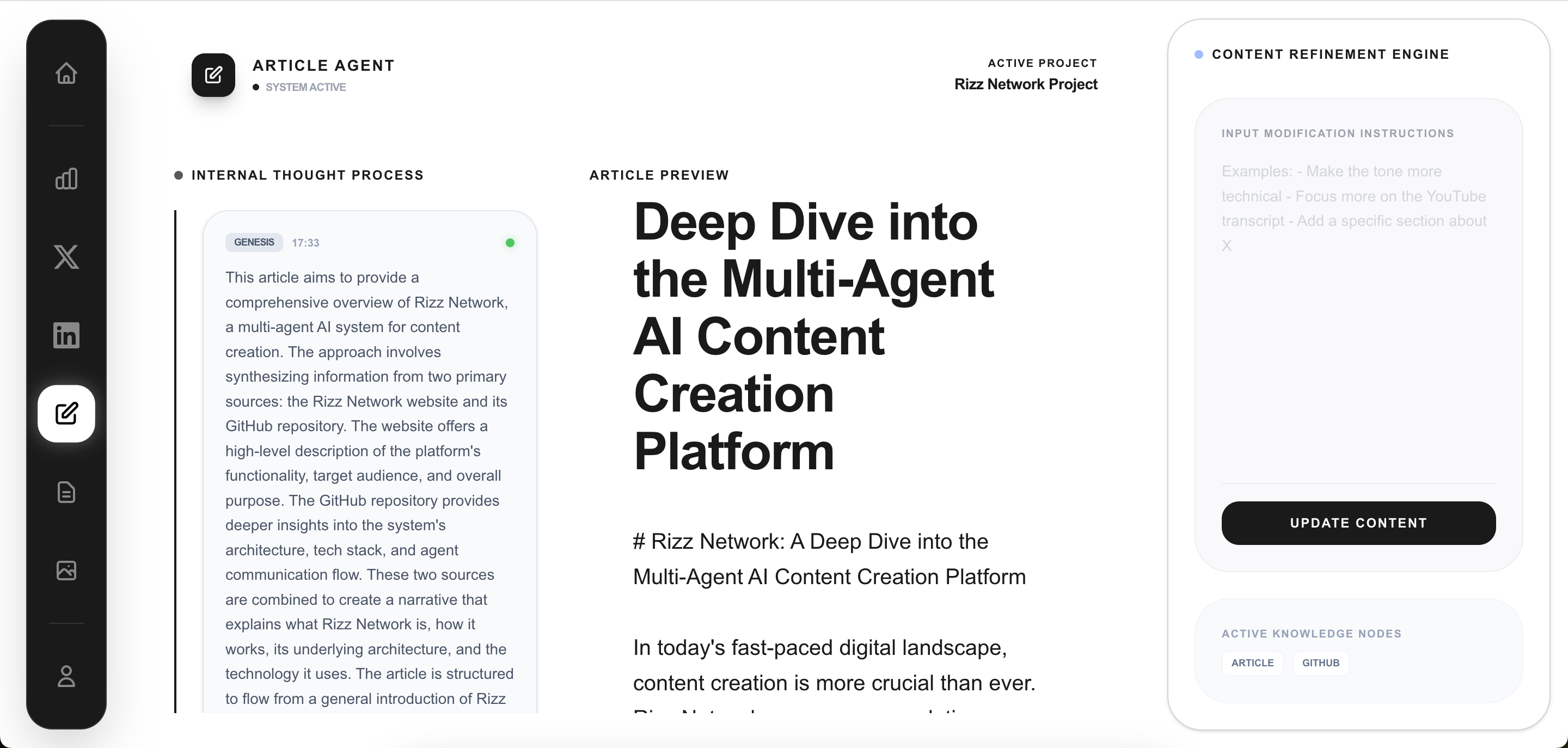
Article Example
Inspiration
We’ve all been there. You save fantastic technical articles that you never find the time to read back. You listen to an incredible podcast on your commute and desperately want to share the key learnings with your network, but the thought of summarizing an hour of audio stops you.
We realized this friction exists for everyone from casual learners to professional DevRels. A Social Media Manager spends hours gathering sources before writing a single post. A developer wants to write a thread about a new npm package but gets bogged down in the structuring.
We built Rizz Network to bridge the gap between raw information consumption and high-impact knowledge sharing. We wanted to create a system that takes your "source of truth"—be it a YouTube video, a complex GitHub repository, or a dense article—and gives it the perfect "rizz" (charisma/context) needed for different social platforms. It’s not just about summarizing; it’s about repurposing intelligence instantly.
What it does
Rizz Network operates as a sophisticated multi-agent orchestration layer designed to pipeline raw information into high-velocity intelligence.
Users provide a source input:
A YouTube URL
A GitHub Repository link
A standard Web Article link or PDF
The system utilizes specialized AI agents working in concert to generate platform-specific content:
The Orchestrator ingests the data, synthesizing disparate sources into a "Unified Knowledge Context."
Channel Specialists take that context and transform it based on the desired output:
LinkedIn Agent: Creates high-level executive insights and professional storytelling.
Twitter (X) Agent: Deconstructs complex topics into viral-ready threads and hooks.
Article Agent: Synthesizes data into structured long-form narratives.
Digest Agent: Filters noise forrapid-fire bulleted takeaways.
Visual Agent: Generates context-aware brand assets to match the content.
Crucially, Rizz Network is not a static generator. It features a Refinement Engine—a social content playground where users can iteratively edit the output, asking the AI to "make it more technical" or "change the tone," ensuring the final piece is perfect before publication.
How we built it
The core of Rizz Network is the Multi-Agent Architecture illustrated in our system diagram.
The Orchestration Layer (The Foundation) We built a central Orchestrator Agent that acts as the entry point. Its job is data aggregation and context synthesis. It coordinates specialized scrapers (for YouTube transcripts, web text, etc.) and merges that raw data into a JSON schema we call the Unified Knowledge Context. This JSON acts as the single source of truth for all subsequent agents, ensuring consistency.
The Specialist Layer (The Creators) Once the context is established, a Channel Router directs the task to specialized agents. We used distinct system prompts to engineer different "personalities" for each agent. The LinkedIn agent is prompted for professionalism and narrative structure, while the Twitter agent is optimized for brevity and engagement hooks. The Visual Agent communicates with image generation models (like DALL-E or Gemini Imagine) to create accompanying graphics based on the text context.
The Refinement Loop (The Editor) This was the most critical part of the build. We created a Refinement Agent designed to close the loop. It takes the initial draft from a Channel Specialist, combined with user feedback instructions, and performs surgical updates to the content without losing the original context. This iterative drafting process turns the platform into a true content playground.
Challenges we ran into
The Deep GitHub Analysis: Standard AI implementations often just read a GitHub repo's README.md, resulting in superficial content. We wanted Rizz Network to truly understand code. We had to build a custom repo agent that could traverse file trees and analyze actual code logic, not just documentation. Managing the token window while feeding an entire codebase into the context was a significant technical hurdle.
Maintaining "Contextual Integrity": When passing information from the Orchestrator to a Twitter agent, and then to a Refinement agent, it’s easy for the AI to suffer from "telephone game" syndrome, where the original nuance is lost. Developing the robust JSON schema for the "Unified Knowledge Context" was essential to ensure every agent was working from the exact same facts, regardless of how they formatted them.
Distinct Agent Voices: Preventing the agents from sounding the same was difficult. We spent a lot of time on prompt engineering to ensure the LinkedIn agent didn't sound like the Twitter agent, and that the Digest agent was truly succinct rather than just chopping paragraphs.
Accomplishments that we're proud of
The "Deep-Code" GitHub Agent: We are incredibly proud that our system doesn’t just summarize Readmes. It goes line-by-line through code to produce true technical content. A byproduct of this is a powerful standalone GitHub AI agent that we believe has massive potential beyond just content creation.
The Refinement Engine: We moved beyond "one-shot" generation. Building an iterative playground similar to code editors (like Antigravity), but for social content, feels like a major step forward in AI usability.
The Orchestration Architecture: Successfully implementing the complex flow of data from raw source -> unified context -> specialized routing -> iterative feedback loop works seamlessly in practice.
What we learned
Structure is King: AI agents perform significantly better when unstructured data (like a video transcript) is first converted into highly structured data (our JSON Knowledge Context) before being asked to generate creative output.
Specialization beats Generalization: Instead of one giant prompt trying to do everything, breaking the system into "The Architect," "The Creators," and "The Editor" yielded far higher quality results.
Human-in-the-Loop is Essential: AI gets you 90% of the way there, but the final 10%—the "rizz"—requires human intuition. Building the Refinement Engine to facilitate that last mile was crucial to the product's value.
What's next for Rizz Network
We want to transform Rizz Network from a content generator into a complete social media command center.
Direct Integration & Scheduling: Currently, you copy-paste the output. The next step is integrating directly with social APIs (X, LinkedIn) so users can schedule and post their content directly from the Rizz Network playground.
Multimodal Upload Support: Allowing users to upload raw video files and images directly as sources, rather than just links.
Spinning off the GitHub Agent: The deep-code analysis tool is powerful enough to be its own product for developer education and documentation, and we plan to explore that further.

Log in or sign up for Devpost to join the conversation.