
Inspiration
What it does
How we built it
Challenges we ran into
Accomplishments that we're proud of
What we learned
What's next for Riveto
Inspiration
We saw that many web apps (especially early-stage or side projects) lack clean separation between frontend and backend which leads to tangled code, scaling issues, and harder team collaboration. Also, integrating payment, analytics, and media handling often gets messy when bolted in ad hoc.
So we set out to build RIVETO — a full-stack scaffold that handles common needs (auth, payments, image upload, user analytics) out of the box, giving developers a strong foundation to build real apps faster.
What it does
RIVETO is a modern full-stack web application with clear separation of frontend and backend.
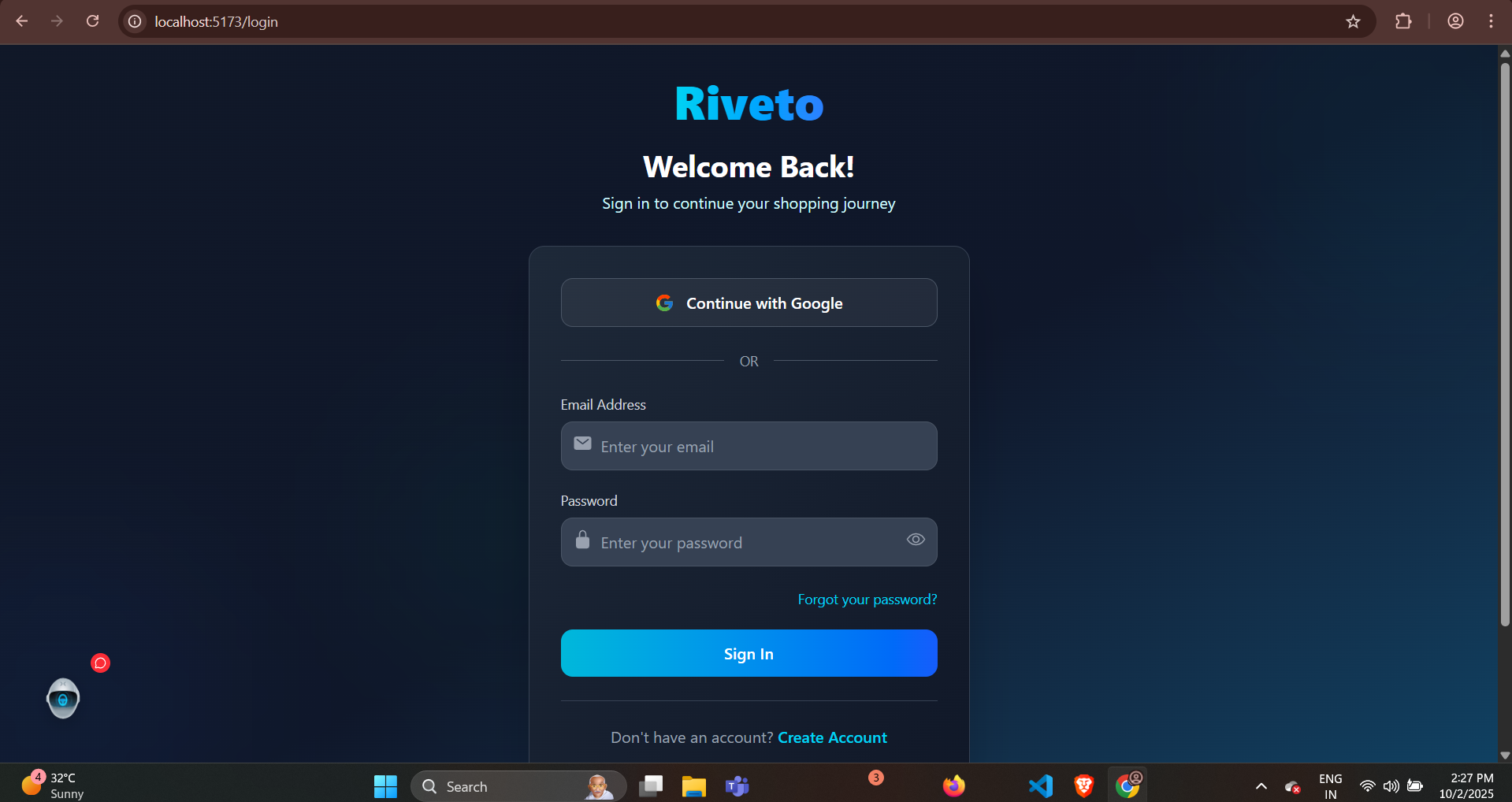
It provides user & admin interfaces, supporting authentication/authorization.
It integrates Razorpay for payments (checkout, webhooks, payment status tracking).
It handles image uploads / media via Cloudinary, giving secure, optimized media management.
It implements custom analytics / event tracking so admins can monitor user behavior, transactions, etc.
The UI is built to be responsive, with clean components and use of Tailwind CSS.
The backend exposes a REST API for the frontend (and potentially mobile / other clients).
Admin panel allows managing users, payments, analytics, and media in one place.
How we built it
Frontend: React + Tailwind CSS
Component-based architecture (pages, components, hooks, utils)
Integrates with backend API (fetch / Axios)
Handles file-input, image upload flows, forms, dashboards, etc.
Backend: Node.js + Express
RESTful routing layer
Business logic and controllers
Models defined using Mongoose (MongoDB)
Middleware for auth, error handling, etc.
Cloudinary integration via cloudinary + multer-storage-cloudinary for image uploads
Payment flows implemented with Razorpay: creating orders, verifying, handling webhooks
Analytics / event logging logic to store user events, transactions in DB
Database: MongoDB
Schemas for Users, Payments, Events, Media, etc.
Relationships and indexing for efficient queries
Dev setup / environment
.env files for configuring secrets (Mongo URI, JWT secret, Razorpay keys, Cloudinary credentials)
Local dev mode: backend on http://localhost:5000, frontend on http://localhost:3000
Ability to extend into deployment (Docker Compose, or host separately)
Architecture / Design
Clear separation between frontend & backend
Modular codebase structure
Use of cloud services (Cloudinary, Razorpay) to offload heavy tasks
API-first design so the backend could be reused beyond this UI
UI/UX / responsiveness
Tailwind makes styling consistent and adaptive
Dark / Light mode (if you included that)
Charts / dashboards for analytics
Challenges we ran into
Handling synchronous vs asynchronous flows in payments & webhooks: ensuring that payment status updates reliably and authentically was tricky.
Ensuring secure file uploads — validating file types, preventing malicious content, restricting access.
Designing the analytics / event tracking system: deciding what events to track, how to structure them, how much data to store, and making queries performant.
Managing state & error handling in frontend when many API calls (upload, payments, data fetch) can fail or timeout.
Keeping the separation of concerns: making sure frontend doesn’t leak business logic, backend stays API-agnostic.
Deployment & environment configurations: managing secrets, CORS, domain / URL differences, allowed origins.
Accomplishments that we're proud of
A working end-to-end flow from UI → API → DB → payments → analytics → dashboard.
Secure media uploads with Cloudinary integration and storage of media URLs.
Payment integration with Razorpay, including handling responses, verifying signatures, and webhooks.
A neat admin panel for managing users, payments, analytics, all in one place.
Clean modular codebase that can be a starting point for many apps.
You now have a demo-ready app that can be extended (e.g. adding more features) rather than always starting from scratch.
What we learned
How to integrate third-party services (Cloudinary, Razorpay) properly — dealing with credentials, security, API constraints.
The importance of clear architecture boundaries (UI vs API vs database) — this pays off in maintenance and extensibility.
Practical lessons in error handling, retry logic, and edge cases for payments, uploads, network failure.
How to design analytics / event tracking systems to balance between detail and performance.
Better understanding of React state management when many asynchronous flows run in parallel.
Deployment considerations: CORS, environment variables, secret management, domain / path routing.
What’s next for RIVETO
Add role-based access control (RBAC) so different admin/user roles have finer permissions.
Expand analytics dashboard: more charts, filters, export features, real-time updates.
Add notifications / email alerts (e.g. for failed payments or suspicious events).
Modular plugin / module system so new features (chat, subscriptions, etc.) can be added easily.
Mobile / API client support (mobile apps, alternative frontends).
Deploy in production: containerization (Docker), CI/CD pipeline, cloud hosting.
Add tests (unit, integration, end-to-end) for both frontend and backend to ensure robustness.
Possibly add caching, performance optimizations, logging & monitoring in production.
Built With
- and
- cloudinary
- design
- express.js-database:-mongodb-(mongoose-odm)-payments:-razorpay-integration-tracking:-custom-analytics-&-event-tracking-ui:-advanced
- for
- frontend:-react
- image
- media
- performant
- responsive
- secure
- tailwind
- tailwind-css-backend:-node.js
- uploads:
- with


Log in or sign up for Devpost to join the conversation.