-
-
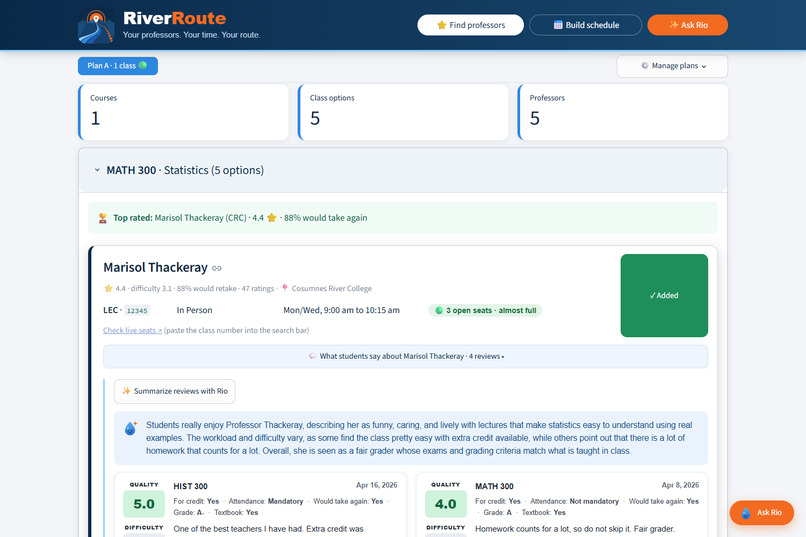
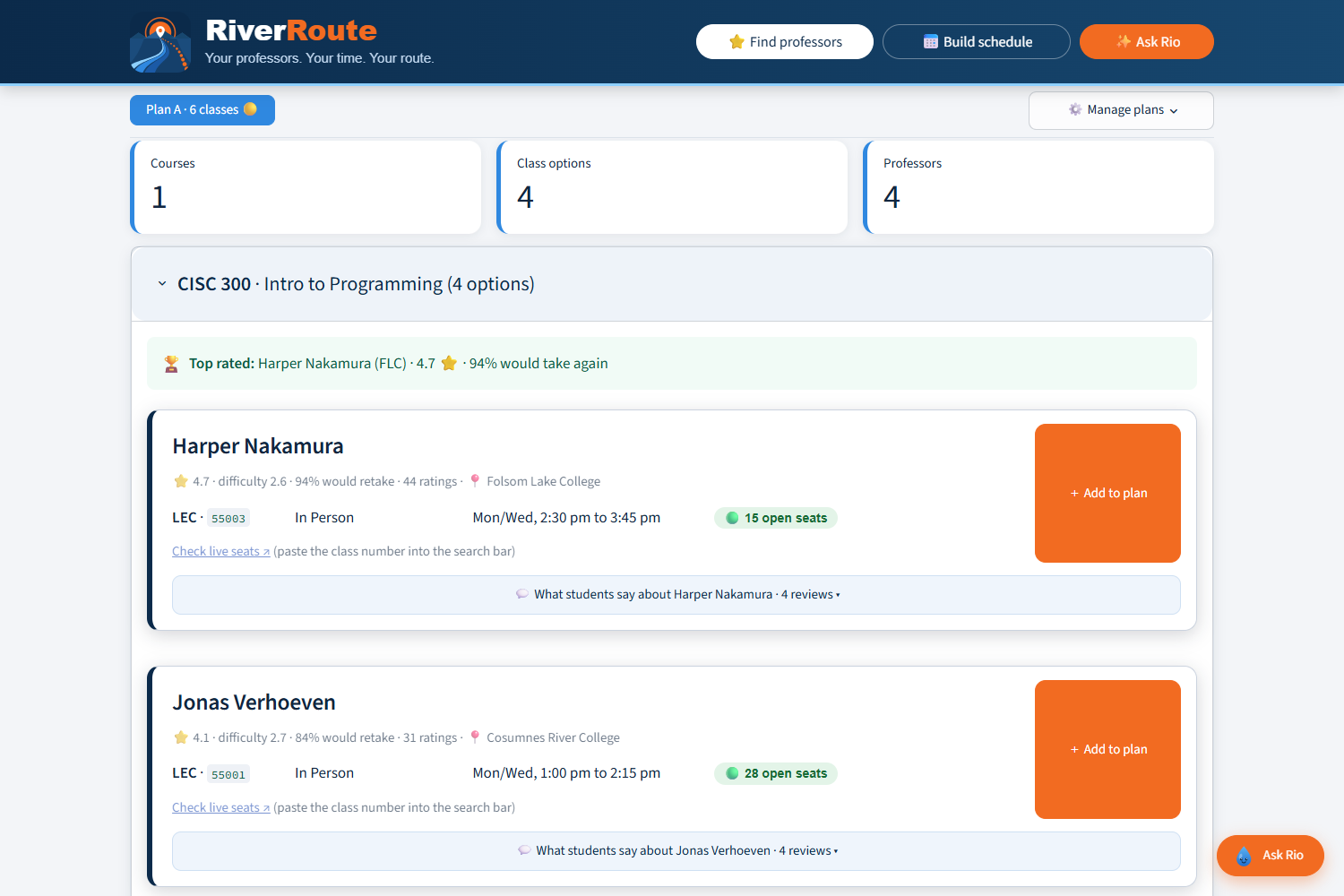
Search classes and compare professors. Seats are color-coded, and Rio, our Gemini AI guide, summarizes the student reviews.
-
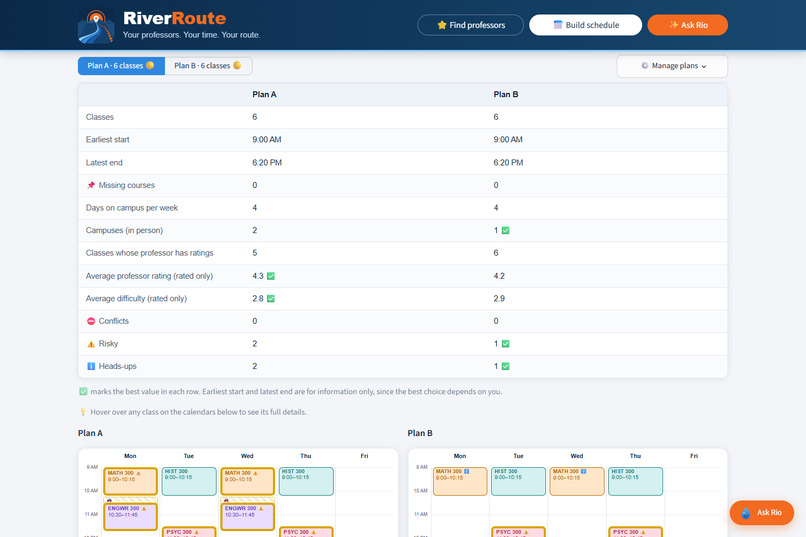
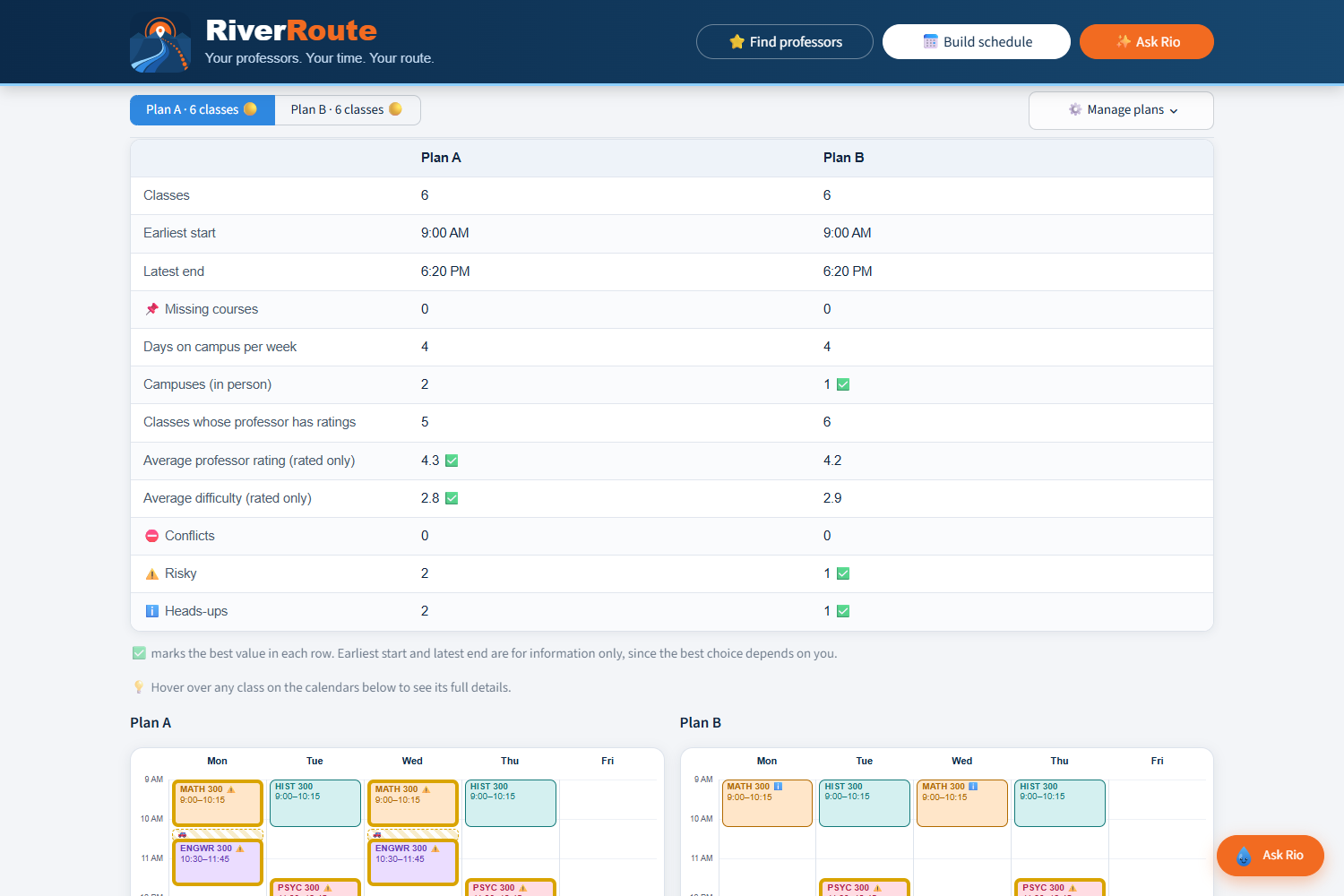
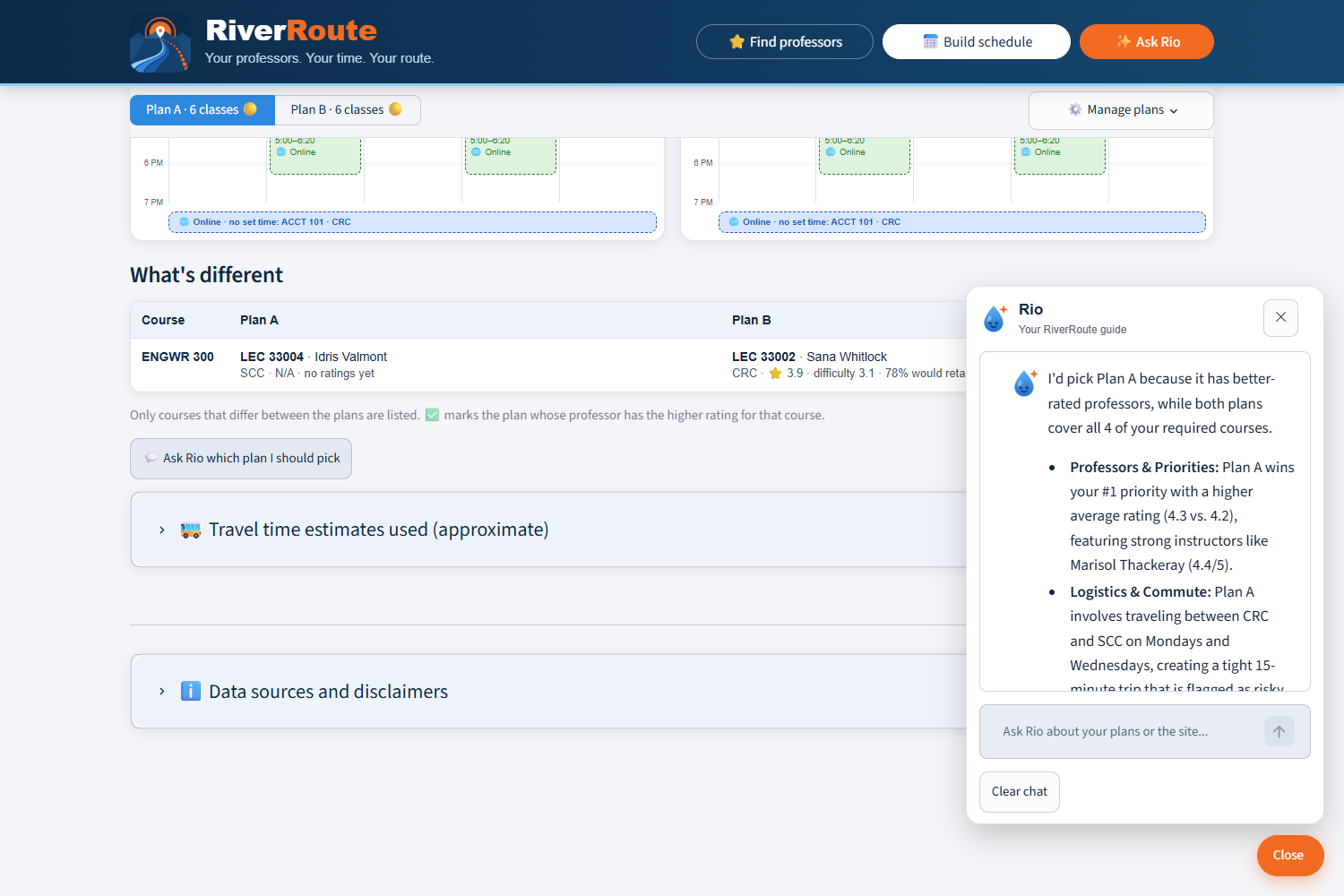
Compare up to three plans side by side. The best value in each row gets a check mark.
-
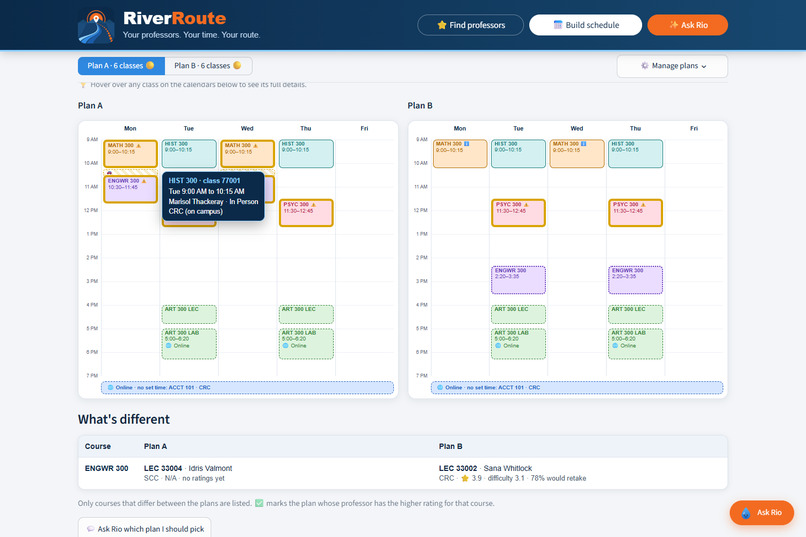
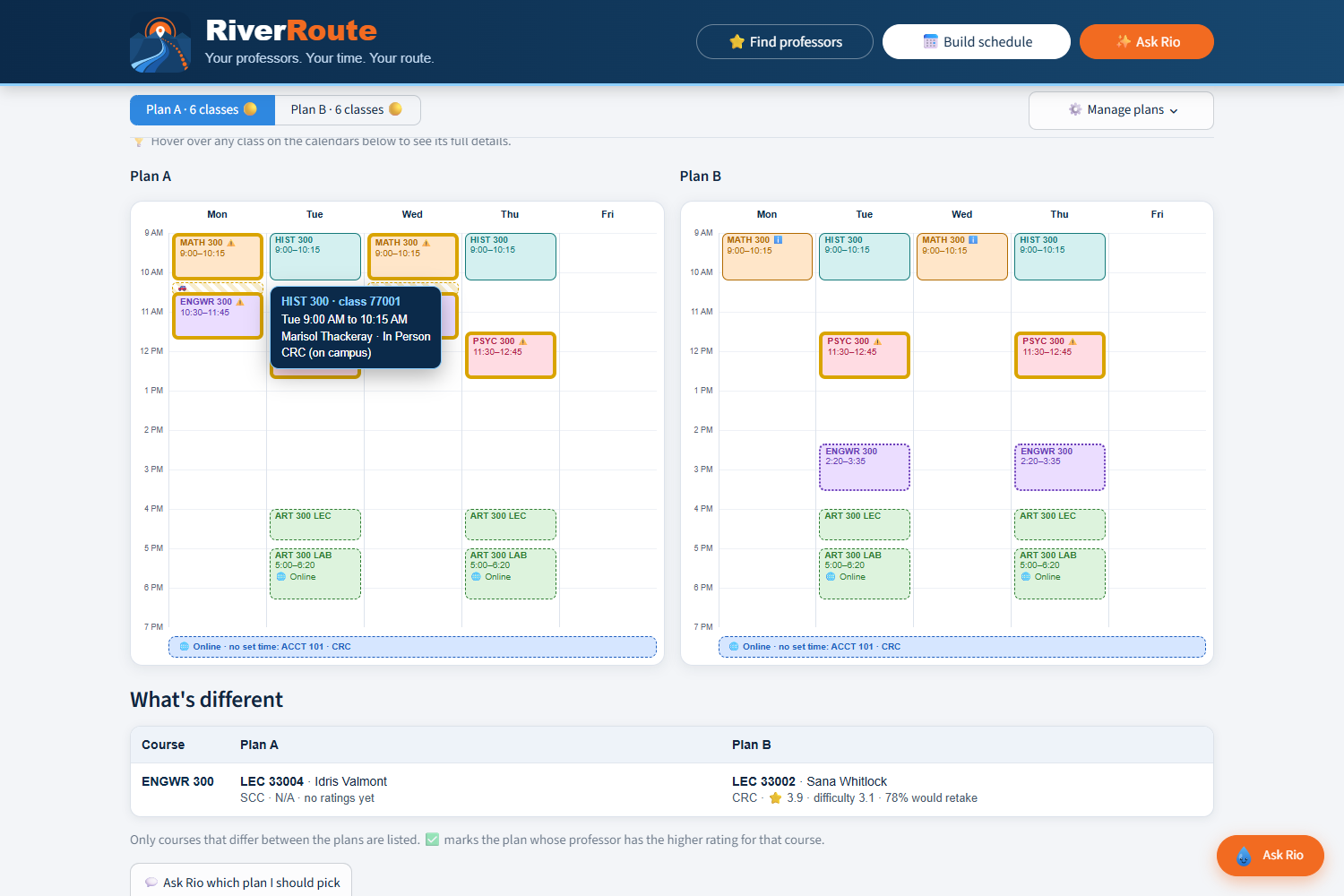
The same plans as calendars, with commute time drawn between campuses, so the differences are easy to see.
-
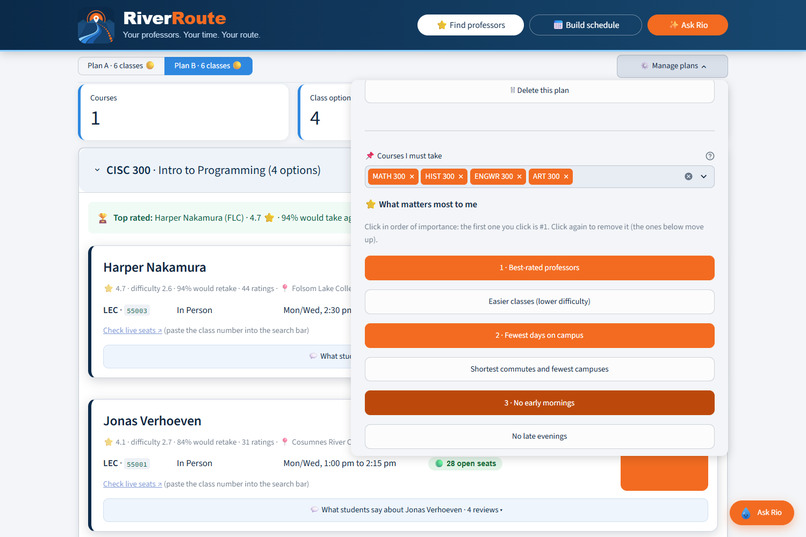
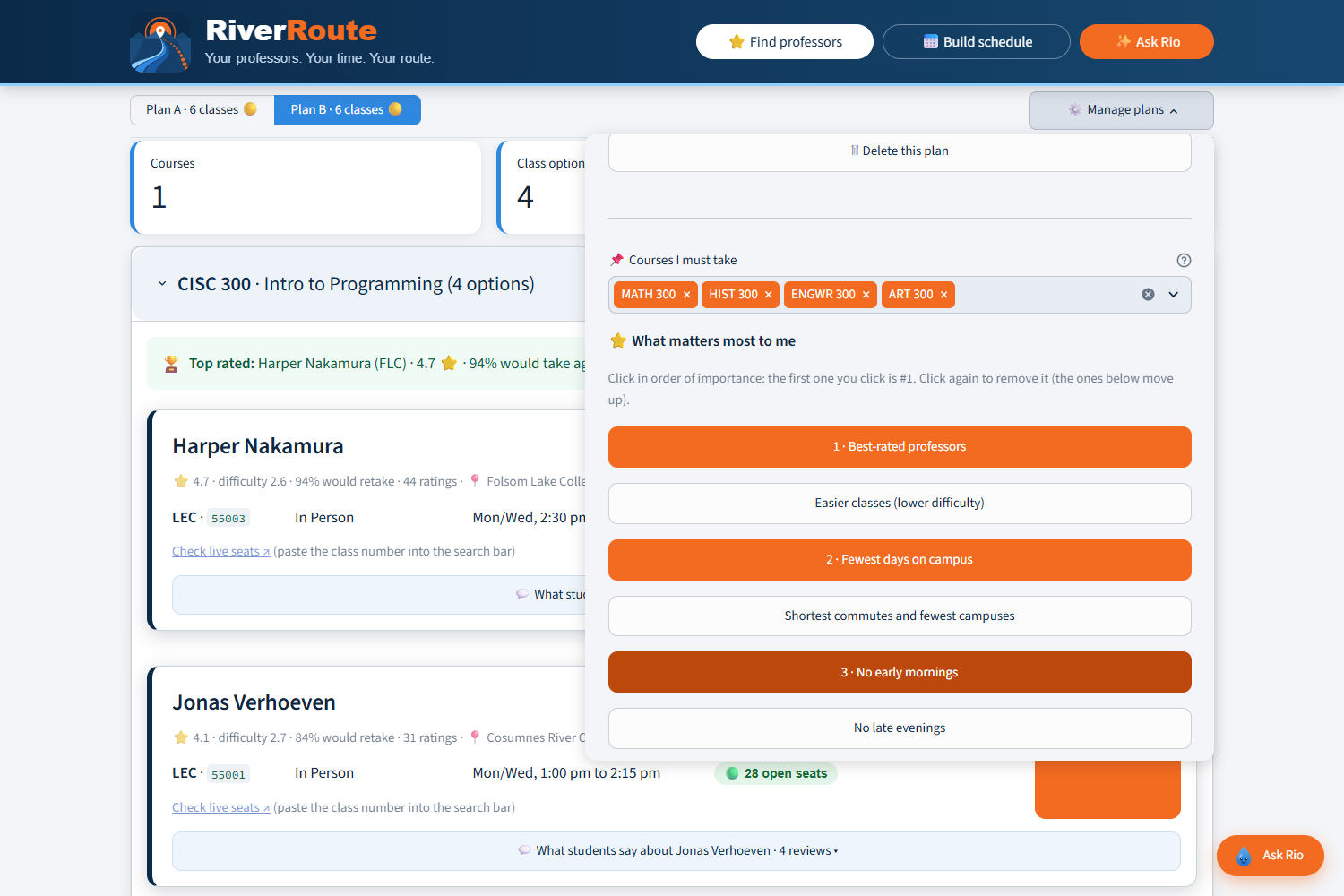
Pick the courses you must take and rank what matters most to you. Rio uses this when it advises you.
-
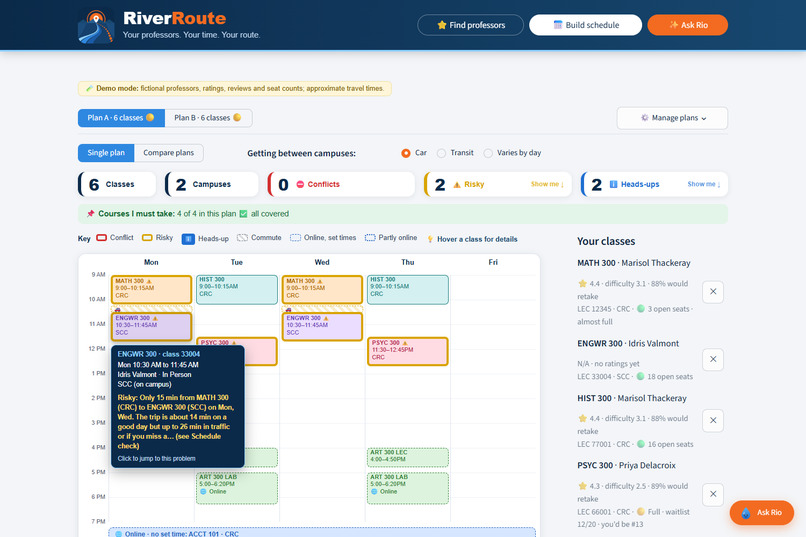
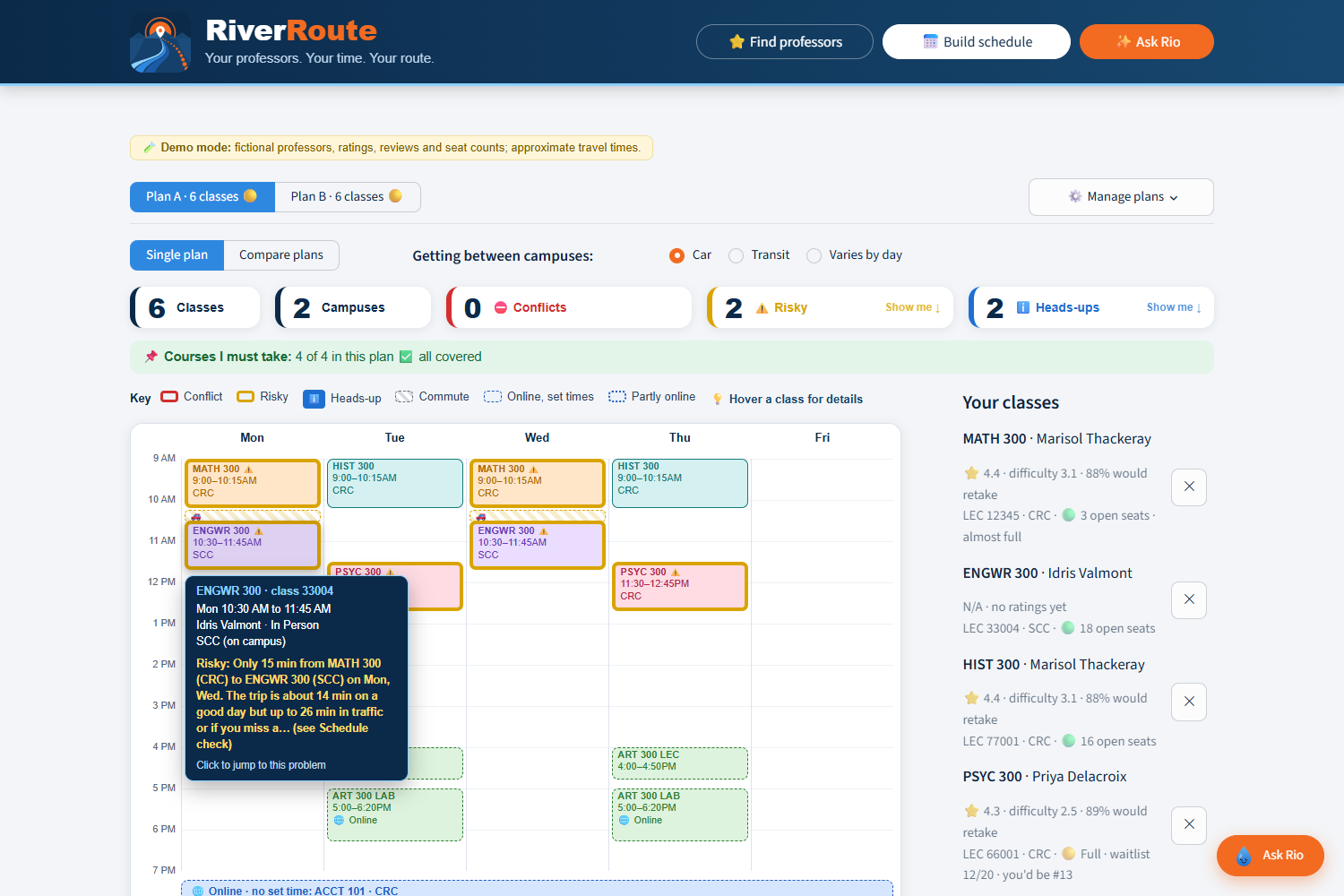
Build schedule: the calendar flags conflicts, risky commutes, and heads-ups. Hover any class for its full details.
-
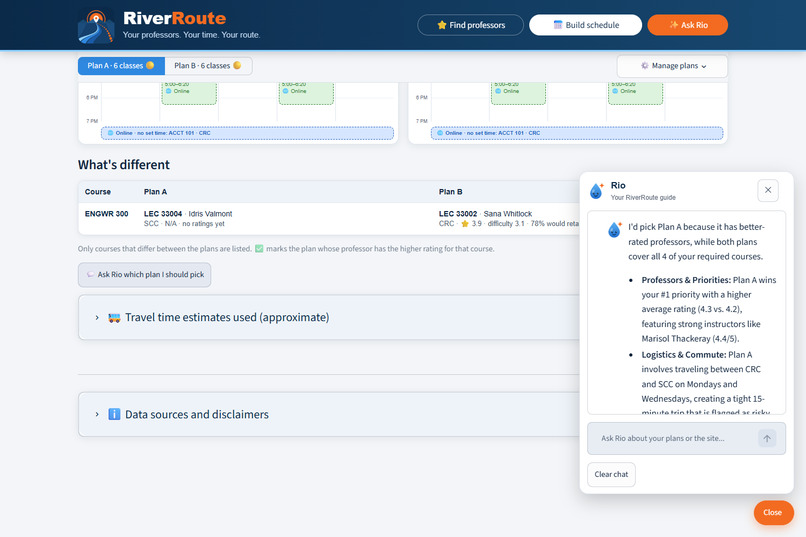
Rio, our Gemini-powered AI guide, recommends a plan using professor ratings, commutes, and your ranked priorities.
-
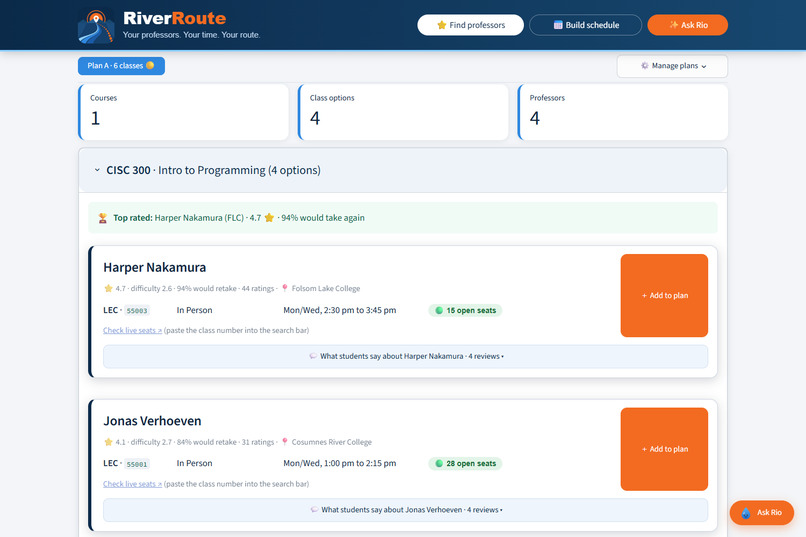
Seats in plain words: green is open, yellow is full with a waitlist spot, and red is full with the waitlist full too.
Inspiration
After hearing about this hackathon, I was lying down on my bed thinking about what project I would create, yet the one thing that stopped the flow of any ideas was the constant dread of having to plan courses for the upcoming spring semester. From the stories of friends, and from my own experience, I've learned that one's college career can be either a whimsical dream or a living nightmare depending on your professors and schedule. I've heard some horror stories from friends who are taking the exact same course as me, just with a different professor—and while my experience is an A for "amazing," their F for "fantastic" shows otherwise.
It's not the hardest thing in the world to find a good professor, whether it be from Rate My Professors or word of mouth; there's a multitude of methods—but actually being able to take those professors is a whole other story. Between class seats filling up, the distance between campuses, the timing of courses, the commuting, the creation of backup plans, the management of your required courses, the debating between plans, and just the act of juggling all these variables, planning can be extremely overwhelming.
Still lying on that bed, I thought, "I really wish everything could just be in one place; maybe then I could finish my schedule without worry and start this hackathon... wait"—cue RiverRoute.
What it does
RiverRoute is a class planner for Los Rios students who need good professors and a schedule that actually works.
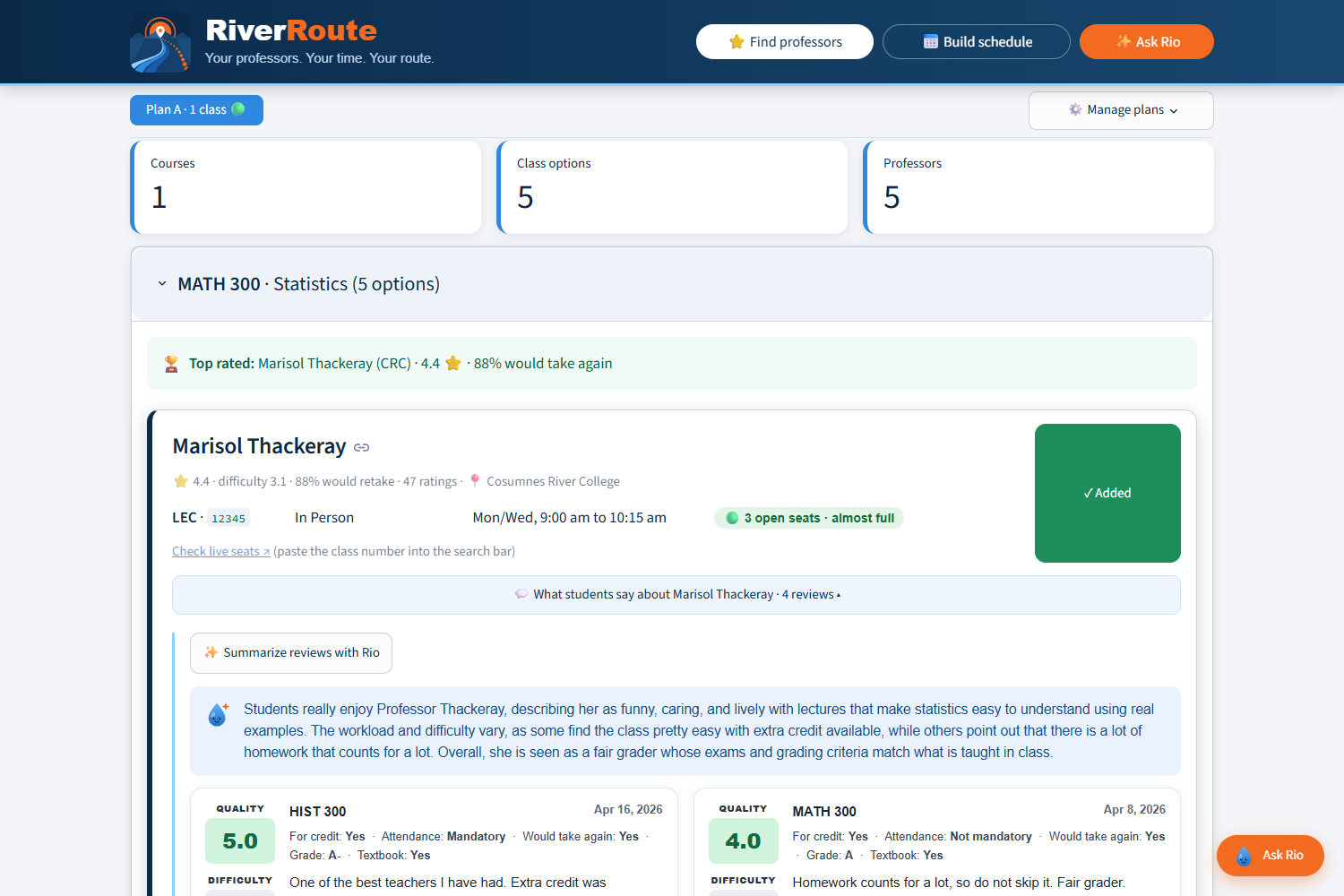
- Find professors: search classes by course, instructor, or class number, and filter by campus, mode, seat status, time, and rating. Each class shows seats in plain colors (green = open, yellow = full with a waitlist spot, red = waitlist full too). Under each card, Rio, our Gemini-powered AI guide, summarizes student reviews. Professors with no ratings yet are marked "N/A" instead of guessed.
- Build schedule: add classes to up to four plans and see them on a weekly calendar. A schedule check flags conflicts (overlaps, trips that can't be made, full classes), risky spots (tight commutes between campuses, very short breaks), and heads-ups (few seats left, unrated professors). Commutes are checked by car, by transit, or a different choice for each day. Hover any class for its full details.
- Compare plans: put up to three plans side by side with a table, small calendars, and each professor's rating.
- Plan around what you need: pick the courses you must take and rank what matters most (best professors, fewest days on campus, shortest commutes, and more).
- Ask Rio: a chat guide that compares your plans using professor ratings, commutes, required courses, and your ranked priorities, and also shows you around the site.
The schedule checks are plain Python, so the AI explains real results instead of inventing them.
The professors, ratings, reviews, and seat counts in this demo are fictional sample data.
How I built it
This is my first time attending a hackathon, or any coding-related event for that matter, and as a person with very basic coding knowledge, I relied heavily on Anthropic's Claude Code (Claude Sonnet 5.5) running inside Cursor to create the code for my concept, which is now RiverRoute.
Claude Code wrote and edited all the Python code, the CSV sample data, and the SVG logo and Rio icon. It also started the Streamlit server and drove a real browser (Playwright with Edge) to click through every feature and catch bugs. Meanwhile, a free plan of Gemini's API powers Rio and the review summaries inside the app. Lastly, it built the GitHub-ready README and helped me check the repository after I uploaded it.
I imagined and proposed the core concept of the website, overseeing and guiding Claude along the coding process—manually experimenting with the website, noting bugs, improving the user experience, recommending new features, and guiding the direction of the overall theme and UI of the site (taking inspiration from the Los Rios District, the CRC website, and Rate My Professors).
RiverRoute is built with Python and Streamlit, using pandas for the data and the Google Gemini API (google-genai) for Rio and the review summaries. All the schedule checks (overlaps, commutes, seats, comparing plans) are plain Python, so the AI explains real results instead of inventing them. The data for vehicle and transit commute times came from research I performed myself with the aid of Google Maps and Gemini. The class data lives in simple CSV files.
Challenges I ran into
To begin, well, yeah, that was the main problem: how to begin? As I mentioned, I have barely any experience, outside of a beginner coding course in high school, so the main roadblock was simply figuring out how I could code this project in the first place. Doing research on the web led me to different coding programs where I could get the aid of AI assistants, and that's how I landed on this combination of Cursor and Claude. Stemming from this founding adversity came the following:
Third-party APIs and scraping: Early research for this project led me to ideas of scraping data from the CRC website itself, as well as using a third-party API for Rate My Professors—due to the website not having a public API. Yet because scraping can break each site's terms of service and stops working whenever the pages change, I decided to have Claude load hand-collected data from simple CSV files instead and label our demo data as sample data. A real version would use an official data source with the school's permission.
Guiding Claude: With me not having to actually do any coding, the importance of my role came down to whether I could actually prompt Claude to code what I had envisioned in my mind. A lot of the conflicts simply stemmed from me having to repeatedly ask for changes to the UI, a feature, or a design choice until the website looked and functioned as I envisioned.
Navigating GitHub and API keys: Prior to this event, I had been on GitHub and had some knowledge of API keys for various reasons, yet I didn't actually know how to apply either of them to this project. Having Claude teach me how to upload the project to GitHub, as well as how to keep my API key private, was a challenge yet a good learning experience.
Claude's adversities: When creating the code, Claude ran into its own issues, such as the following:
- Making the AI trustworthy. Early on, Gemini invented a professor rating and mentioned a system that doesn't exist on our site. Later, when a student ranked "fewest days on campus" first, it still recommended the plan with more days on campus. The fix was to stop asking the AI to do the math: the site now works out which plan wins each priority in Python and hands Gemini the result, so it explains the answer and doesn't guess it.
- Streamlit isn't built for this kind of interface. A fixed top bar, a plan bar that stays in view, a tall "Add to plan" panel, and a floating chat all needed custom styling tricks. Along the way we hit odd bugs: a stray "None" printed in the chat, two scroll bars in one box, and switching plans bouncing you to another tab. We replaced the tabs with our own page switcher so each page keeps its settings.
Accomplishments that I'm proud of
Honestly, there are many, but I want to simplify them all into one thing: learning. For a lot of my life, I thought producing projects such as this one was way out of my reach—which, honestly, without the aid of AI and with my skills at the moment, it still is—but being able to see how far artificial intelligence has come is really insightful. There is still so much for me to learn, but I want to frame this accomplishment not around everything I still have yet to improve on, but around the fact that I was able to find a way to make this dream concept come to life—which I think, for a person such as myself, is something to be proud of.
What I learned
- How to work with AI: A lot of this process for me was figuring out how to set up the programs I needed and, especially, how to guide Claude into creating my concepts.
- How to navigate GitHub: With the aid of Claude, I was able to learn how to use the platform better, as well as how to upload my own projects.
- Perspective of a tester: A majority of us use apps and websites in our daily lives, but it's so easy to forget that someone had to build and test them in the first place. Going through the building phases of RiverRoute, and actually having to make changes and point out ideas that would aid the user experience, was very insightful as to how many of our day-to-day applications were made.
- API keys: Before this project, I already had a bit of knowledge about what API keys were and kind of what they did. By actually experimenting with one myself in this project, I feel like I have a much better idea of the exact function of API keys and why they are so important.
- Progression of AI: I knew AI had grown exponentially since its birth, but creating this project showed me firsthand how intelligent it has become. Not only its coding abilities, but also the sudden nuances in its logic are amazing. A lot of the time I figured I would have to spell it out for Claude, but it was simply able to implement a lot of the subtle details that made the website work that much better.
- Anyone can do it: Simply that: anyone can do it. I truly thought this project would be a very difficult challenge, one in which I would be met with adversity after adversity pointing to my lack of experience, but that wasn't the case. Of course, there were challenges and a lot of confusion, but with the help of modern technology and AI, I truly feel that anyone can make these dream ideas come true.
- This is very fun: Lastly, I didn't realize how much fun I was having until it was over! Learning, designing, troubleshooting, conceptualizing, watching the project come together—all these different processes were genuinely so fun!
In summary, I learned a lot, and though this may be my first hackathon, it will not be my last.
What's next for RiverRoute
Official data through partnerships. My demo uses sample data because there is no official way to pull Los Rios or Rate My Professors data automatically. The biggest next step is to ask for it:
- A partnership with Los Rios to receive the official class schedule, seat counts, and waitlists as a regular data feed, so every class and seat number is current and correct without anyone copying it by hand. It could even replace the current schedule builder in Los Rios eServices.
- A partnership with Rate My Professors (or Los Rios' own course evaluations) to use real, approved professor ratings and reviews in place of our sample ones.
Live travel times. Replace our fixed travel estimates with a maps and transit service, so commute checks reflect real traffic and real bus and light-rail schedules.
More of Los Rios. Add off-campus centers such as Elk Grove, and walking times between buildings on the same campus.
Help students stay on track.
- Accounts, so plans are saved and can be shared with a counselor.
- Alerts when a seat opens in a full class.
- Exporting a plan to a calendar.
A better Rio. Retry automatically when Gemini is busy, and let Rio help with more of the planning, such as suggesting a swap that fixes a conflict.
Running it for real. Host the site so any student can use it. Gemini's free tier covers a demo, and we'd move to a paid plan as use grows. Rio's summaries are already remembered during a session, so the same review isn't summarized twice.


