

Inspiration
Every year, urban flash floods cause billions of dollars in catastrophic damage and displace thousands of families. In over 60% of municipal drainage emergencies, the crisis is not merely extreme rainfall—it is clogged culverts, trash buildup, and physical grate blockages that choke urban drainage capacity.
Traditional municipal flood monitoring relies on two broken paradigms:
- Manual Inspection Crews: Municipal workers take 45 to 120 minutes to be dispatched, whereas urban flash floods surge in under 4 minutes.
- Isolated Point Sensors: Basic depth sensors can only measure water levels after flooding has already started, without diagnosing why the water is rising or whether physical grates are clogged.
Passive infrastructure cannot defend itself. We created RIVER PULSE to turn passive city drains into an active, self-healing cyber-physical defense network at under $45 per node.
What It Does
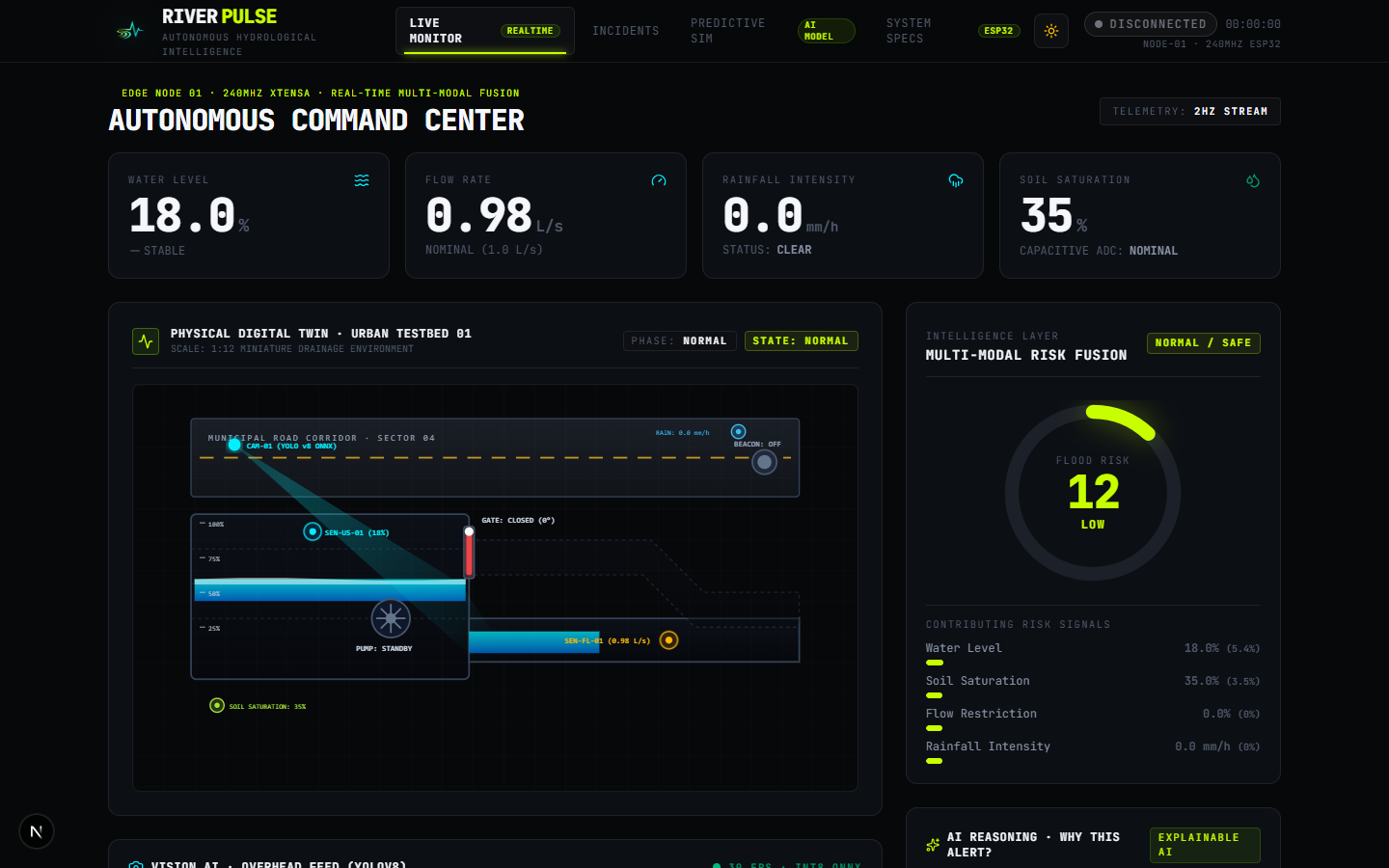
RIVER PULSE operates in an autonomous 5-stage closed loop: See → Sense → Predict → Act → Recover.
- SEE (Overhead Edge Computer Vision): Quantized YOLOv8 ONNX models process edge camera feeds locally in real time, detecting debris, trash bags, and surface obstructions with pixel-accurate bounding boxes.
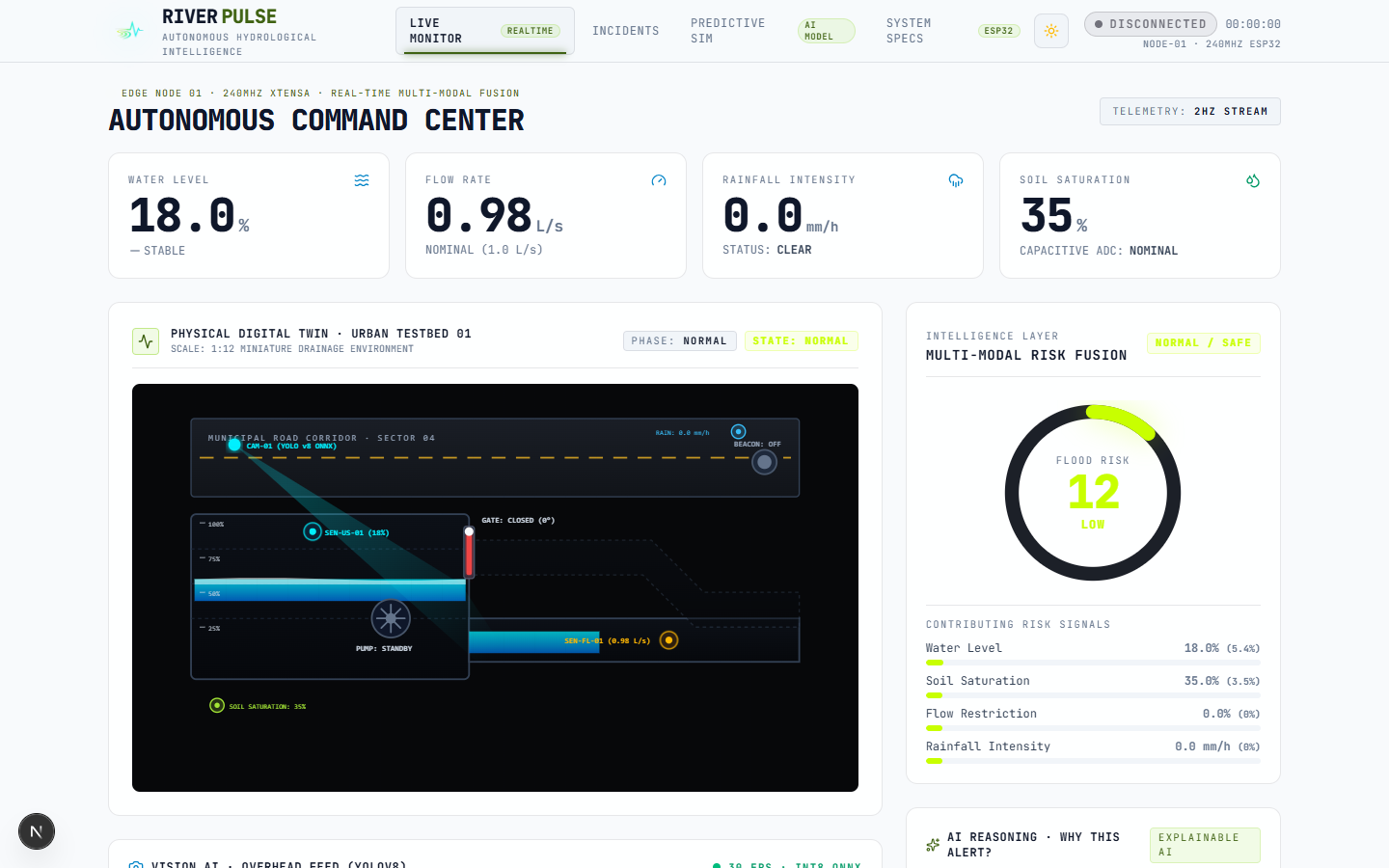
- SENSE (10Hz Physical Sensor Telemetry): A dual-core ESP32 microcontroller polls 4 physical sensor channels at 10Hz: ultrasonic depth, Hall-effect turbine flow rate, optical rain gauge, and capacitive soil moisture.
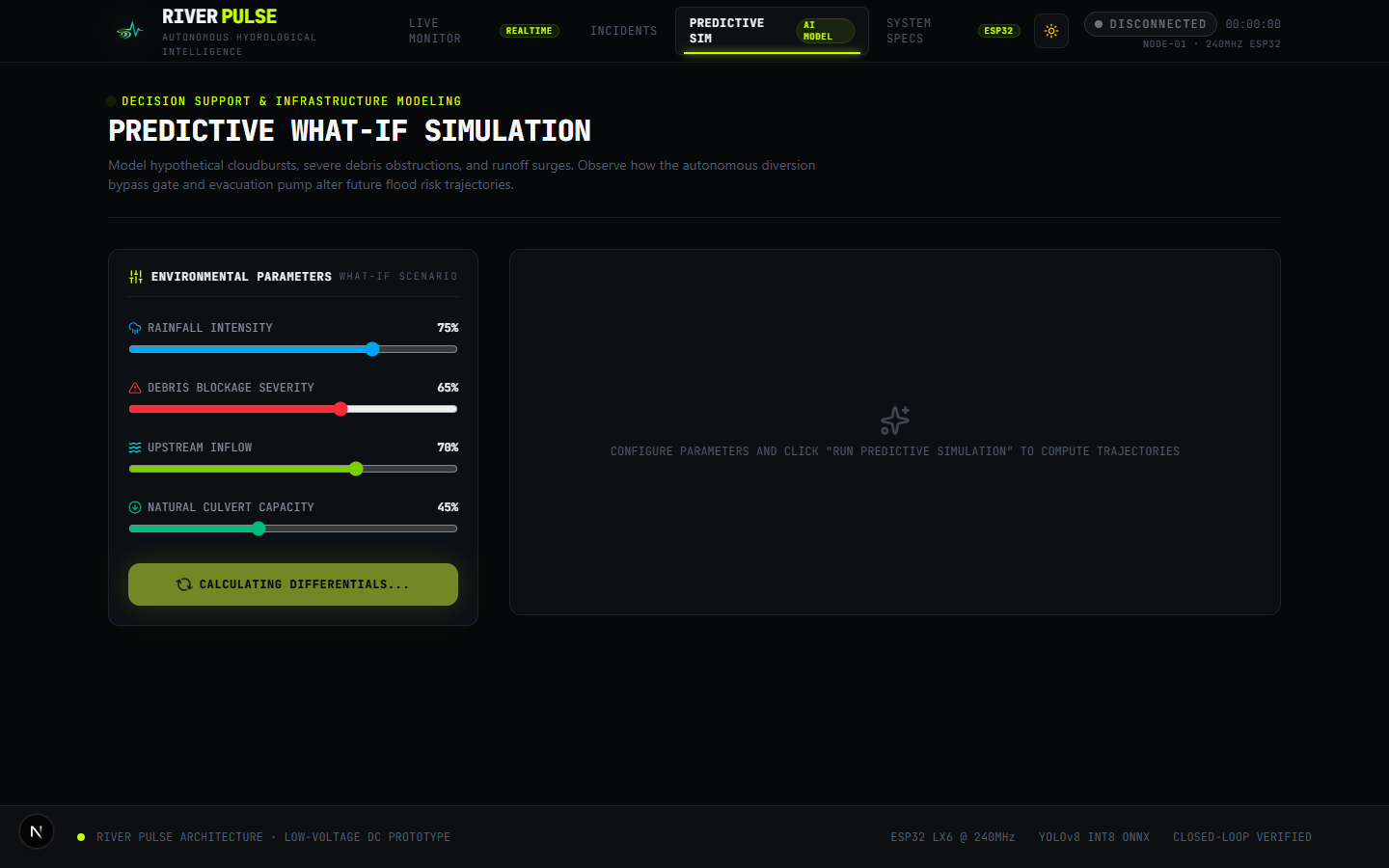
- PREDICT (Multi-Modal Fusion & Differential Simulation): The system fuses visual blockage confidence with physical rate-of-rise and flow deficit signals, calculating a unified 0–100 Risk Score and modeling time-to-critical overflow.
- ACT (Deterministic Autonomy): When risk crosses threshold limits, a deterministic safety state machine triggers physical actuators—opening an MG996R servo diversion bypass gate (90°) and engaging a 12V high-flow evacuation pump (0.85 L/s @ 14.2W).
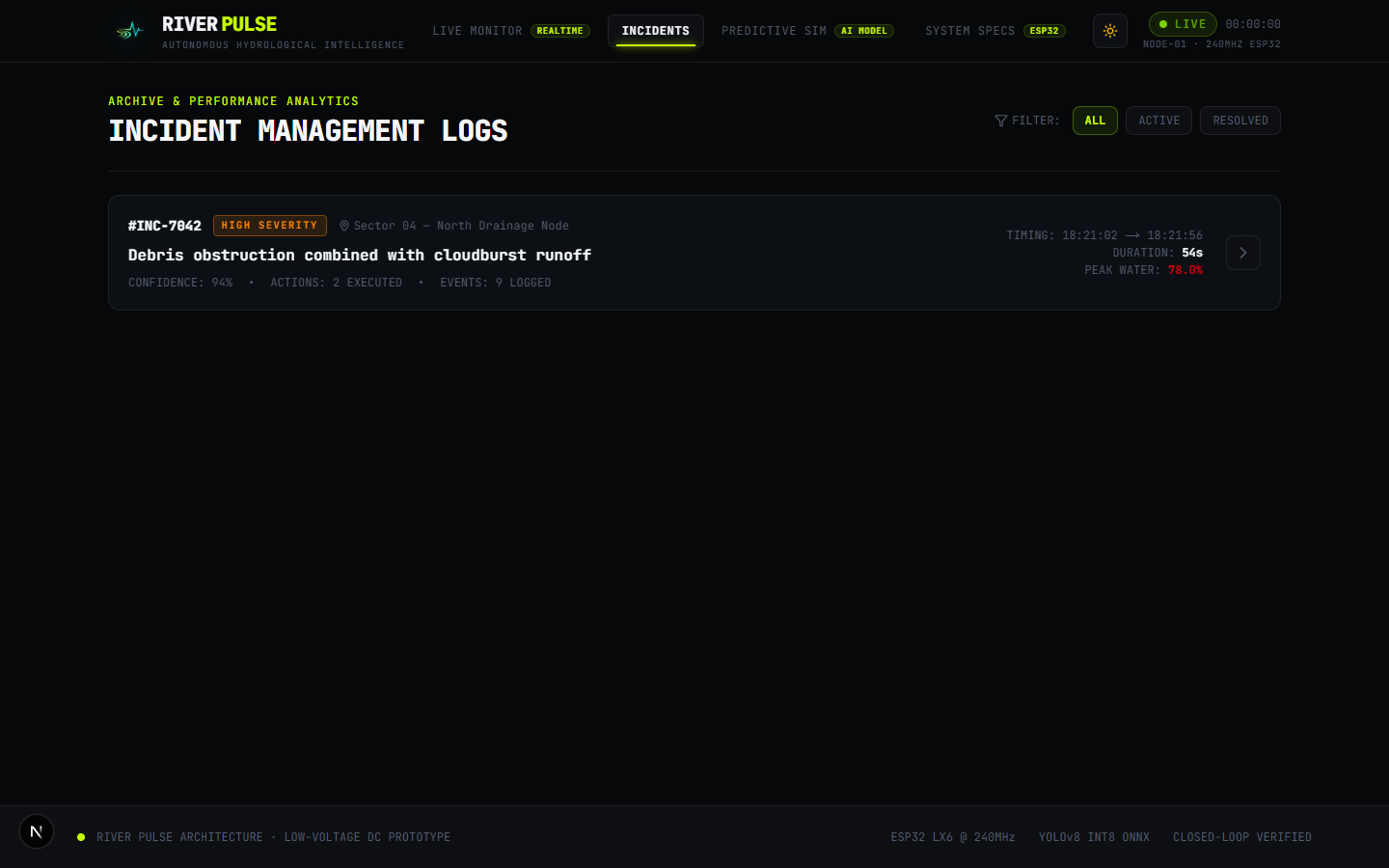
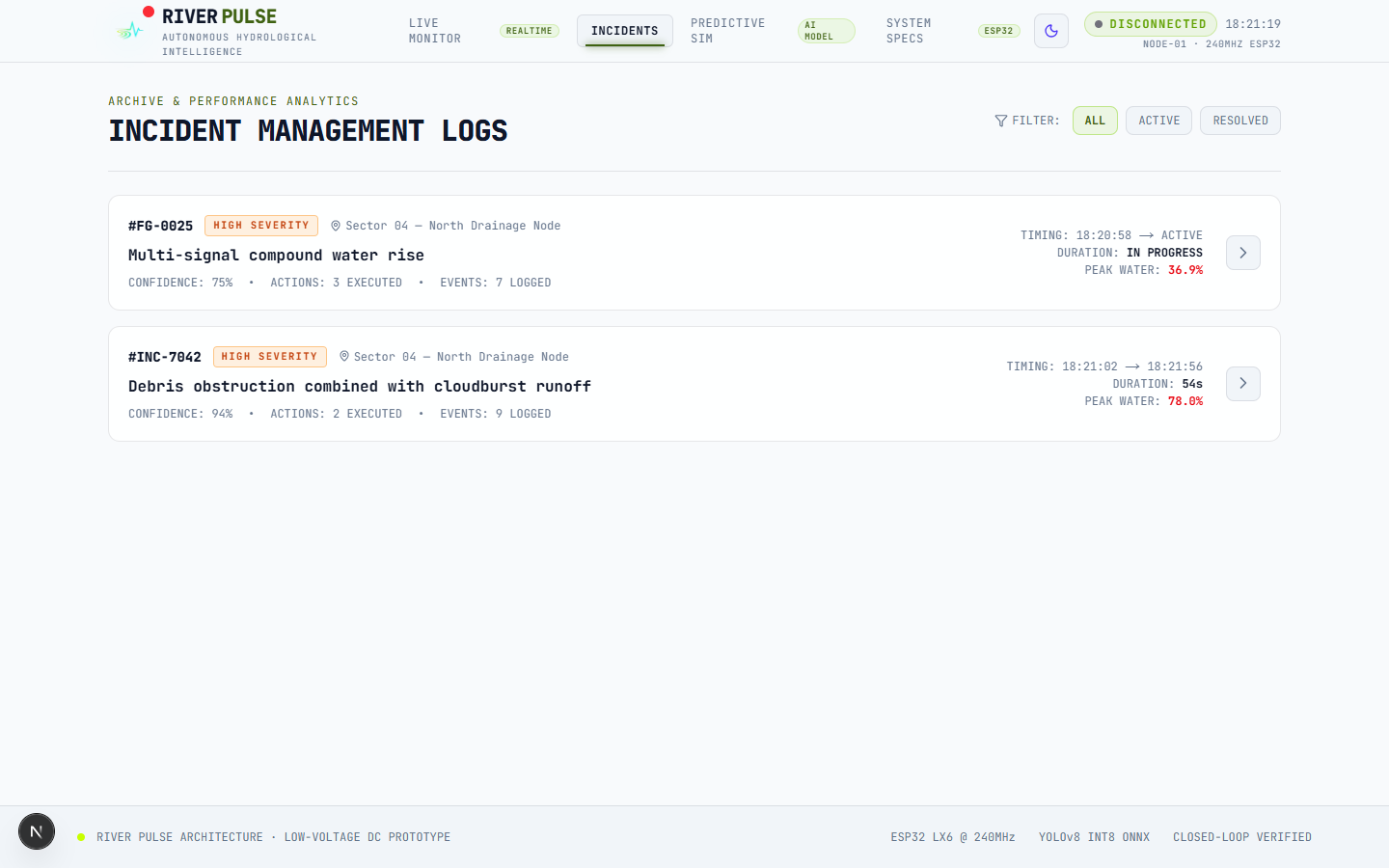
- RECOVER (Mathematical Verification): The system does not assume intervention success; it tracks negative rate-of-rise slope derivatives until hydrological equilibrium is restored, logging explainable incident timelines.
How We Built It
- Embedded Hardware: Dual-core ESP32 (Xtensa LX6 @ 240MHz), Ultrasonic Transducers, Hall-Effect Flow Turbines, MG996R High-Torque Servos, 12V DC Evacuation Pumps, and Low-Voltage DC Step-Down Buck Converters ($42.30 total BOM).
- Perception & Edge Inference: YOLOv8 INT8 ONNX running with OpenCV on local video pipelines to detect culvert blockages with sub-15ms inference latency.
- Backend & Fusion Core: Python 3.11 with FastAPI, weighted multi-modal sensor fusion algorithms, differential predictive simulation models, and 2Hz bi-directional WebSocket telemetry streams.
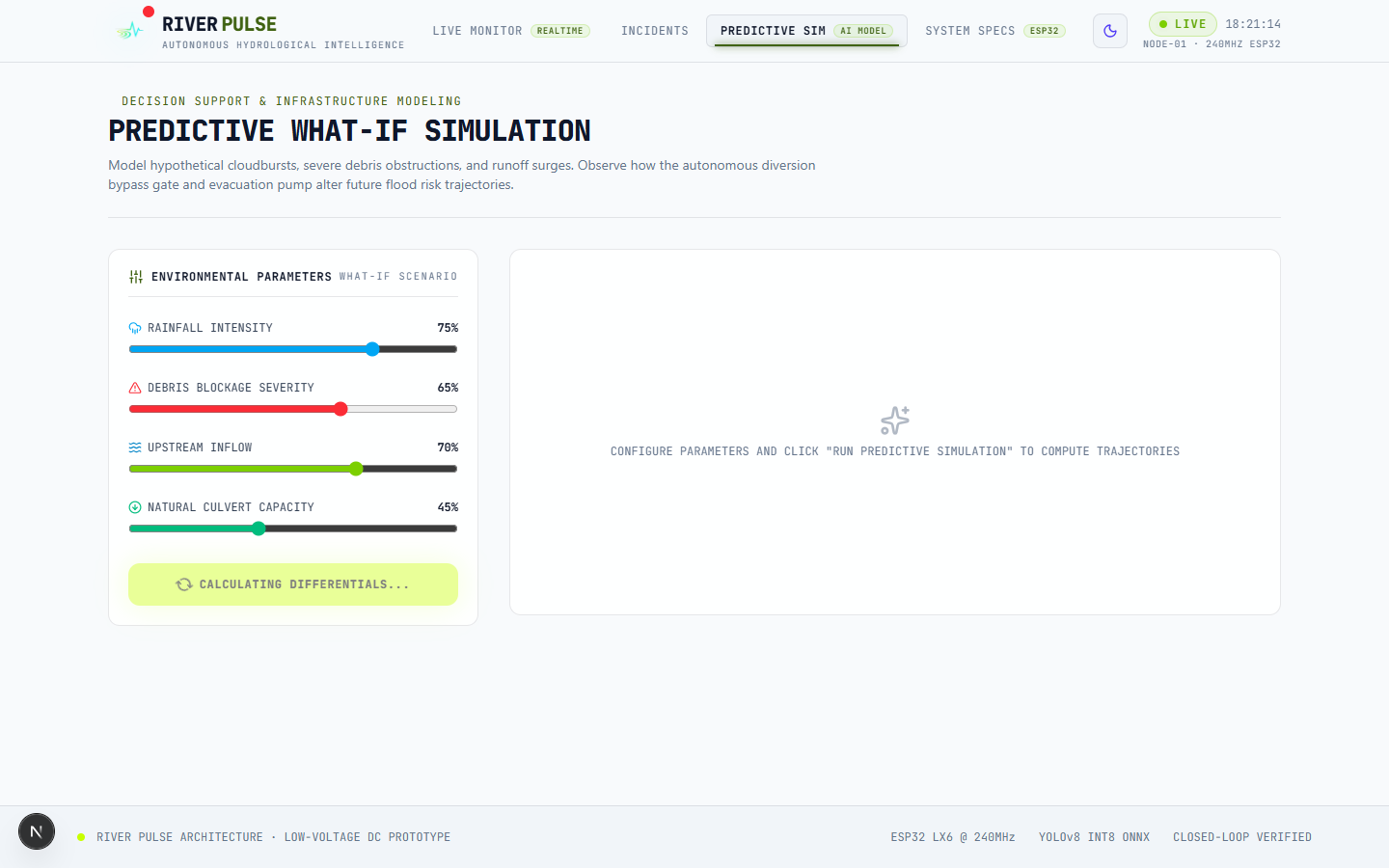
- Command Center & UI: Next.js 16 (App Router, Turbopack), TypeScript, Tailwind CSS, Recharts for predictive trajectory visualization, Framer Motion, and a dual WCAG AAA Light & Dark design system.
- Zero-Dependency Orchestrator: Root launcher (
scripts/dev.js) coordinating the entire Python backend and Next.js frontend with a singlenpm run devcommand.
🧗 Challenges We Overcame
- Fusing Asynchronous Multi-Modal Data: Correlating continuous 10Hz physical sensor analog data with discrete bounding-box computer vision detections without introducing race conditions or false alarms.
- Closed-Loop Verification: Developing a mathematical verification algorithm that tracks negative rate-of-rise derivative slopes so the system knows with mathematical certainty when an incident is safely resolved.
- Low-Cost Target Architecture: Designing the entire physical hardware bill of materials to remain under $45, proving city-wide municipal scalability.
Accomplishments That We're Proud Of
- Implemented a complete end-to-end cyber-physical loop where physical sensing, AI inference, actuator control, and mathematical verification run autonomously.
- Built a digital twin and simulation engine that models flood curves both with and without River Pulse interventions.
- Single command boot (
npm run dev) with instant WebSocket reconnection and zero build errors across all routes.
What's Next for RIVER PULSE
- Catchment-Wide Mesh Networking: Connecting upstream and downstream nodes via ESP-NOW and LoRaWAN for whole-river-basin swarm coordination.
- Edge TPU Integration: Deploying Google Coral Edge TPUs for multi-camera aerial drone feeds.
- Municipal GIS Integration: Direct automated dispatch integration with smart city traffic signals and emergency management dashboards.
Built With
- computer-vision
- edge-ai
- esp32
- fastapi
- framer-motion
- hardware
- iot
- next.js
- onnx
- opencv
- python
- react
- recharts
- robotics
- sensor-fusion
- tailwindcss
- typescript
- websockets
- yolov8

Log in or sign up for Devpost to join the conversation.