-
-
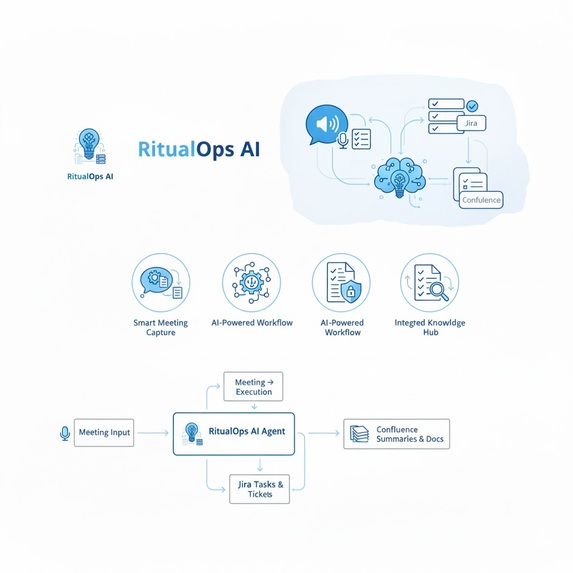
Representation of the RitualOps AI
-
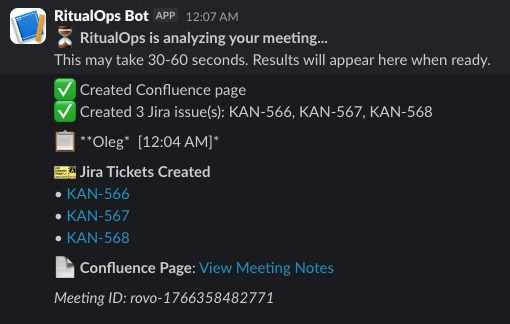
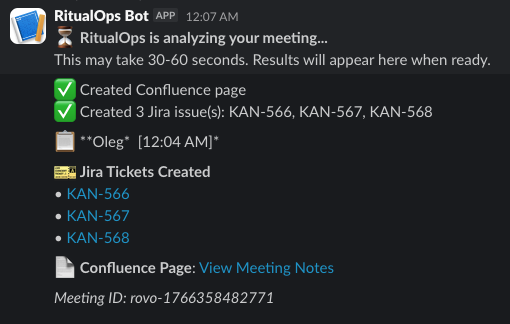
Example of response from RitualOps AI
About the Project
💡 Inspiration
Every meeting ends the same way.
People agree on what to do.
Someone says, “I’ll create the tickets later.”
And then… it doesn’t happen.
Action items get lost in chat.
Decisions live in someone’s memory.
Jira tickets appear days later — without context, without clarity, without the why.
We realized the problem wasn’t meetings.
The problem was what happens after.
So we asked a simple question:
What if meetings ended in execution — automatically?
That question became RitualOps AI.
🧠 What We Built
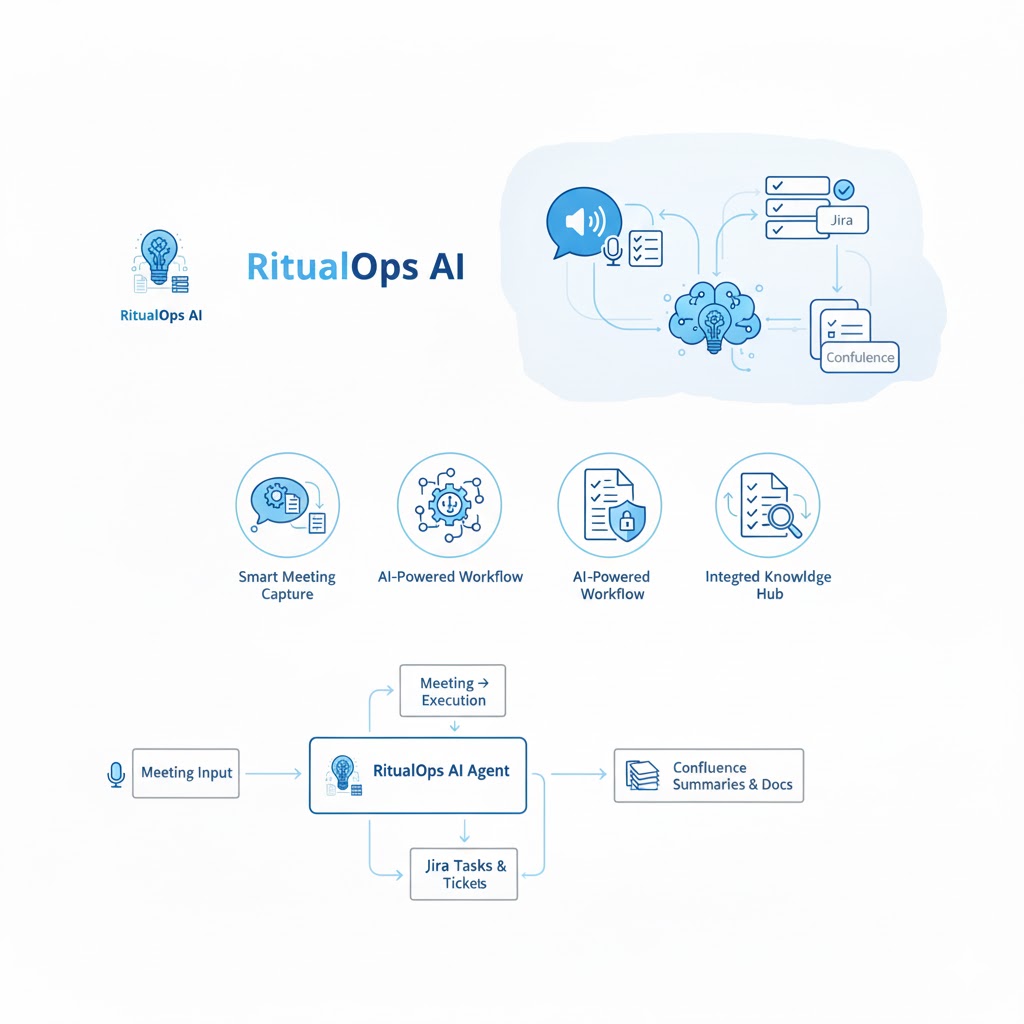
RitualOps AI is an autonomous meeting execution agent.
It takes real conversations — meetings, chats, discussions — and turns them into real work inside Atlassian:
- Jira issues for action items
- A Confluence page capturing the meeting summary and decisions
- Linked artifacts that preserve full context
No manual follow-up.
No copy-paste.
No lost decisions.
RitualOps is triggered directly from Slack and responds in the same conversation, making it feel less like a tool and more like a teammate.
And when someone opens a Jira issue weeks later, they don’t just see what to do — they see why it exists.
🛠️ How We Built It
RitualOps AI is built as a production-ready Atlassian-native system, not a demo script.
Atlassian Forge App
- Runs directly inside Jira and Confluence
- Uses Atlassian Rovo AI to understand meeting conversations
- Automatically creates Jira issues and Confluence pages
- Adds a dedicated Jira Issue Panel that shows meeting context
- Persists relationships between meetings and issues in Forge storage
Orchestrator (Go, Cloud Run)
- Secure, multi-tenant backend
- Ingests transcripts from Slack, Microsoft Teams, or API input
- Validates AI output to prevent low-quality or unsafe artifacts
- Coordinates all workflows between integrations
Real-World Inputs
- Uses real meeting transcripts, not simulations
- Supports Microsoft Teams built-in transcription without requiring a Teams bot
- The same pipeline works for meetings, chats, and informal conversations
All communication is secured with HTTPS and HMAC signing, with strict tenant isolation and dev/prod environment separation.
⚙️ Technical Highlights
- Atlassian Rovo AI as the core intelligence layer
- Strict validation to ensure only high-quality AI output creates artifacts
- Automatic Jira and Confluence creation
- Context preserved exactly where work happens
- Slack-first, autonomous user experience
- Production Forge deployment with a live install link
🚧 Challenges We Faced
The hardest challenge wasn’t building AI — it was making it reliable enough to trust.
We had to ensure that AI output was structured, accurate, and safe before creating real Jira issues or Confluence pages. This required multiple validation layers and clear failure modes.
Another challenge was preserving context across tools. Jira tickets often lose the decision-making background that created them. Designing a way to embed meeting context inside Jira itself was critical.
Finally, we deliberately avoided fragile live audio pipelines, choosing real-world transcripts to balance realism with reliability — especially in a production-like environment.
📚 What We Learned
- AI delivers the most value when it creates real outcomes, not just insights
- Execution matters more than summarization
- Reliability and UX beat raw technical complexity
- Atlassian Forge and Rovo enable powerful, native AI experiences when used intentionally
🔮 What’s Next
- Fully automated Microsoft Teams transcript ingestion
- Zoom and Google Meet integrations
- Action-item tracking and reminders
- Marketplace distribution and billing
🏁 Closing Thought
Meetings shouldn’t end with:
“I’ll create the tickets later.”
They should end with tickets already created.
RitualOps AI turns conversations into execution — automatically, inside Jira and Confluence.
Built With
- artifact-registry)
- atlassian-forge-(jira/confluence/rovo-apis)
- cloud-build
- docker
- go
- google-cloud-platform-(cloud-run
- node.js-22
- react
- slack-api
- typescript

Log in or sign up for Devpost to join the conversation.