-
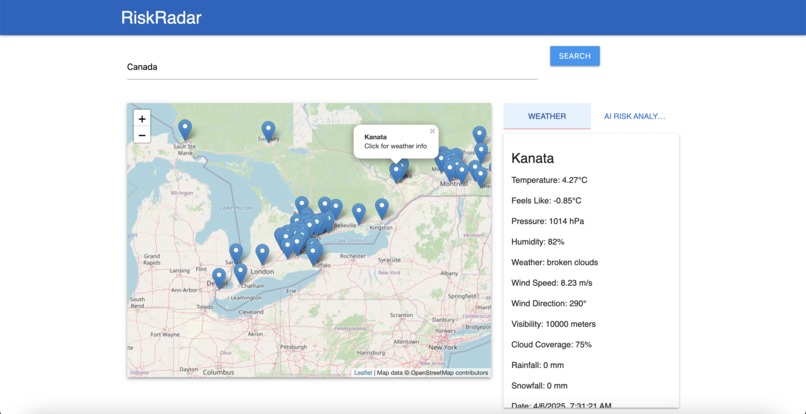
Viewing weather on a Canadian city
-
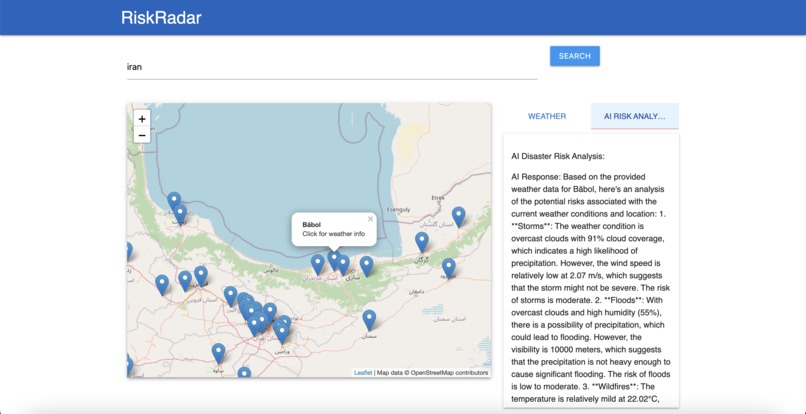
AI Analysis on an Iranian city


RiskRadar: Predicting and Navigating Natural Disasters with AI
Inspiration
The inspiration behind RiskRadar comes from the increasing frequency and intensity of natural disasters worldwide, mainly due to climate change. Just recently there was an earthquake in Burma / Myanmar that left thousands dead. From hurricanes to wildfires, floods, and avalanches, communities are facing greater risks due to climate change and geographical factors. Even in Silicon Valley, we are very prone to earthquakes. So, my goal was to empower individuals, businesses, and emergency services with better insights so they can prepare and respond to these risks effectively.
What it does
RiskRadar is a web application that provides real-time insights into natural disaster risks based on weather patterns, geographical data, and AI analysis. The platform features:
- A dynamic map displaying weather data, natural disaster alerts, and risk analysis for various locations.
- A search bar where users can input a country or city to see disaster risks and weather data for that area.
- AI-powered risk analysis that uses weather variables like temperature, humidity, and wind speed to predict potential natural disasters.
How we built it
RiskRadar was built using a combination of modern web development tools and machine learning technologies:
- Frontend: The user interface was designed using HTML, CSS, and Materialize CSS for responsiveness and accessibility. The interactive map was implemented using Leaflet.js.
Backend: Data was stored in MongoDB Atlas, which houses information on cities and natural disaster occurrences. Originally, the AI model was developed using Palantir AIP. However, as I couldn't figure out how to use it in my enviornment, I switched to a custom grok model using their API.
API Integration: Weather data was fetched from external APIs, and disaster data was integrated from sources like EM-DAT. This data feeds into the AI model for real-time analysis. For cities, I simply used a large CSV, sorted by population.
Challenges we ran into
Building RiskRadar came with its own set of challenges:
- Data Integration and Accuracy: Gathering accurate and timely data from different sources, including weather APIs and disaster databases, was difficult. Ensuring the data was cleaned and structured for consistency across platforms was a major challenge.
Even more so, much major weather data is collected by government agencies and not made available to the public. Lists never include concurrent weather, and rarely include timestamps or latitude/longitude.
- User Interface Design: Ensuring the UI was both intuitive and functional was a challenge. The application needed to handle large amounts of data while still being accessible and providing real-time information in a clean, organized layout.
Accomplishments that we're proud of
We are proud of several accomplishments in RiskRadar:
Real-Time Weather and Disaster Data: We successfully integrated real-time weather updates and natural disaster alerts into an interactive map, providing users with up-to-date information at their fingertips.
AI-Powered Risk Analysis: The AI model provides valuable insights by analyzing weather data and predicting the likelihood of natural disasters. This feature is central to the project and has the potential to save lives by helping users prepare in advance.
User-Centered Design: The application’s design allows users to interact seamlessly with the map and panels, making the data not only accessible but also actionable.
Cross-Platform Compatibility: Ensuring the app works on both desktop and mobile devices was a major achievement, giving users a consistent experience across platforms. (Try it out!!)
What we learned
During the development of RiskRadar, we learned several key lessons:
The Importance of Data Quality: Data integrity is crucial when building any application that relies on external sources. Ensuring the data is clean, accurate, and updated regularly was a valuable takeaway.
Balancing Design and Functionality: While it’s important to have a sleek user interface, it’s just as important to ensure that the app is functional and provides useful insights. Balancing these two elements was a critical lesson.
Optimizing Performance: Real-time data processing can be demanding, and optimizing the backend and frontend processes for speed was a key learning experience.
What's next for RiskRadar
Some ideas to expand RiskRadar:
Expanding Data Sources: We aim to integrate more weather-related data sources and extend the AI model to predict a wider range of natural disasters.
Push Notifications: We plan to implement real-time push notifications to alert users of emerging risks and extreme weather events in their selected locations.
AI Model Enhancements: As more data becomes available, we will continue to refine the AI model to improve its prediction accuracy and make it more reliable.
Thanks!
Built With
- css
- em-dat
- groq
- html
- javascript
- json
- leaflet.js
- materialize
- mongodb
- openweathermap
- python

Log in or sign up for Devpost to join the conversation.