-
-
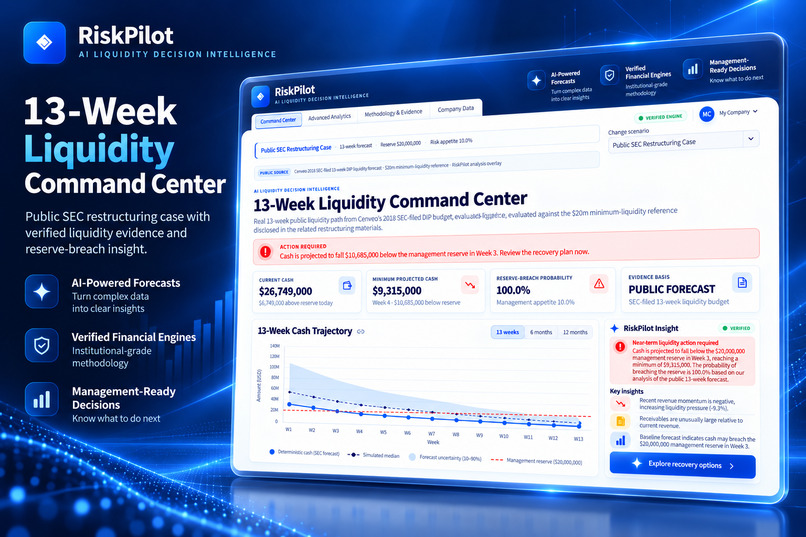
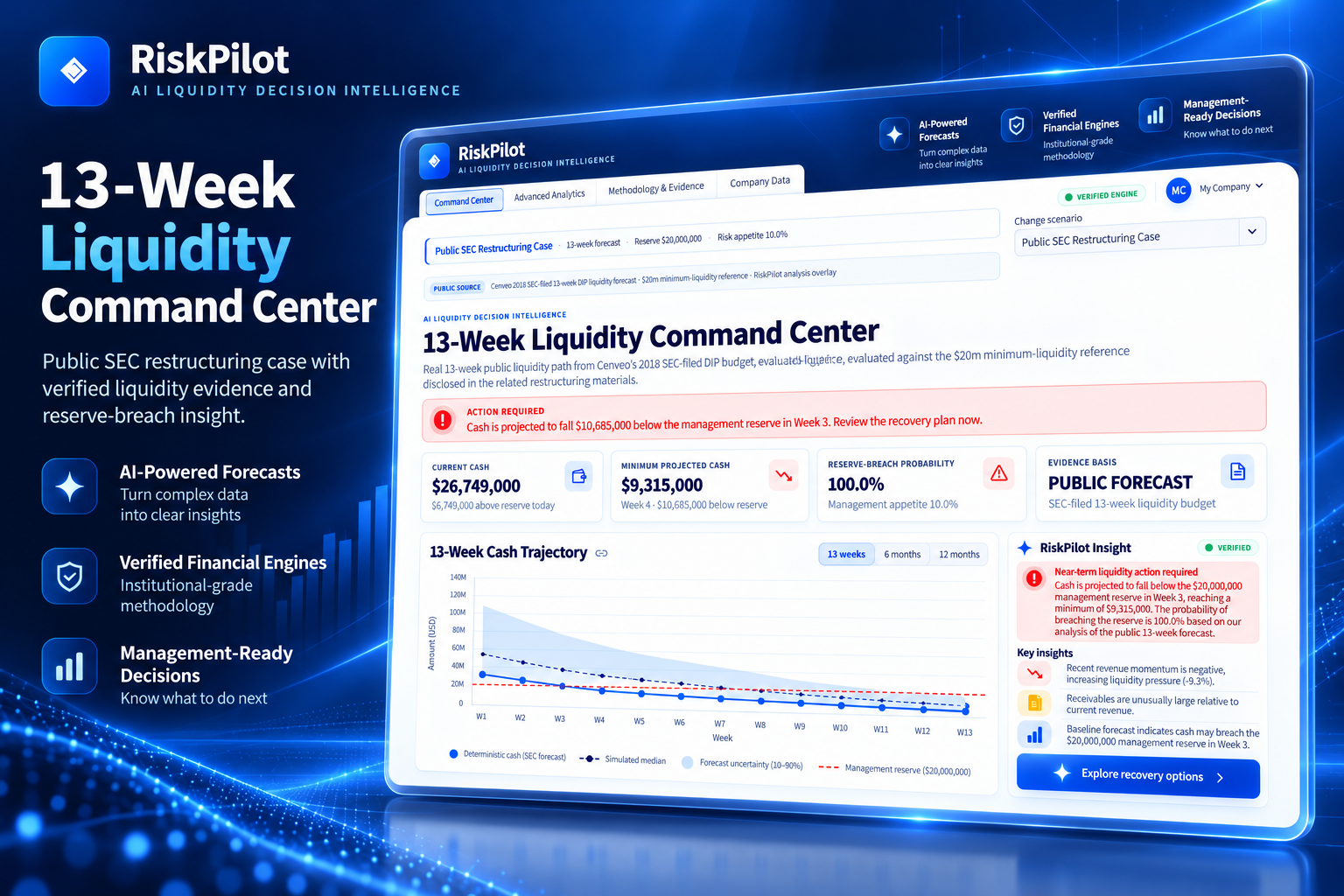
13-Week Liquidity Command Center — verified cash forecasting, reserve-risk monitoring, and management-ready insights
-
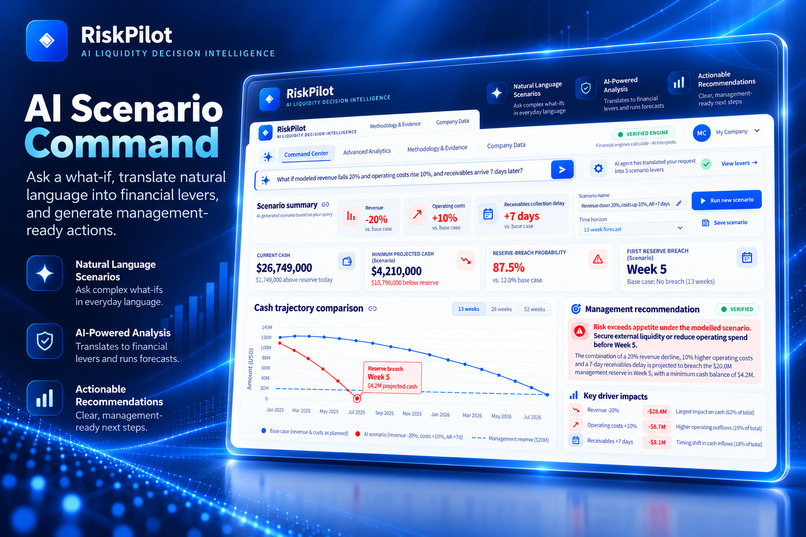
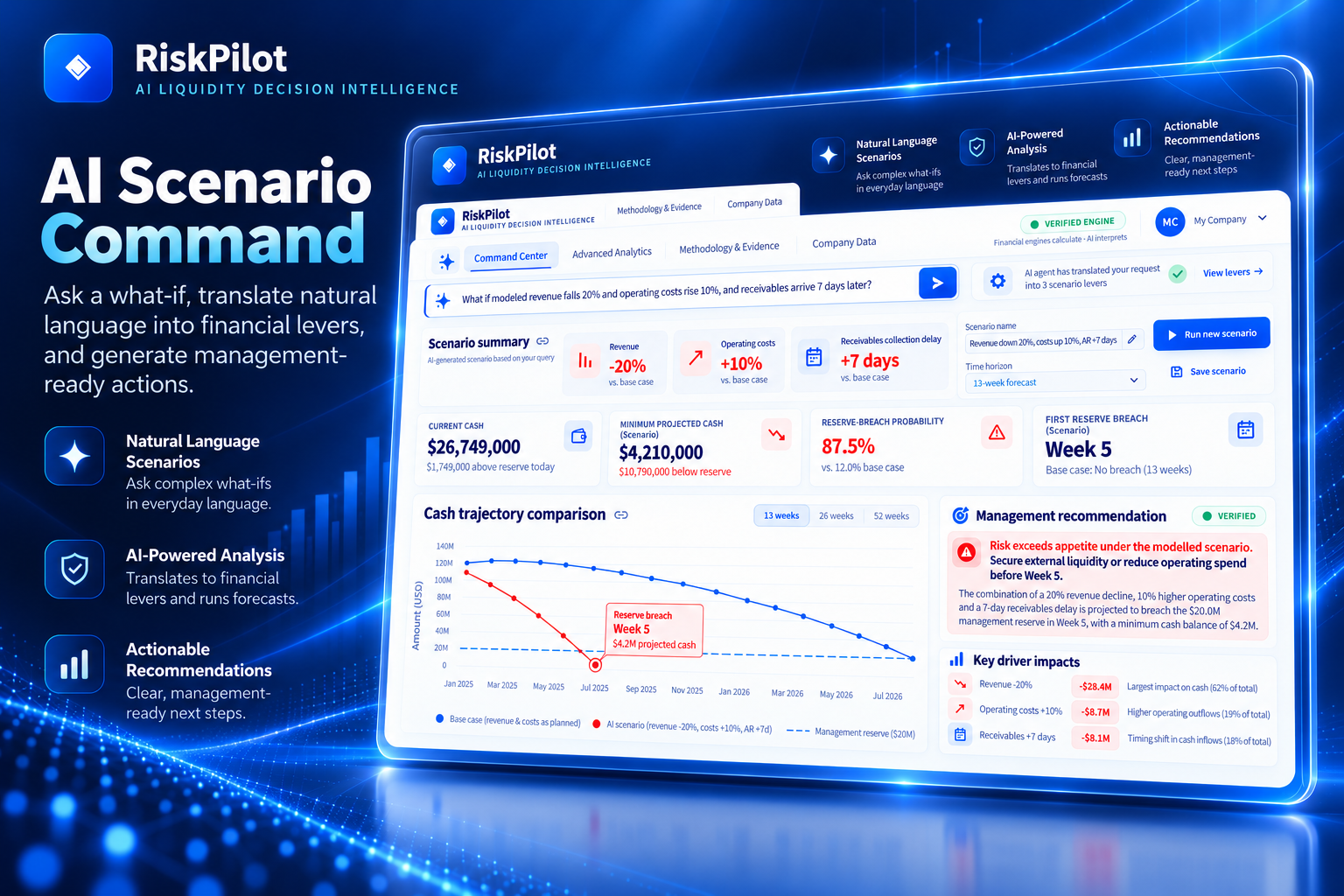
AI Scenario Command Center — ask what-if questions in natural language and get verified scenario impacts instantly
-
Advanced Analytics Workspace — run monthly stress tests, reverse stress, and AI analysis on verified financial data
-
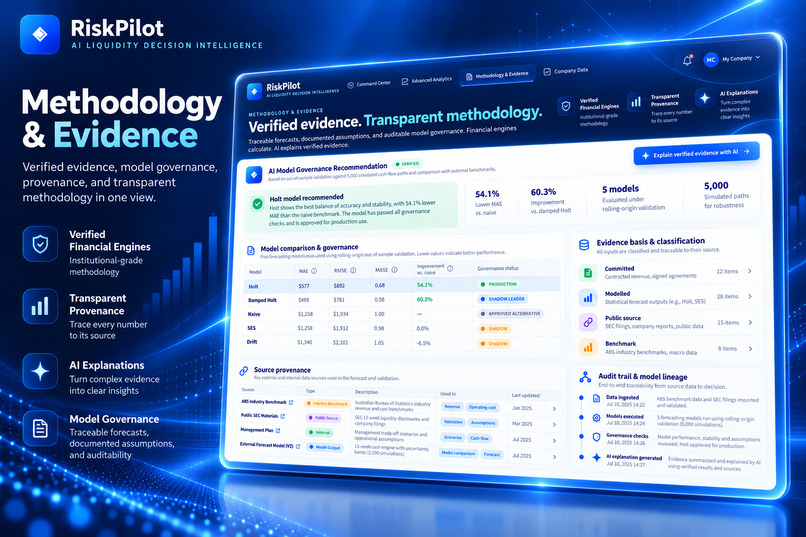
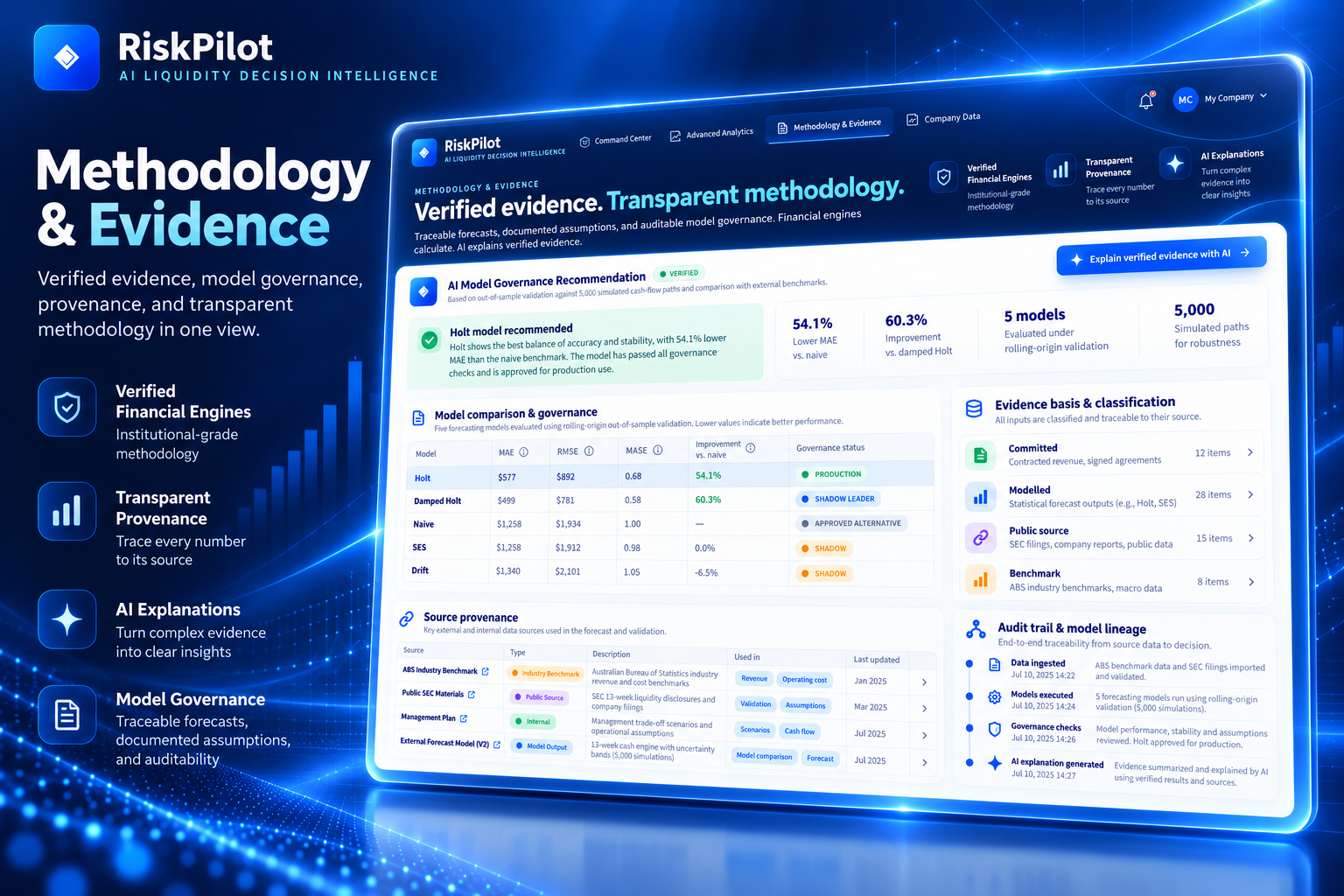
Methodology & Evidence — transparent model governance, source provenance, and auditable financial-engine logic
-
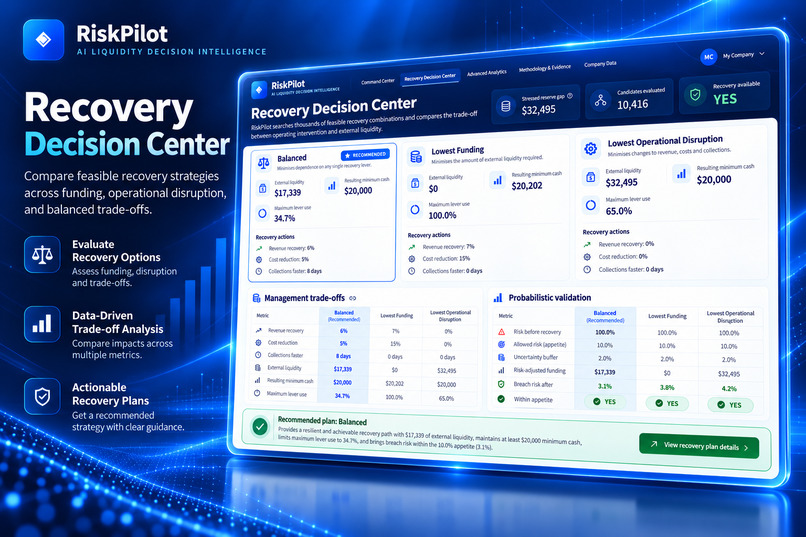
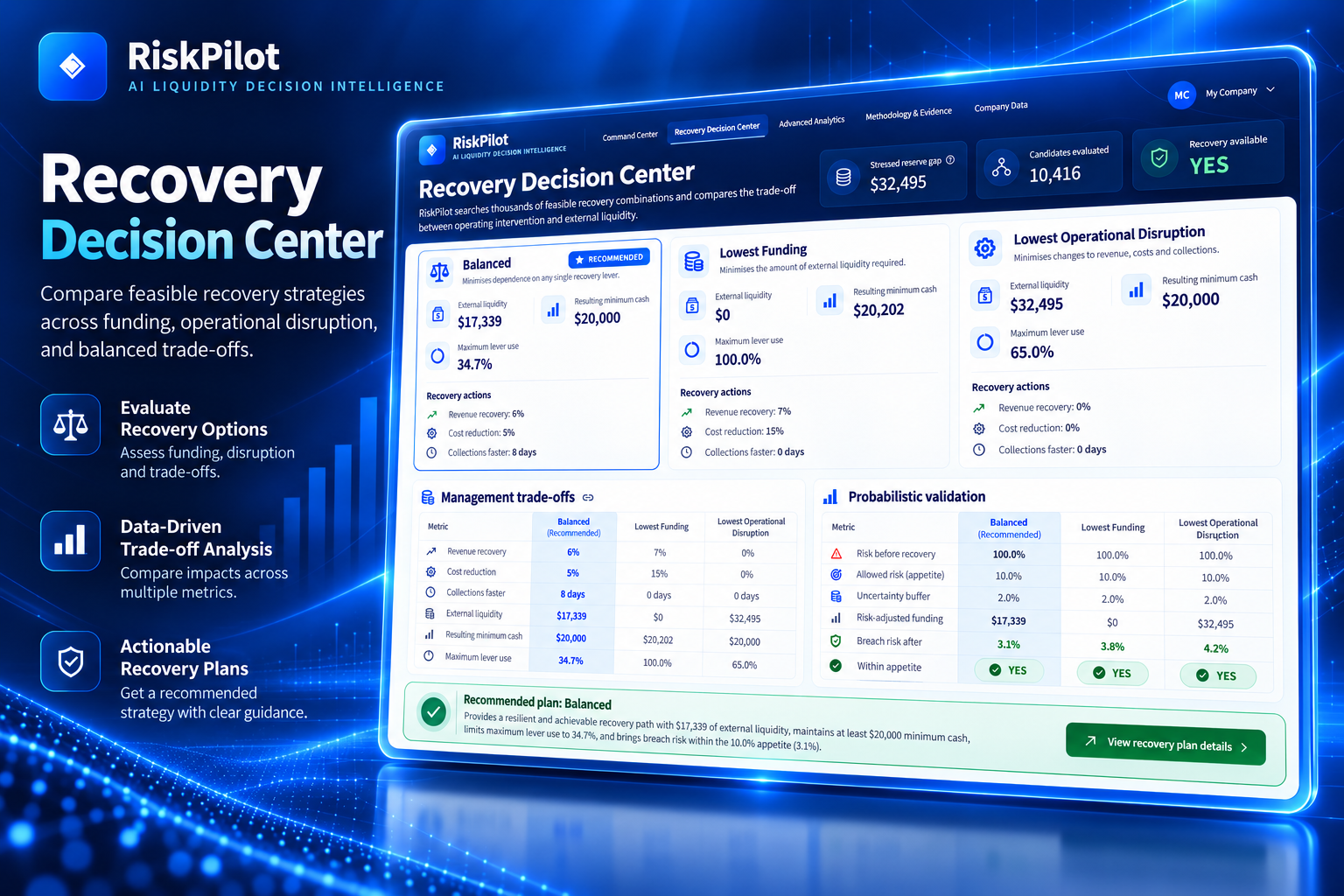
Recovery Decision Center — compare recovery plans, trade-offs, and funding needs with verified decision support
-
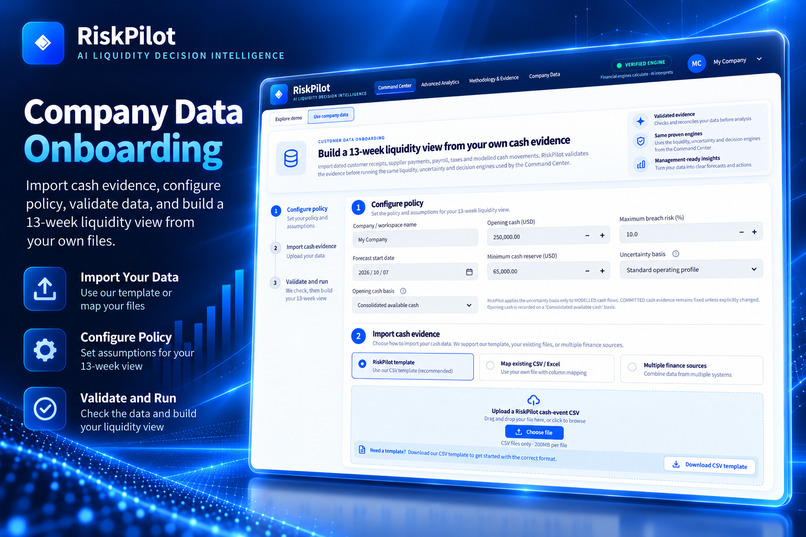
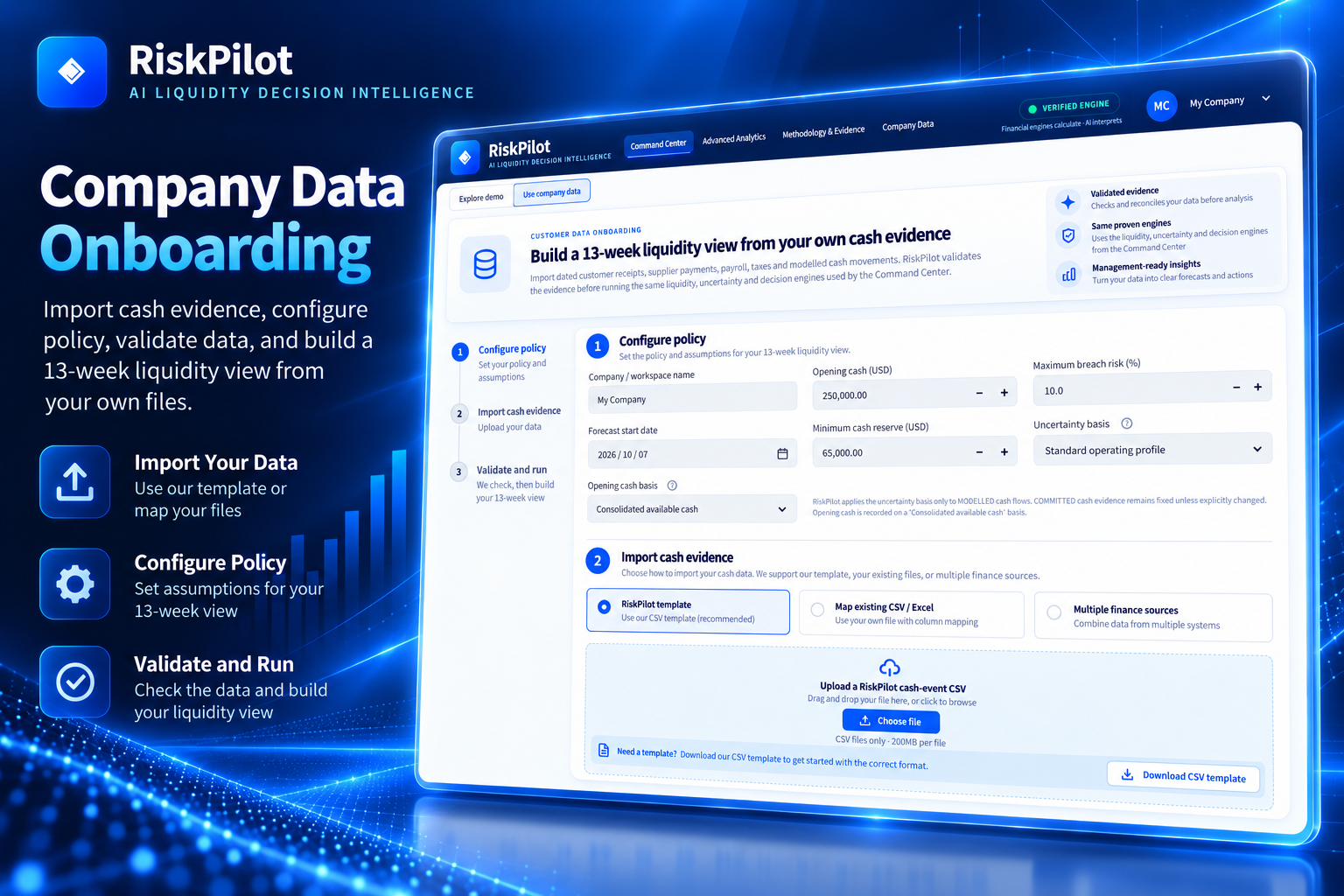
Company Data Onboarding — upload cash evidence and turn customer data into a decision-ready 13-week liquidity view
Inspiration
Finance teams rarely struggle because they lack data. They struggle because the data is fragmented across spreadsheets, receivables, payables, payroll, tax obligations and management assumptions — and turning that information into a clear liquidity decision can take hours.
We built RiskPilot to answer a more useful management question:
Are we going to face a liquidity problem in the next 13 weeks, why is it happening, and what should management do next?
We wanted to go beyond a forecasting dashboard or a generic AI chatbot. RiskPilot combines verified financial engines with a tool-using AI decision agent so that natural-language management questions can trigger real financial workflows.
What it does
RiskPilot is an AI-powered 13-week liquidity decision-intelligence platform for founders, CFOs and finance teams.
A finance team can import CSV or Excel data from sources such as:
- accounts receivable
- accounts payable
- payroll
- tax and other obligations
- management assumptions
RiskPilot then:
- builds a 13-week direct-cash forecast
- measures liquidity against a management reserve
- quantifies reserve-breach risk under uncertainty
- preserves evidence provenance
- identifies material cash drivers
- tests constrained recovery actions
- compares deterministic feasibility with probabilistic adequacy
- saves and compares forecast snapshots
- exports management-ready reporting
The product also includes a tool-using RiskPilot AI Decision Agent.
A manager can ask a question such as:
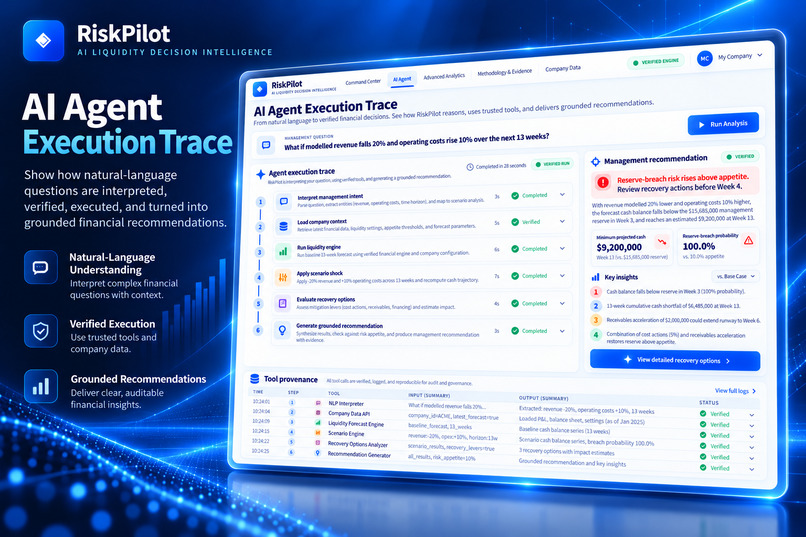
What if modelled revenue falls 20% and operating costs rise 10%?
The agent interprets the request, selects the appropriate RiskPilot tools, runs a verified compound scenario, evaluates the resulting liquidity position and returns a grounded management recommendation.
Financial values are never invented by the language model.
Financial engines calculate. AI orchestrates verified evidence. Management decides.
AI Agent architecture
RiskPilot's AI layer can call domain-specific tools for:
- liquidity position
- cash evidence
- recovery validation
- actions and monitoring
- temporary what-if scenarios
The agent dynamically selects tools based on the management question.
For example, a what-if question can trigger the scenario engine, while a recovery question can route to recovery evidence and probabilistic validation.
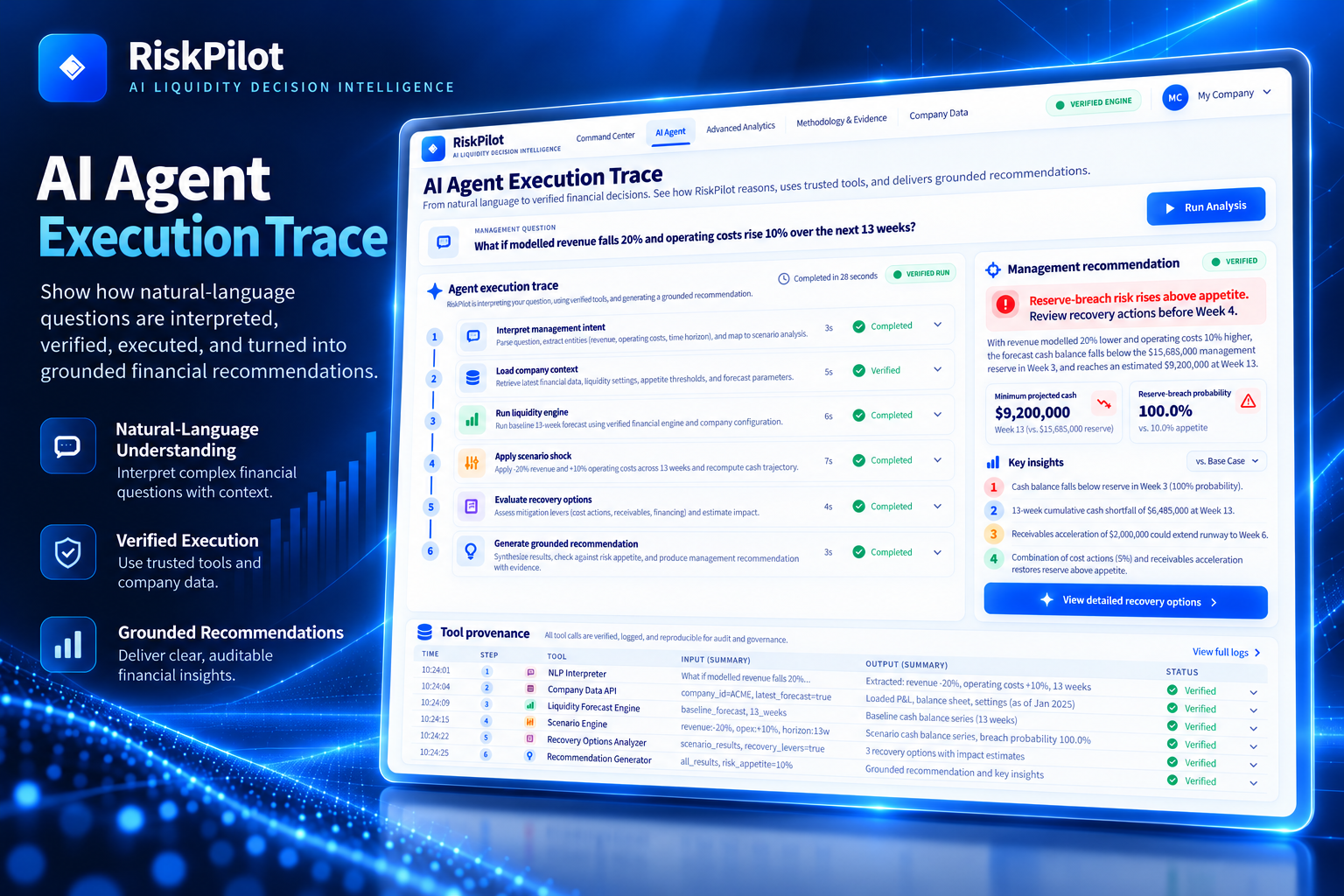
The UI also exposes an Agent Execution Trace showing actual runtime tool provenance.
This gives users visibility into how a management question became a grounded recommendation, without exposing private model reasoning.
How we built it
RiskPilot is built in Python with a deterministic financial core and a separate AI orchestration layer.
The financial layer includes:
- 13-week direct-cash forecasting
- Monte Carlo liquidity simulation
- reserve-breach analysis
- evidence classification
- cash-driver analysis
- constrained recovery testing
- probabilistic recovery validation
The AI layer uses the OpenAI Agents SDK to interpret management intent and call verified RiskPilot tools.
The architecture deliberately separates AI interpretation from financial calculation. The AI can orchestrate and explain engine output, but it cannot replace or invent financial values.
We also built customer-data onboarding for CSV/XLSX files, finance-source mapping, forecast history, evidence drill-down, recovery workflows, management brief PDF export and verified audit JSON output.
Real-world grounding
To test the product on more than synthetic scenarios, we reconstructed the 13-week liquidity path disclosed in Cenveo's 2018 SEC-filed restructuring materials.
RiskPilot reproduces the reported weekly liquidity path exactly and then applies its own analytical risk layer against the disclosed $20 million minimum-liquidity reference.
The public SEC case is used as a demonstration dataset only. Cenveo was not a RiskPilot customer.
Challenges we ran into
One of the biggest challenges was deciding what the AI should and should not be allowed to do.
Allowing an LLM to calculate financial values would make the system difficult to verify. We therefore designed RiskPilot so that financial engines remain authoritative, while the AI handles intent interpretation, tool orchestration and management explanation.
We also had to keep deterministic liquidity outcomes, probabilistic risk, evidence quality and recovery adequacy separate so that similar-looking metrics were not incorrectly combined.
Another challenge was creating a flexible customer-data workflow while still preserving provenance and evidence classification.
Accomplishments that we're proud of
We are especially proud that RiskPilot is not just an AI wrapper.
The final product includes:
- a working 13-week liquidity Command Center
- a tool-using AI decision agent
- compound engine-backed what-if scenarios
- visible runtime tool provenance
- customer CSV/XLSX ingestion
- evidence classification and drill-down
- constrained recovery intelligence
- probabilistic recovery validation
- forecast history
- management reporting
- a real public SEC liquidity case
The final regression suite contains 551 passing tests.
What we learned
The most important lesson was that AI becomes more useful in finance when it is given clear boundaries.
Instead of asking the model to generate financial answers directly, we found that combining deterministic financial engines with AI orchestration creates a more explainable and auditable workflow.
We also learned that evidence quality, uncertainty and management action need to be presented as distinct concepts rather than collapsed into a single confidence score.
What's next for RiskPilot
Next, we would like to extend RiskPilot toward production finance integrations, including accounting and banking systems, richer permissions and audit controls, collaborative workflows and continuously updated cash evidence.
We would also expand the agent toolset while keeping the same principle:
the AI can orchestrate financial workflows, but verified financial engines remain the source of truth.


Log in or sign up for Devpost to join the conversation.