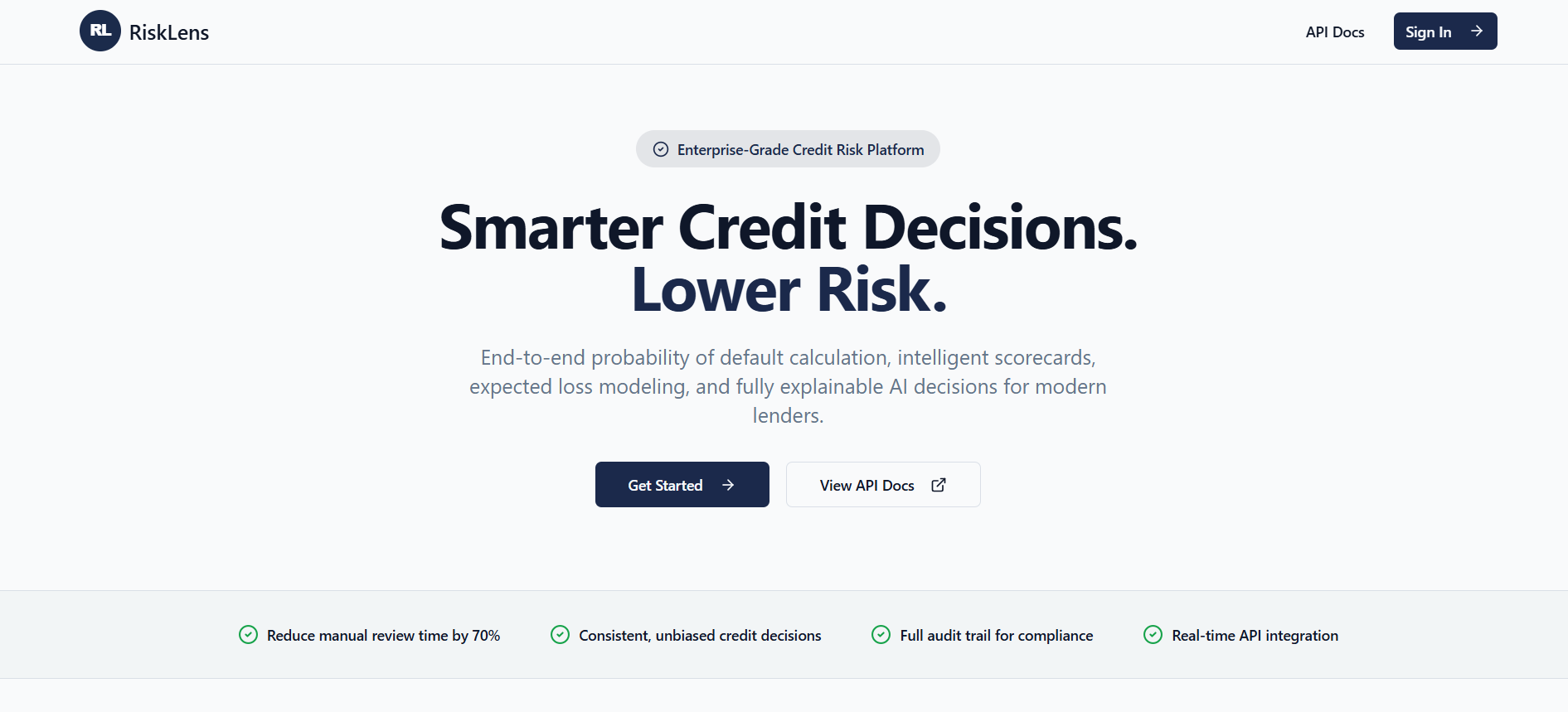
RiskLens
Inspiration
Risk is often hidden inside noisy, unstructured data—whether in medical scans, operational logs, or visual inputs. The goal was to build a system that not only analyzes data but surfaces critical risks early, reducing reaction time and improving decision-making.
What I Learned
- Integrating computer vision and deep learning into a practical pipeline
- Working with noisy, real-world data instead of curated datasets
- Designing for interpretability, not just accuracy
- Managing trade-offs between model complexity and inference speed
How I Built It
- Developed a pipeline: data ingestion → preprocessing → model inference → risk scoring
- Applied deep learning models for feature extraction and anomaly detection
- Implemented a scoring mechanism:
$$ Risk = f(x) = \sum_{i=1}^{n} w_i \cdot s_i $$
Where ( s_i ) are signals/features and ( w_i ) are learned weights
- Deployed using Vercel for fast iteration and accessibility
- Built a simple interface to visualize results in real time
Challenges
- Data ambiguity: Inputs were inconsistent and poorly labeled
- Model reliability: Balancing false positives vs missed risks
- Latency vs performance: Ensuring fast inference without degrading accuracy
- Interpretability: Making outputs understandable for end users
Outcome
RiskLens functions as a decision-support layer that converts unstructured data into structured, actionable insights.

Log in or sign up for Devpost to join the conversation.