-
-
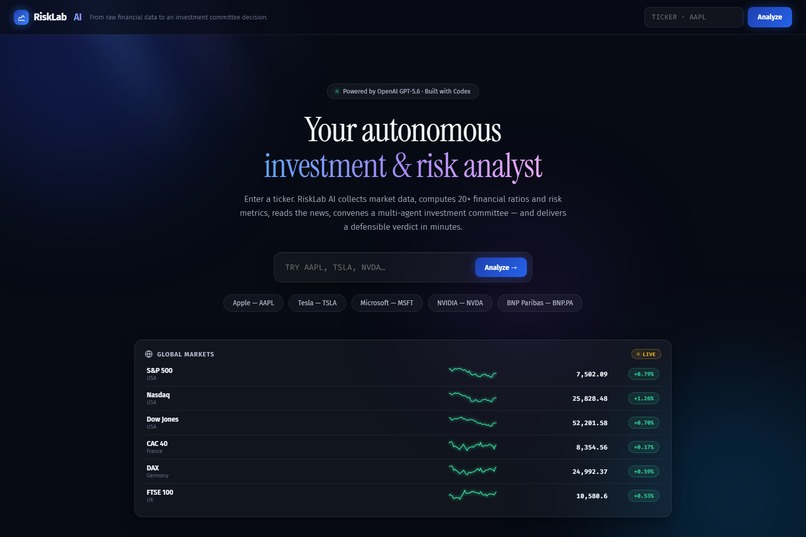
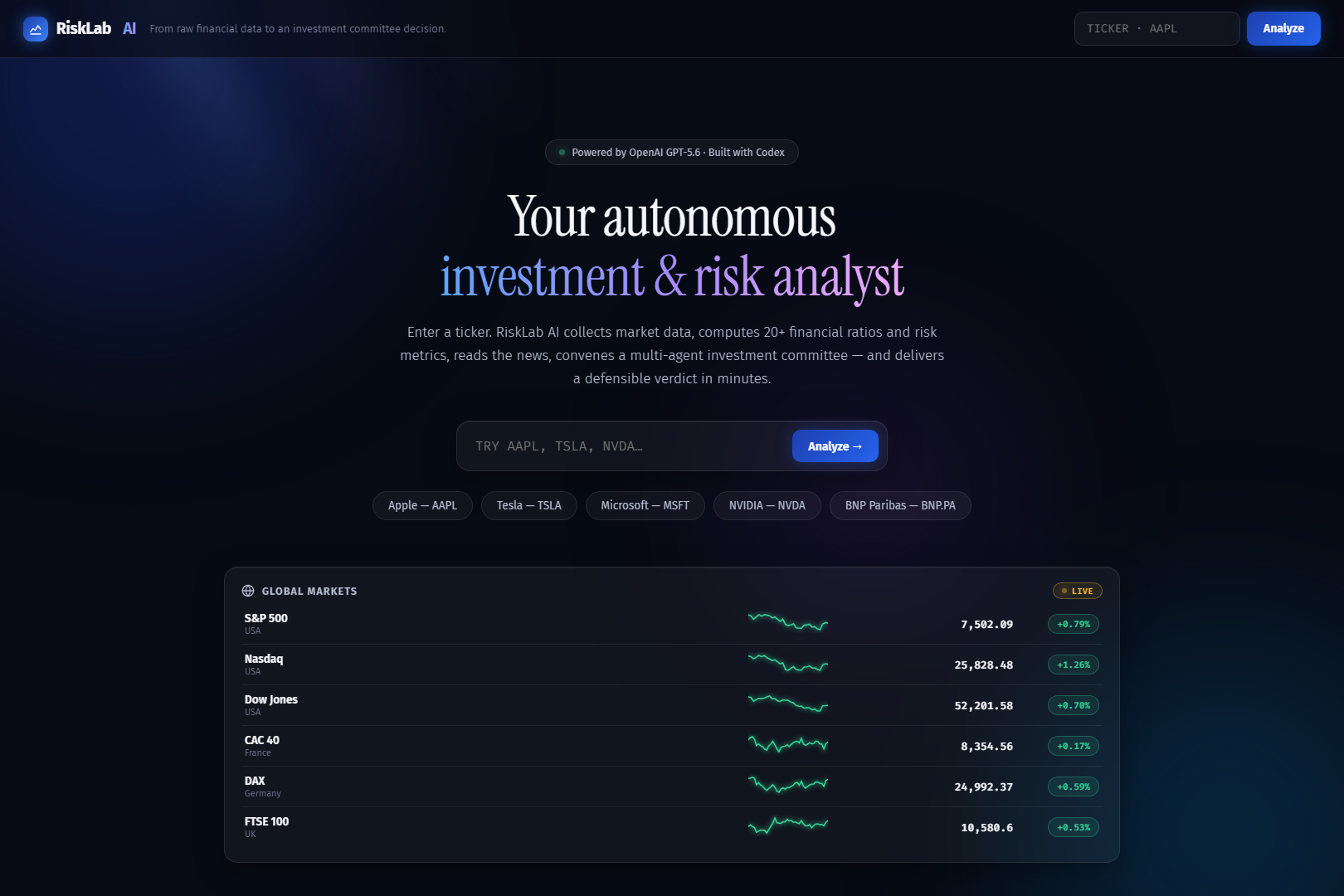
Home page with live global markets — real-time indices, glowing sparklines, and one-click company analysis.
-
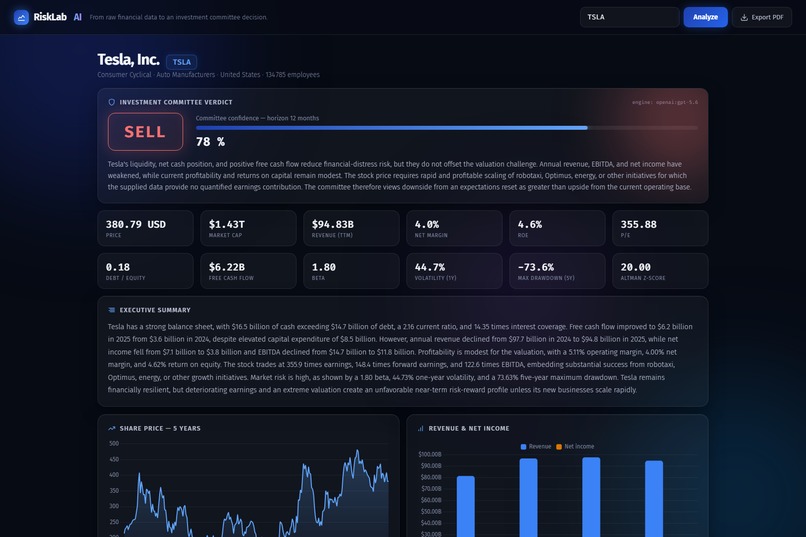
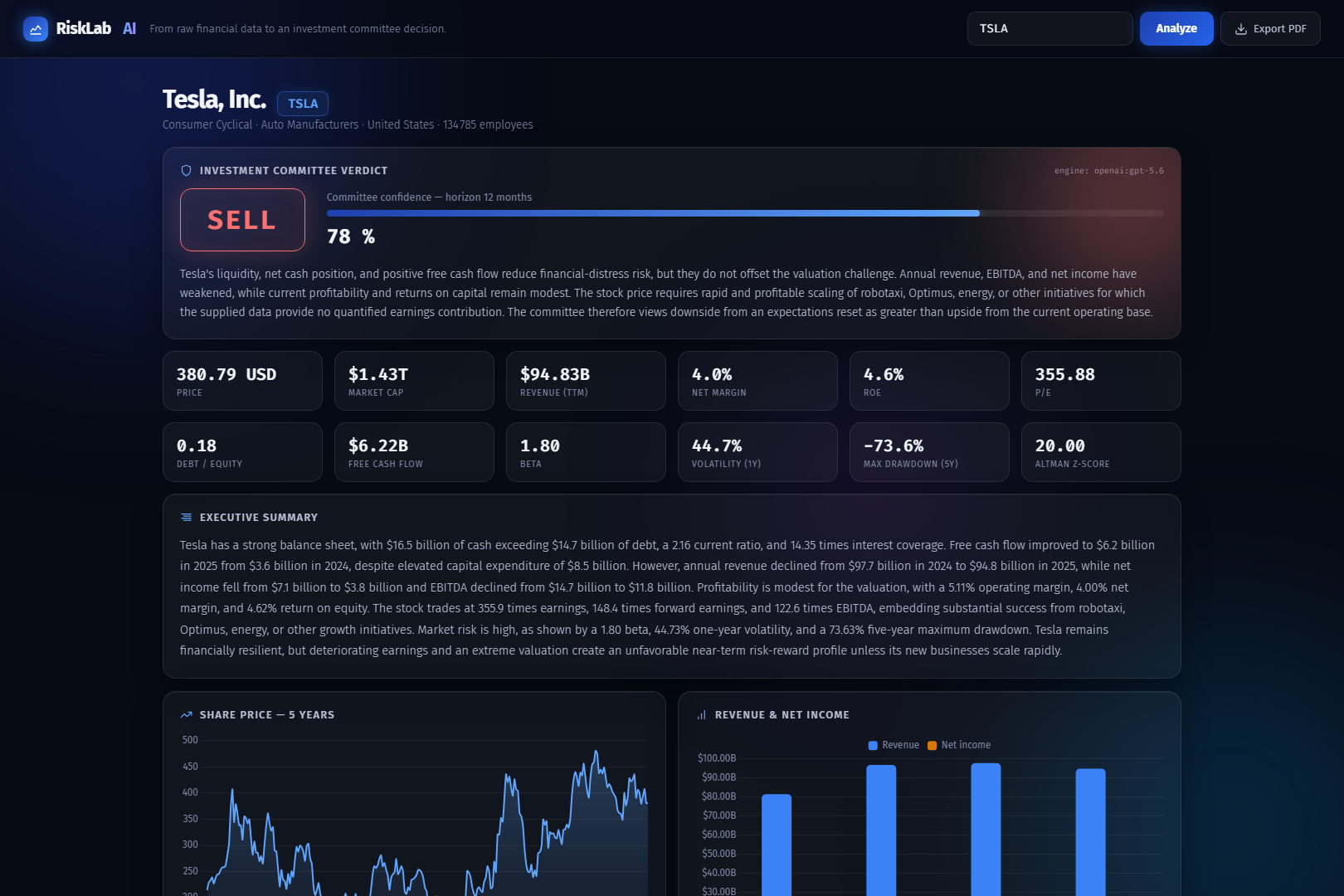
GPT-5.6 investment committee verdict on Tesla: SELL at 78% confidence — 12 risk metrics, charts and full reasoning.
Inspiration
Financial analysts spend hours on every company they cover: reading statements, computing ratios, scanning news, estimating risk, writing the report. As a risk-modeling graduate student, I wanted to see how much of that workflow GPT-5.6 could genuinely automate — not as a chatbot, but as a complete autonomous workflow that ends in a defensible decision.
What it does
Type a ticker (AAPL, TSLA, BNP.PA…). RiskLab AI then:
- Collects live market data, financial statements and news
- Computes 20+ financial ratios (margins, ROE/ROA, leverage, coverage, Altman Z-score) and quantitative risk metrics (annualized volatility, 95% VaR, max drawdown, Sharpe, beta)
- Scores every headline for sentiment and impact
- Convenes a simulated investment committee — Chief Risk Officer, Portfolio Manager, Quantitative Analyst, Macro Economist — whose members genuinely disagree (on Tesla, our CRO went Bearish while the PM stayed Bullish) before reaching a verdict
- Delivers BUY / HOLD / SELL with a confidence level, three scenarios (optimistic / central / pessimistic), an interactive dashboard, and a printable PDF report
- Answers follow-up questions: ask the committee "Why SELL?" and it defends its reasoning with the actual numbers
How we built it
- Codex was our OpenAI coding agent throughout development — refining and debugging the application (data layer, deployment, docs), guided by an AGENTS.md playbook in the repo. We also used Claude as an additional AI assistant alongside the required GPT-5.6 + Codex — the Build Week rules explicitly allow any model as long as GPT-5.6 powers part of the project.
Challenges we ran into
Getting a language model to behave like a committee rather than a single voice: the fix was forcing distinct personas with explicitly permitted disagreement, grounded in the same shared quantitative data, plus a strict JSON schema so four opinions and one verdict come back in a single call. Also: financial data is messy — every ratio has a defensive fallback for missing statement lines.
Accomplishments that we're proud of
A committee whose members actually disagree before deciding; a full analysis (data → ratios → risk → debate → verdict → PDF) in under a minute; and answers you can interrogate — the committee defends its verdict with real figures instead of hand-waving.
What we learned
GPT-5.6's structured-output reliability makes it possible to treat the model as a reasoning engine inside a pipeline rather than a chat interface — the quantitative layer feeds it verified numbers, and it never needs to invent one.
What's next for RiskLab AI
PDF/annual-report upload to analyze private companies, peer comparison against sector competitors, stress-testing scenarios (rate shocks, recession), and portfolio-level risk aggregation.

Log in or sign up for Devpost to join the conversation.