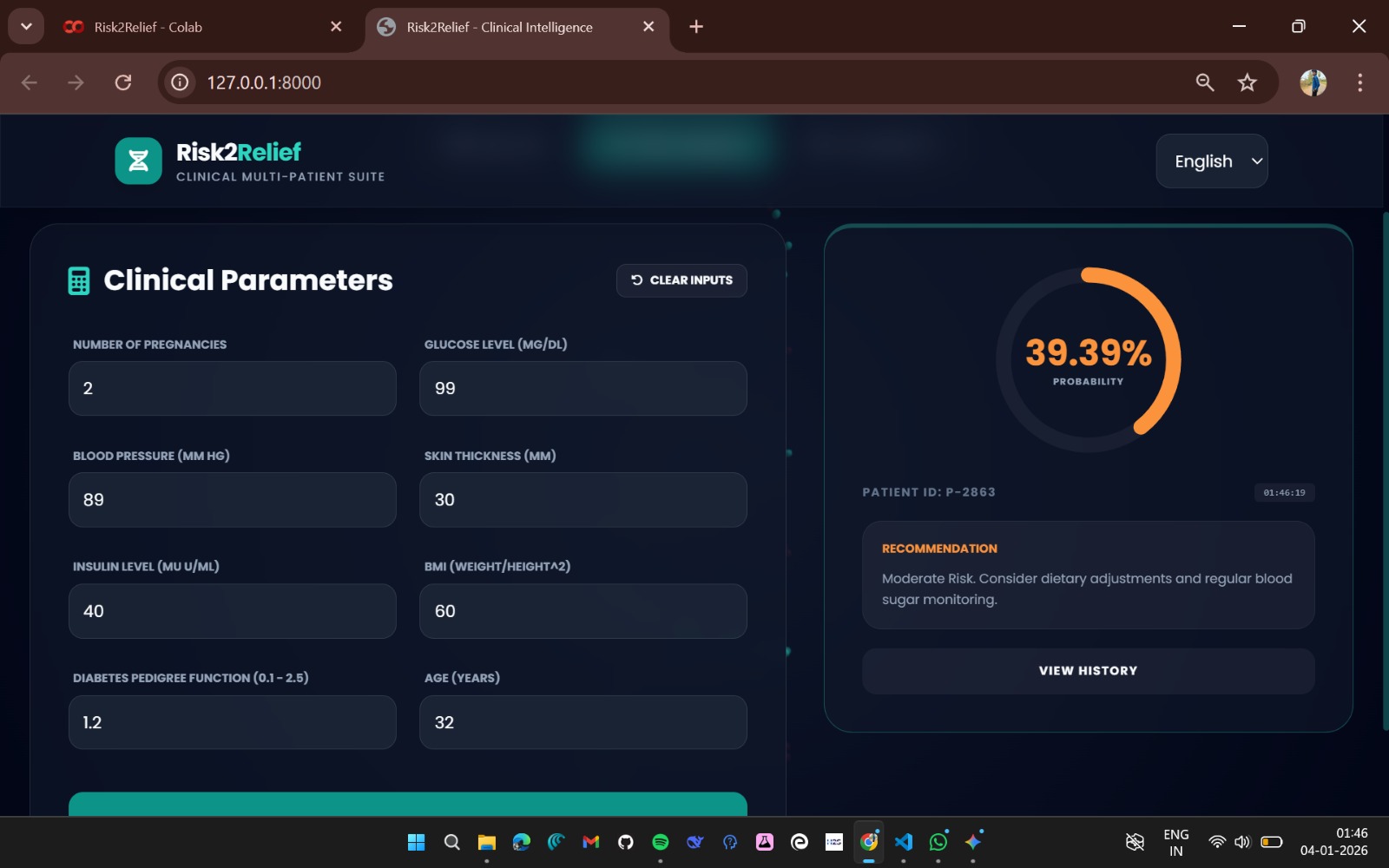
Inspiration Our team was driven by the critical gap in Gestational Diabetes Mellitus (GDM) diagnostics. Clinical research shows that 73% of women are unaware they have the condition. This lack of awareness leads to severe complications, including a 6.4x higher risk of stillbirth and 4.5x higher odds of neonatal death. We were inspired to build a solution for "maternity care deserts" where specialized diagnostic tools and obstetricians are scarce. What it does RISK2RELIEF is an AI-powered predictive intelligence platform that transforms noisy patient data into actionable clinical assessments.
- It analyzes vital metrics like Glucose, BMI, and Insulin to provide specialized Clinical Risk Profiling.
- It features an Advanced Dashboard for real-time tracking of Risk Evaluations, Critical Alerts, and Safety Scores.
- A Gemini-powered AI Assistant provides multilingual dietary and lifestyle advice in English, Telugu, and Hindi. How we built it We developed a unique multimodal fusion architecture called the "Synthesis Engine".
- Foundation: We built an Advanced Preprocessing module for data imputation, scaling, and feature engineering.
- Parallel Analysis: Data is processed by four algorithmic "experts": Classical ML (RF/XGB), Deep Learning (DNN/CNN), Artificial Neural Networks (MLP), and Quantum-Logic Streams via Qiskit.
- Meta-AI Synthesis: A final layer uses Weighted Fusion to integrate these perspectives into a single, uncertainty-aware report. Challenges we ran into A major hurdle was the complexity and noisiness of clinical data, which often makes single-model predictions brittle. We overcame this by implementing Uncertainty Awareness. By measuring "model discordance" (the standard deviation between model streams), our system identifies cases requiring human oversight, turning a "black box" into a trusted clinical tool. Accomplishments that we're proud of
- We successfully integrated Quantum Computing principles to explore high-dimensional relationships that classical algorithms might miss.
- Our Weighted Fusion approach consistently outperforms individual models by mitigating their inherent biases.
- We created a modular architecture that can easily incorporate new AI breakthroughs in the future. What we learned We learned that clinical risk assessment is fundamentally a challenge of diversity. By employing a "council of experts" approach rather than a single model, we can provide more stable and generalizable predictions. We also gained deep insights into the necessity of Standard Scaling to ensure clinical significance over raw numerical values. What's next for RISK2RELIEF We plan to expand our Population Neural Map to aggregate larger global datasets for visualizing broader health trends. We also aim to refine our Predictive Logic Engine to support more real-time data synchronization and remote patient monitoring features.
Built With
- antigravity
- api
- css
- deep-learning
- gemini
- googlecolab
- html
- javascript
- machine-learning
- python
- quantum


Log in or sign up for Devpost to join the conversation.