Inspiration
Our biggest source of inspiration for DealPilot - RiskRadar was that loan fraud doesn't always appear on an individual application but can, instead, be spread out across multiple applications. Therefore, our project seeks to contextualize loan applications by connecting information across multiple deals.
Imagine three supposedly unrelated businesses applying for commercial loans:
- Business A and Business B report different ownership structures.
- Both applications contain documents originating from the same suspicious source.
- Business B and Business C share an unusual financial relationship.
- All three applications contain overlapping individuals or other uncommon attributes. A traditional, application-by-application review might miss these connections.
What it does
DealPilot - RiskRadar is a commercial loan intelligence platform that automates loan processing, analyzes supporting documents, and detects potential fraud patterns and clusters across multiple applications.
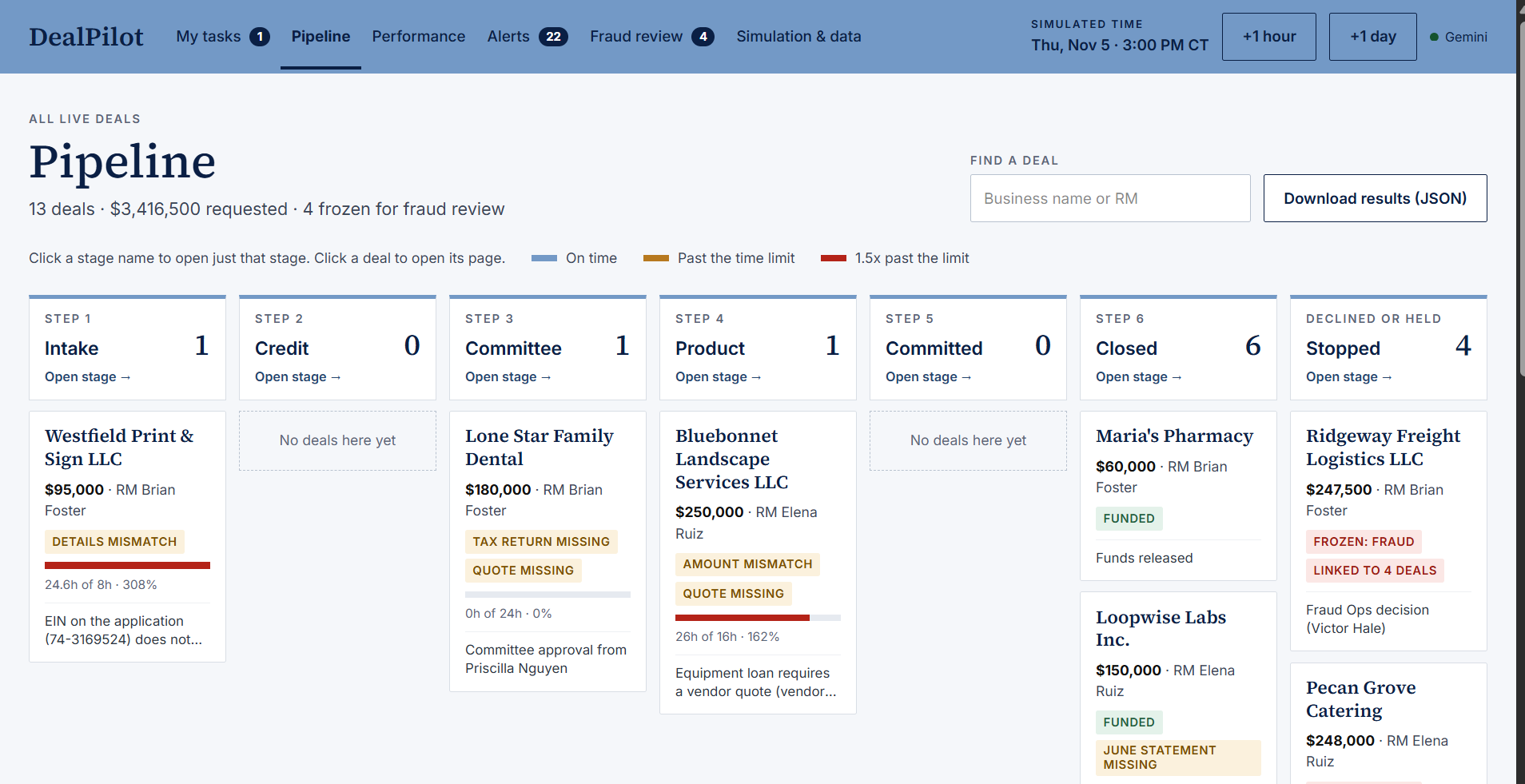
- Automates Loan Processing: Streamlines the commercial lending lifecycle, from initial document intake through credit review, committee approval, commitment, and closing.
- Document Intelligence: Extracts and analyzes information from loan documents, identifies missing information, and generates summaries to reduce manual review.
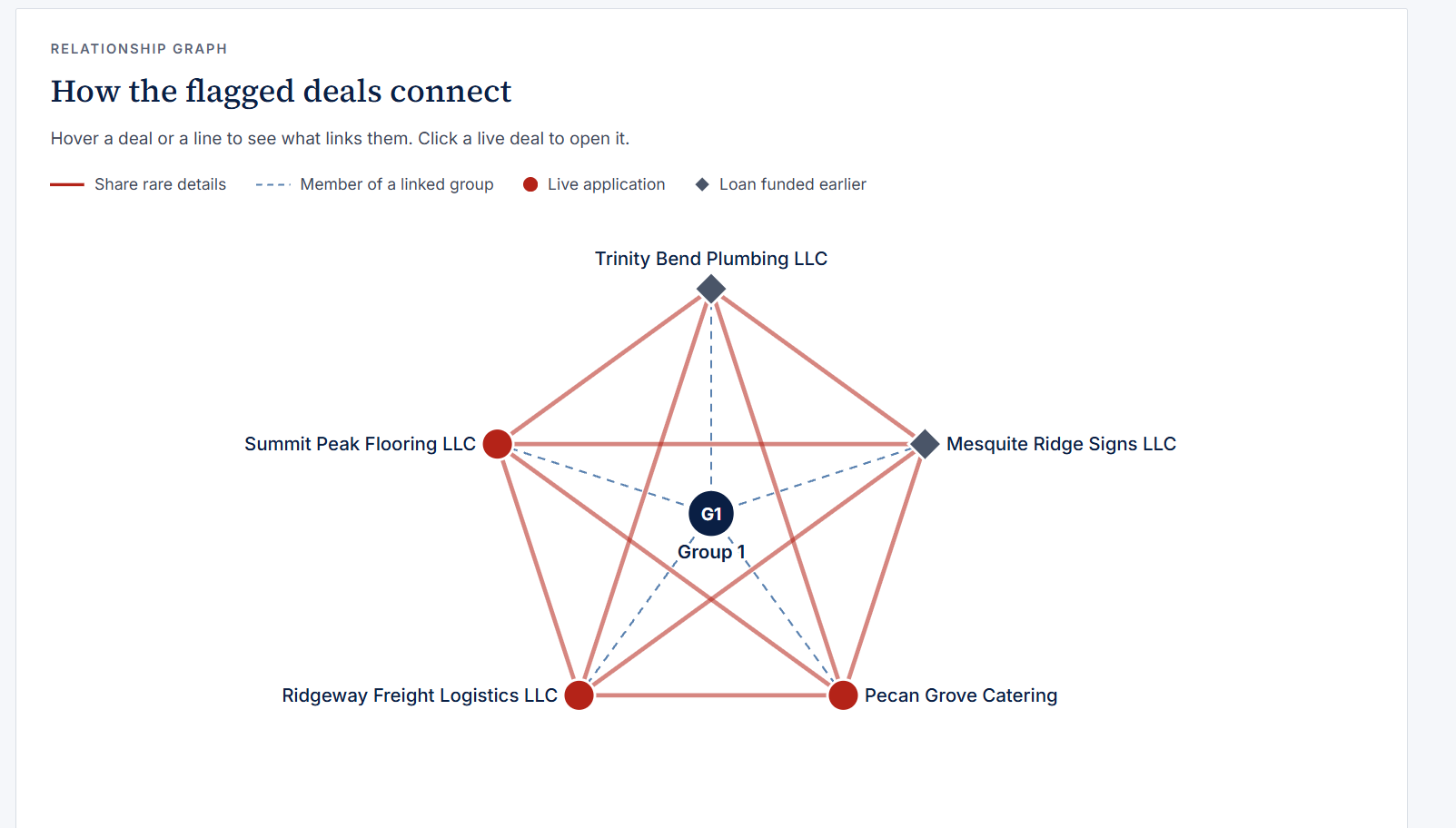
- Cross-Deal Fraud Detection: Connects borrowers, businesses, individuals, financial records, and document sources across applications to uncover suspicious relationships and potential fraud patterns.
- Anomaly Detection: Identifies unusual financial or application patterns that warrant further investigation using machine learning.
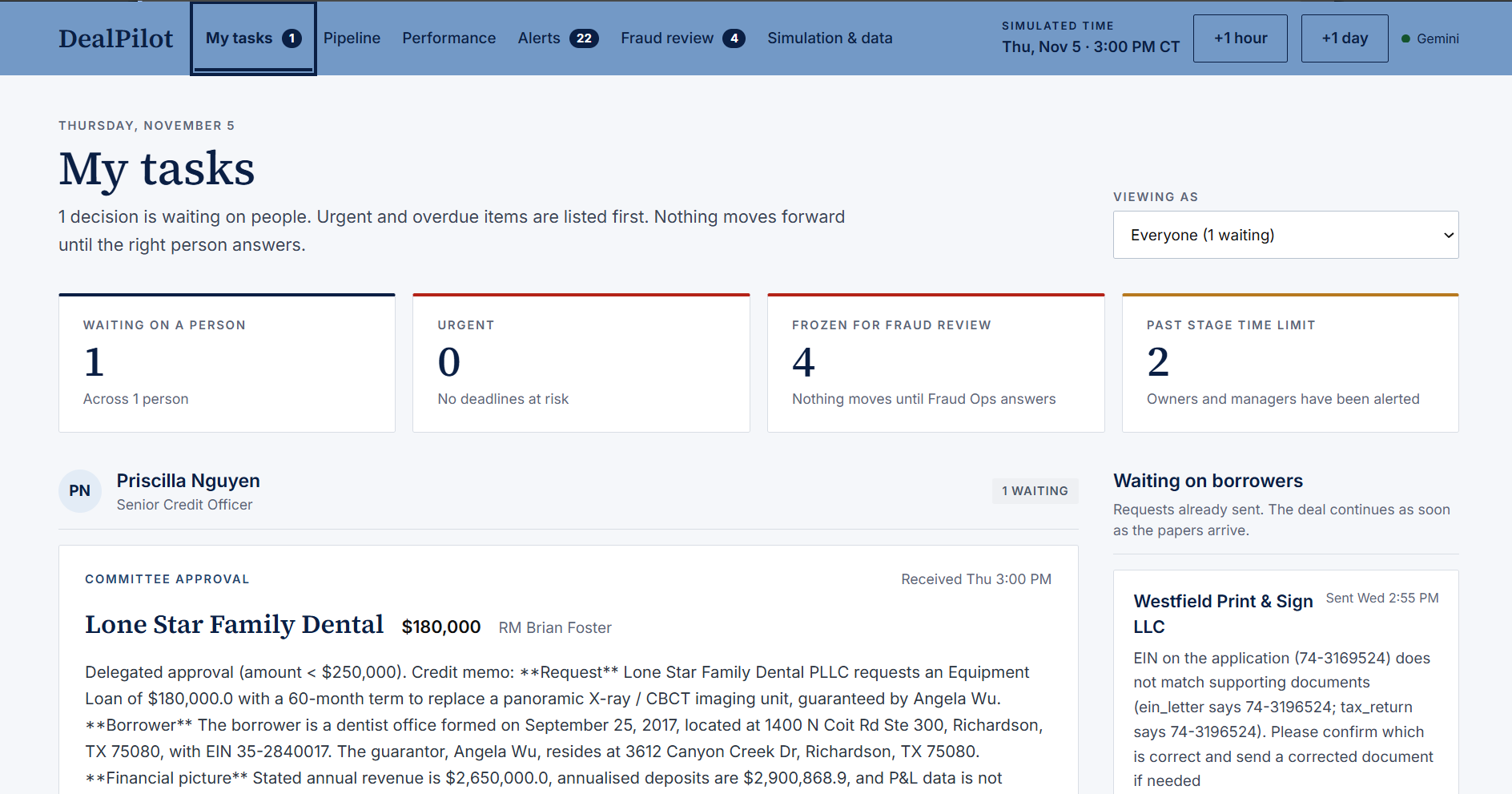
- Human-in-the-Loop Decisions: Routes critical approvals, fraud holds, and funding decisions to the appropriate banking professionals rather than allowing AI to make consequential decisions autonomously.
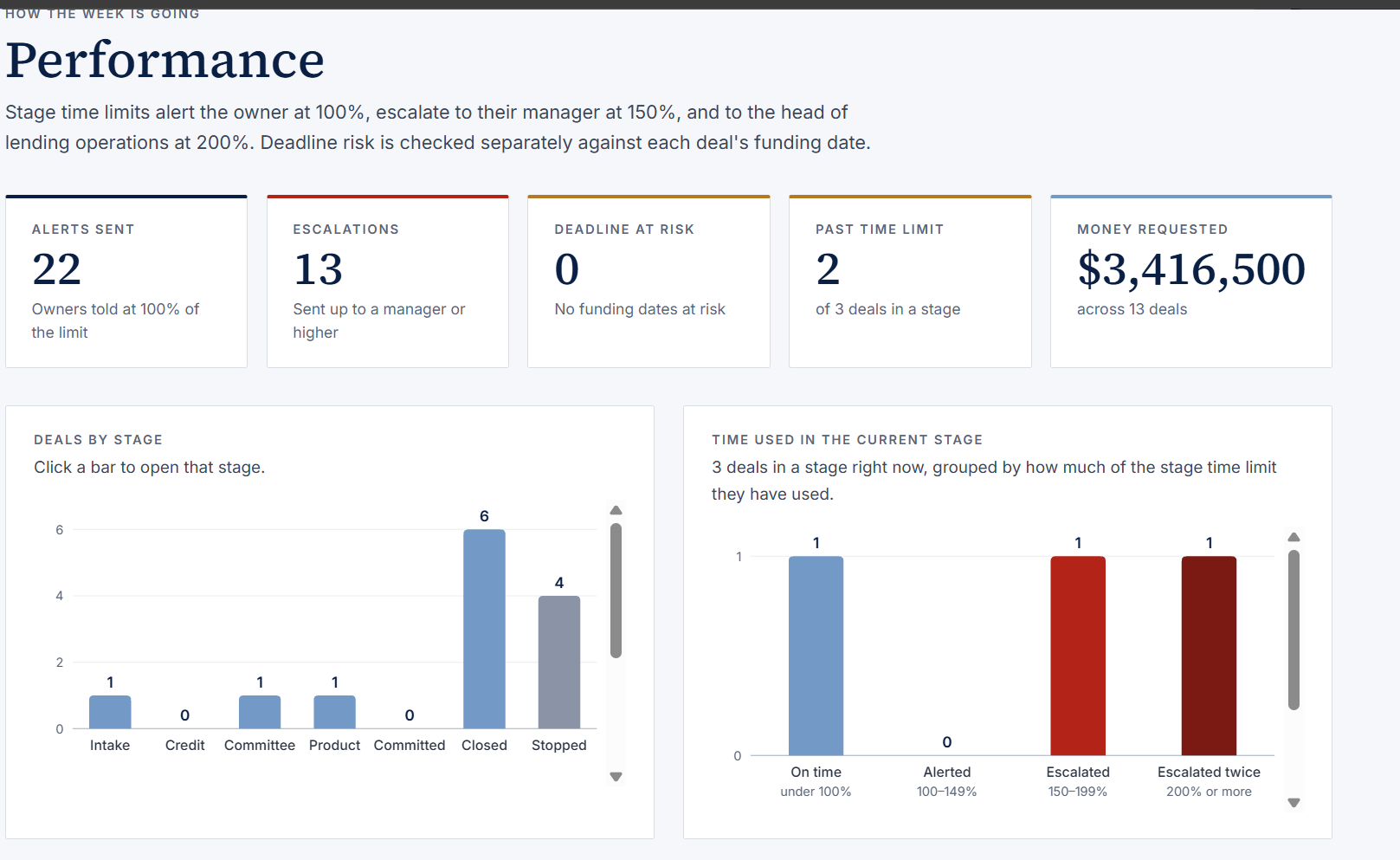
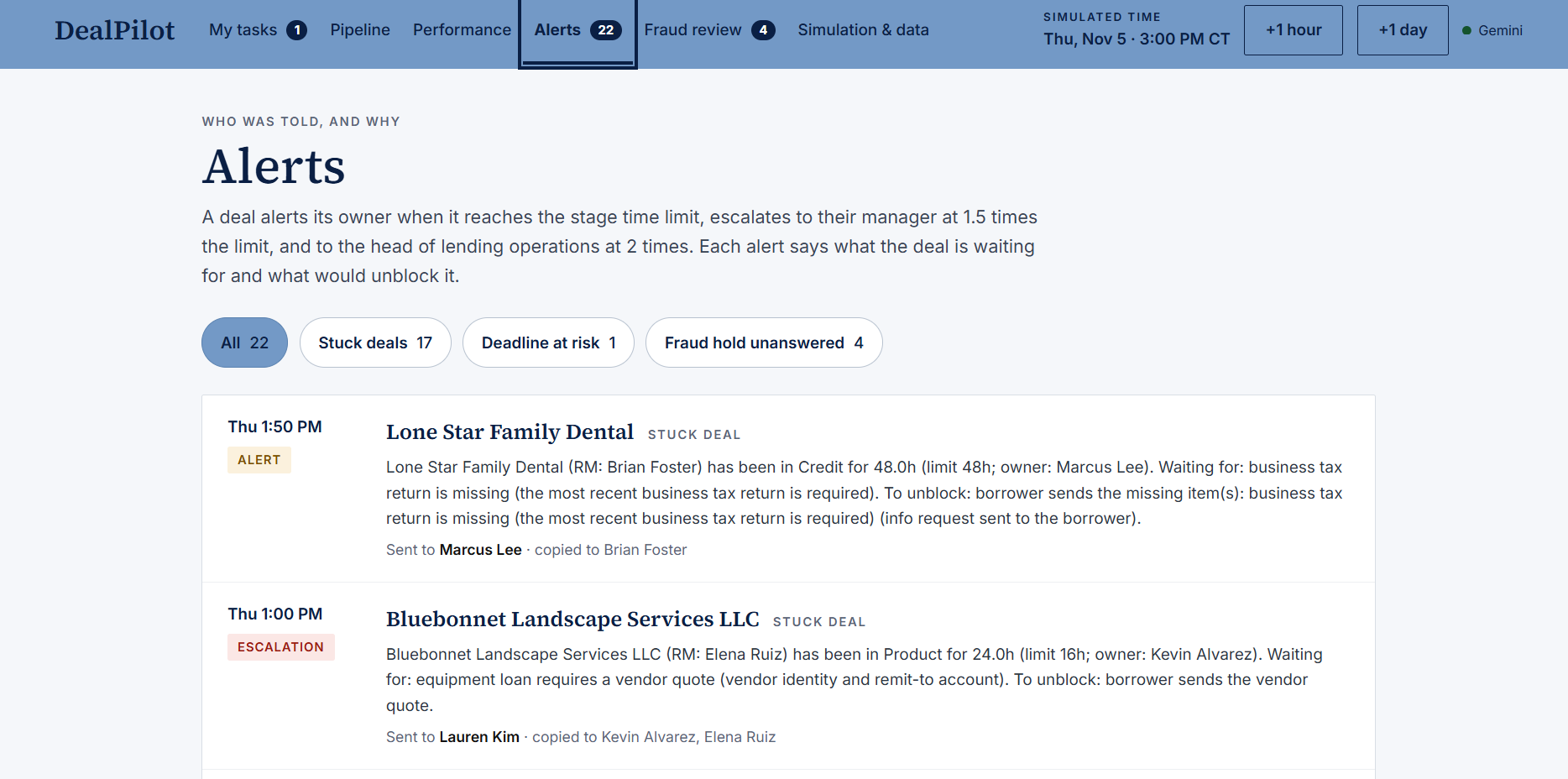
- Real-Time Risk Monitoring: Tracks deal statuses, outstanding approvals, operational bottlenecks, SLA deadlines, and fraud alerts through a centralized dashboard.
How we built it
We built DealPilot using a combination of full-stack development, document processing, machine learning, and graph-based fraud detection.
- Frontend: Built an interactive financial-services dashboard using React, TypeScript, and Tailwind CSS, with the assistance of Loveable, providing loan pipeline monitoring, fraud intelligence visualizations, human review workflows, and an analytics dashboard.
- Backend: Developed a Python FastAPI backend to manage loan processing, API communication, workflow orchestration, and application state.
- AI Document Processing: Integrated Google's Gemini API to extract structured information from commercial loan documents, generate summaries, and assist with document review.
- Machine Learning: Implemented Isolation Forest anomaly detection to identify unusual patterns and prioritize applications for additional investigation.
- Workflow Automation: Created a state-driven lending pipeline that moves applications through intake, credit, committee, product, commitment, and closing, with human approval gates for consequential decisions.
- Workflow Automation: Created a state-driven lending pipeline that moves applications through intake, credit, committee, product, commitment, and closing, with human approval gates for consequential decisions, based upon a set of given stages and rules.
Graph-Based Fraud Intelligence:
- We developed a graph-based relationship analysis engine to identify suspicious connections across commercial loan applications.
- First, we use Google's Gemini API to extract structured information from loan documentation, including borrower-related information, associated individuals, financial attributes, and document provenance.
- Next, our fraud detection engine organizes these attributes into four evidence categories: people, money, provenance, and numerical information.
- Rather than evaluating each application independently, we compare attributes across applications and identify shared relationships. An important part of this process is considering the rarity of shared attributes, since an uncommon connection between supposedly unrelated businesses can be more meaningful than a common characteristic.
- We then use these relationships to construct cross-deal connections and identify clusters of potentially related applications. These findings provide fraud analysts with evidence-backed investigative leads, allowing them to understand not only which applications are suspicious, but also how those applications may be connected.
- Finally, the findings feed into our lending workflow, where authorized human reviewers can investigate suspicious activity and manage fraud holds. The key innovation is moving from isolated loan-level fraud screening toward connected, portfolio-wide fraud intelligence.
Challenges we ran into
- Detecting Cross-Deal Fraud: Identifying suspicious relationships between seemingly unrelated businesses was challenging. We needed to distinguish meaningful, uncommon connections from coincidental similarities without generating excessive false positives.
- Maintaining Explainability: We wanted fraud analysts to understand why a deal was flagged, rather than simply receiving an unexplained risk score. This required connecting findings back to specific evidence and relationships.
- Full-Stack Integration Under Time Constraints: Connecting our FastAPI backend, AI processing pipeline, fraud detection engine, and React frontend while maintaining consistent application state was challenging within the limited HackUTD development window.
- Creating realistic test data: Figuring out how to generate realistic commercial loan applications, financial records, and supporting documents that accurately represent real-world lending scenarios. We needed enough variety to test the platform while intentionally including suspicious patterns to evaluate fraud detection.
Biggest Challenges We Faced
- API and frontend integration: One of our biggest challenges was connecting our React frontend to the FastAPI backend. We had to troubleshoot API communication, configure endpoints and CORS, and ensure that data and actions were properly reflected across both sides of the application.
- Designing a Goldman Sachs-aligned frontend: We also struggled with creating a frontend that felt appropriate for an institutional banking environment. We wanted the platform to reflect the professional, polished, data-driven design expected in financial services while still making complex information—such as loan pipelines, fraud connections, risk alerts, and approval workflows—easy to navigate.
Accomplishments that we're proud of
- Building a polished, institutional banking interface: We're especially proud of our final frontend design. We created a professional, Goldman Sachs-inspired banking dashboard that organizes complex lending information into an intuitive experience. Analysts can monitor loan pipelines, review risk alerts, investigate suspicious relationships, and manage approval workflows from one centralized platform.
- Developing our cross-deal fraud clustering system: One of our biggest technical accomplishments was building a backend system that identifies hidden relationships between seemingly unrelated commercial loan applications. Rather than evaluating each application independently, our system compares shared attributes across four evidence categories: people, financial information, document provenance, and numeric data. It weighs the significance of shared attributes, giving more attention to unusual connections than common similarities.
- Making fraud patterns visually understandable: We connected the backend clustering results to the frontend's Fraud Intelligence interface. Instead of presenting analysts with isolated risk scores, the dashboard surfaces connected deals and their shared attributes, helping users understand why applications may be related and where further investigation is warranted.
What we learned
- The importance of data relationships in fraud detection: We learned that evaluating loan applications individually can miss suspicious patterns. Connecting information across multiple deals can reveal relationships that would otherwise go unnoticed.
- Applying graph-based analysis to a real-world financial problem: We gained experience identifying shared attributes across borrowers, individuals, financial records, and document provenance, then using those connections to surface potentially suspicious clusters.
- Designing for financial professionals: We learned that a strong banking application needs more than functionality. Information must be organized clearly, risk indicators must be understandable, and the interface must support efficient decision-making.
What's next for Risk Radar
- Improve fraud detection accuracy: Expand our clustering system with more sophisticated relationship scoring, additional fraud indicators, and larger datasets to identify increasingly complex cross-deal fraud patterns while reducing false positives.
- Integrate real-world financial data: Move beyond simulated test data by exploring secure integrations with commercial banking systems, financial databases, and document management platforms.
- Move toward real-world deployment: Test Risk Radar with larger and more diverse lending scenarios, gather feedback from banking professionals, and refine the platform around real commercial lending workflows. Our long-term vision: Transform Risk Radar from a hackathon prototype into a scalable commercial lending intelligence platform that helps financial institutions detect hidden fraud patterns earlier, streamline loan processing, and make more informed lending decisions.
