Inspiration
It is hard for partients to distinguish between which symptom can be the cause of what. Do I have just a seasonal allergy, a cold or maybe COVID-19? Am I potentially infectious for others or could others in the waiting areas actually infect me? A small survey before booking an appointment with a family doctor provided by us gives a rough analysis of his/her infectious status as well as an analysis of the patient's susceptibility and vulnerability to the most common infectious diseases. After that, the patient can directly book the appointment with a family doctor. Currently, the medical staff on the other hand receive patients without any prior knowledge about their symptoms, as well no indication of their risk level. This resulted in some cluster infections of COVID-19 in the hospital in the past as well as quite commonly infections with flu in the waiting areas (see below). Therefore, to reduce infections in the facility and more specifically in the waiting room, we also provide the medical staff with the information whether a patient might be infectious as well as how vulnerably a patient probably is. All appointments are then scheduled in a way that the risk of infections between patients is minimized. Moreover, we make sure that high risk patients (those with a high susceptibility and vulnerability to infectious diseases) have the least possible contact to any other patient that could infect them.
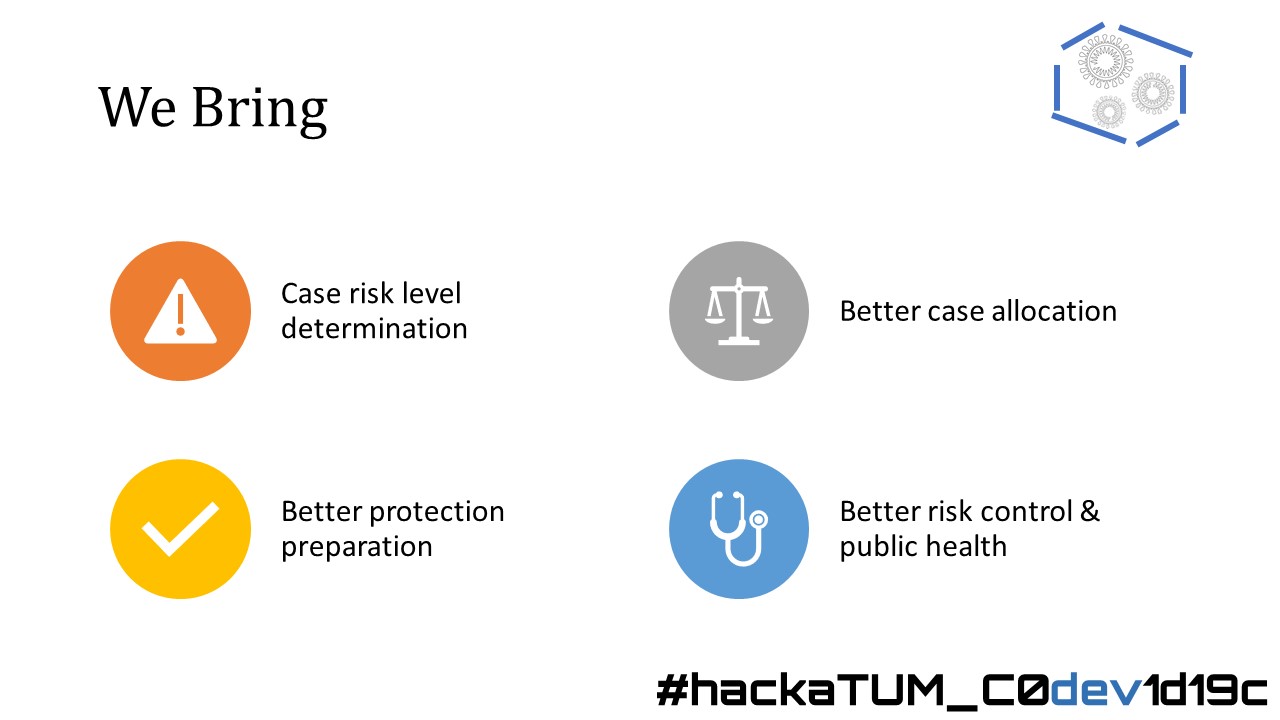
This system provides better risk management for both sides of patient and medical department. Patients with non-urgent signs can reduce the contact with other patients. Doctors and nurses can prepare correct protection with the coming cases.
What it does
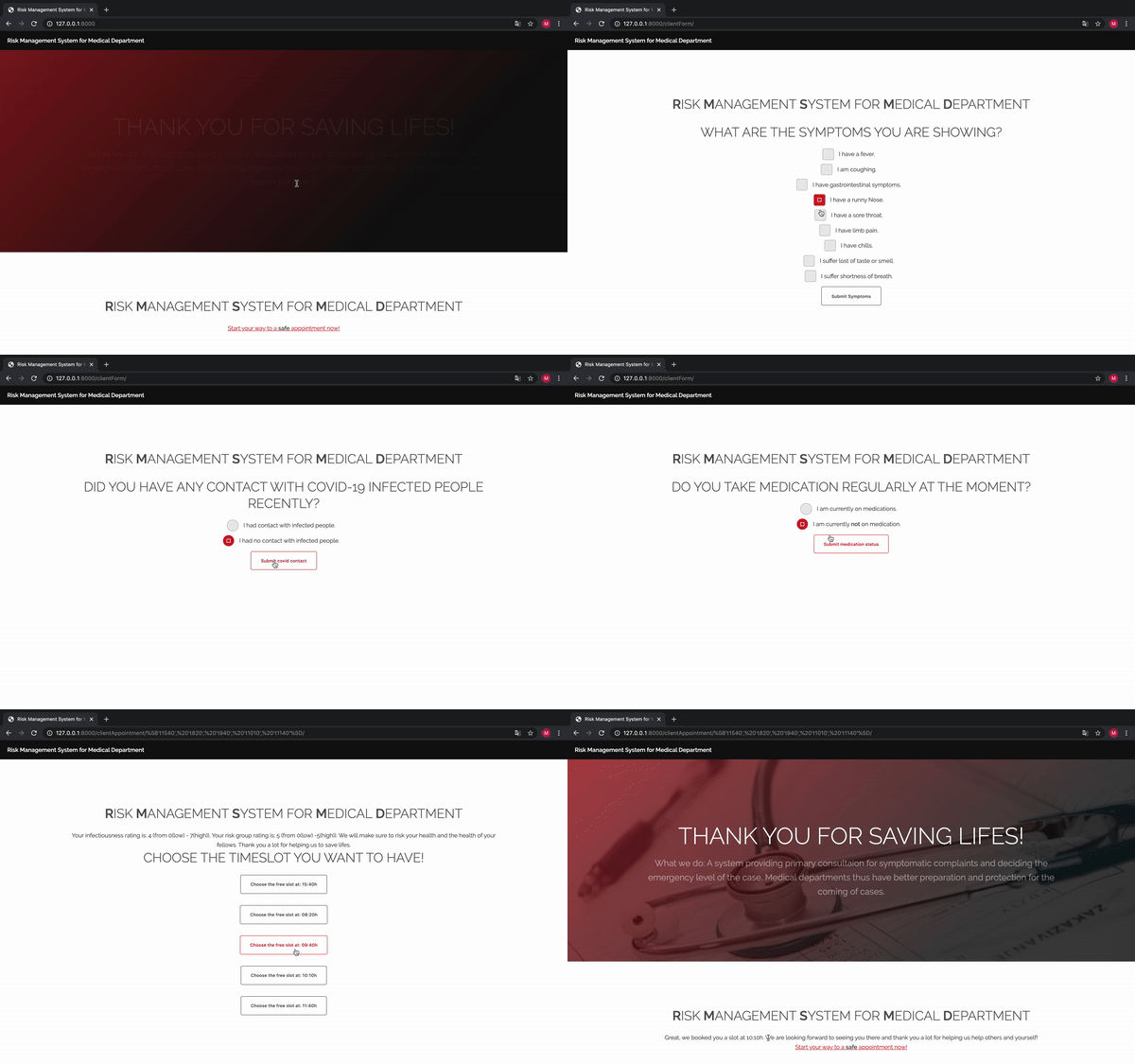
The system serves as a two-folded solution for patient and medical departments. People consult the system in the form of a website (either stand-alone or embedded on the doctors website) to answer the provided question about their complaints. An easy adjustable decision tree is used as a basis for this.
The system works as a virtual GP, analyzing the symptoms and decide the emergency level of the case. In can give suggestions, such as home remedy and what nutrients to take for the light cases. If the data privacy is ensured, a high-risk case, for example loss of smell in terms of COVID-19, could be reported by our system to the local Centers for Disease Control and Prevention.
On the other hand, the system works as a risk management system for medical departments. Doctors and nurses will have the information of symptoms and risk level of the coming cases transferred via our system. They know when the case is potentially highly infectious or not. Thus, the front-line medical staff are clear about what kind of equipment such as N95 or protection suit they should prepare and what protocols they should adopt.
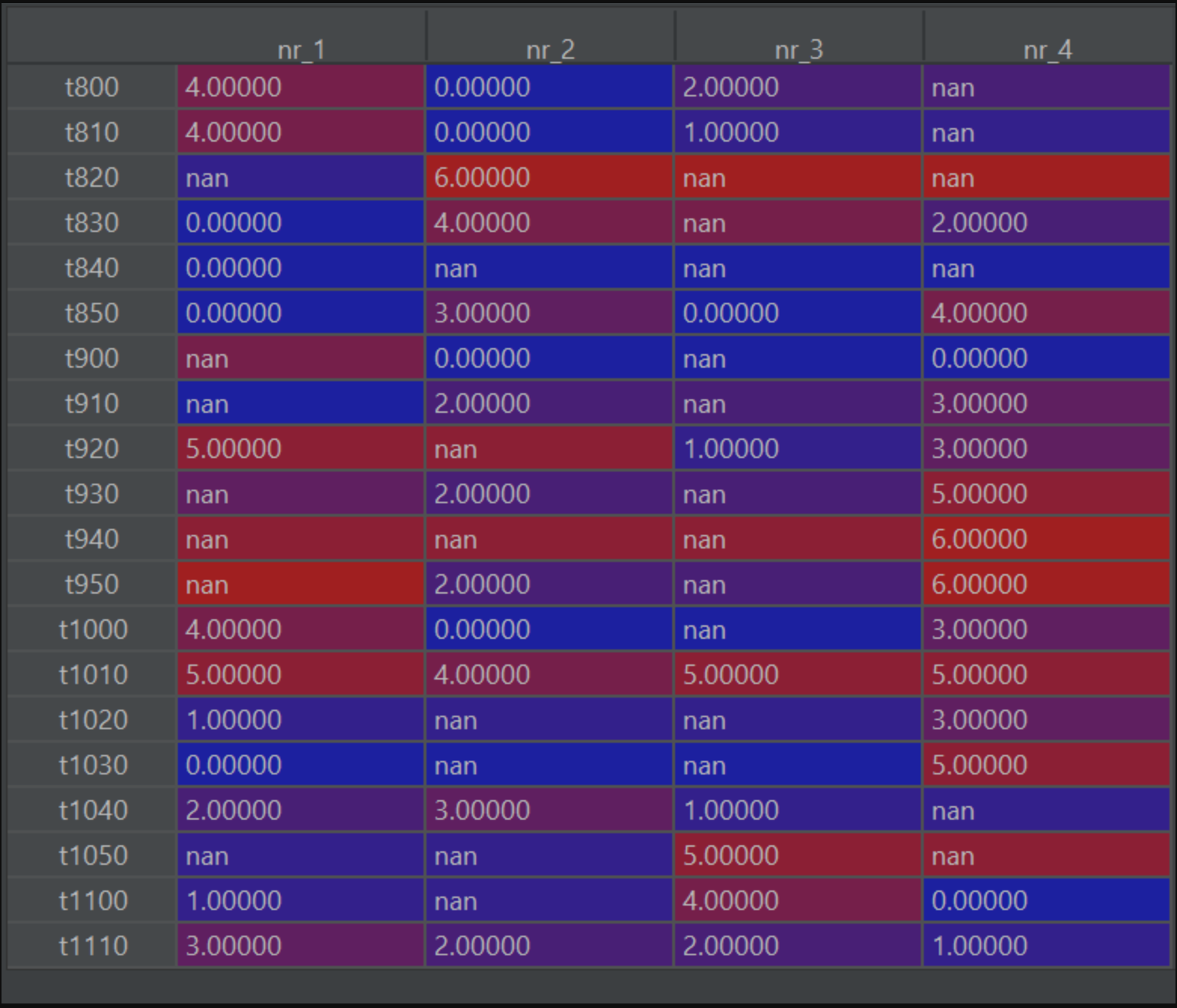
The system is also a shared platform of real-time capacity of medical departments. It automatically separates the cases with low and high risks into different visiting time slots and helps reducing the amount of cases to the overloaded units. The intelligent allocation ensures the reduction of cross-contact and keeps the smooth running of the whole medical system.
Lastly, we made it possible to store all inputted symptoms data anonymously in our database once an appointment has been set up. This can be an enormous novel source of tracked symptoms over time linked with the area in which the symptoms occurs. This could become a base to control the spreading of infectious diseases better, as symptom irregularities and peaks can be detected.
How We built it
- Landing page and user interface for user and doctor respectively - Website by django
- Symptom check form in decision tree - Python
- Algorithm for disease classification and emergency level - Python
- Back-end database - PostgreSQL + Python
- Real-time calendar system - Coming soon
- Massaging system for user and medical units - Coming soon
- Risk reporting system connected to Centers for Disease Control and Prevention - Coming soon
Challenges We ran into
This is an ambitious project concerning the technical background of the participants. The first challenge we encountered is to build a working prototype, also called minimal valuable product, in a relatively short time. We were brainstorming about how to build a platform with all the core functions and also a clear user interface. We want to make sure the user experience for patients and medical staff reaches the same satisfaction.
The second challenge is the integration and communication of all functions writen by different team members. Non of us hat prior knowledge about the website framework django or the relational database PostgreSQL.
Accomplishments that We're proud of
A single system that fulfills both the needs of patient and medical staff. It provides:
- symptom-based consultation
- emergency and risk estimation
- automatized classification of diseases by the database of symptoms
- more understandable suggestions and booking for patients
- early warning mechanisms before the coming of cases
- real-time intelligent allocation based on capacity of medical units
What We learned
hackaTUM_C0dev1d19 provides great opportunity of interdisciplinary challenges. We decided to make use of this chance to break our old routines. We built the website entirely in python with django framework, which means a complete paradigm shift. We also noticed the importance of interdisciplinary knowledge. Since every member has coding skills, the forming of workflow and visualization was quite smooth. Now we are confident to work with much more frameworks and libraries such as React in limited time. We are experts of django now!
Our Next Step
Given that the level of digitization is much higher in the US and East Asia such as Japan, Taiwan and South Korea, we primary target the markets. We will firstly cooperate with the governments and persuade as many as medical units to join our system framework. We expect more medical units and doctors will adopt our system after they see the effectiveness of protection among the first clients.
On the technical side of things, we still have a lot of ideas on how to improve and evolve our system. Obviously that process start with optimizing what we achieved during the HackaTUM, this optimization is especially important as this is going to be a real time system with clients concurrently working with shared resources. We want to ensure a safe and easy to use product, and our aspirations can only be fulfilled by especially building up the product's base.
We want to especially focus on optimizing our matching algorithm, so that we can ensure that patients that are not infectious and maybe only need a vaccination are not thrown into waiting rooms with several potentially highly infectious people, this will slow down the spreading of infectious diseases. Our clients already get rated on infectiousness as well as on wether they are part of a group in risk (e.g. old people and people with medical preconditions). Our goal here is, that we make sure to cut down contact of risk group patients with potentially highly infectious people to zero (wherever possible), as those contacts are the ones that have a higher potential to result in death.
Background information and references
The infection risk in the waiting areas of healthcare facilities is quite high. Above that, a comparably large number of patients in the waiting areas have underlying conditions which predispose them to infections. Studies show that the most promising approaches to reduce the infection risk is to lower the number of patients in the waiting areas as well as their time waiting there. Above all, patients with an immunosuppressive state or chronic disease should not be waiting together with other infectious people (see Beggs et al. (2010), Potential for airborne transmission of infection in the waiting areas of healthcare premises: stochastic analysis using a Monte Carlo model. https://www.ncbi.nlm.nih.gov/pmc/articles/PMC2939637/#!po=0.943396). BT analysis of the reported data of the flu infection rate to the RKI in the season 2018/2019 showed that only about 1% of the medical practices actively reported their data (source: https://influenza.rki.de/Saisonberichte/2018.pdf). With the symptom checking of our system it would be possible to analyse the infection state of more patients which could improve the assessment of the infection spread within different regions.


Log in or sign up for Devpost to join the conversation.