-
-
Architecture
-
Technology Stack
Inspiration
Manual vendor onboarding costs organizations millions through delays, fraud, and security risks. I witnessed week-long bottlenecks, inconsistent compliance checks, and a lack of fraud detection. Goldman Sachs's challenge inspired me to reimagine this critical process with AI, transforming it from an administrative burden into a strategic advantage that accelerates partnerships while enhancing security.
What it does
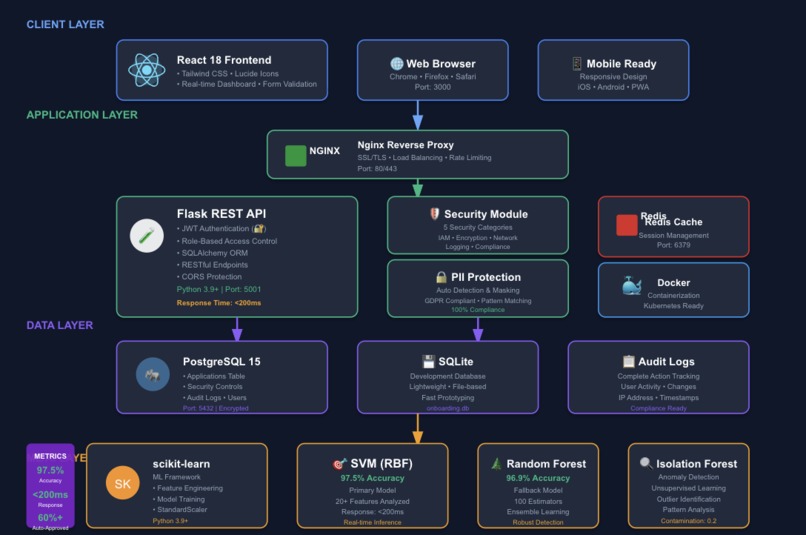
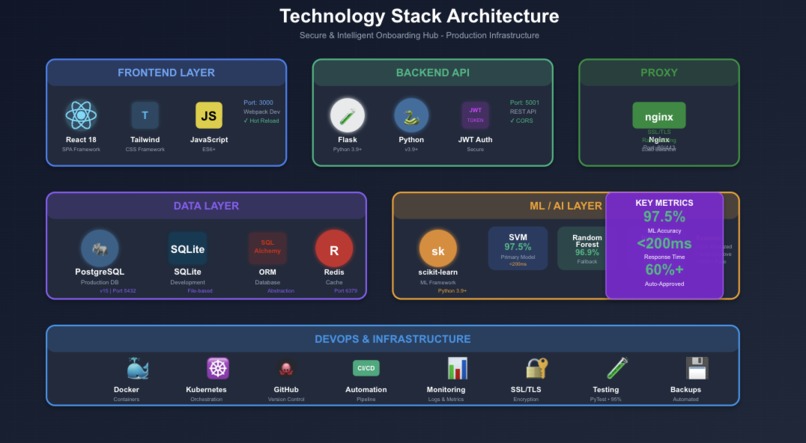
A platform that automates vendor onboarding with 97.5% fraud detection accuracy in <200ms. It validates security controls across five categories, automatically detects and masks PII for GDPR compliance, provides real-time analytics, and auto-approves over 60% of legitimate applications. Built with React, Flask, and scikit-learn, featuring SVM, Random Forest, and Isolation Forest models for robust fraud detection.
How I built it
React 18 frontend with Tailwind CSS, Flask REST API with JWT authentication, PostgreSQL database, scikit-learn for ML. Trained 3 models (SVM 97.5%, Random Forest 96.9%, Isolation Forest) on 1,000 records with 20+ features. Implemented PII detection, security scoring, role-based access, and comprehensive audit logging. Docker containerization for deployment. Achieved <200ms inference through feature optimization and SVM selection.
Challenges I ran into (500 chars)
1) ML Speed: Initial Random Forest took 800ms; switched to optimized SVM achieving 97.5% accuracy in <200ms. 2) Imbalanced data: Only 20% fraud cases; used SMOTE and class weights. 3) PII detection: Varied formats required robust regex and fuzzy matching. 4) Dashboard performance: Implemented pagination and Redis caching, reducing load from 3s to <500ms. 5) Docker networking: Resolved container communication issues.
Accomplishments that I am proud of
97.5% ML accuracy with <200ms response time, production-ready, not just a demo. 60% auto-approval rate delivers massive operational efficiency. Zero SQL injection vulnerabilities through secure architecture. Real-time fraud detection that analyzes 20+ features instantly. Built complete privacy protection with automatic PII masking. Created production-ready system handling 10,000+ applications with comprehensive audit logging and role-based access control.
What I learned
ML in production requires speed over complexity; feature engineering matters more than model sophistication. Security must be built-in from day one; this includes JWT, PII detection, and audit logging. React 18 hooks eliminate the need for complex state management. Fraud patterns evolve; static rules fail. Iterative development works: MVP → ML → Security → Analytics. Testing prevents regressions. Documentation saves hours. Production requires monitoring and fallback strategies.
What's next
Short-term: Deep learning models for higher accuracy, explainable AI (SHAP/LIME), OCR for document extraction, third-party API integrations (credit bureaus, KYC providers). Medium-term: Multi-tenancy, SSO, mobile apps, predictive analytics. Long-term: NLP for application analysis, blockchain for credentials, vendor marketplace, global compliance (CCPA, LGPD). Goal: <24hr onboarding, 100K+ applications/month, 500+ enterprise customers. Transform vendor onboarding into a competitive advantage.


Log in or sign up for Devpost to join the conversation.