




Inspiration
"Every extra minute you stay in bed, you are personally buying braised drumsticks for your roommates."
Why do college students set seven alarms (06:50, 06:53, 06:55, 07:00) and still sleep straight through an 8:00 AM midterm?
Because modern alarm apps worship frictionless UX. Giant snooze buttons and silky-smooth swipe gestures empower spinal-cord muscle memory: your thumb dismisses the alarm before your prefrontal cortex even wakes up.
Meanwhile, most "Reverse UX" experiments fail a fatal product test: if an app is merely annoying (like a broken volume slider), users curse once and uninstall it within 30 seconds. Conversely, stranger-based cash-pool habit apps demand massive cold-start traffic and suffer from rampant cheating.
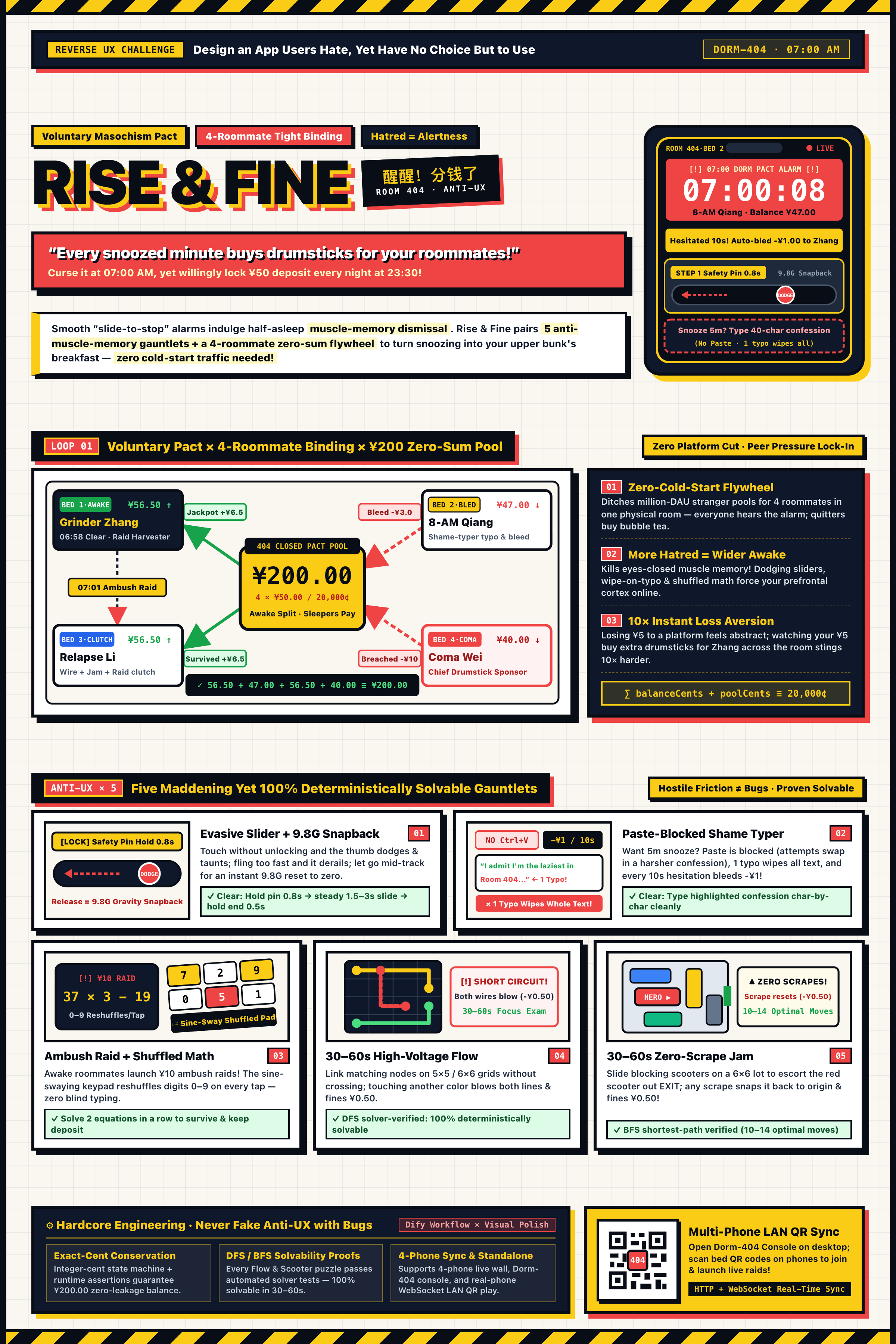
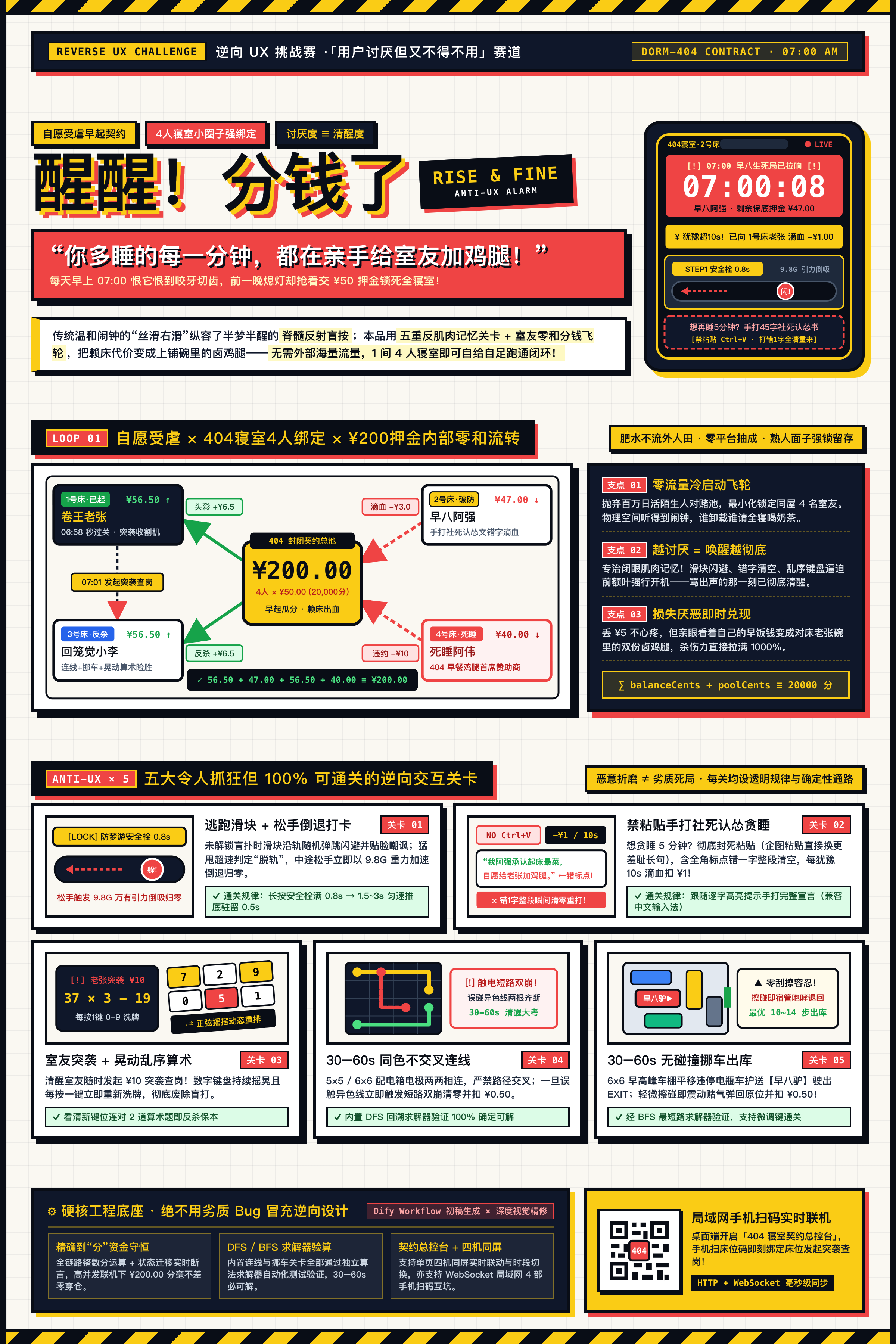
We built Rise & Fine (醒醒!分钱了) for the Reverse UX Challenge by fusing deliberately hostile cognitive friction with the smallest, highest-density social-proof unit on earth: a 4-person college dorm room ("Room 404"). When four roommates lock CNY 50.00 each into a closed CNY 200.00 morning pact at 11:30 PM, two forces make the app impossible to abandon:
- Zero-Cold-Start Peer Pressure: You sleep three feet away from the people who hear your alarm. Uninstalling or rage-quitting means instant public surrender.
- 10x Immediate Loss Aversion: Losing $1 to a faceless platform barely stings; watching your cash fly across the room in real time to buy extra breakfast drumsticks for your smug upper-bunk roommate hurts ten times more.
What it does
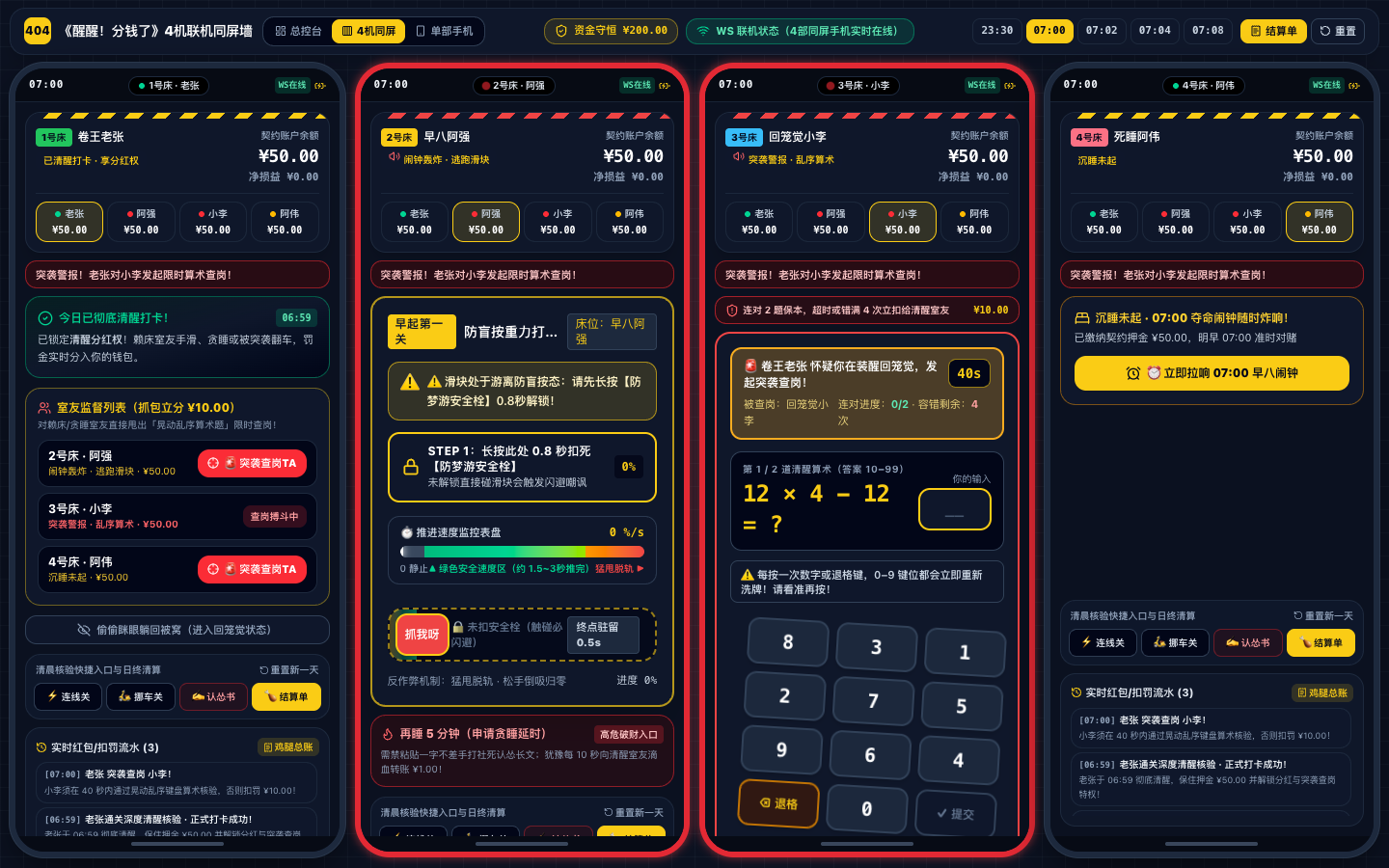
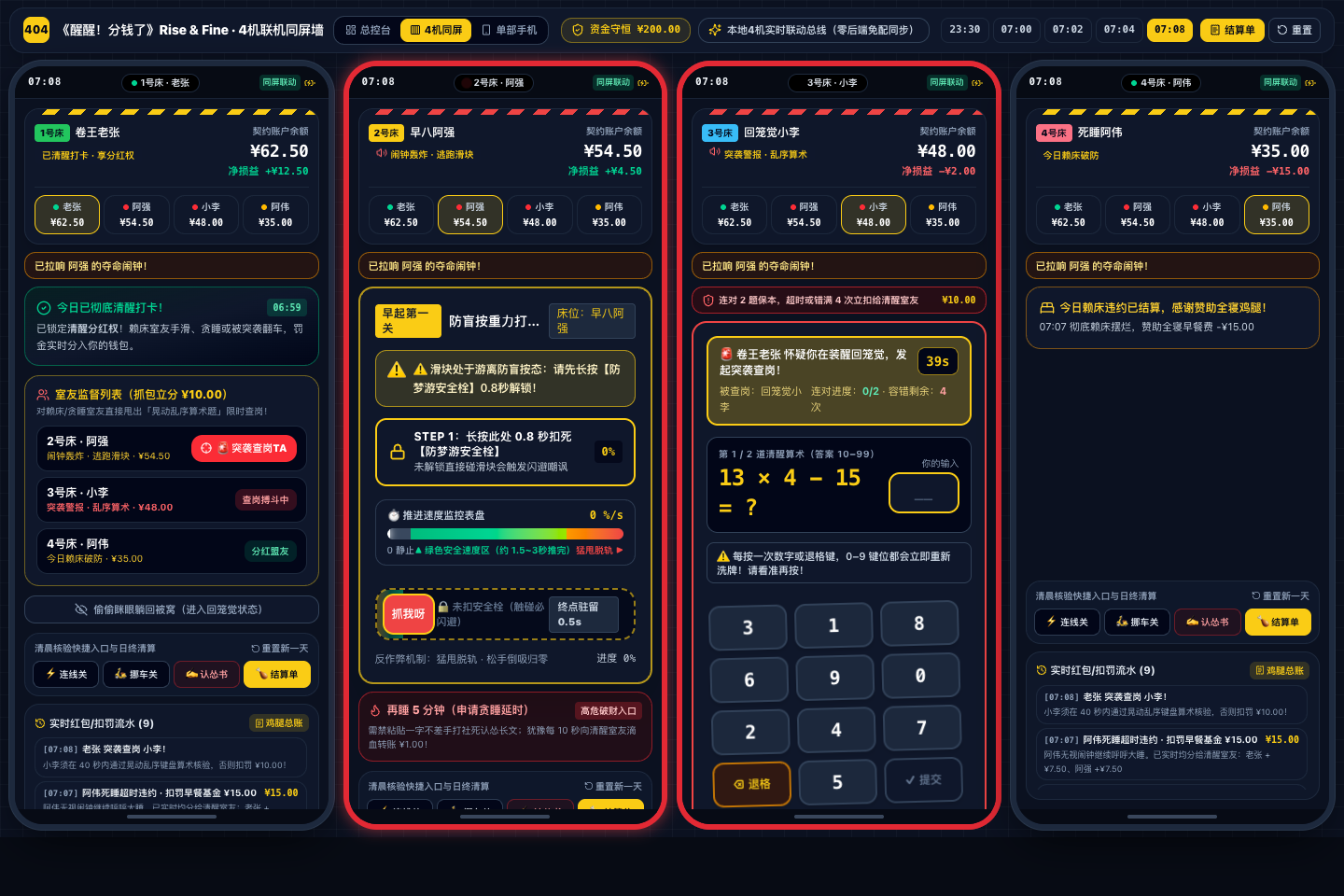
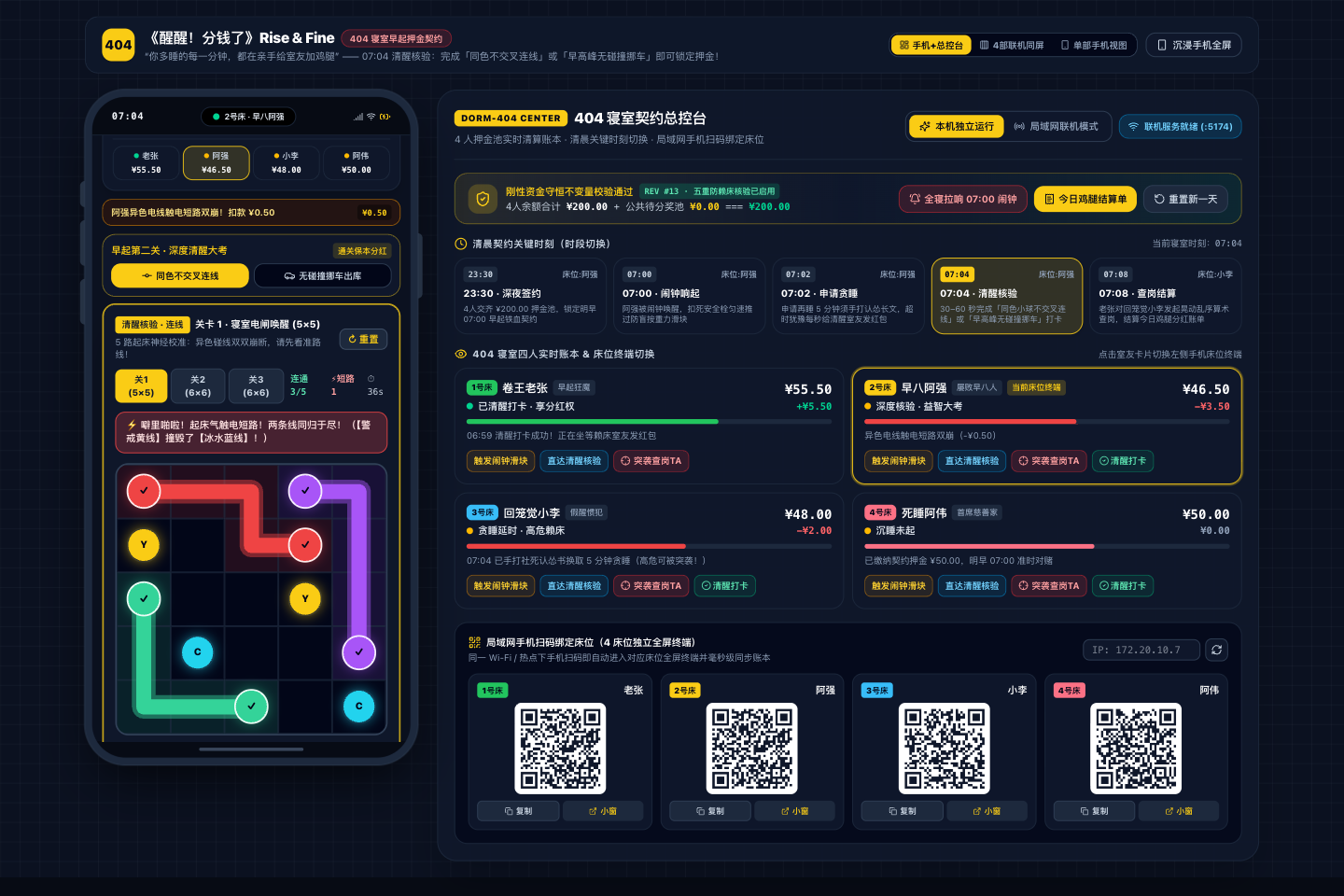
Rise & Fine turns waking up in Room 404 (Grinder Zhang in Bed 1, 8-AM Qiang in Bed 2, Relapse Li in Bed 3, and Coma Wei in Bed 4) into a real-time, zero-sum social battlefield:
1. Closed-Loop 4-Roommate Deposit Pact (CNY 200.00)
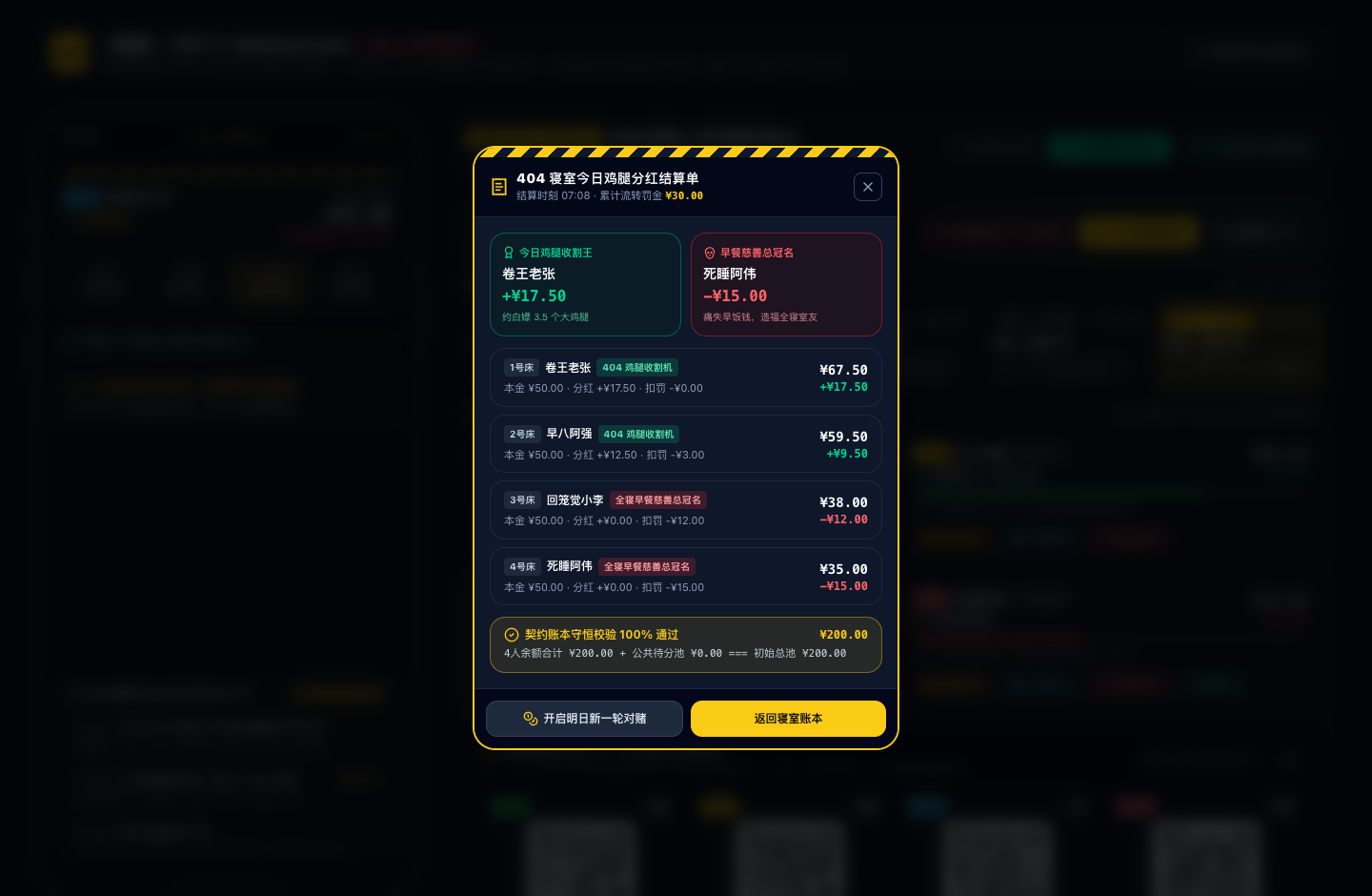
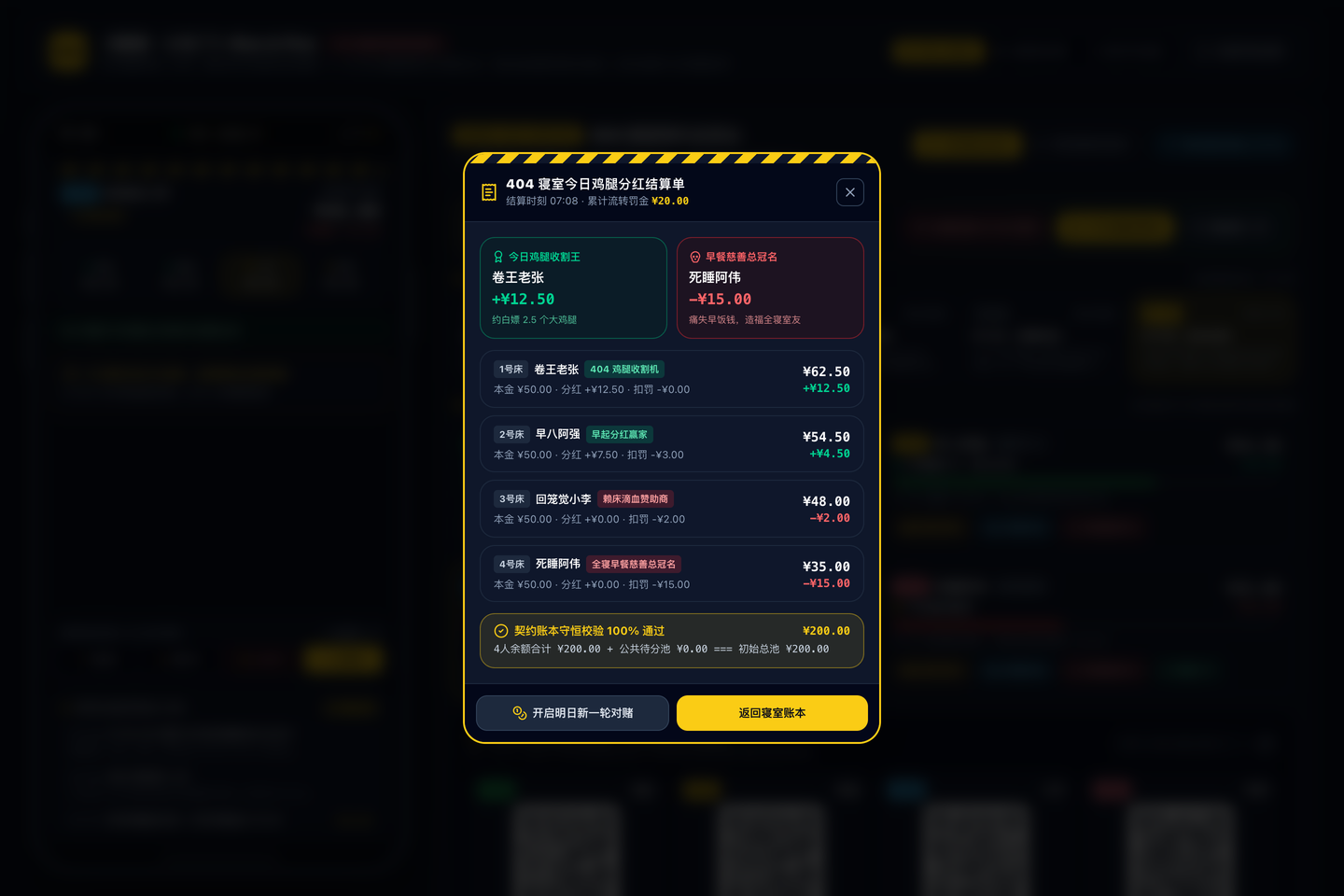
Every night at 23:30, four roommates lock CNY 50.00 (5,000 cents) each into a CNY 200.00 (20,000 cents) shared contract pool with zero platform rake. Every penalty lost by a sleepy roommate flows directly into the balances of awake roommates, while an Early-Bird Jackpot awards accumulated pre-dawn penalties to the first roommate who clears morning verification.
2. Five Maddening, Yet 100% Deterministically Solvable, Anti-UX Gauntlets
Dismissing the 07:00 alarm or begging for extra sleep requires surviving five anti-muscle-memory mechanisms:
- Gauntlet 1: Evasive Slider & 9.8G Bed-Gravity Snapback: Lunging blindly at the wake-up slider makes it dodge away across the track. You must hold a
0.8santi-sleepwalking safety pin first, push steadily within a narrow safe-speed band (1.5s-3.0s), and hold at the finish (>=98%) for0.5s. Flick too fast (>105%/s) and you derail for a CNY 0.50 fine; let go early and 9.8G reverse gravity yanks your progress straight back to zero. - Gauntlet 2: Paste-Blocked Humiliation Confession Typing: Want 5 more minutes of sleep?
Ctrl+V,Cmd+V, drag-and-drop, context menus, and clipboard bursts are strictly blocked (attempting to paste swaps in a harsher confession!). You must manually type a ~40-character self-roasting dorm confession, including exact Chinese full-width punctuation. A single typo wipes the entire input, while every10sof hesitation bleeds CNY 1.00 live to awake roommates. - Gauntlet 3: Roommate Ambush Raid & Oscillating Shuffled Keypad: Awake roommates can launch a CNY 10.00 Ambush Raid on anyone suspected of relapsing into bed. The target's screen erupts with an alarm and two-digit arithmetic problems on a keypad that continuously sways in a 2.3s sine wave AND Fisher-Yates shuffles digits
0-9after every single keystroke. Solve 2 problems before countdown or 4 strikes to survive; fail and CNY 10.00 splits among awake roommates. - Gauntlet 4: High-Voltage Flow Connect (
5x5/6x6): Pair all matching colored electrodes across the grid without crossing wires within 30-60s. Brushing against another color triggers a Double-Circuit Blowout, wiping both your active wire and the innocent wire you touched while fining CNY 0.50. - Gauntlet 5: Zero-Tolerance Scooter Jam (
6x6): Slide blocking campus e-scooters along their axes to escort your red breakfast scooter out theEXITgate. Even a slight scrape triggers a Dorm Warden Collision Alert, snapping the scooter back to its pre-drag origin and fining CNY 0.50.
3. Multi-Device LAN QR Sync & Three Standalone Views
Alongside full-screen mobile QR join links over local Wi-Fi/Hotspot, Rise & Fine ships with three zero-dependency, double-click standalone HTML editions: 4-Phone Live Sync View (?view=quad), Single-Phone Personal View (?view=single), and Room 404 Contract Console (?view=director).
How we built it
- Frontend & Visual Architecture: Built with React 19, TypeScript 5.7, Vite 6, and Tailwind CSS v4 in a high-contrast Neo-Brutalist palette (
#FACC15hazard yellow,#EF44448-AM alarm red, and#0F172Acontract slate) designed to jolt sleepy retinas awake. - Exact-Cent Pure State Machine (
dormEngine.ts): All monetary transitions operate exclusively on integer cents (balanceCents,publicPoolCents). Every state transition (hesitation bleed ticks, collision fines, ambush settlements, early-bird jackpots, and remainder-safe integer splits) runs a runtime conservation assertion:
$$ \sum_{i=1}^{4} B_i(t) + P_{\text{pool}}(t) \equiv 20000 \text{ cents } (\text{CNY } 200.00), \quad \forall t \ge 0, \quad B_i(t) \ge 0 $$
- Algorithmic Solvability Solvers (
verify-puzzles.mjs): Hostile UX must never degenerate into broken soft-locks. Every built-in puzzle board is verified by zero-dependency solvers:- Flow Connect levels (
5x55-color,6x65-color,6x66-color) are proven 100% full-grid solvable via Depth-First Search (DFS) backtracking. - Scooter Jam levels (
6x6) are verified via Breadth-First Search (BFS) over vehicle coordinate state vectors, calibrating exact shortest paths to a 30-60 second human wake-up window:
- Flow Connect levels (
$$ d_{\text{BFS}}^{*}(S_0, S_{\text{exit}}) \in {10, 12, 14} \text{ moves} $$
- Dual-Mode Real-Time Sync (
syncServer.mjs+syncClient.ts): A lightweight Node.js HTTP + WebSocket (ws) server auto-detects LAN IPv4 addresses, renders per-bed QR codes (qrcode), and broadcasts revision-checked state transitions across phones in milliseconds, seamlessly falling back to an in-browser bus when opened offline viafile://. - AI-Assisted Visual Pipeline: Our competition poster (
2400x3600PNG & single-page vector PDF) was bootstrapped via a 3-node Dify Workflow DSL (Start -> LLM -> End, compatible withdeepseek-v4-proandAMD Free Token Factory), then refined into layered, editable HTML/SVG vector artwork.
Challenges we ran into
- Separating Deliberate Frustration from Unfair Input Bugs: Early builds of the Humiliation Confession Typer wiped the input box mid-syllable during Chinese Pinyin typing because raw
onChangefired intermediate ASCII letters before character selection. Implementingcompositionstart/compositionendIME lifecycle tracking ensured Pinyin candidates never falsely trigger a wipe, so every reset is 100% earned by an actual typo. - Zero-Cent Drift Under Concurrent Multi-Phone Fines: When Bed 2 bleeds CNY 1.00 (
100cents) across 3 awake roommates (100 = 33 * 3 + 1cent remainder) at the exact moment Bed 1 settles a CNY 10.00 raid, naive floating-point math breaks conservation. We built deterministic quotient-and-remainder integer distribution with optimistic revision rebasing (REBASE_REQUIRED), verified across 1,500 randomized fuzz steps in Vitest. - Zero-Server
file://Portability: Standard Vite ES module builds fail with CORS errors when double-clicked directly from Finder or Explorer without a local HTTP server. We engineered a custom inline IIFE bundler (build-standalone.mjs) so judges can open any of the three views directly from disk with zero setup.
Accomplishments that we're proud of
- 100% Product-Logic Self-Consistency: Every ounce of user hatred directly measures how effectively Rise & Fine is firing up their prefrontal cortex and saving their 8:00 AM attendance.
- Mathematical Rigor Behind Playful Chaos: Pairing 1,500-step randomized money-conservation fuzzing with DFS/BFS puzzle solvability proofs guarantees zero soft-locks, zero negative balances, and exact cent-level accounting.
- Instant Multi-Phone Dorm Theater: Tapping Launch Ambush Raid on Bed 1's phone and watching Bed 3's screen erupt into a swaying, reshuffling arithmetic siren in under
500msturns a mundane alarm into unforgettable live comedy.
What we learned
Building Reverse UX taught us that breaking usability conventions actually demands stricter UX engineering than conventional smooth design. In normal apps, users forgive minor ambiguity; in high-punishment interfaces, if a user cannot immediately tell why they were fined or how to succeed on the next try, productive friction collapses into learned helplessness. Crisp visual telemetry (our live safe-velocity gauge on the Evasive Slider, next-character highlight in the Confession Typer, and 1-cell nudge controls in Scooter Jam) is what transforms frustration into wide-awake mastery.
What's next for Rise & Fine
- Accelerometer Proof-of-Verticality: Requiring upper-bunk roommates to physically climb down the ladder and walk 15 verified steps before final morning settlement unlocks.
- Campus Canteen Drumstick Vouchers: Partnering with university breakfast stalls so Room 404's weekly zero-sum ledger converts directly into QR vouchers for real soy milk and braised drumsticks.
- Procedural Daily Puzzles with Live BFS Gating: Synthesizing fresh Flow Connect and Scooter Jam boards every morning in a Web Worker, gated by our BFS solver so every board is guaranteed solvable in \( 10 \le d^{*} \le 16 \) moves.
Built With
- algorithms
- css3
- deepseek
- dify
- html5
- javascript
- lucide-react
- node.js
- qrcode
- react
- state-machines
- svg
- tailwindcss
- typescript
- vite
- vitest
- websockets


