-
-
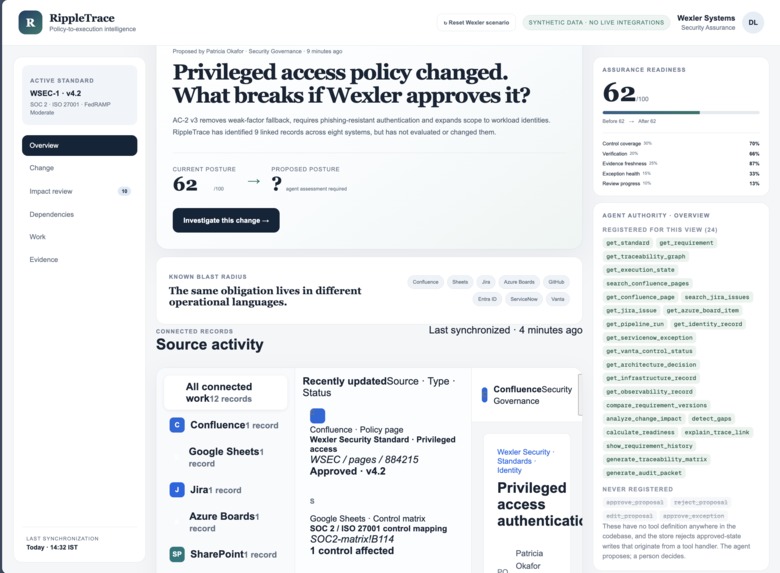
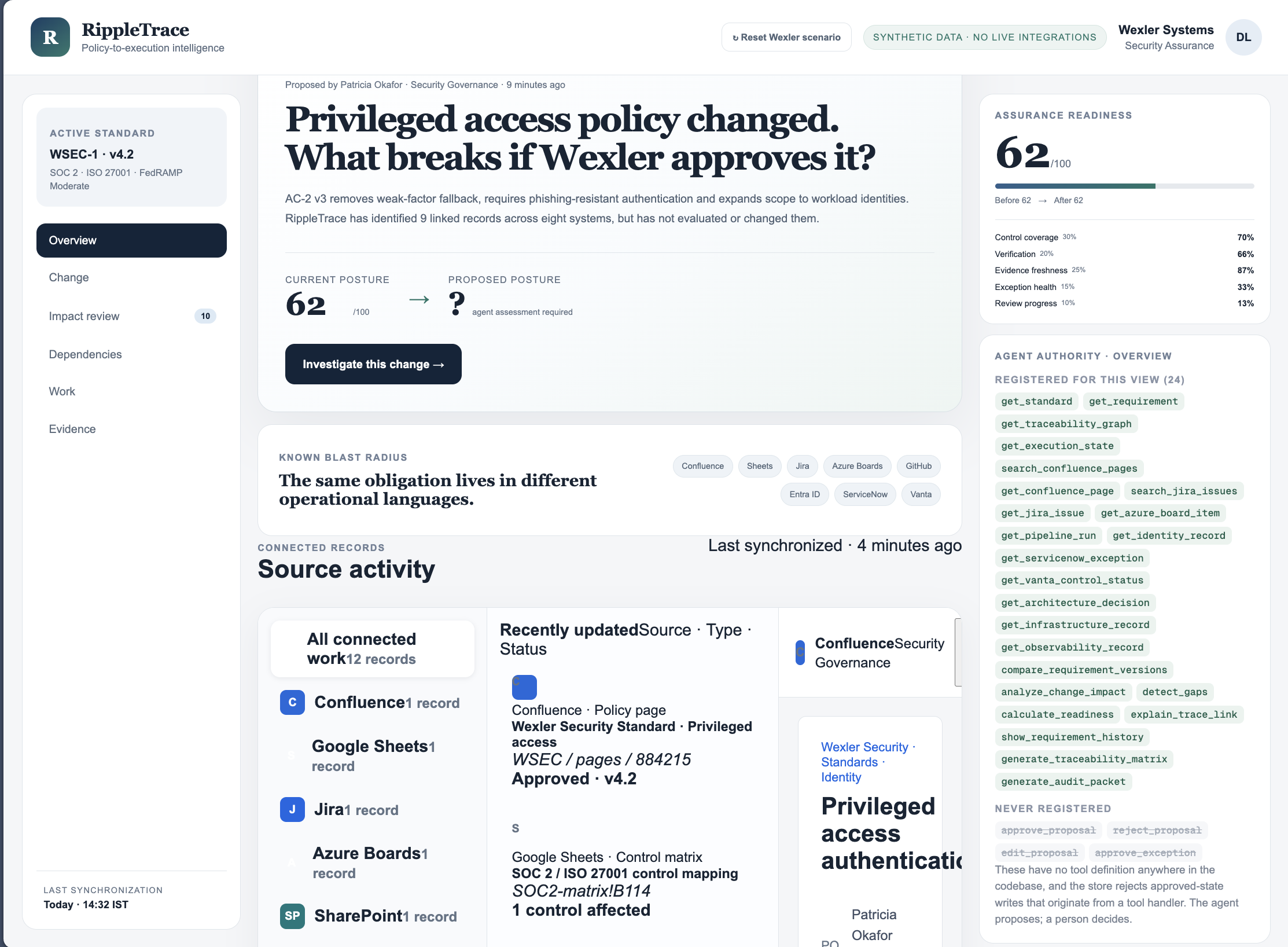
Overview
Inspiration
The idea for RippleTrace came from my experience working at a software company. Whenever a feature, configuration change, or update was pushed to production, I watched DevOps engineers manually check multiple platforms to trace its potential consequences.
They had to move between deployment dashboards, monitoring tools, logs, incident systems, and other services to understand whether the change had caused something downstream to fail. The information was available, but it was fragmented across different interfaces. During a production incident, every minute spent switching platforms and reconstructing context mattered.
That experience inspired RippleTrace: a faster way to trace the ripple effects of a production change, understand which systems may be affected, and identify where an investigation should begin.
What it does
RippleTrace helps engineering and DevOps teams investigate the potential impact of production changes from one place.
A user can begin with a deployment, commit, service, or incident. RippleTrace then gathers the relevant signals, connects related events, and presents them as a single investigation trail. Instead of manually checking every platform, the user can follow the path of a change and see how it may have affected the wider system.
RippleTrace is designed to help answer questions such as:
- What changed immediately before an issue appeared?
- Which services or dependencies could be affected?
- Are errors, alerts, or other events connected to the deployment?
- What should the team investigate first?
- What evidence can be shared with the rest of the team?
The goal is not to replace engineers’ judgment. It is to reduce the repetitive work required to collect context so engineers can spend more time understanding and resolving the actual problem.
How we built it
We built RippleTrace as a unified investigation experience for production changes. It organizes information from different engineering platforms into a consistent model of changes, services, events, and possible consequences.
We used WebMCP to make the product’s capabilities directly understandable to AI agents. RippleTrace exposes structured tools that describe the actions an agent can perform and the information it can retrieve.
This allows an AI assistant to work with explicit application capabilities instead of attempting to interpret the interface through screenshots, page text, or fragile click sequences. An agent can request relevant deployment context, examine related signals, and help the user navigate an investigation through well-defined inputs and outputs.
The human-facing dashboard and the WebMCP tool layer operate on the same underlying context. This means users can visually inspect the evidence while an AI assistant helps them explore it.
Challenges we ran into
One of the biggest challenges was connecting information from platforms that represent the same incident in very different ways. A deployment, an alert, an error, and a service may all have different identifiers and timestamps. Establishing useful relationships between them requires careful normalization and correlation.
Another challenge was determining how much confidence RippleTrace should place in a possible connection. Events that occur close together are not necessarily related. We therefore designed the experience to present evidence and potential relationships without claiming certainty where it does not exist.
Designing the WebMCP tools was also an important challenge. Each tool needed to be focused enough for an agent to use reliably while still returning enough context to support a meaningful investigation. Clear descriptions, predictable parameters, and structured responses were essential.
Finally, we had to keep the AI workflow transparent. Production investigations are high-stakes, so users should be able to see why something was surfaced and verify the underlying evidence themselves.
What we learned
We learned that much of incident response is not a lack of data—it is a lack of connected context. Teams already have valuable information, but it is distributed across tools that were designed for separate stages of the software lifecycle.
We also learned that building an agent-ready web application requires more than placing a conversational interface on top of it. An effective AI experience needs clearly defined capabilities, structured data, useful metadata, and strong boundaries.
WebMCP provides a practical way to expose those capabilities directly from the web application. It gives an AI agent a shared language for interacting with the product while keeping the user in control.
Accomplishments that we're proud of
We are proud that RippleTrace turns a fragmented, multi-platform investigation into a more coherent workflow.
We created an experience that supports both people and AI agents: engineers can inspect the information visually, while agents can access the same capabilities through structured WebMCP tools. We are also proud that the product focuses on assisting human decision-making rather than hiding the investigation behind an unexplained AI answer.
Most importantly, RippleTrace was built around a real problem we observed in production environments—the time and effort engineers spend tracing the consequences of every change.
What's next for RippleTrace
Next, we want to expand the number of platforms and data sources that RippleTrace can connect with. We also plan to improve event correlation, service-dependency mapping, investigation timelines, and team collaboration.
Future versions could proactively identify unusual signals after a deployment, compare current behavior with previous releases, generate incident summaries, and recommend the most relevant next steps. We also want to add configurable policies so organizations can control which actions AI agents may perform and what information they can access.
Our long-term goal is for RippleTrace to become the starting point for every production investigation: one place where teams can trace a change, understand its ripple effects, and respond with confidence.
Built With
- ai
- api
- apis
- css3
- devops
- github
- html5
- javascript
- node.js
- observability
- react
- rest
- typescript
- webmcp

Log in or sign up for Devpost to join the conversation.