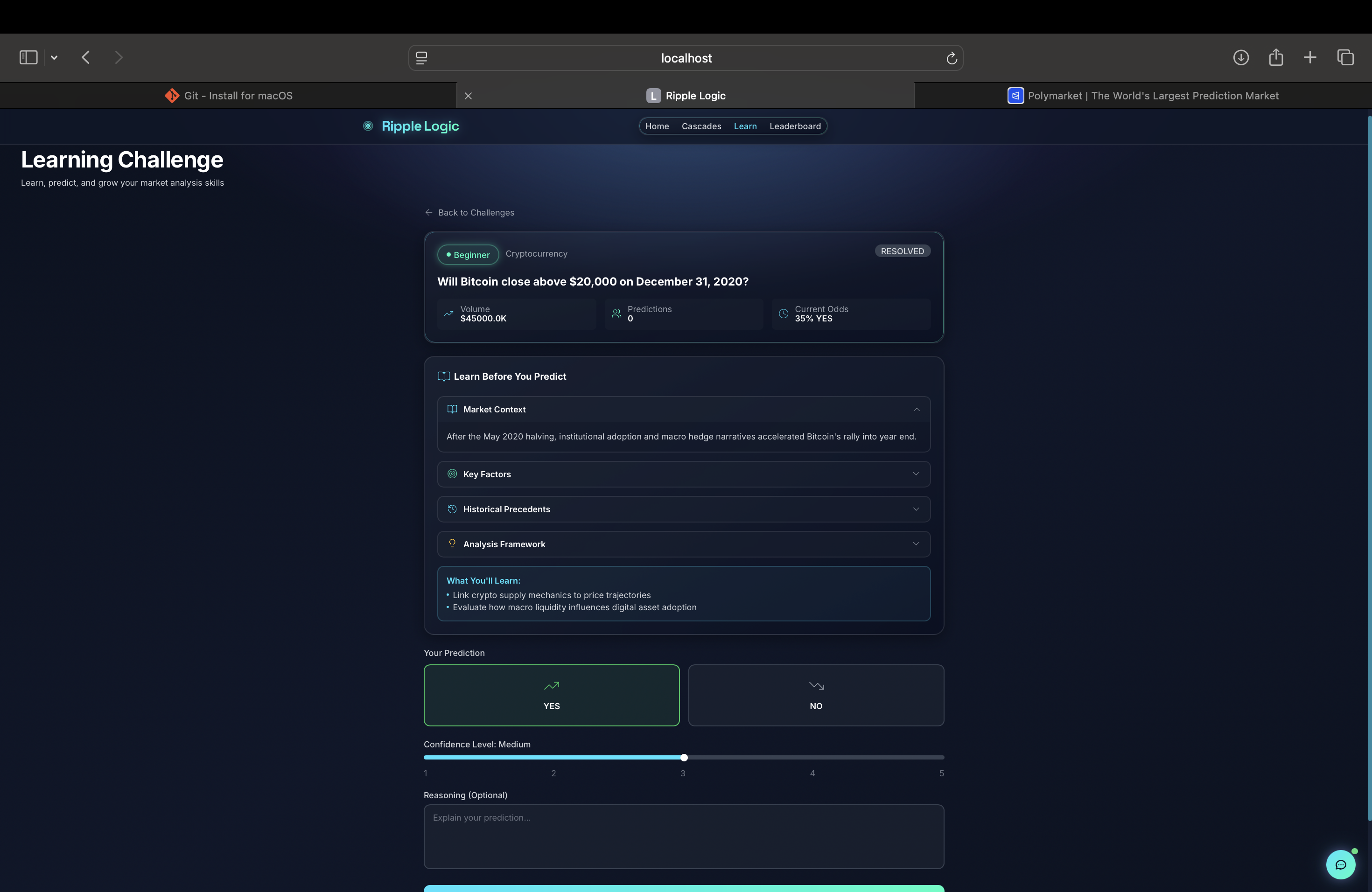
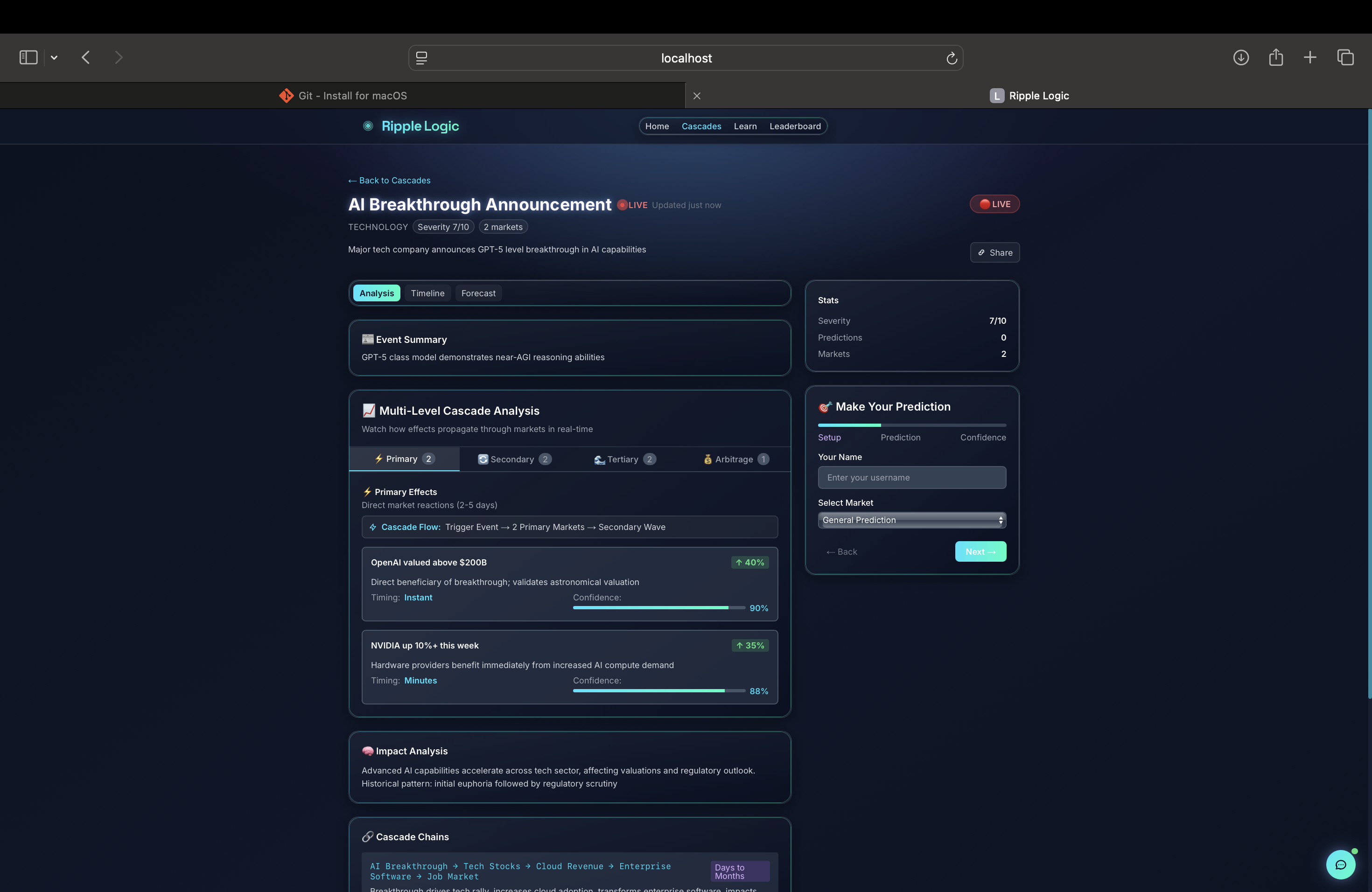
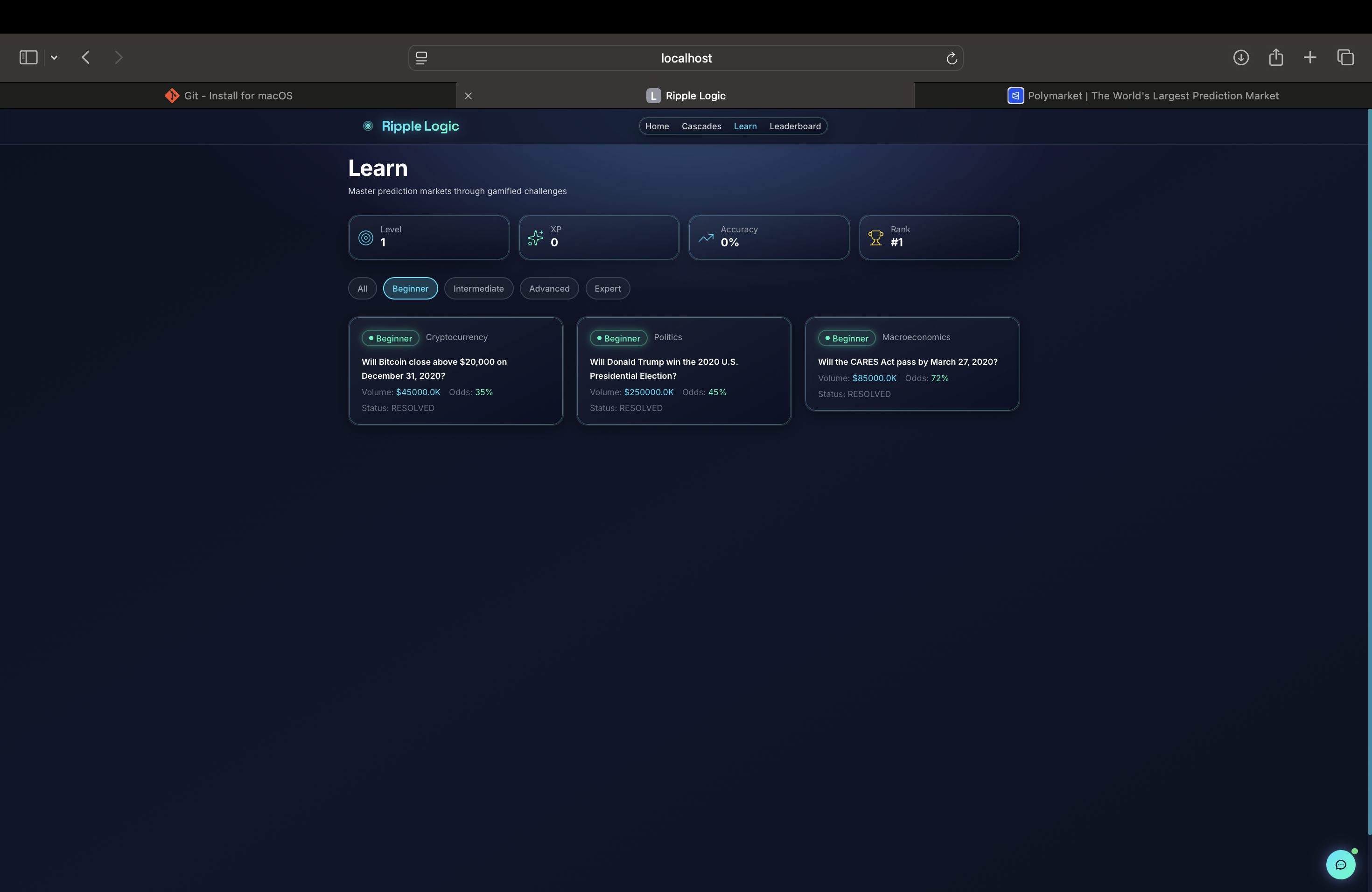

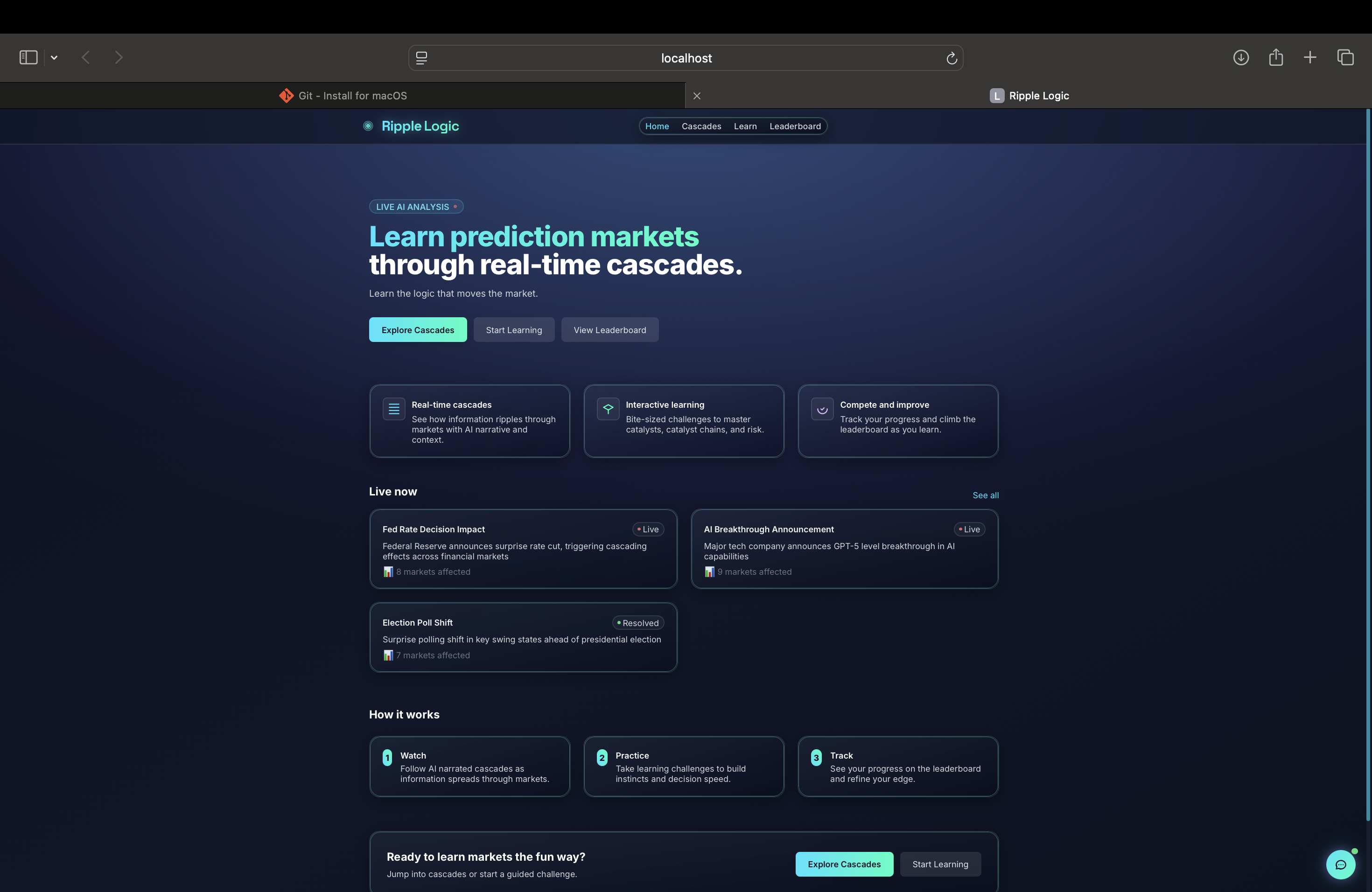

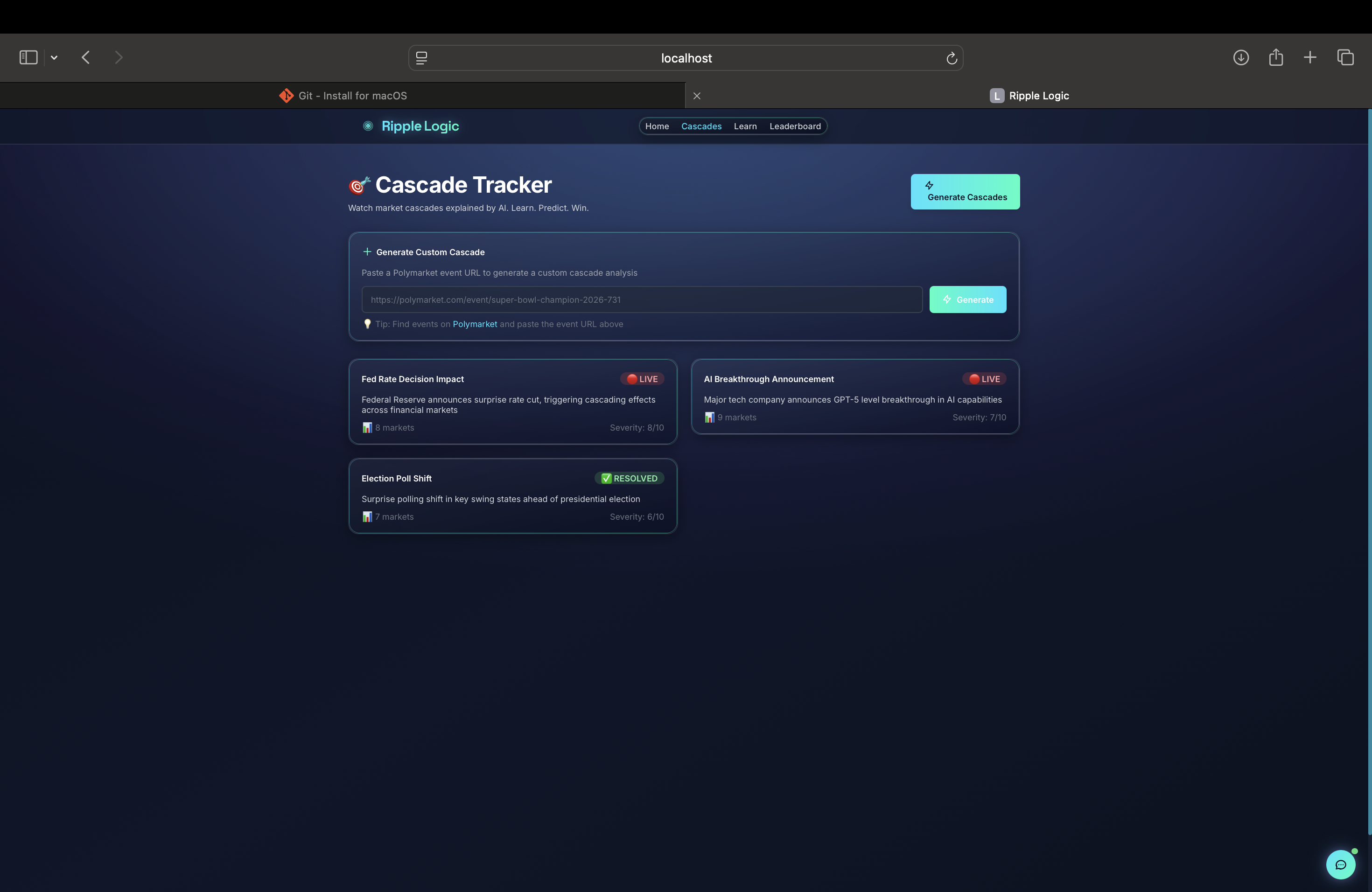
🌊 RippleLogic: Mapping the Domino Effect of the Future “What if every event you predict could ripple through a web of connected futures?” 💡 Inspiration RippleLogic was born out of curiosity — the kind that wonders: How does one event set off another, and another, like a line of dominos? Watching the cascade of outcomes on Polymarket, I realized prediction markets are not isolated bets — they’re reflections of interconnected worldviews. A single shift in belief about an election, regulation, or innovation can send ripples across countless related forecasts. I wanted to visualize and understand this chain reaction of human foresight and thus, RippleLogic was conceived. 🧠 What RippleLogic Does RippleLogic is a gamified learning and reasoning framework built on the intersection of AI-driven analysis (Claude) and real-world prediction data (Polymarket). 🎮 1. Gamified Learning of Futuristic Trades Users can simulate how different futures unfold by tweaking one variable like tipping the first domino — and watching the chain of probability shifts. It transforms abstract forecasting into an interactive learning experience. 🔗 2. Cascade Tracker of Events RippleLogic tracks how beliefs and probabilities propagate through linked markets. It builds a “ripple map” showing how one event’s confidence shift impacts others — turning market data into a living ecosystem of interconnected futures. ⚙️ How We Built It We fused multiple technologies into a coherent system that thinks, predicts, and visualizes:
Store events fetched real time from Polymarket API -> Claude Haiku -> Process and perform chaining 🧩 Challenges We Faced Building RippleLogic was as enlightening as it was complex. We ran into several deep technical and conceptual challenges: 🧮 Limitation of General-Purpose Models: Claude (and similar LLMs) struggled to sustain multi-step reasoning chains across events — making causal inference consistency a major hurdle. 🔌 API Constraints: Polymarket’s data granularity and refresh rate limited real-time responsiveness, requiring creative caching and smoothing techniques. ⏱️ Time Limitations: Balancing architectural ambition and delivery deadlines meant we had to prioritize core functionality over polish — yet the system still came alive. 🏆 Accomplishments Despite challenges, RippleLogic emerged as a harmonious orchestration of reasoning, simulation, and visualization. Was able to achieve multi-layered functionality that worked in sync from semantic reasoning to probabilistic modeling. The final product mirrored the vision we set out with: a digital ripple effect visualizing human foresight. The project stands as a proof of concept that AI can reason about interconnected events in a dynamic prediction environment. 📚 What was Learnt Reasoning isn’t linear it’s networked. Models need to think in webs, not lines, to truly capture event interdependencies. Prediction markets are living systems. They teach us more about collective belief flow than about static probabilities. Harmony matters. The biggest success was blending AI reasoning, live data, and visualization into an experience that feels intuitive, alive, and exploratory. 🚀 What’s Next The journey doesn’t stop here. RippleLogic’s next phase aims to make it smarter and more autonomous: 🗣️ Improve the Chatbot Layer: Let users ask “What’s likely to happen next if this occurs?” — and get dynamic, multi-hop reasoning. 🔁 Fine-Tune on Prediction Chains: Train specialized models on Polymarket data to improve causal linking accuracy and learn ripple coefficients over time. ✨ Closing Thought RippleLogic started as a curiosity — an experiment to see if we could visualize the domino effect of belief. Today, it stands as a reminder that every prediction is part of a larger chain — and understanding those chains is the key to forecasting the future. “In a world of probabilities, every ripple counts.”
Built With
- claude
- nextjs
- node.js
- polymarket
- sqlite
- tailwindcss
- typescript

Log in or sign up for Devpost to join the conversation.