-
-
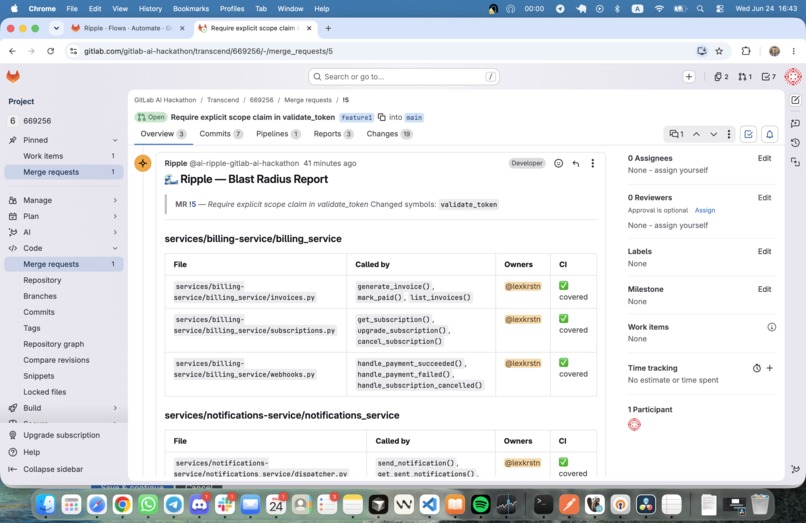
Ripple Report Comment (Part 1)
-
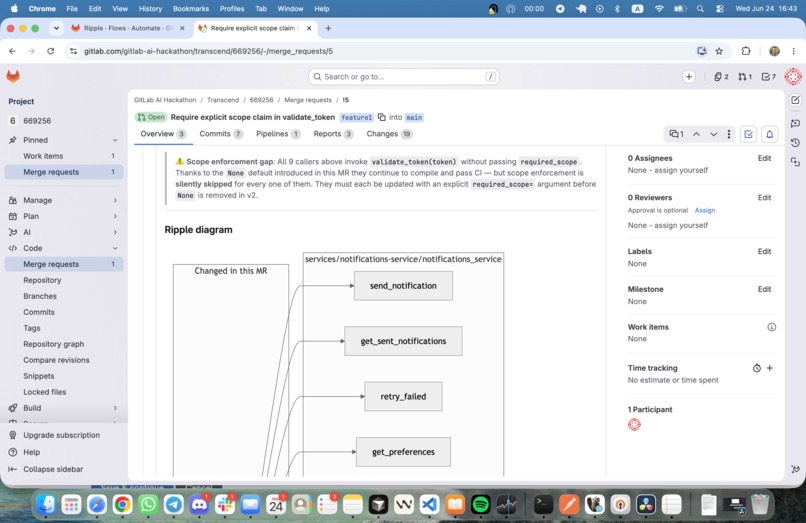
Ripple Report Comment (Part 2)
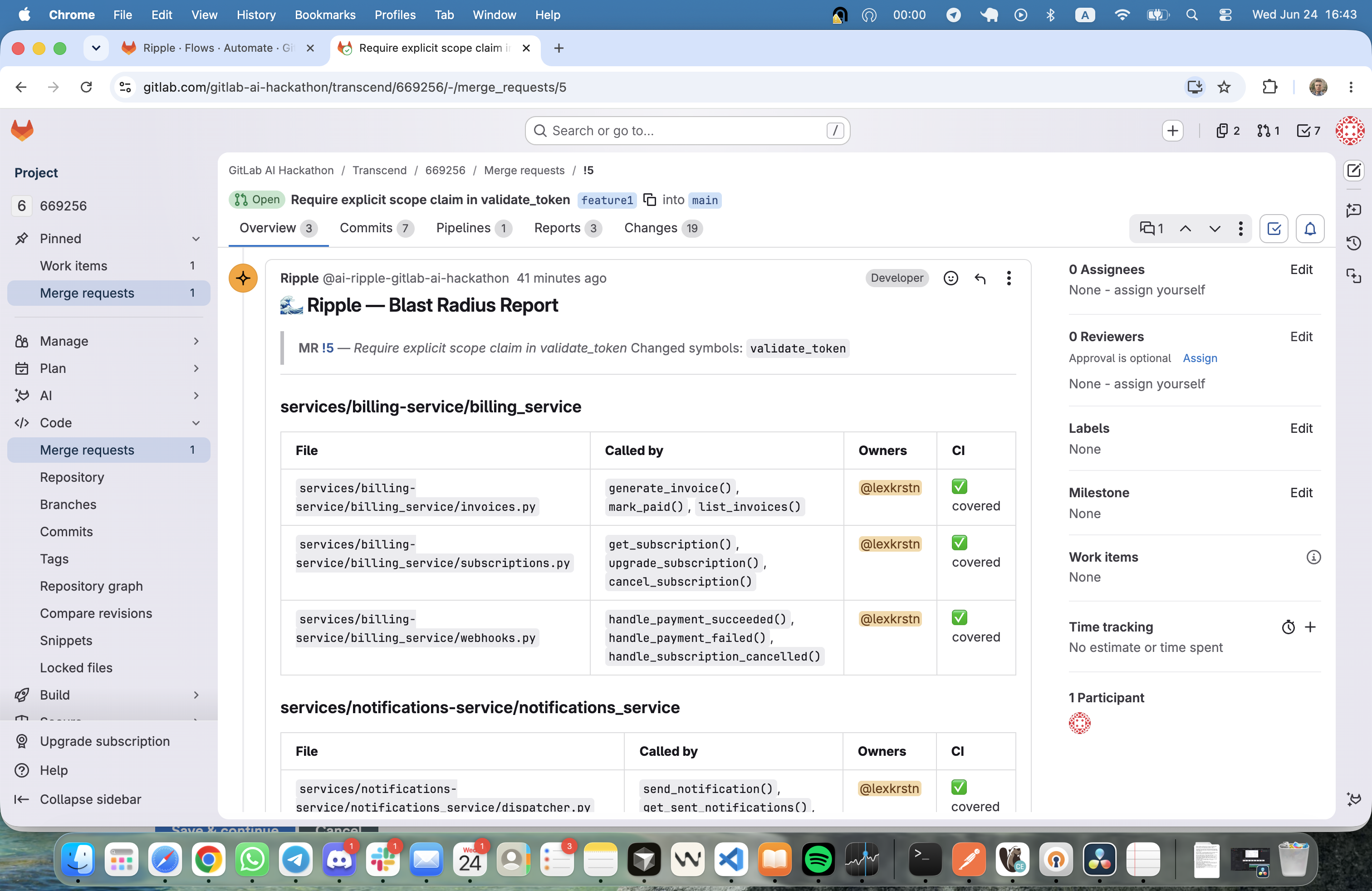
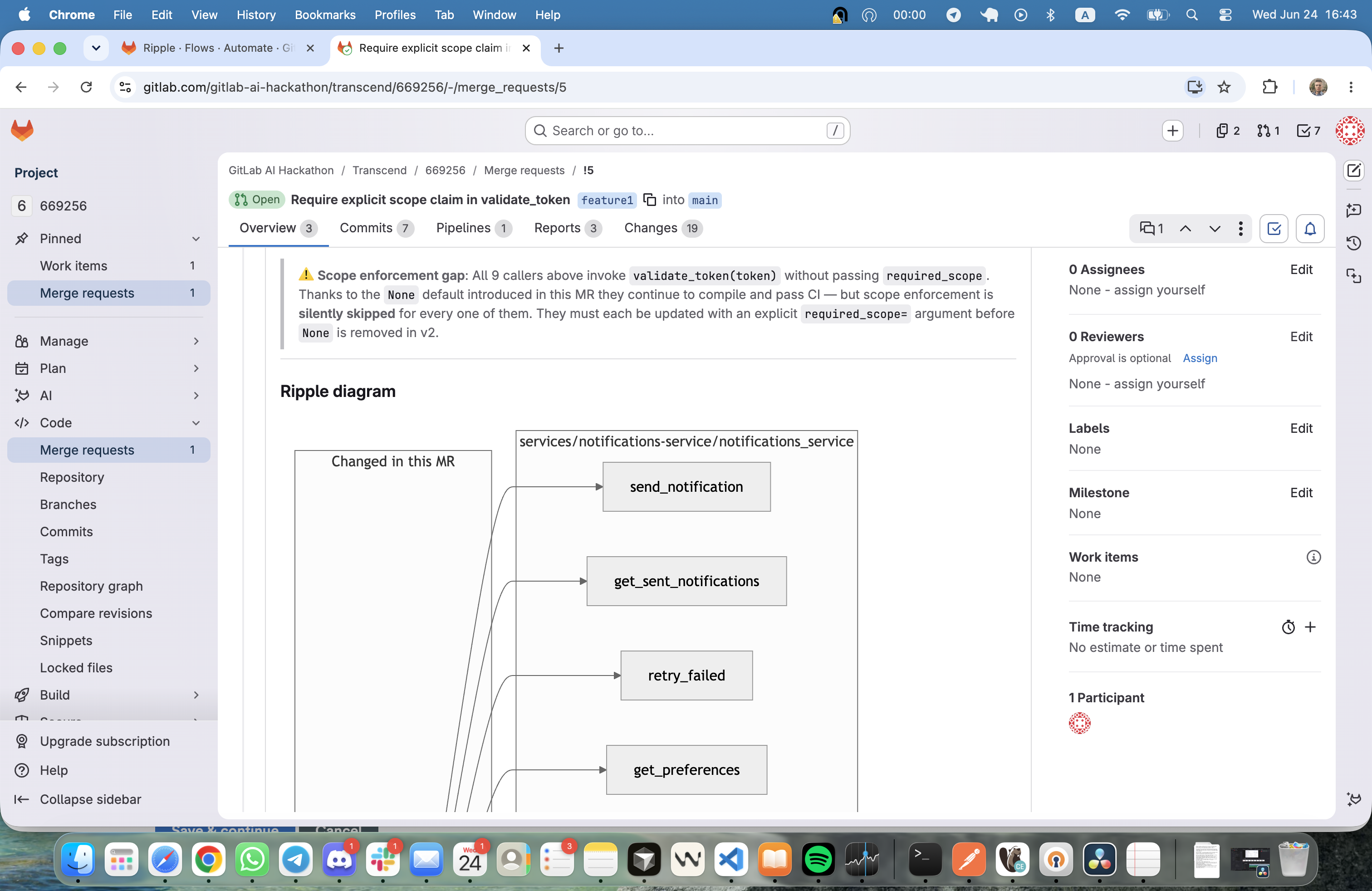
Ripple: Blast-Radius Reviewer
GitLab Transcend Hackathon 2026 · Showcase Track
The pain point
Every engineering team has felt the moment: someone changes a shared utility function, opens a merge request, and nobody realises until after the merge — or worse, after the deploy — that five files in three other services were calling the old signature.
Code review tools today operate on the diff in front of them. GitLab Duo Code Review will tell you whether the change looks correct within the changed file. What it won't tell you is which other modules, services, or repos depend on the symbol you just changed.
This isn't a new observation. The GitLab community has been asking for it:
- Issue #591861 ("Make Code Review DAP flow review step agentic with on-demand repository context access") — the current reviewer cannot fetch additional files or search code during a review, making cross-file bug detection and reverse dependency analysis (finding every caller of a changed symbol) impossible.
- Issue #596274 ("Contextual Dev Assistant: Accuracy degrades with multi-repo complexity and cross-dependency chains") — across repository boundaries the assistant cannot reason about how a change in one repo affects another, what the correct dependency interfaces are, or how shared libraries are consumed downstream.
Both issues describe the same root cause: the reviewer's context window is the diff. The blast radius lives outside it.
Demo scope note. Ripple analyses the entire project — every directory, any language — not a fixed set of paths. The blast-radius walk here runs at project scope because hackathon provisioning gives us a single project, not a full group. But the same Orbit
query_graphcall that traces callers within this project will, withgroup_idsubstituted forproject_id, trace callers across independently-hosted repos in a real group. The query pattern is identical; only the scope parameter changes. Project scope is a faithful stand-in for the cross-repo production case.
How Ripple fixes it
Ripple is a GitLab Duo Agent Platform Flow that answers the blast-radius question automatically, on every merge request, with no extra work from the developer.
When triggered (via @ai-ripple mention or MR reviewer assignment), the
agent:
Reads the diff and extracts the names of every changed function or class — the changed symbols.
Queries Orbit (
query_graphMCP tool, after confirming the live graph schema withget_graph_schema) with a semantic call-graph query:
   MATCH (caller)-[:CALLS|IMPORTS]->(callee)
   WHERE callee.name = "validate_token"
     AND callee.project_id = {{project_id}}
   RETURN caller.file_path, caller.name
The query is unscoped by path — it finds callers anywhere in the project,
then results are grouped by their top-level directory. Orbit's knowledge
graph resolves import aliases and indirect references that git grep
misses. At group scope the same query spans multiple repos.
Maps CI coverage — for each affected file, checks whether a pipeline job exists that exercises it, so the reviewer knows immediately whether there is a safety net.
Identifies owners — queries git history and recent MR activity to surface the people most likely to care about each affected file.
Posts a single MR comment containing:
- A per-directory table: file · callers · owners · CI status.
- A Mermaid dependency diagram showing the blast radius visually.
The entire analysis runs in under a minute and requires no configuration beyond enabling the Flow.
What changes for the developer
Before Ripple:
- Developer adds
required_scopetovalidate_tokenwith aNonedefault so existing callers keep compiling. - Opens an MR.
- Reviewer reads the diff — looks fine in isolation. CI is green across all three services.
- MR merges.
- Five callers across two services are silently skipping scope enforcement. No test fails. No alert fires.
- The compliance gap surfaces at the next security audit, weeks later.
After Ripple:
- Developer changes
validate_token. - Opens an MR.
- Ripple posts:
🌊 Ripple — Blast Radius Report
MR !7 — feat(auth): require explicit scope claim in validate_token Changed symbols:
validate_tokenbilling-service
File Called by Owners CI billing_service/subscriptions.pyget_subscription(),upgrade_subscription(),cancel_subscription()@alice ✅ test:billing-servicebilling_service/invoices.pygenerate_invoice(),mark_paid(),list_invoices()@alice ✅ test:billing-servicebilling_service/webhooks.pyhandle_payment_succeeded(),handle_payment_failed(),handle_subscription_cancelled()@alice ✅ test:billing-servicenotifications-service
File Called by Owners CI notifications_service/dispatcher.pysend_notification(),get_sent_notifications(),retry_failed()@bob ✅ test:notifications-servicenotifications_service/preferences.pyget_preferences(),update_preferences(),reset_preferences()@bob ✅ test:notifications-service
- Developer updates all five files before the MR is reviewed.
- All CI jobs pass. MR merges cleanly.
The developer doesn't change their workflow. They open an MR exactly as before. Ripple adds the blast-radius context they would otherwise have to gather manually — or discover the hard way.
Technical highlights
- GitLab Duo Agent Platform Flow
source:
.gitlab/duo/flows/blast-radius-reviewer.yamlwith a singleAgentComponentdriven by a structured seven-step prompt. - Orbit
query_graph+get_graph_schemaMCP tools for semantic call-graph traversal — the key differentiator vs. text search. The agent reads the live graph schema first, then runs the same DSL query at project scope (this demo) and group scope (cross-repo production use). - Language-agnostic by design — symbol extraction and test-coverage inference key off the declaration and naming conventions of whatever language each changed file uses (Python, JS/TS, Go, Rust, Java/C#, …), and callers are grouped by top-level directory rather than a hard-coded path list, so the Flow drops into any project unchanged.
- GitLab API tools:
get_merge_request,list_merge_request_diffs,list_commits,gitlab_merge_request_search, andcreate_merge_request_note— the full read + write surface the Flow needs, with no external infrastructure required. - Mermaid diagram generated inline in the MR comment (
graph LRfor a narrow, scroll-friendly layout) for at-a-glance visual blast-radius mapping. - Offline simulator (
tools/simulate_blast_radius.py) uses Pythonaststatic analysis to reproduce the Orbit query locally, so the blast-radius output can be validated without a running GitLab instance.
Built With
- duo
- mermaid
- orbit

Log in or sign up for Devpost to join the conversation.